Hutch/Bookshelf review and giveaway from CSN Stores

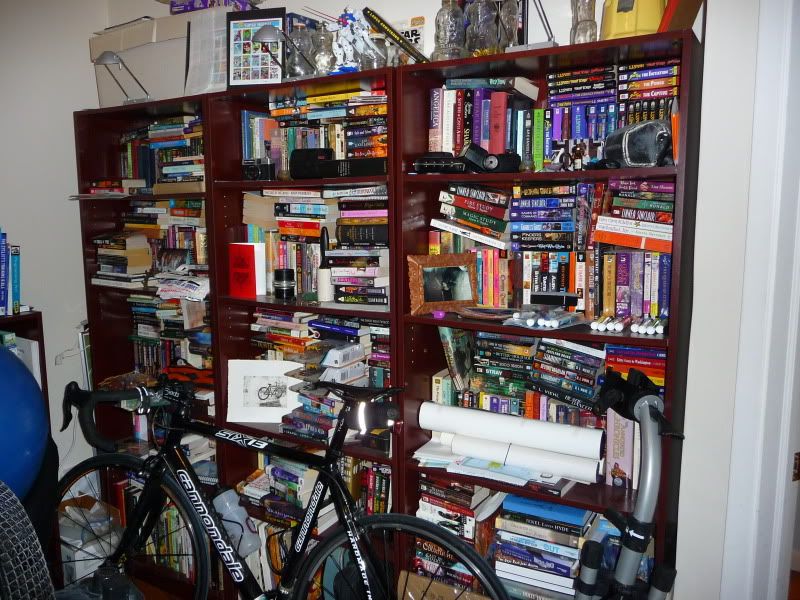
This is what our bookshelves in the office look like. It holds all our read books (my TBRs are in the living room and under my bed). Yes, it is like an explosion. If you click it a supremely HUGE version of this picture is viewable for the curious.  Sorry about the bike.

For a while we’d been talking about putting in a shelf to go over the office desk.  When CSN Stores offered me a chance to review furniture, I decided to try a bookshelf because it was book-related and it would be a nice excuse to post pictures of books as well as finally get that shelf we’ve been talking about for probably a year now.

CSN gave me $60 towards the bookshelf, and I spent another ~$40 0n top of that to get the shelf we liked which was $99 (shipping was free on that item).  By the way, CSN Stores has over 200 websites for all kinds of furniture, not just bookshelves.  I’m going to be doing a giveaway for $65 (U.S. and Canada only this time, sorry) for their stores. Check the end of this post for details. You can buy anything from a modern chair, to a dog bed, to a briefcase! I like their modern cat furniture, except I’m pretty sure my cat will still go for our couches.

The bookshelf we decided to buy was the Belcarra Contemporary Hutch/Bookshelf in expresso.

It came in a long box about a week (probably 4 business days) after I placed the order, but it took us a couple of weeks to get to putting it together because we kept having to go somewhere during our weekends.

1. When we finally started to set it up, the cat promptly sat his ass on it.

2. When we opened the box, the cat explored it.

3. His highness, Prince Nosy-Bum inspected it from every angle.

4. “Helping” unpack.

I didn’t notice any chips in the laminate. It was packed pretty well. Eventually I think there was one nick that we colored in with a brown pen that came with the screws and other parts. I’m not sure if that was already there or we did it putting the shelf together.

5. Cats have no need for instructions. They sit on your instructions.

The instruction sheet that came with the shelf was a little brief on detail. It was a legal sheet length of paper with both sides covered in steps in both English and French, but you had to pay attention to not only the steps but the pictures too. And read between the lines. For instance the first step is  to “attach the top and bottom to center gables and sides using  Confirmat screws”. Well, you needed to notice in the picture that at the back of each center gable will be screwed into the rear stabilizer, and that there is a hole on the back of each gable for that. But only on one side. So it is easy to put them in upside down and then you have to take the whole thing apart and put it back together right. Which I did.

6. Almost done with step 1.

I swear I didn’t keep putting the cat on the shelf and box. He really is that nosy/annoying.

7. While I was putting the shelf together, The Mister looked for studs and made sure things were level.

8. Wall Stabilizer mounted on the wall. Computer screens protected from dust by cut up grocery bags.

9. The Hutch fits on top of the Wall Stabilizer.

We had a bit of trouble putting the hutch onto the wall stabilizer. It needed two people because it’s long and heavy, and at one point it kind of slipped, which was scary because we’re doing this over a desk full of flat screens (all not mine by the way, in case you were thinking to be jealous of me. Nope. Using a tiny little netbook at the moment). Although the instructions say when you mount the wall stabilizer, “position screws so that they do not line up with the hutch gables”, somehow the Mister managed to line up one screw with the hutch gable which meant the hutch did not fit QUITE right. The measurements on this thing are EXACT. EXACTTT. Which is good unless this sort of thing happens and then the hutch doesn’t fit into the wall stabilizer. The Mister said that he measured and thought he was good but turned out he was not. In the future it would be helpful if the wall stabilizer had lines where the gables would be so you DIDN’T put the screw there.

The finished product. One half of the shelf is mine, other half is The Mister’s. Guess which (click for humongous).

I decided to use the shelf for my favorite author’s with last names beginning with A. Yes, I know it looks rather sad right now, but think of the possibilities. Lots of room for more books no?

Giveaway Details:

It’s the usual, but this time since this is $65 bucks, which is nice, you get more points for being a follower (subscribed to RSS/friend on LJ):

1. Email janicu[at]gmail[dot]com with the subject CSN GIVEAWAY, and with

“please enter me” or something like that, and that should be it. Counts as one entry. But if you are a follower, please let me know, you get an extra entry.

2. One email per person please.
3. This giveaway is US and Canada only. Sorry, usually I do international giveaways but CSN only ships to North America.
4. This contest ends midnight EST September 10th.

Winner gets a $65 dollar gift certificate from CSN stores which will be emailed to them.

ETA – photobucket  resized the “humongous” picture to merely “big”. I reuploaded them but leaving the “big” size for people with slower connections. This is the old bookshelf (explosion), and this is the new bookshelf in “humongous” size.

Also, I’ve had questions about followers for the giveaway. I meant subscribed to my RSS feed. On wordpress you can do that here, and on livejournal you can do that here. These two blogging platforms just don’t allow javascript which the Google Friend Connect widget uses. I know that caused some confusion looking for it.

Following on twitter doesn’t count, sorry.

Book Chat – The Black Prism by Brent Weeks

Book Chat

Since The Mister (aka the guy I married), is a Brent Weeks fan, I let him read my review copy of The Black Prism before I did. [The Mister: My wife is supremely awesome for letting me drench myself in Weeks’  fantasy before her]. Although The Mister didn’t want to write a review, he did agree to do a book chat with me. This is my last Brent Weeks post for a while, I swear.

So here goes (Big spoilery bits blacked out. Highlight and read at your own peril):

1

OK, so first question: So if you were to describe this book to someone else who you were pimping the book to, what would you say about it?


2

So what, you want me to give some flashy summary blurbs? uhm..

The Black Prism follows the life of Kip, a kid from a rural town who  suddenly finds himself thrown in to a world of magic, war, and general mayhem. Luckily for us, the stereotype doesn’t much hold up as you dig in to the details. To be honest I’m not sure if Kip is intended to be the protagonist, and I suspect that’s intentional – from the start, the character building is a bit twisted in an enjoyable way. There are  some details of the immediate gratification type, but also some longer term building, with all of the *-agonist characters. As an aside, I expect there will be some negative criticism of how some of the characters have been designed (particularly Kip), but those critics are short-sighted.

On the larger scale, The Black Prism is the story of a kingdom still recovering from a civil war now 16 years past, with divisive rulers of uncertain power…basically, poised to drop right back in to war. The construction of the world has some obvious heritage, but also enough unique touches to avoid the feeling of been-there-done-that. It has a good balance of being fantastic enough that you can escape in to it (color magic, low/medium-tech culture, moderately detailed side info on geography, politics, etc), but not so out there that a reasonable imagination can’t find a way to connect their world with ours (“humans” are the only sentient race, swords + armor + guns, …).


1

I agree, there are multiple points of view but it was done well, with probably Kip and the Prism, Galvin Guile as the two most important protagonists. I also liked that Kip was this overweight kid who felt very uncomfortable in his skin and always mentally berates himself for things that come out of his mouth. I also agree that while this world has some familiar fantasy elements, Weeks makes it his own. I particularly loved the magic aspect of the world building.

Comparing this to The Night Angel Trilogy, I notice a couple of themes – teen boy with a mentor, unvoiced love, and secrets! Do you agree?


2

I dug the mechanics of the magic as well. Color magic has been done before in various ways, but not like this. The simple physics of the (slightly tweaked) rainbow combined with details like having to squint just-so to see superviolet…good stuff. It’s believable in the context of the world because, who could make it up? (Yes, you in the aisle seat? Ah. Well yea, obviously it IS made up. You’re missing the point)

Actually, I hadn’t yet thought of The Black Prism in comparison to the Night Angel crew. The themes are generally there but the distinctions may be more interesting. Kip and Azoth each end up with very powerful mentors, both arguably of similar convictions at one point or another; but whereas Azoth showed hints of strength from the beginning, and sought out Durzo, Kip fumbled “fatty-style” all over the place until he happened to fall in to Gavin’s lap.

There are more similarities, I think, in the unvoiced love and secrets categories. Both Azoth and Kip have big hearts from the start, which of course makes them likable even when they’re killing (in Azoth/Kylar’s case) or doing bad/stupid things. Their love isn’t limited to romance though; Azoth’s first kill is driven at least initially by his love for Jarl, and Kip’s first acts of bravery are to save others (admittedly along with himself), and they occur before Liv is anywhere near the picture. From there though, as with the mentorships again I think the examples diverge. Both have loves that are initially unvoiced, but in Azoth’s case, it was easy to understand Doll Girl’s initial adoration, and eventual love for him. In Kip’s case, it’s easier to imagine that his love will be revealed but unrequited. Not because of physical appearance necessarily, though that may be considered, but because I get a sense that Kip is simply much more fragile than Azoth. He’s being forced to grow up ridiculously fast, and he’s learning a lot about his strengths, but he’s not yet having to face his weaknesses on a grand scale (no pun intended, and Thresher notwithstanding). I’d think that would be a great detriment for him having any sort of relationship with Liv – his continued weaknesses may serve to keep him as a pre-teen in her mind.


1

I was thinking about Gavin in the unvoiced secrets/feelings arena too. Yeah, hmm, Kip is in many ways more vulnerable than Azoth was – he shows the world a glib face but his inner self confidence is not there yet, and Liv sees him as a kid, but then she’s older than him, (he’s 15, she’s what, 17?) so of course she would.

Anyway. New topic. When I read Weeks books, I sometimes worry about what will happen to the characters I like because there are often crazy twists. Do you feel like that too? And what do you think of some of the bombshells? Awesome? Evil? Awesomely evil?


2

I do worry about the characters I like, because the twists often alter your view of the characters themselves. It seems one of Weeks’ favorite mechanisms is to F with your sense of who’s good and who’s bad; there’s just not much black/white stuff going on. Durzo certainly had a lot of redeeming qualities. Before we’re made aware of the whole Gavin is Dazen is Gavin thing, it’s hard not to like Gavin, even given the assumption of his transgressions (one of which of course turns out to be the real Gavin’s). With Kip, it’s sometimes unclear whether his quirks are meant to provoke laughter, or pity, or what…I suppose it depends on the reader…but whatever the reaction, it serves to lessen ones view of him in a purely “hero” sense. Not that that’s a bad thing!

Interestingly, Weeks seems to design his women more straightforward than the men..

The bombshells are 100% evil, 100% awesome. That’s right, 200% awesome/evil bombshell goodness, baby.


1

I think that because Kip and Gavin are the two main protagonists we see a bit more nuances to their characters than we see in the women. Liv and Karris are slightly more secondary but they get their spotlight too and we begin to get hints about their internal struggles. I’m particularly interested in what happens to Liv in the second book.

In the video Brent Weeks made at Comic Con for this blog, he said that book 2 was looking so long that he may break it up into two books. What do you think of this?


2

The setup for the sequel(s?) is obvious, and I do hope it ends up being at least a trilogy as originally advertised – if the alternative is to cut down the story to fit in a second book that cleans everything up, I’ll be pretty disappointed. I happened to think The Black Prism was a good length, too – despite its 600+ pages. By page 200 or so I was lost, and I don’t remember counting pages at all through to the end.

It’s also easy for me to imagine (and hope for) prequels, detailing the False Prisms War, the personal/political stuff between Dazen and Gavin, Karis’ relationships, General Danavis + Dazen, etc. Then pre-prequels, going back to Papa Guile’s younger days..


1

Overall what did you think? I think I may like this first book better than Night Angel’s first. I’m dying the read the second one.


2

Overall, I loved it. I’m a pure fantasy genre kind of guy, and I’ve read enough to spot most of the cliches; TBP isn’t totally devoid of them, but when Weeks uses them he finds a fresh, cerebral way to do so. That much would be enough to bring my rating up to “like”. The world development, especially the magic, takes it up another notch. The character design and development gives it that last little (big?) shove. Reading it evoked a large spectrum of emotions just like a good story should. Perhaps most importantly, it left me wanting MORE…

Compared to the first Night Angel book, I feel similarly anxious for the next, but I feel more “in the know”. After The Way of Shadows, I remember having almost too many unanswered questions. It made me want to read Shadow’s Edge immediately (and I did), but it was a lot to process…or maybe I’m remembering wrong. In any case, I think the end of The Black Prism gives an excellent balance of satisfaction versus what’s-next, so overall I liked it better than The Way of Shadows.

The Black Prism by Brent Weeks

Brent Weeks is an author I was introduced to because of my husband, who nagged and nagged me to try the Night Angel trilogy. I enjoyed it. So this year I requested a review copy of  The Black Prism, the start of Weeks’ new Lightbringer series. Tomorrow I’ll be posting a chat the two of us had about the book, but for today, here’s my review:

The Premise: Kip is a fifteen year old, overweight son of a drug addict mother and an unknown father. He lives in Rekton, a small village in Tyrea, a satrapy which has suffered in the sixteen years after the Prisms’ War because it sided with the losing brother, Dazen Guile. Now the victor, Gavin Guile, is Prism and figurehead of the seven satrapies, but the Prisms’ War has left a lasting impression.  There are those in Tyrea who are displeased with the current state of affairs. They have their own agendas, which start to become known when they set to wipe out every man, woman, and child in Kip’s village.

In the meantime, the Prism, Gavin Guile, is 5 years away from the end of his rule and 5 goals he has set for himself.  He is the only man in the satrapies with the ability to bend light in all seven colors of the spectrum, but his power is not that of a ruler, it is more that of a figurehead.  When Rekton is targeted, he has a unique perspective on what the ramifications are, on both the Chromeria and on the secrets he’s been hiding from everyone for over sixteen years.

Read an excerpt of the first three chapters of The Black Prism here

My Thoughts: I don’t think the premise really covers everything that is going on in this story, but it will have to do because there is a lot going on in this book. Where do I even begin? Let’s start with the characters. The book is told in the third person with multiple points of view.  The focus mostly shifts between Kip and Gavin Guile, but it sometimes moves to others, like Karris, Gavin’s one time fiance, now a warrior elite, and Liv, Kip’s childhood crush. There is also one more character we hear from – a mysterious prisoner.

We begin in Kip’s village as Kip learns that the army of the Tyrean satrap is moving in to make an example of his village. The horror of the killing seen through Kip’s eyes as well as his confused escape feels like classic Brent Weeks stuff. In Night Angel, I found the life of children in the slums very dark (it’s probably the darkest part of the book), and similarly in The Black Prism, war is hard on it’s victims, and as a reader, you feel very protective of those that have escaped those horrors. Kip is a boy who thinks of himself as a “fatty” and is painfully aware of his own awkwardness, but that is balanced with a strong sense of loyalty and a stubbornness that endears him to the reader.

In contrast, Gavin Guile seems like the opposite of Kip – powerful, accomplished, handsome and smart, he exudes a confidence which is matched by what he actually can do – he’s probably the most powerful Prism the world has seen. Of course when we read more about him, we find that he has his own problems. In some ways he’s been an outsider like Kip, and although he’s ruthless, he’s been using his power in the hope of doing something for the Greater Good.  It was interesting to compare Gavin’s revelations about his past with Kip’s current growing pains. He’s very likable despite what we find out about some of the things he’s done as the book progresses. I found myself seeing a person who is at fault for some horrible things, but not a bad person. His past decisions haunt him. It was fascinating to find out more and more about his past and what his secrets are, and I don’t think we uncover it all by the end of The Black Prism.

The female characters in this book have less face time compared to their male counterparts but I did enjoy what I read. There were certain passages while the focus was on them that I think Weeks must have asked for female input because I think he got it spot on. I am also happy when there are characters who are mixed or minorities. We see many of those in this book, and Liv has a unique point of view as a Tyrean in a world where her skin color marks her as such and they’re not treated well by the rest of the satrapies. It does affect her experience and how she sees other people’s actions.

There was an excellent balance between the individual character development and the overall plot line which has a much broader scope. It’s through the individual struggles at we piece together an idea of the overall picture – the complex politics, relationships, and past of the world is made human and relatable. For example – as a reader who does not have much interest in battle scenes in books, I was much more engaged in The Black Prisms battles than I usually am.  That’s because I felt much closer to the action. The jumping from Kip’s viewpoint, to Gavin’s, and Liv’s and Karris’, I only see a small sliver of the general chaos but I can piece together what is going on and I’m invested in the survival of Kip, Gavin, Liv, and Karris. This is a technique used throughout the book with a lot of success.

Weeks also has a way of putting a lot of twists and turns into each of his stories. If you’ve read Weeks before, you will be familiar with it, but this is a heads up for those who haven’t. At this point, I do find myself expecting the unexpected and I’m beginning to enjoy trying to guess where the next surprise will be, although Weeks still manages to throw in several things that I never saw coming (and I would say are impossible to see coming). In his video interviews, Weeks says that he plans the twists and turns. That has to be the only way to have so many revelations that may have had minor forewarning, but readers won’t realize the clues till later. I’d say that overall I haven’t had a nasty surprise in the revelations or plot twists (Well. One in the beginning tore me up a bit, I recovered), although I do admit worrying about my favorite characters and what could happen to them.

I liked the characters and their development, but my favorite part of this story was the world building. If you follow my reviews, world building is one of those things where if it’s unique and done well, it makes a big impact on whether I ended up liking the book. The familiar fantasy world in the Night Angel books was probably my biggest complaint about them, but I have no such complaint for the Lightbringer series. I loved the level of detail that went into the magic in this book. The concept here is that magic users in this world can transfer light into physical form, and to do so they have to absorb the particular color that they “draft” through their eyes – so light affects magic as does eyesight. Drafters of different colors can do different things and there is a physical toll to using magic that is not only exhaustion. Using magic essentially shortens the lifespan of a drafter. That the world’s government and religion is linked to the seven colors and to the one person a generation who can draft all seven colors (the Prism), just makes things better.

Overall: If you are a fan of epic fantasy, this is an excellent series to try. I found the characters likeable, the world building unique and better than Weeks’ last series, and the twists and turns addictive. I’m not really sure I can come up with any negatives here, and I’m also having a hard time not going into some of the great parts of this book because they would be spoilers. Just know that this story is over 600 pages and it is jam packed with epic goodness.  I’m really looking forward to the second book.

Buy: Amazon | Powell’s | The Book Depository

Other reviews:
Fantasy Book Critic – A++
Grasping for the Wind – “Weeks has written an epic fantasy unlike any of its contemporaries”

Exclusive Brent Weeks Q & A Video

Something special for today – a video where Brent Weeks, author of the Night Angel trilogy and a new series, Lightbringer, answers a few questions I sent to him via the folks at Orbit at Comic-con!

I’m about two thirds done with his newest book, The Black Prism (which comes out August 25th), and it is so far really good. My husband has already read it and has been asking me where I am every night. I’ll be posting a review next week plus a book chat with The Mister about it.

In the meantime, this is the video where Weeks discusses Geekery, Weird Research and the length of this new series:

Other Brent Weeks videos and Black Prism fun stuff:
Here are the videos in this series so far, which ask excellent questions about the new world, characters, and the writing experience:
1) Grasping For the Wind
2) Fantasy Book Critic

Pixelated Geek has a 15 minute interview up at their site.

For some fun stuff go to Brent Weeks’ website and take the What Color Is Your Magic Quiz. I’m apparently a superchromat and Blue Drafter.

Zombies vs. Unicorns by various authors, edited by Holly Black and Justine Larbalestier

Ah, anthologies!  I do love them and really should read more. I get to try out new authors and put the book down in nice short story length increments. Zombies vs. Unicorns started as a online argument on Justine Larbalestier’s blog, and then became a book. The humor in this “fight” shines through in the first pages where Holly Black and Justine Larbalestier discuss how the book came about, and again in their introductions before every story. It was fun to hear the argument from both sides as to whether zombies or unicorns are the better creature.

This review is for an ARC copy I received at BEA. Zombies vs. Unicorns comes out September 21st, 2010

My reviews are going to be brief impressions for each of the 12 stories as I read along.

1) The Highest Justice by Garth Nix – This is the story of a princess who calls the aid of a unicorn to avenge the death of her mother. I think this is a Team Unicorn story, but it’s hard to tell. Pretty straight forward revenge tale, with perhaps a little more violence than the princess bargained for. I think the author may have been aiming for a bit of “fairy tale creatures may be noble but extreme views of right and wrong are also rather creepy”, and he got it.

2) Love Will Tear Us Apart by Alaya Dawn Johnson – A teenage zombie finds himself going against his instincts when it comes to another teenage boy because of their shared love of Joy Division. A star-crossed lovers sort of tale, full of music references. Made me really want mac and cheese. Romantic yet grisly and perhaps doomed (or perhaps not).

3) Purity Test by Naomi Novik – a drunk teen girl on a park bench in New York City is accosted by a unicorn looking for a virgin to help him on his mission. This was a funny and cute one. The sarcastic banter plus their creative problem solving were very entertaining.

4) Bougainvillea by Carrie Ryan – A dystopian zombie tale with the sheltered teenaged daughter of a powerful man as the protagonist. Loved the dystopian feel and the way this ends in a turning point for the protagonist. I wanted more. I also liked how the story jumps back and forth between past and present, but it was presented clearly. Good sense of place – even Papiamento (a creole language spoken in Curaçao) was interspersed (but I had trouble figuring out what the words meant since it was just off of what I knew to be Spanish).

5) A Thousand Flowers by Margo Lanagan – Set in a medieval setting, this short story has three narrators who each witness a small part what happens to a princess after a mysterious event in the forest. This has some questionable bits in it  (lovely prose sort of shields you from a high ew factor). Haunting with a ‘ghost story’ vibe.

6) The Children of the Revolution by Maureen Johnson – a teen follows her boyfriend to a summer job in a farm in England, and meets some zombies.. a tongue-in-cheek story that has an interesting take on who and what could start a zombie epidemic.

7) The Care and Feeding of Your Baby Killer Unicorn by Diana Peterfreund – I believe this is set in the same world as Peterfreund’s Killer Unicorn series (unicorns were once extinct but have reappeared and certain girls have the power to hunt them). The narrator is a teen girl who is an untrained unicorn hunter, so they are drawn to her. One has already killed her cousins. This story had some good growing pains – questioning parents and beliefs, and felt like it could be the seed of a whole book. Liked this one.

8 ) Inoculata by Scott Westerfeld – This is about teens post-zombie-apocalypse living in a gated, zee-free farm with some adults that have protected them. Surrounding the chain mail fence are zombies waiting outside. Interesting take on a communal life after escaping the zombie horde from a teen POV (which includes teen rebellion and crushes). Another one where I wished I could find out what happened next.

9) Princess Prettypants by Meg Cabot –  A teen gets a unicorn for her 17th birthday. A glowing, farting rainbows kind of unicorn. I think Cabot had a lot of fun creating a unicorn that fits an extreme schoolgirl fantasy, and giving it to a teenaged girl who’s been a little bit jaded by life. I liked this one. Fun but also with a bit of a message for girls.

10) Cold Hands by Cassandra Clare – The girlfriend of the Duke-to-Be witnesses her boyfriend die and then come back to life in Lychgate, a town cursed to have it’s dead come back to life. This had a modern-day fairytale feeling to it, with a combination of Old World traditions in a place that has modern day technology. The ending is an odd combination of both comforting and creepy.

11) The Third Virgin by Kathleen Duey – This is told from the first person POV of a unicorn who has lived a long time and although he can heal people, there’s a price for it. He’s been wandering the world looking for the perfect combination of purity and need. I don’t think I really understood this unicorn but I’m glad I didn’t. This story speaks to a dark place.

12) Prom Night by Libba Bray – Another post zombie-apocalypse story, where the adults are all gone and teens keep the town running. The story is told from the first person POV of a teen who stepped in as law enforcement as the kids in town gear up for the Prom. This was a tale which I thought had an interesting message about hope and survival when there is none.

Overall: There was a consistent level of quality in these stories that impressed me. I don’t think I encountered a dud in the bunch and every one left me with something to think about. This is one of the better anthologies I’ve read in a while, although I would warn that much of it is grim and gory and there are only a couple of light stories. I tried to decide which were my favorites and really had a hard time. I finally settled on Meg Cabot’s for my favorite light story, Margo Lanagan’s for my favorite dark (and disturbing), and Diana Peterfreund’s for something in between. Uh oh, all unicorn tales… let the hate mail from Team Zombie begin.

Buy: Amazon | Powell’s

Other reviews:
The Book Smugglers – various ratings for each story, 7 overall (very good) –  with a giveaway that ends Sat August 21st.
Karissa’s Reading Review – “An above average collection of stories”

Since there are SO many dystopian stories in the bunch..
Dystopian-august

Giveaway – ARC of Clockwork Angel by Cassandra Clare

Time for another giveaway. This time it is Clockwork Angel by Cassandra Clare.. so shiny.

I reviewed it over here: https://i0.wp.com/i58.photobucket.com/albums/g254/jayamei2/livejournal_com.gifhttps://i0.wp.com/i58.photobucket.com/albums/g254/jayamei2/wordpress.jpghttps://i0.wp.com/i58.photobucket.com/albums/g254/jayamei2/vox.png


To enter:

1. Email janicu[at]gmail[dot]com with the subject CLOCKWORK ANGEL GIVEAWAY, and say “please enter me” or something like that, and that should be it. I try not to make there be too many hoops.
2. One entry per person please
3. This giveaway is INTERNATIONAL. I’ll mail it anywhere that the USPS delivers to.
4. This contest ends midnight EST August 24th

Thief with No Shadow by Emily Gee

This was one of my birthday books last year which I’m finally getting to reading this year (eek, I fail against the almighty TBR). This is Emily Gee’s first book. I enjoyed her second, The Laurentine Spy, which I read and reviewed last year (https://i0.wp.com/i58.photobucket.com/albums/g254/jayamei2/livejournal_com.gifhttps://i0.wp.com/i58.photobucket.com/albums/g254/jayamei2/wordpress.jpghttps://i0.wp.com/i58.photobucket.com/albums/g254/jayamei2/vox.png)

The Premise: This is the story of two people. Melke is a wraith, someone who can disappear, which is a magic hated by many. She’s never used her power to do wrong until now – because her brother was caught stealing from the fire-breathing salamanders, Melke stole a necklace from the sal Vere family in exchange for her brother’s freedom. Bastian sal Vere is the man who Melke stole the necklace from, and he’s furious. He catches Melke, but too late – after she’s already given the salamanders his family’s necklace, and the only chance for him to break the curse put on his family by a psaaron generations ago.

My Thoughts: This is a fantasy with a romantic element – there is no lust at first sight but rather a slow build and was not the main focus although it is obviously there. In some ways I felt like Bastian is like a historical romance hero translated into a fantasy world. He’s very proud and very very angry. When he catches Melke he hates her and shows her a barely contained violent facet of himself. Melke reacts stoically but feels secret guilt and shame for stealing something even if it was for her brother’s life. Actually there is plenty of shame and guilt on many of the characters parts as the story continues, because they all blame themselves for the situation they find themselves in.

In this world magic is accepted in every day life.  Bastian can speak to dogs (I enjoyed Bastian’s interactions with his dog Endal), and his sister Liana can heal with her touch. Then there are magics that people despise – like the wraiths – Melke and her brother Hantje lost their family because of who they are. There are also terrible magical creatures who men avoid – the salamanders, the psaaron, lamia, and gryphons. In Thief with No Shadow , salamanders and psaaron are the two creatures that interact with the four characters, but the gryphons and lamia are mentioned as well.

For much of this book, I would say that although there was a lot of angsting by the characters, I felt like there would be a HEA because of the slow building romance of the main characters as well as a secondary one, and it reminded me of stories in the vein of Anne Bishop, or perhaps Sharon Shinn (I just reread my earlier Gee review and I said the same thing there). The characters have gone through a lot because of the curse or their magical legacy, but they are honorable and proud, and pretty much “Good”. This is something repeatedly illustrated as the third person focus moves between Bastian and Melke and to some extent their younger siblings. We see Bastian’s day-to-day despair and his attitude when he has to go into town where his family’s fall is well-known.  The sal Vere lands, once rich, haven’t gotten any water although lands around them have. Their sheep are dying and their large and beautiful house is run down and empty of valuables. Melke’s family’s misfortune is obvious in their arrival far from their home and resorting to thievery, and she exchanges stories with Liana as how they got to this desperate point.

The back story of violence to Melke and her brother because their family are wraiths, and the heartbreak due to the curse put on the sal Veres I thought was heavy enough stuff, but Gee adds another aspect to all of this. The sadistic punishments the salamanders and psaaron inflict. There are mentions that past members of the sal Vere family were raped by the psaaron when he did not get what he wanted, and I thought that was violence aplenty. Unfortunately not. There is rape (off the page but the aftermath is described in detail) and forced sex in this story which I was hoping not to find but did. I question how it was handled or why we needed two such incidents. Because of that, even though there’s an HEA, my enjoyment of this book was tempered, and I prefer Gee’s second book, The Laurentine Spy.

The pacing of this book also felt a little slow because much of the time the characters are waiting for someone to heal from injuries – particularly in the first part when Melke has to wait for Hantje to recover so she can find out about the salamader’s cave. I know this also allows time for the characters to get to know each other as people, and for Bastian to cool down (it takes him a really long time), but the book was too easy to put down during this part of the book.

Overall: It’s a fantasy with romantic elements, but it also has rather dark elements as well. If it wasn’t for the rape and sadism, I’d say that this is a light fantasy and comfort read with everything turning out all right after all the characters go through (something that I like), but the path along to the HEA hits a wrong note for me. I found Emily Gee’s second book (The Laurentine Spy, also a standalone), better.

Buy: Amazon | Powell’s | The Book Depository

Other reviews:
Scooper Speaks –  “It was alright and slightly different from what I’ve been reading”
Twisted Kingdom – “disappointed”

On Childhood Summers Spent Reading

from about.comI listen to NPR a lot now as I drive to and from work. This week I was listening to All Things Considered and there was a segment which I thought was such a lovely personal tale of how Ralph Eubanks, now an author and Director of Publishing at the Library of Congress began his love of reading:

“The bookmobile began stopping at my house in the summer of 1965, one year after the passage of the Civil Rights Act. As a boy, I took it for granted. A library on wheels was just part of the rural landscape. Isolated on a farm and oblivious to much of the turmoil of the civil rights movement, most Wednesdays I was finishing a book on the front steps when I heard the bookmobile’s tires rush over the gravel in my driveway. The civil rights movement remained distant, even though I knew that because I was black, I could not go to our local public library.

Even after the passage of the Civil Rights Act, Mississippi resisted enforcing it. But when my mother, a school teacher, asked for the bookmobile to stop at our house in the summer of 1965, the librarian did not hesitate even though schools were still segregated. By simply following the law rather than ignoring it, the bookmobile transformed me into a lifelong reader and eventually a writer.”

Listen to his commentary here, or read it online.

It was wonderful listening to this. It reminded me of my own childhood introduction to reading and how much libraries and librarians helped cultivate my love of books. There weren’t many English books where I grew up. We had a small school library which I loved but was only open when school was open. There was a British Council Library which needed a membership (and most of those were reference books so I rarely went). And then there was the row of used booksellers that sold tattered old mass market paperbacks in what was essentially a bunch of tiny shacks on the side of the road with books packed in so high that there was no room for more than a tiny gap to walk between them.  You could buy books there with a discount if you worked out a deal to return them. My mom would buy us stacks of series books – lots of Carolyn Keene mysteries which she bought along with a her Harlequin Presents. Those trips in a trishaw to get more books and then lying in bed reading them are a lovely part of my early memories of summer.

(Pictured here is a bookstore in India, but it’s not exactly the same thing).

What are your memories of learning to love reading?

Clockwork Angel by Cassandra Clare

This is an ARC that I picked up at BEA. Cassandra Clare is an author who is relatively new to me. I’ve read a short story of hers but none of her full length books. I was assured however that while this new series (The Infernal Devices) is related to one that she has out (The Mortal Instruments), I could start Clockwork Angel without reading the other one.

The Premise: This is the story of Tessa Gray. Tessa’s aunt just died and because Tessa has no where else to go, she’s moving from her home in New York to join her brother Nate in Victorian London. Unfortunately, as soon as Tessa steps off the boat, she’s pretty much kidnapped by the Dark Sisters, members of the secretive Pandemonium Club, who tell her that she has to do what they tell her or her brother will be hurt. What they do is surprising – they train Tessa to shapechange. Tessa realizes that she may not be completely human, but what she is, she doesn’t know. What she does know is that the Dark Sisters are training Tessa for the mysterious head of their Club – the Magister. Tessa manages to escape with the help of yet another hidden organization – the Shadowhunters, who protect humanity by policing the Downworlders like the warlocks, demons and vampires who haunt London streets.

Read an excerpt of Clockwork Angel here

My Thoughts: I was going to be lazy and just cut and paste the blurb for this book because I thought that it would describe the world and the premise better than what I could come up with, but on second thought I decided not to. Why?  Well, it implies a love triangle that I didn’t really think was there for about 80 percent of the book. I think that it’s pretty clear who Tessa is most attracted to, and while she cares about Boy #2  and they have their private moments, I felt like that relationship is mostly in the friend territory, until bam, near the end. So: a little spoilery, that blurb (but go read it if you just want to see who is in the love triangle, I’m sure you can guess).

Since this is the first book in what I assume will be at least a trilogy, there’s a lot of what feels like set up for long running story arcs. Through Tessa we’re introduced to a whole world and to several characters that work and live in the London Institute. Among the Shadowhunters are other teens – the volatile Will, the zenlike James (Jem), and the spoiled Jessamine who are under the guidance of Charlotte and Henry Branwell. Then there are servants around the age of the teens – Sophie and Thomas, and an older cook – Agatha. Most of the characters have a past, and Tessa, as the nosy newcomer, discovers their individual personalities and nuggets of their backstory.  There’s a lot in this book that is hinted at and ambiguous, like a story sort of taking shape but leaving much hidden. The hints of the complex relationships between the characters is one example. The mysterious back story of every character is another (the best example of this is Will, but Jem, Jessamine, Sophie, even Tessa’s past is shrouded in mystery). This is all while the Shadowhunters try to figure out who is behind the Pandemonium Club and what their plans are with Tessa. Once the story is over, we discover very little of our questions as readers have been answered. The many dangling plot strings and Mysterious Pasts peppered throughout the story feel like manipulation so you have to pick up the second book. Usually I don’t mind being manipulated a little to read on, but Clockwork Angel seemed to take it to another level.

Setting that aside, the story was entertaining. Even with the length (the ARC is 476 pages, but big font), the pacing went at a fast clip with plenty going on. I can’t go into much here without spoiling it so I’ll just say there is lots of action – fights and chases, but also very interesting developments between characters. The world was described in lush detail, with lots of steampunky elements – little clockwork tokens, automatons, and Henry Branwell, an absentminded inventor, against a backdrop of the huge and amazing church on whose ruins the London Institute was built (there’s a lot of description, but I liked it). Tessa also has the mentality of someone of that era. She quotes books she’s read that come from that time, and was brought up thinking there are things that women do not do, although the Shadowhunters have her changing her mind on that. Jessamine’s anger seems related to this too – wanting to just be a Lady – someone who stays a home and isn’t expected to kill Demons. She and Will were the darkest and most interesting characters.  Jessamine for being unlikeable, but with the opportunity to grow, and Will for his tendency to push people away (sometimes cruelly if truth be told), although I think all the characters in this book had some depth.

Overall: Hmm. I had a hard time classifying how I felt about this book so I will settle for: diverting but feels like it’s target is teens. It’s fast paced and it has boys who are beautiful and a little mysterious, a plucky heroine who has something special about her, and I’m entertained and want to know what happens in the next book because it deliberately dangles carrots to make me want to. There’s something that kind of bothers me in that, but I was entertained, so I’m not sure how I feel about it.

Clockwork Angel comes out August 31st

Buy: Amazon | Powell’s | The Book Depository

Other reviews:
Wicked Walker – 4.5 stars

Websites:
The Infernal Devices