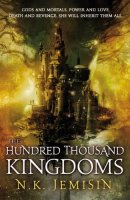
The Hundred Thousand Kingdoms by N. K. Jemisin

I’ve been seeing lots of good reviews for this book but the cover wasn’t particularly pulling me in. It was reading an excerpt that sold me (and why I bought the book), but now that I’ve read it I have changed my mind about the cover – it’s not just a random fantasy castle. The column it sits upon means something, as does the dark figure with hair whipping around it’s face. I think I like the cover more after reading the book!

The Premise: Yeine Darr’s mother has recently died, and soon after the death Yeine was called to the palace in Sky, seat of the powerful Arameri family. Yeine expects to be killed off is surprised when her grandfather, who disowned her mother years ago, formally announces that she is now one of his heirs. The problem is that he already has two heirs – Yeine’s cousins Relad and Scimina. To be Arameri is to be utterly ruthless, and Yeine does not fit into this world although as a Darr she’s a leader in her own right. Yeine is being thrown into the mix without much knowledge of the family and the palace of Sky, including it’s four resident gods, who have been chained in human form by Itempas, the Skyfather.

Read chapter 1, chapter 2, and chapter 3 of The Hundred Thousand Kingdoms

My Thoughts: This book started off very strong for me. I loved the world building and the beautiful palace of Sky which towers over the city of Sky on top of a giant, impossible column – a palace created by gods. When Yeine meets her relatives they don’t think much of her and her “barbaric” upbringing as a Darr. It doesn’t help that she is really half Darr and half-Amn, since her mother abdicated when she met Yeine’s father. (A minus for Yeine’s family, a big plus for me – I love a heroine of mixed race). It seems like a big clash of cultures where Yeine’s world is equivalent to a matriarchal, Amazonian, tribal society who are used to plain speaking, while the Arameri are a metropolitan, Euro-centric society who value treachery and maneuvering. The power is definitely in the hands of the Arameri, who have magic, religion, and four captive gods to rule the world, and who are ahead of the game of succession against Yeine.

The basic story of the universe begins with one god, Nahadoth, who represents chaos, darkness, and change. He is joined by his brother Itempas, who is his opposite – the god of order and light, and their sister Enefa was the gray in between, and bringer of Life to the universe. They also have children. If you have ever read Greek or Roman mythology you should have and idea regarding the things that gods do which seem dysfunctional and childish to mere mortals. This is the case here – their morality is different from Yeine’s and our own and sometimes their relationships are surprising.

The gods were fascinating characters. Yeine’s first encounter with them starts off with a bang when her cousin Scimina sics the most powerful of the gods, Nahadoth, on her like a horrifying hunting dog. The desperate race through the castle is riveting. Anyway, Yeine meets the gods and throughout the book she learns the real events that led to their slavery, rather than the story she was brought up to believe. The gods want to be free from the chains put upon them by Itempas and they have plans that involve Yeine.

Yeine finds herself manipulated from multiple directions. From the gods, and from her family, who have their own power struggles that she is not completely privy to. In the meantime, Yeine has her own agenda. She didn’t come to Sky because she was summoned. She wants to find out what really happened in her mother’s recent death. Her first suspects are of course her Arameri relatives, and so she asks questions about her mother and learns the family dynamics. Not all the answers are easy. Yeine’s mother, who she remembers as loving and open, was someone else in the palace of Sky. Somehow this is related to the current fight for succession.

I thought the multiple machinations were very clever in sucking me into the story. I wanted to know who was doing what, what had happened in the past and what was going to happen. This story is told from the first person POV, but throughout the book Yeine’s recalling what has happened to her and sometimes her memory is faulty. Once in a while, she backs up and restarts, and she has conversations with herself about what was happening or what will happen next. Not to say that the book was confusing – it was the opposite. The prose is clear and simple – it has a sort of young adult feel because of this. The hints of what would happen next were the most effective in keeping me reading to see if my guess was right.  Usually I was still wrong. There were a couple of plot twists I did not expect.

Like Yeine, I was drawn to the gods and in particular Nahadoth, although Sieh, his son, the god of mischief who usually takes the form of a child, was compelling as well. Sieh seems almost human in his need for comfort, but Nahadoth was temperamental and hard to read, like you’d expect from the god of chaos. The idea that a slip of the tongue from an Arameri in commanding him and he will happily kill them added to his fearful power. Any one of the gods is capable of horror beyond imagining. That’s why when the relationship between Yeine and the gods changes, it began to feel nonsensical.  After the narrative stresses how immense their power is, how time moves differently for them, how alien their minds are compared to a mortals, the idea that Yeine would mean much to them in the short time this book spans was difficult to believe. I allow that the gods shared the feeling of being trapped with Yeine, and she has another quality that draws them to her, but I struggled with anything beyond that. I can’t really go into detail without giving spoilers, but there was one part of the relationship where I thought the scene that I had trouble buying could have been removed completely and the story wouldn’t have really changed, so I don’t understand why it’s there at all.

Overall: This was a keeper. The writing let me slide smoothly into a story of treacherous families (both human and divine) living in a beautiful palace called Sky. Yeine’s impact on these families (and their impact on her), knocked my socks off, but I did have reservations regarding the extent of Yeine’s relationship with the gods, and because I struggled with that, the book was just shy of being on my uber-selective Blew Me Away pile (but it came very close). If I think about the reservation, I feel like saying “Don’t mind me. Read this book”. Basically – I’d recommend The Hundred Thousand Kingdoms because I don’t think everyone will have the reservation I did, and frankly, I loved rest of it.

I’m looking forward to the next book, The Broken Kingdoms (expecially after reading the excerpt at the end of The Hundred Thousand Kingdoms). The cover (which may still be a work in progress, I don’t know for sure), looks excellent.

Buy: Amazon | Powells | The Book Depository

Other reviews:
Review at tor.com by Kate Nepveu – loves it “almost without reservation”
My Favourite Books – positive review
My World…in words and pages – positive review
Fantasy Cafe – 9/10
Fantasy Literature – “a very solid debut”
Fantasy Literature – “Almost perfect debut”
The Book Smugglers – 9 (Damn Near Perfection)
Fantasy Book Critic – “almost-perfect debut”
Starmetal Oak – A+
bookblather – positive review

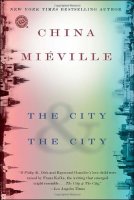
The City & The City by China Miéville

The City & The City
China Mieville

This was written up for a guest blog on Dreams and Speculation (formally known as Book Love Affair), so it’s cross-posted there. I know I’ve mentioned this blog before so go forth and check it out if you haven’t already. It’s one of my favorite speculative fiction blogs.

I’ve never read China Miéville before, despite hearing how good Perdido Street Station and Un Dun Lin were. This was one of those authors I would try “one day”. When I heard Miéville won the Arthur C. Clarke award for the third time for The City & The City, I thought, “Hmm, yeah, I really should try out his books when I get the TBR under control”. This might have been in a couple of years or never at the rate I’m going, but when Dreams and Speculation contacted me for a guest review and offered The City & The City to read, it jumped to the top of my priority list.

The Premise:
When the body of a young woman is found dumped naked under a mattress, Inspector Tyador Borlú of the Extreme Crime Squad is on the case. He lives in Besźel, a city that shares the same space as another city, Ul Qoma. At first the case looks like many before it, but as Tyador learns more about the young woman who was murdered, it becomes apparent that this is more than it first seems.  Conspiracies swirl around the investigation and Tyador has to cross the border into Ul Qoma to solve it.

My Thoughts: When I finished this book, closed it’s cover, and put it down, one word came out of my mouth. That word was: “Weird”.

The biggest mind bender for me was the setting.  Besźel and Ul Qoma are cities that overlap each other in the same spot.  Before I started reading, I assumed there was some sort of inter-dimensional magic involved and perhaps Besźel was on one plane and Ul Qoma was on another, but when I read the book I realized maybe that wasn’t it. People in Ul Qoma could see and hear (and smell) the people in Besźel and vice versa, so while they are separate, they are together. If you were in Besźel, you quickly unsee or unhear Ul Qoma, and if you are in Ul Qoma you unsee or unhear Besźel. This made perfect sense to the people in these two cities, who were trained from a young age to recognize the colors, clothes, and walk of their neighbors and to willfully ignore their existence. To enforce this rule, if someone were to actually interact in some way with the other country – perhaps mistake a Besź for an Ul Qoman, Breach steps in. Breach is the bogeyman which coalesces upon a person who has breached. Everyone fears it.

To me though, this was a foreign concept. While Inspector Borlú’s perception of the other country when he was in his own sounded like he was looking at it through some misty barrier, I began to wonder about the true nature of the separation between the two cities. Méiville sets the cities in our world, in what sounds like Eastern Europe. Do the rules of physics apply, or is this a fantasy? Is Breach magical or does it seem that way to everyone raised to revere it? Is it just in the minds of the people in the two cities? And how about the breaches which happen regularly, but people must expect?  If you unsee or unhear, you must see and hear first, right? There are a lot of these types of questions, and I have my opinion, but I don’t think there is a “correct” answer.

From there I wondered what genre The City & The City fell into. It was definitely detective noir, but was it also fantasy? Is it science fiction? Is it neither? It depends on how you interpret the setting, I think. Yes, Ul Qomo and Besźel are made up, which means there’s a lot of word building here I associate with speculative fiction, but I don’t know if the cities are separated by magic, or by science, or by societal rules. I had a really hard time deciding. Well, Wikipedia mentions that Miéville describes his work as “weird fiction”.

Wikipedia: “Weird tales often blend the supernatural, mythical, and even scientific”
Me: “Yup, that works. “

The setting is folded neatly into Borlú’s investigation because his murder victim has links to a third city. The one in children’s stories that exists alongside Besźel and Ul Qoma – Orciny. As you can probably guess by now, Miéville plays it cagey there too. Whether Orciny exists is intertwined in the investigation, because the murder victim may have discovered it. I enjoyed Borlú’s moments of brilliance that moved the investigation along when it looked like it was about to stagnate, but the existential dilemmas tangled in the crime solving sort of narrows down who is going to enjoy this book. I think if you’re a reader who enjoys Weird Fiction and this sort of clever setting, you’d be as happy as a clam, but despite the good writing and interesting world, I think while I read this, I wanted a twinge less headspace taken up with pondering the cities, and more pondering the murder.

I have the Random House reader’s circle edition of this book. It comes with a conversation with the author at the end of the book, reading group questions, and an excerpt of Kraken.  The conversation made me feel like I was getting some of the things the author was aiming for in the story so it was nice to read it, although it did reinforce my feeling of being teased.

Overall: A story that combines detective noir with a weird but clever genre-bending setting. I liked it – the prose is perfect and the world building (a very important thing in my enjoying a book) superb, but I think I wanted a little less cleverness, and a little more straight detective noir.  I’m giving this an actual numerical score for D&S’s archives – 7, leaning towards an 8. Can I say 7.5?

Buy: Amazon | Powells | The Book Depository

Other reviews/Link:
Fantasy Book Critic – “Beautiful prose, empty book”
Walker of Worlds asks if this book is really science fiction

Video of an author interview

Before the Storm by Marian Perera

This is book that I finished off during the 24 hour readathon. It first came to my attention through moirarogersbree on twitter who said she was excited about it’s release because of the cover, the premise and the excerpt. I read the excerpt and really liked it, and I got even more excited because the author is Sri Lankan (I’m biased, I grew up there).

The Premise: Alexis Kayne (Alex) is a courtesan in the coronet city of Radiath, in the country called Dagre.  She is known as the Black Mare and owned by a powerful man named Stephan Garnath. She hates Stephen and his treatment of her and waits for the day that she can escape, but before she does, Stephen suddenly gifts her to one of his enemies, Lord Robert Demeresna, baron of Dawnever. Neither Alex or Robert know why, but they both know that Stephen never does anything without a reason. Robert thinks that Alex could be a killer sent to his home, but he’d rather she travel with him than behind him. Alex believes that Robert is a despot because of his reputation as the Bloody Baron (a reputation Robert cultivated to dissuade attacks), but she can’t escape.

Read an excerpt of Chapter one of Before the Storm here

My Thoughts: The first thing I have to say is that I wish this cover was a little bit different. It does a very good job in that it conveys the small steampunk aspects, the romance, and the war. Even the lightening behind the couple is significant to the story. I just wish that the couple was wearing clothes. My first impression was this story was erotic or had high heat content because of the topless people. Steaminess that isn’t what I tend to gravitate towards (and reading that the main character was a “whore” being given away doesn’t help the impression). What this book really is, is a fantasy with romantic aspects which I do read, so that’s my one nitpick about the cover perhaps not being ideal for it’s audience.

So upfront: this is not erotica/erotic romance. This is a fantasy with a bit of romance. There’s one sex scene in the whole book and it isn’t something that happens early on. It also has some steampunk elements in the form of machines of war. They do have a significant part in the story, but the are not the focus so I’d call this steampunk influenced but not really steampunk.

In this world, there are two main groups that have the power.  First there is Stephen Garnath. He rules everything but in name (the Governing Hand is supposed to have control but Stephen controls it). Stephen rules through force and fear. To me, he represented one extreme – that of depravity. He’s extremely cunning but takes pleasure in making people he has power over suffer. The second group in power is the Quorum. They are a religious group who serve The Benevolent Ones, and who have their own agenda. I felt like they represented the other extreme. They preach piousness and virtue but don’t take practical considerations or grey areas into account. And they were often hypocritical in their views compared to their actions.

Robert Demeresna is part of a small group who sits somewhere in the middle of these two opposing powers. His land is far from the main city and not that influenced by the Quorum. Robert just wants what’s best for his people, and his rule is has neither the extremes of the other two. Unfortunately for him, neither Stephen Garnath or the Quorumlords allow him to be a neutral party in the struggle for the country.

Alex and Robert are well suited for each other. Alex may be beautiful, but she’s also got a quick mind and she’s had an insider’s view of how Stephen thinks, so she becomes a very important asset (I really enjoyed her strong character). Robert is someone who can see the gray in the world so he’s more open minded than others in the story are. He was a leader but he was neither an alpha or beta male. I enjoyed the way their relationship progressed.  It happens slowly so you see the beginnings of respect and attraction that turn into more. It was refreshing that Alex doesn’t find Robert attractive until she gets to know him. That’s not to say that this relationship didn’t have it’s missteps for me. Robert says some idiotic things when arguing with Alex that I never felt he really apologized fully for, and his realization of his feelings needed a kick-in-the-pants moment to happen rather than figuring it out himself.

I also liked the secondary characters in this story. There’s Robert’s right hand man, Mayerd, who was exiled from his own land, and his backstory was an interesting one. Then there’s Robert’s allies. Perera writes strong female characters, so there’s Robert’s cousin Susanna who has a pet maddog (two headed dog!), and Quorumlord Victoria who annoyed many but had depth. And there was the Word who was an ally in the Quorum who I despised even more than Stephen Garnath.  I thought he was interesting in the way he highlighted the hypocrisy of the Quorum, but the author doesn’t really preach against religion, so much as it being misused by certain people I think.

Most of the story deals with the war that Stephen brings to Robert’s home. There are alliances and maneuvering, secret (steam!) weapons, betrayals, ambushes, and many weary days on the road. The battles are a large part of the book, and at times the details of the skirmishes dragged for me, but there were some interesting tricks that Robert’s smaller army used to even the odds, and interesting side battles fought in magic between Stephen’s pet sorcerer and Robert’s right hand man. The best part was the exciting culmination of the whole thing. I loved that Alex was an integral part of it all and didn’t just sit pretty while the fighting was happening.

This is the first in a planned trilogy.

Overall: I feel like I discovered a hidden gem in this new author. This was a lovely fantasy story with a slow moving romance amid battles and steam machines. The characters are strong minded and interesting, and it left me with things to ponder. My only reservation may be pacing because there are a lot of battle scenes, but your mileage may vary on that count.

Buy (it’s in ebook only as of this review): Samhain | Amazon
(if you buy through My Bookstore & more link through Samhain, there’s a 20% off deal now by entering “shinynew” at checkout)

WIN IT!! – Interview and contest with Marian Perera @ Moira Rogers’ blog (enter soon because I am not sure when the deadline is!)

Links:
Marian Perera’s website
Marian Perera’s blog

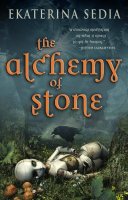
The Alchemy of Stone by Ekaterina Sedia

The Alchemy of Stone
Ekaterina Sedia

Every month at Calico reaction, there is a reading challenge and discussion of a single book. And every month I mean to join but never seem to plan things properly to read the book in time. Well, this month I resolved to read the selection which was The Alchemy of Stone, and with the 24-hour-readathon I even set the date to start it! This means for possibly the first time, I have read a book selection on time for a challenge. A personal victory over my own procrastination. Thank you, thank you.

The Premise:
In the fantastic city of Ayona lives a mechanical girl named Mattie. Mattie lives her life preparing alchemical concoctions for her customers and contemplating how to become truly free from her maker, Loharri.  Although Mattie is emancipated, she still needs Loharri to wind her up and he holds on to her key despite her requests for it. The story begins when Mattie is visited by the guardians of the city – the gargoyles. They ask her to work on saving them, because they are slowly turning into stone and every day their numbers dwindle further. In the meantime, change is coming to the city, as unrest under the ruling classes of Mechanics, Alchemists and Aristocrats begins to increase. As a machine, Mattie is overlooked so she has a unique perspective of the events on the streets and in the meetings of those in power.

Read an excerpt of Alchemy of Stone at Fantasy Magazine

My Thoughts: I just finished The Alchemy of Stone and I don’t really know how to put what this book makes me think about into words. My mind is a big jumble of thoughts. First of all, the prose is lovely. The world in The Alchemy of Stone would be perfect set in a stop-motion animation directed by the Quay brothers. There’s a dark loveliness to everything. Most of the story is told in the third person as we follow Mattie around the city, and although she’s intelligent, I thought that her viewpoint had a sort of innocence to it, because she’s still learning how to be a human and gaining her experience in life. The other perspective is from the gargoyles who speak with one mind as they watch over Mattie. They brought a sense of wistful sadness – watching over the people they’ve seen born into the city they created, sworn to protect them, but never really being able to affect much of what goes on.

I thought that Power was one of the big themes in this book. Power of individuals over each other and power struggles between classes. Everyone seems to hold a little something back from whoever they want to control and everyone wants something. For Mattie the automaton, her master, Lohari, has power over her.  Initially I wondered at Mattie’s resentment of him, because at the surface they seem to have a cordial relationship. She comes by and visits him, makes sure he’s alright and cleans up or makes him something to eat, but at other times, Mattie recalls hating being at his beck and call. I saw some of her resentment of him but his treatment of her at first glance was kind and patient. Then I started to see a little more beyond the surface.  Even though she’s emancipated, she still has to go see him in order to get wound up and continue running. He holds her life in his hands, and through this and other small ways, you discover how insidious his control is.  When I finally realized Loharri’s manipulations, it became a creepy, abusive relationship in my mind. Mattie’s feelings gyrate between love and hate, and I don’t think she even understands them completely or knows what parts are programmed into her. Mattie becoming an Alchemist was her way of trying to get back some of the control by doing something that Loharri didn’t understand and thus feared. But how do you really get control if someone has the key to your life or death?

I didn’t find many of the other characters to be much better towards Mattie as an automaton.  I thought that this was another theme within the book – the treatment of the majority towards the minority, or the treatment of those in power toward those who were not. I felt that we’re reading a lot of things through Mattie’s eyes and she is a forgiving character, and sometimes subtleties of the humans around her don’t register but maybe they do to the reader. Most people in power – the mechanics, ignore Mattie. The alchemists are better, but even then they seem to treat her a little lower class.  When Mattie makes what seem like friends, I felt a little sad because it didn’t seem that their affections were that deep. Most seemed to need something out of her each time. The people most isolated, the gargoyles and the Soul Catcher were perhaps the closest Mattie comes to have people genuinely care about her.

This treatment of Mattie extrapolated to the bigger picture represents the clash between the upper class of aristocrats, alchemists and mechanics and the poor miners, farmers and laborers. It also represents the clash between the locals and the immigrant population who are immediately blamed for rebel attacks on the ruling class. It all explodes suddenly when the upper class, in the pursuit of progress, move labor around for more coal and the lower class has no choice in the matter. But I don’t think it’s as simple as the upper class is in the wrong. They believed in their progress and in improving the city, and when there’s rebellion, they just want to keep their lives as they are and fight to keep what they have. There aren’t really easy answers because everyone is trying to protect themselves. Mattie as well. In the course of defending their own interests without acknowledging others leads to betrayals and struggles for control.

Overall: A lovely steampunk fantasy that mixes magic and technology with revolution. The prose is simple and lyrical, but the messages are not. In the end I enjoyed the mental exercise, but it made me a little sad as well. I put it under “well, that took a little bit out of me”.  It’s a little more serious fare than I’d usually choose for myself and has no easy conclusions.

Buy: Amazon | Powells

Other reviews/links:
Fantasy Book Critic
Ekaterina Sedia guest blog post @ Calico_reaction

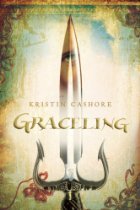
Graceling by Kristin Cashore

Graceling
Kristin Cashore

This is the copy of Graceling I bought on my trip to Boston and finished on the plane ride to AZ this week. My review of Fire, Cashore’s other book in this world, is here: livejournal | wordpress

The Premise: Graceling is the story of Katsa, who is a graceling — someone who has two different colored eyes and preternatural ability in a certain skill. Katsa’s grace is that of killing, and since this was discovered, she’s been nothing but her uncle the king’s enforcer; threatening and killing as he sees fit.  As Katsa grows up she dislikes herself and her role in the kingdom more and more. Things begin to come to a head when Katsa meets Po, a prince from another kingdom who is a Graceling too.

My Thoughts: I read Fire before Graceling. Graceling was published before Fire, but chronologically Fire happens before Graceling. I think you can read these books in either order, but I felt that I was a little more spoiled from reading Fire first than I may have been the other way around. I was less surprised about the villain of Graceling than I think I would have been if I’d read them in the other order.

I really LOVED Fire, I found myself just contentedly reading it and not wanting to move or do anything else, but I had a different reaction to Graceling. Graceling was an excellent fantasy with a sweet romance, but it didn’t enthrall me in the same way that Fire did. I found Graceling a slower read and I put it down more, especially in the first third of the book.  I think I connected to Katsa a little less than I did Fire.  She grew as the book progressed, and she learned to accept her Grace and believe that she wasn’t really a monster, but she was less emotionally available and had problems with opening herself up to people, and maybe that was why I couldn’t connect as well.  Or maybe the reason is that I read Fire first so I love that most? It’s hard to tell what makes me love one book more than another sometimes..

I think a few people have already commented on Katsa’s unwillingness to get married. I could understand the idea in general, but when Katsa kept trying to explain it she alienated me more. I don’t think I really needed to read that she felt that getting married was too similar to being owned by someone, the way she was with King Randa. After a while, her constant fearful explanations about it made me think she was just a chicken rather than someone who had a life philosophy and just didn’t want to get married. Why was it brought up so much?! Ug, it started to irk me.

On the other hand, I really liked Po, Katsa’s love interest. He was a lovely secondary character, especially in the way he responded to Katsa and her moods. Cashore really writes some great guys in her stories! Po has a way of accepting Katsa for exactly who she was that was refreshing. I also loved Bitterblue, who is one of the most levelheaded young ladies I’ve read of in a while. I’m glad to know she has her own book which is coming out sometime next year (word is we also can catch up with Po and Katsa in it too).

Final note: There are sexual situations in this book, but it was written in a very vague way;  nothing explicit.

Overall: I liked Fire better, but it’s another good young adult fantasy by this author. Brave heroines, understanding heroes and deep friendships make this series a recommended read. Cashore goes onto my autobuy author list.

Buy: Amazon | Powells

Other Reviews:
Book girl of Mur-y-Castell – “it was ok”
Book Love Affair – 9 out of 10
Lurv a la Mode – 4 scoops (out of 5)
Jawas Read , Too – Positive with some quibbles. I agreed with this review
Calico reaction – Worth the Cash

Heroes at Risk by Moira J. Moore

Heroes at Risk
Moira J. Moore

Slowly going through the review backlog, whoohoo! 🙂 As with the last book, I bought this one.The Hero series so far:
Book 1: Resenting the Hero (livejournal | wordpress)
Book 2: The Hero Strikes Back (livejournal | wordpress)
Book 3: Heroes Adrift (livejournal | wordpress)Excerpt of Heroes at Risk (it’s the only one I could find)

****** mild spoilers for the rest of the series, go read my earlier reviews if you aren’t up to this book yet *****


The Premise:
This is the fourth book in the Heroes series. Shield Dunleavy (Lee) Mallorough and Source Shintaro (Taro) Karesh are back on the mainland (they henceforth only refer to Flatwell as “that damned island”) and have to face their old life and friends again, which leads to some awkward situations because their relationship is not really clear. Meanwhile High Scape has gone from being a hotbed of disaster to a cold spot, but the people of High Scape have taken to a new trend – dabbling in magic. Some particularly misguided citizens are murdering “lucky” people so they can use their ashes for these spells. Of course, Lee’s first thought is that her handsome partner is prime pickings for another kidnapping.

My Thoughts: This was a good one. I don’t know what it is, but I love to analyze these characters, especially Lee, and we get a lot of fodder for discussion when Lee as usual gets everything all wrong by assuming things in her own blind way. Oh god do I want to shake this woman! Of course, if she was the type of person who was better at reading people (or even as half as good as she thinks she is), I don’t think this series would be as fun. As people have commented on my earlier review, she’s the ultimate unreliable narrator.  I was amused that in this book Lee’s faults such as this one, are pointed out to her face, much to her irritation. I agreed with Lee that it was rude, but I think she should listen to some of these criticisms sometimes.

The primary relationship I love to observe is of course Lee and Taro’s.  I’m going to point at Angie’s review where she said it perfectly with “it’s always a treat to watch them circle each other once more, to attempt to navigate the treacherous waters that lay between their opposing natures and meet somewhere in the middle”. After the events of the last book where the Pair reach a new plateau in their relationship, some may think that everything is settled, but this is Lee we’re talking about. She as usual makes her assumptions about Taro and when they’re back in High Scape, she bases her actions on these assumptions. It’s a little telling how Lee shields herself from grief by doing things like this, but she’s emotionally inexperienced. Taro’s reaction to this is so Taro as well – he gets emotional, but his reaction seems to bounce harmlessly off Lee’s Impervious Wall of Logical Assumption. Watching things come to a head was one of the reasons why I love this series.

While I’m obsessed with gleaning meaning from every interaction between Taro and Lee, the story is really not primarily focused on their relationship. Lee spends a lot of time in the city trying to learn about the new trend in dabbling with magic. She questions why it’s considered illegal if it is supposed to be all fake anyway, and her discoveries raise some interesting questions about whether magic is real and what it means for Sources and Shields. This intersects with some of the other odd discoveries that she and Taro have made over the past few books regarding their powers and their world. I’m not sure where the author is going to take this, but I sense she has a plan, and I’m really curious to see how it all comes together. Moore introduces a new group of people in High Scape who seem to know a lot about magic and hold a lot of power, and meanwhile there has been a shift in rulers which suggests that their world is on the cusp of change. I think I’d be most happy to see some sort of change in the expectations that are put on Sources and Shields. Throughout the series, there have been questions about how Things Are Done regarding for example, the role of the Triple S in politics, if Sources and Shields are allowed to have a relationship, and whether it’s fair that Sources and Shields never have to pay for anything or never get paid.

A not on the cover: I love the colors and I like how Lee looks, but this is not what Taro looks like in my head. He doesn’t look good to me here.

Overall: Possibly my favorite book in this light fantasy series so far. I’m loving Lee and Taro’s relationship, and the way the series is unfolding has me very interested in where it’s all going.

Buy: Amazon | Powells

Other reviews (all good!):
Angieville – A lovely review. She writes what I want to say but better!
The Book Smugglers – Thea gave it a 7
See Michelle Read – also a positive review

Interview with Moira J. Moore at Angieville

The Way of Shadows (Night Angel book 1) by Brent Weeks

This book languished on my nightstand for a few months. My husband bought this series after realizing it’s about assassins and he recommended it to me after he finished. The 645 page length was daunting though so I didn’t get around to reading it until I was threatened, err, reminded that my husband wanted to lend it to a friend and I better read it before he gave it to them.

The Premise:
The first book in the Night Angel trilogy, this is an epic tale about the citizens of Cenaria, but the focus is on Azoth, a street urchin who lives on the streets with a ragtag band of other children. His group all hand in most of their earnings to Rat, one of the “Bigs” of their group, who leads through terror. Azoth rashly provokes Rat who decides to use him as an example and Azoth’s only hope for survival (and protect his two friends, Jarl and Doll Girl) is to apprentice under Durzo Blint, the best wetboy (an assassin with a magical edge) in the city. Durzo is never afraid and Azoth wants to never be afraid again. That’s how the book begins, but it becomes bigger and more complex as we meet new characters and see the intricate interactions between them their ramifications on the fate of Cenaria.

My Thoughts: How do I describe this book? It starts off sort of simple and then becomes more complex as you go along. At first when I got a sense of the city, I wasn’t that impressed by the world building. II felt like it wasn’t something I hadn’t seen before: the groups of street children, the idea of Guilds, the corrupt king and unrest while a neighboring land populated by evil magic-doers plots to invade. It reminds me of a lot of other fantasy, but that was okay, because after the world building foundation was in place, the characters and the plot were so unique fascinating my earlier quibbles were forgotten and I enjoyed the book. The author also introduces some new-to-me magical aspects which are peppered throughout the story.

The Way of Shadows begins as a coming of age tale. Azoth has nothing to protect himself or his two friends, the young, mute Doll Girl and the smart but small framed Jarl, and he dreams desperately of leaving the streets and apprenticing under the number one wetboy in the city, Durzo Blint. Azoth’s dream is an almost impossible one, but he does manage to catch Blint’s attention and Durzo promises to teach him only if he passes a test. I was really engrossed by this part of the story – wanting Azoth to pass his test and to destroy Rat, but it is also probably one of the most violent parts of the book. The abuse against children, by other children, while adults may know what’s going on and do nothing, was really hard to read. It gave me chills, but it sets up the story so you know not to expect things to go the way you want them to.

The second part is the apprentice-ship phase where Azoth becomes someone else–Kylar. He trains and grows up and so do his friends and enemies. The focus of the book shifts a little and we get introduced to the points of view of some other characters. Brents starts setting the characters up like pieces on a chessboard. Friendships and actions that occur in this phase may be small and seemingly insignificant but have greater repercussions later on. We also get a lot of interesting characters and begin to learn about their motivations and secret griefs. I particularly liked Durzo Blint who avoids morality and emotional connection. Finding out why and whether it really works for him is part of the fun. Azoth/Kylar’s training as a wetboy was fascinating but not glamorized. The book doesn’t shy away from the darkness of the job.

The final part of the book is Azoth’s final trial to become a full-fledged wetboy. The one thing you should keep in mind if you read this book is DO NOT expect things to go the way you think. At first the twists are minor, but the further you get into the story, the more you realize much of the book is set up for more and more surprises and turns. I think this author has an evil streak, because characters I had begun to like as suddenly killed off while characters I hated kept being despicable and unchecked. Each of the characters only knows his or her little part of the story and often acts without knowing that they’re doing the wrong thing for the overall picture. If you really connect to a character you may get disappointed at what happens to them, but ultimately I thought that the book did end in a hopeful place despite all the things that go wrong. Of course, this book is LONG. I was 200 pages from the end and wondering how we weren’t already at the end, because the sh*t was hitting the fan and I couldn’t see how there were 200 pages to go. Usually in fantasy the ending happens shortly after a battle, but in The Way of Shadows, the author was not done, things kept coming, more and more twists showed up, I couldn’t believe it. While I could appreciate the twists, if I can find any fault, I’d say they did start to feel improbable just by how often a new one was thrown in.

Overall: An gritty epic fantasy tale with more twists than a bag of pretzels. It didn’t quite wring me out and I thought it was ultimately hopeful and worth the read, but it was a roller coaster. I’m very curious where things will go now.

Buy: Amazon | Powells

Other reviews:
Hello, Ilona Andrews liked it! (link has Andrews’ thoughts plus an interview with Brent Weeks)
Un:bound – Haglerat called it a wonderfully rich traditional fantasy
Tempting Persephone – also liked it and recommends it
Fantasy/SciFi Book review – loved it
Fantasy Book Critic – Highly recommended
My Favourite Books – also a positive review
Giraffe Days – a mixed review

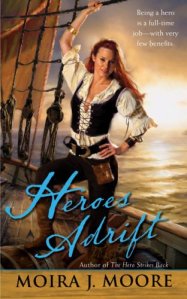
Heroes Adrift by Moira J. Moore

Heroes Adrift
Moira J. Moore

This is (for some reason) one book I read last year but didn’t review. I just read Heroes at Risk and wanted to review it, but it felt like I was skipping this book, so here goes: a review from my memory to fulfill my OCD completest tendencies. This is another series I’m addicted to where you have to get used to the heroine (and narrator) to enjoy it. She can be really obtuse about herself while simultaneously making observations about other people. Check out my reviews of book 1 and 2 if you’re interested in trying it out.The Hero series until now:
Book 1: Resenting the Hero (livejournal | wordpress)
Book 2: The Hero Strikes Back (livejournal | wordpress)

The Premise: This is the third book in the Heroes series which is about a Shield and Source Pair who protect the populace from natural disasters by channeling them away. Dunleavy Mallorough (Lee) and Shintaro Karish (Taro) have been mysteriously called to court in Erstwhile by the Empress. Lee doesn’t like it, and soon she’s proved correct for this reaction because the queen tasks the Pair to find one of her heirs, who was hidden away on Flatwell, one of the Southern Islands. Lee and Taro go there, only to discover that Flatwell doesn’t recognize Pairs the same way that the mainland does. This means Lee and Taro have to actually earn their own money while trying to find this lost relative!

Excerpt of Heroes Adrift

******** possible mild spoilers of the earlier books from this point ********

My Thoughts: I really enjoyed this one, probably because when push come to shove, Lee and Taro really worked together in this book. They’re both miserable, and only have each other. It’s hard, particularly for Taro, because Flatwell people see him as plain and useless, not as vibrant and beautiful as he was always seen in the mainland (and in other books). The role reversal was amusing, and Lee becomes the stronger, more admired part of the Pair, much to her and Taro’s astonishment. Meanwhile, poor Taro begins to question his usefulness, because in Flatwell, his skills as a Source and his pretty manners are seen as unmarketable. Only stubborn Lee continues to see him as he was seen on the mainland, which says a lot about their relationship.

This book was a little bit of a breather for me in terms of getting annoyed at Lee. I think that Lee has a habit of not speaking her thoughts out to people (because Shields are supposed to be stony), and just letting them talk, which leads to misunderstandings. I often think “Why don’t you SAY that!”, but no, she doesn’t, she assumes they should logically realize what she’s thinking and then she’s surprised when they come to their own decision, because of their “talk”.  Thankfully, in Flatwell, the people are a bit different from the mainland–they’re less interested in what Taro and Lee are up to, and so Lee doesn’t get into those situations so much. The focus is much more on just the two of them, and the results are delightful.

You could say this is sort of a transitional book, but I think the mission this Pair is on may have repercussions later on in the series. I feel like Moore is very subtly putting it into the readers heads through Lee that there’s beginning to be a shift in the political climate in this world. There’s also a lot of questions about if things being done the way they are now are the right way to do things, particularly in regards to Sources and Shields.

Also: This may be my favorite cover for this series so far.

Overall: A really interesting installment where Lee and Taro’s roles get a little twist and there are some juicy developments in their relationship.

Buy: Amazon | Powells

Other reviews:
Angieville a positive review
The Book Smugglers – 7-Very good

Cast In Silence by Michelle Sagara

Cast in Silence (Elantra)
Michelle Sagara

This is one of my reads this weekend during the 24-hour read-a-thon. I bought this a while ago but hadn’t had the time to read it until now.

The Premise: This is the fifth book in the Chronicles of Elantra series which is a fantasy set in the city of Elantra, where Kaylin Neya, a member of one of the arms of law, called the Hawks, lives. Kaylin is the focus of a lot of attention because of mysterious symbols written all over her body, which have been there since her birth, and for the amazing things she can sometimes do. In this installment, the story continues shortly after the events in Cast in Fury when a message makes it’s way to Kaylin, demanding her help with something that’s disrupting the fiefs.

Book 1: Cast in Shadow
Book 2: Cast in Courtlight
Book 3: Cast in Secret (review – LJ | wordpress)
Book 4: Cast in Fury (review – LJ | wordpress)

My Thoughts: By this book, the characters surrounding Kaylin have been introduced, but we get some surprising background into Kaylin’s past when someone she knows from the fiefs shows up on Kaylin and Severn’s patrol with a message from the fieflord Barren. I don’t remember if it was mentioned in any of the earlier books in this series, but we discover that Kaylin spent time in Barren in between leaving Nightshade and before joining the Hawks. Exactly what she was doing there is slowly revealed in this book. I liked that I was learning some new back story about Kaylin, and we also get surprised by a different view of Lord Nightshade. I think I got part of my wish after reading the last book, which was to learn more about Kaylin and her powers. Each of the books in this series has delved a little into the different people of Elantra, and this time we’re circling back to the fiefs and to the characters and their pasts. I’m a big fan of the way Sagara writes her cities and the characters in them. It always feels like there’s a lot interesting things that the reader wants to know more about, so I’m glad that in each successive book, we learn something new. I also wanted to see more relationship development between Kaylin and the other characters, which we do see, however, don’t expect much romance in this one. Although the book is published by Luna, an imprint of Harlequin books, the romance in this series is very low and usually only faintly hinted at. In this installment there is even less than that.

When this series first came out, I think I read the first book like it was candy. I loved the idea. When the second book came out, I loved it even more than the first (it’s my favorite of the series). Then in the third and fourth, I started to have some problems (which I brought up in my earlier reviews): there were too many times where people either berate Kaylin for asking some obvious question about the world that she should know the answer to, or would just NOT tell Kaylin something because it was some taboo to talk about and again, Kaylin is just an idiot for asking. Meanwhile, Kaylin (and the reader) have no idea what the other character was going on about. In this book, thankfully, we don’t have another situation where the story would have ended 100 pages earlier if someone had answered Kaylin’s question, but we do have the usual – “Kaylin, I don’t know how you’ve survived for so long” comments. Sometimes I agreed because I know Kaylin is not supposed to be blabbing certain things to certain people, and she just can’t help letting secrets slip out, but other times, I just found that old chestnut exasperating. I know this is supposed to be part of her character (I’m pretty sure, because this is not a trend I see in other Sagara novels), but it still annoys me a lot. I hoped it would improve, but while Kaylin has grown over the course of the series, she’s still considered in need of  learning, so I suspect it won’t for the next few books.

The other (bigger) problem I had, (and I suppose it’s connected), is that so much is conveyed through dialogue and I often had trouble understanding it. Someone would say something loaded with meaning, and it would completely go over my head. But I knew it meant something because of the reactions of the other characters. So I’d reread it. And still not get it. I didn’t realize how often this happened until the read-a-thon when I noticed that my reading speed was about 30 to 40 pages an hour, when my usual reading speed is more like 60 to 100 pages an hour. I just kept having to reread pages and it had a significant impact on my pace. I’m not sure if it was just because I was getting tired from reading hours on end, but I think that the way the dialogue is written lends itself to needing rereading for understanding.

Overall: My feeling are mixed. I love this author. I think that this book is very well written, especially in terms of world building, actual writing style and characters. I will keep reading to find out how things play out for Kaylin, however, with the repeated problems in understanding the dialogue and with how Kaylin’s character is treated, my enthusiasm for this series is dropping. I hope the next installment renews it.

Buy: Amazon | B&N

Other reviews:
Dear Author – gave it a B

Fire by Kristin Cashore

Fire
Kristin Cashore

I was pretty sure I would like this book when Graceling got glowing reviews from the usual suspects (people who have tastes that tend to mesh with mine), which is why I got an ARC copy of Fire at BEA. The next day, when I saw that the author was signing the book, I got another copy. The first copy was contested off earlier this summer, but I hadn’t gotten around to reading Fire until now (what can I do, so many good books in my TBR, so little time).

The Premise: Fire is a 17 year old girl who lives in the kingdom of the Dells. This is a land where monsters live. Monsters are just like their normal counterparts, except they are gorgeous, with amazing colored skin and hair and fur, and they use their beauty to compel their victims to do what they want. Fire is the only human monster alive. The strong minded want to kill her, the weak throw themselves at her feet, and other monsters just want to eat her. This is the least of Fire’s problems because the country is gearing for war. The young King Nash’s position is threatened by a couple of power-hungry lords and although his brother and war commander, Brigan, doesn’t trust Fire, she soon becomes embroiled in their fight to keep the kingdom together.

Read a 40 page excerpt of Fire

My Thoughts: I haven’t read Graceling, and I had no problems because of this, so I will happily say that there is no need to read Graceling first. This is supposed to be an earlier companion novel set in the same world but a different geographical location, with ONE (I think) common character, and the rest are new characters. I didn’t even know who this common character was until I saw reviews by people who had read Graceling before reading Fire.

This book started off with a prologue which doesn’t come into play until much later on in the book. I spent some time wondering what the prologue was about because it didn’t seem to affect the story for a long time. But it does finally come into play, so you do have to read it. When the book really starts, we’re introduced to Fire who has just been shot by an arrow, but accidentally, which is a surprise to Fire. Fire believes at any time she could die, either from a monster attacking her and her not being fast enough to avoid it, or from someone going insane in her presence, killing her.  At first I didn’t really grasp the monster concept and what it really meant for Fire to be one, but over and over again, everyone’s reactions to Fire, and I do mean everyone’s, is to first see her as that beautiful monster. By the time I was done, I was right there with Fire in being completely sick of people who couldn’t control themselves absolutely hating her or throwing themselves at her on sight, but it was realistic and a huge part of what she is. It was really a burden, especially because she was a woman.

I loved Cashore”s writing style. Fire is written in the third person, but the focus is mostly on Fire, and I think the author makes a deliberate choice to have the reader experience what Fire experiences. So there’s a lot of showing, not telling, especially when it comes to emotions that belong to people other than Fire. We can see their faces, but we’re left to interpret what emotions propel their facial expressions and body language. I love that I don’t always know whether my guess is correct, and the author doesn’t lay it all out there clearly. It also makes Fire the focus of all my emotional empathy, and boy, does this girl go through things. Because of Fire’s father, another human monster, a selfish man who was adviser to the previous king, Fire is the target of hatred because of his sins. There’s only her neighbors, Lord Brocker and his son Archer who seem to care for her, but as the book continues, Fire’s strength earns her more friends. It’s not easy. There are some scenes of very realistic grief, the kind where you are so sad and depressed, all you know is feeling, not logic. I wanted to cry with her. Don’t worry though, this is not, for the most part, a sad book because Cashore writes things in a way where I could accept the sad parts and move on. There is more hope and happiness, and a big part of that is the romance.

The relationships between characters in this book were just amazing. Even the minor characters had individual personalities and impacted the major characters, but my favorite relationship was of course the romantic one! I think it was quite obvious from quite early on who Fire was going to end up with, but the journey to get there was gradual and lovely. It was a mental process, although Fire and other characters are not shy about sex. Actually, despite their young age, and although Fire is categorized as young adult, most characters had adult responsibilities and were mature people. The writing has a simple, no frills feel of a young adult book, but there are a lot of themes which makes this book have an adult appeal.

Overall: I thought I would like it, but Fire really bowled me over: I loved it! Superb writing, fantasy with a really sweet romance, and amazing character development. It’s a young adult book that has adult appeal. I highly recommend it, especially if you are a fan of Robin McKinley or Sharon Shinn or Maria Snyder. I closed the book with a sigh, and then I hugged it.

Other reviews:
Angieville – she loved it
The Book Smugglers gave it a 9, Damn near perfection
Steph Su Reads – 5 out of 5

Other links:
Kristin Cashore’s blog
Fire Blog Tour