Pictures from the SOHO Teen Launch Party

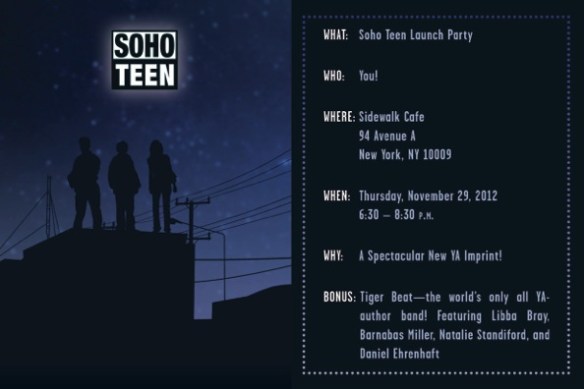
Soho_Teen_Invite
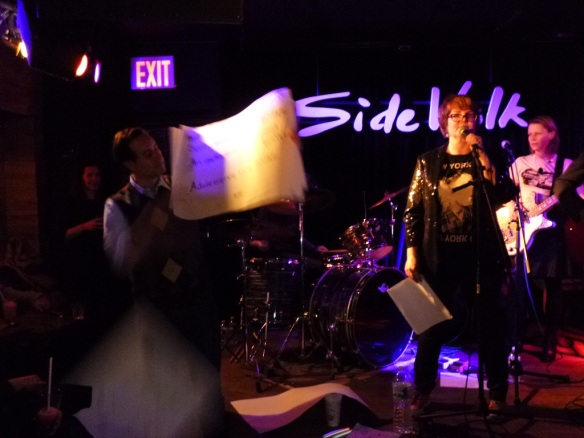
Last night was the Soho Teen Launch Party. Soho Teen is a new imprint from Soho Press, and it looks like it has some exciting new books coming out.  I was invited via my YAcker buddy Nicole from Word for Teens (and I also got to meet her for the first time). The place was packed with people. A little overwhelming, but I still had a nice time. Highlight was seeing Libba Bray rock it with her band Tiger Beat (especially when she sang YA song, accompanied by David Levithan holding up placards with the lyrics on them). I had a hard time getting non-blurry pictures because of the lighting, and I may have been laughing… there are videos of this song on youtube if you want to hear it.

P1000137 - CopyP1000142 - CopyP1000148 - CopyP1000153 - CopyP1000154 - CopyP1000156 - CopyP1000144 - Copy

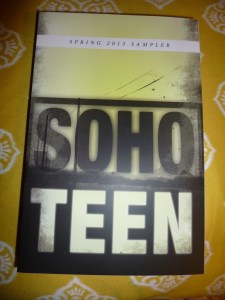
Also picked up a sampler of what’s coming out in 2013.
P1000166 - Copy

Jepp, Who Defied the Stars by Katherine Marsh

In an unprecedented vote, the YAckers unanimously chose Jepp, Who Defied the Stars for this month’s pick. To see how we all eventually reacted once we read Jepp, you can check out our chat here.

Jepp, Who Defied the Stars
Katherine Marsh

The Premise: This is the story of young dwarf Jepp, who grew up in Astraveld, a crossroads between the Spanish Netherlands and the Protestant North. Loved by his mother, who runs a bustling inn, Jepp is treated like a prince and is fiercely protected. It is a good life, but when he is fifteen years old, a man comes by the inn, offering to bring Jepp to the court of the Infanta Isabella Clara Eugenia and her husband, Archduke Albert of Austria. Eager to see the world beyond the narrow one he knows, Jepp agrees. He has always held a dream of one day meeting his father and he believes that the man offering to take him away is part of his fate. This begins Jepp’s journey away from childhood and all its innocence and into the big world, where perhaps he can

My Thoughts: Before reading Jepp, Who Defied the Stars, I didn’t really know what this book was about or what category of young adult it belonged to. I actually thought Jepp was YA fantasy at first because it begins at a inn at a crossroads (familiar Fantasy territory).  I soon figured out that I was reading historical fiction when Jepp says he lives in the Spanish Netherlands and mentions the Infanta Isabella, its sovereign from 1598 to 1621. There’s an author’s note at the end of the book that explains the real life people and events that inspired Jepp, (which is fascinating and worth reading), and basically Jepp did exist, but little is known about his life. Marsh took the question of who Jepp was and extrapolated that into this story. Jepp is divided into three “Books”, and each “Book” seems to correspond to a change in scenery and a new direction in Jepp’s life.

Book I begins while Jepp still lives in his mother’s domain, but not for long. A man named Don Diego comes to the inn and invites him to he court of the Infanta Isabella, and that’s where Jepp stays for this part of the story.  Jepp is still rather innocent and unsure of himself so he is mostly an observer, doing what he is bid by the others around him. We get Jepp’s impressions of the specially designed rooms for the court dwarfs, the gardens where they arranged themselves in a tableau for the Infanta’s pleasure, and the performances where he has to play the fool for a few laughs.  As for the people at court, Jepp focus is narrow: Don Diego; the other dwarfs, Sebastian, Lia, and Maria; the court jester Pim, who arranges the entertainment; and Hendrika, the mistress who oversees them. These people are the ones he interacts with most, and everyone else is hazy and not so well-defined.

Despite Jepp’s faithful descriptions, there’s the sense that there’s a certain naivety in what Jepp observes. He sees things that trouble him, but does not fully comprehend them until later. He dislikes his treatment at the palace, but doesn’t immediately see the same misery in others.  His youth is part of the story, but I found some of this innocent observation and floating along very passive. Basically, Jepp wasn’t really doing anything, and this didn’t make him easy for me to connect to.  The only goal he seemed to have was to one day find out the identity of his father, but there seems no way of doing so away from his mother, and so I felt like there wasn’t much of a direction to the story. Sometimes there are other things that saves a story for me in this situation, like a romance I could sink my teeth into, but even here, Jepp disappoints. He thinks he’s in love, but he barely knows the girl. When things do finally pick up, it is instigated by a situation someone else is in, and Jepp is pulled into it by his sweet nature and wanting to help. Of course this changes his life, and propels his fate along in a way he doesn’t expect.

There’s some drama as the story segues into Book II, but the story stalls for a second time as Jepp repeats what he’s done before: letting things happen to him, and observing rather than doing. The eccentricities of his surroundings is where the entertainment lies, not in Jepp’s own actions. Of course Jepp, Who Defied the Stars gets better – Jepp does start to take his fate into his own hands, if you will, and it’s nice that when I think back now, I see how Book I is reflected in Book II, but with an older and wiser Jepp, one who begins to take part in his own life – but reading was a slow process (I’m sorry to report that I kept putting the book down and sighing for at least the first half). The last third of the book (Book III) ended up being the best third for me, but it takes some patience to get there. The change in Jepp from passive to active removes a lot of the issues I had with reading, and with his relationships with other characters.

Jepp, Who Defied the Stars essentially becomes a story about fate versus free will, but this isn’t a clear message for me until the author’s notes at the end. I liked Marsh’s own personal relationship with this theme that she described in the addendum, but I’m not sure if the idea that Jepp was fighting against some fate was really something I picked up on while reading this story. I think the history itself was a little bit more interesting. Despite being set in the past, this story does a good job of keeping the focus on Jepp’s personal experiences rather than on History.  However, Jepp’s voice has a formality to it that is a deliberate reflection of the time (Marsh notes she was careful to choose words in use before 1600 when writing Jepp), and the language contributed to feeling like I couldn’t comfortably sink into the story.

Overall: I have a sort of “middle ground” reaction to Jepp. I wasn’t wowed while I was reading it, and Jepp’s passivity and the formality of his narration made me feel impatient with the story. On the other hand, I can see that these were deliberate choices in the writing because of the theme of “fate versus free will” and because of the time period that Jepp is set. I think my visceral response usually determines how I feel about a story and for much of this book, I felt like I was plodding along, but when I think about it analytically, it comes off much better. So: this may be more for the “thinkers” than it is for the “feelers”.

Buy: Amazon | Powell’s | The Book Depository

Other reviews:
The Book Smugglers – 7 (Very Good)
The Book Harbinger – positive (“it wasn’t only the engaging history but also the character of Jepp himself which drew me in from the start.”)
Word for Teens – DNF
Book Nut – “Overall, it’s a bit uneven” but also, “found it to be a wonderful bit of historical fiction”

(Also may I say, this book was BEAUTIFULLY designed? I loved how the inner pages were NAVY with pretty endpages and chapter headings, and the cover had shiny bits on a matte background, silver font, and those stars. Gorgeous.)
Giveaway: Fairytales from the Brothers Grimm by Philip Pullman

Fairytales from the Brothers Grimm: A New English Version (out since November 12th) is an enjoyable, straight retelling of 50 fairytales. There will be a review from me soon. In the meantime, the publisher has kindly offered a copy for one of the readers of this blog.

Here’s how to enter:

  • Fill out this google form with your name and an email address (please make it one you check often)
  • Enter by Sunday, November 25th.
  • This giveaway is for U.S./Canada only

Psych Major Syndrome by Alicia Thompson

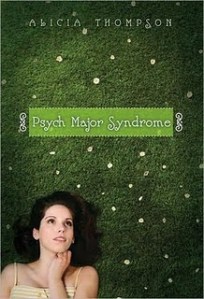
A few weeks ago I went to the Greenburgh Library Book Sale and picked up several books, including this one. Isn’t the cover adorable? I think the wistful, fresh-faced look of the cover model is a perfect representation for what’s inside.

Psych Major Syndrome
Alicia Thompson

The Premise: Leigh Nolan is a freshman psychology major at Stiles College – a progressive school where students aren’t graded and are expected to take charge of their own education. In a small school like Stiles, this means quite a few over achievers, “freaking out about their entire academic career” a couple of months into their first year. It’s a trying time, but on top of trying to decide on a topic for her senior thesis, mentoring cynical middle school students, and dealing with other competitive psych majors, Leigh is also questioning her relationship with Andrew, her high school boyfriend and fellow Stiles underclassman. Lately their relationship has lost it’s luster, and Leigh is confused by how much she’s noticing Nathan, Andrew’s roommate who never seems happy to be around her.

My Thoughts: Well this was as cute a story as I was hoping for. I think it has the right amount of the expected love story, but it’s balanced by writing that gives Leigh a faceted and likable character. Her psychology major fits nicely with delving into her psyche.  Leigh is constantly self-evaluating and acknowledges her own quirks, which include (but are not limited to): refusing to buy a parking pass, waiting until the last minute with her assignments, and a fear of being stranded in the desert. To add to the theme, each chapter begins with a psychological term and its definition, which foreshadows what’s to come.

Ask her some psychology related thing, and Leigh can dredge up what she learned in AP Psychology and class. But for all her book smarts, Leigh is a bit naive. She still has NO clue that her relationship with her boyfriend is in trouble. When you forget a date, and so does he, it doesn’t really say you’re feverishly in love. Leigh’s roommate (and best friend) Ami isn’t enthusiastic about Andrew, but Leigh defends him:

“Ami doesn’t have the benefit of all these great memories, so she continues to think that he doesn’t treat me as well as I deserve. Which, in a way, is totally loyal and cool of her– but completely unfounded. Well, mostly. If anything, his main problem is just that he’s too smart.  He has so much going on in his brain at any given moment that it’s no wonder he’s a little absentminded sometimes.”

Leigh rationalizes Andrew’s non-attentiveness and the distancing that has happened between them since school started. To be honest, from Leigh’s workload, I can understand why it’s easy for her to do so. She’s quite busy with college herself.  Her day-to-day life involves going to class, meeting with her academic adviser, long talks with her roommate, and waiting till the last minute to do her work. (As an aside, Psych Major Syndrome captures the college experience really well — when Leigh stays up till 5am writing a 20-page essay, the details of falling asleep and waking up with barely enough time to hand it in, felt eerily familiar). But schoolwork only goes so far as an excuse, and eventually Leigh has to face what’s really going on between herself and Andrew.

In the meantime, all that schoolwork and the social life of college means that Leigh has a pretty full life, and it’s not all about her romantic relationships in this book. The interactions between Leigh and Ami, the other psychology students, her mentee, and Nathan are all natural extensions of her life and nothing ever feels forced about them. Even if I could predict exactly where the story was going to go, Psych Major Syndrome adds enough humor and color to make the predictability pleasant and comforting instead of dull. Also (and here I go back to the romance), Leigh’s happy ending is one of the sweetest ones I’ve read in a while. I ended up really liking the guy she is paired with, even if I thought he was a bit of a fantasy boy. I can overlook how Leigh acted before she figured out what she wanted because of how well this guy suited her – it all ended on just the right note.

Overall: A sweet and fast comfort read. It has a good balance between an expected plot and a unique approach to that plot. Leigh is an endearing narrator, and I enjoyed this reminder of college life.

Buy: Amazon | Powell’s | The Book Depository

Other reviews:
One More Page – ” a very entertaining contemporary YA read, even if there’s really nothing surprising about it”
A Room With Books – “Psych Major Syndrome was an okay read. Leigh was much too blind to everything around her for me really connect.”

Other:

Ghost Planet by Sharon Lynn Fisher

This review is based on an eARC sent to me by the publisher.

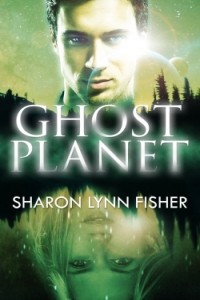
Ghost Planet
Sharon Lynn Fisher

The Premise: Elizabeth Cole was starting a new job as a psychologist on the newly discovered world of Ardagh 1, also known as “the ghost planet”. This is a place with a remarkable phenomenon – everyone who goes there starts being followed around by a manifestation of a deceased person they once knew. Why the local aliens have chosen to do this is a great mystery, but to cope, settlers have set up the Ghost Protocol. The protocol is not to acknowledge the ghosts whatsoever.  Interaction has had adverse effects and colonists find that ghosts weaken if ignored for long enough. When Elizabeth lands on the planet she is apprehensive about what will attach herself to her, and when she meets with her supervisor Dr. Grayson Murphy, her first thought is to wonder if he’s human. He is, but Elizabeth is in for a shock – she’s the one that’s the ‘ghost’! Her transport to the planet crashed, killing all aboard. Now Elizabeth is faced with the alarming prospect of knowing she’s ‘real’ but being treated as if she’s not. She has to fight for herself and against the Ghost Protocol, while being tethered to the man responsible for it.

Read an excerpt of Ghost Planet here

My Thoughts: I’m not sure how long Ghost Planet has been on my radar, but I’ve been following the author’s blog since sometime last year. Its premise just got me aflutter: a planet where everyone has ghost following them around? And the heroine is surprised to discover she’s a ghost too? And there’s chemistry with the guy she’s linked with? AND Linnea Sinclair calls it a “fresh and fascinating take on the human-alien problem”? Uh, yeah, needless to say, I had pre-ordered this long before I was contacted about a review.

The tarmac was deserted. Foggy and disoriented, I wondered how long I’d been standing there, listening to the evergreens groan in the wind and dreading my first encounter on this new world. Would it be human or alien?
I breathed in the crisp, impossibly clean air, trying to clear my head. My gaze traveled around the landing pad hemmed in by towering conifers, and came to rest on the transport terminal, oblong and silent under a slate-gray sky.
What now?
I had the unsettling feeling I was the only person on the planet—Ardagh 1, more commonly referred to as “the ghost planet” by people on Earth. Inexplicable things happened here. The planet itself was a study in the impossible.
Finally the terminal doors slid open, and a figure stepped out onto the tarmac. Half a dozen others spilled out behind him, and a transport whined into view, landing about thirty meters away.
The presence of the other passengers eased my sense of isolation. But that first man out of the building—he was headed right for me. My heart beat out a warning, and my mind snapped back to the original question: Human or alien?
“Elizabeth?” He raised his dark eyebrows, and my gaze locked on his startling eyes. Piercing, round, and the lightest shade of blue, like sky behind a veil of cloud—clean cloud, not the brown smudges that passed for clouds back on Earth. Something about him tugged at my memory, but I found this the opposite of reassuring.
“Yes?” I answered, uneasy. If he wasn’t human, I was minutes on the planet and already breaking the rules. It was dangerous to talk to them. There were institutions back on Earth devoted to caring for people who’d done so. I’d met some of those people.

I think my instinct for what I like served me well with this one. I loved the concept that promised some interesting world-building, but because this is also Romance, there’s a burgeoning relationship for me to enjoy too. I like a balance between these two things, and Ghost Planet does a good job of it. I especially liked this early on, when Elizabeth has to adjust to her new reality. What first struck me was that although she was on a new planet, far from Earth, her work as a psychologist was something relatable and not high-tech or military. She was a middle-class woman, without any special combat skills, just her degree. And because this was told from her point of view, having the ‘ghost’ tell the her side of story was a nice spin on the extra-terrestrial encounter trope: no one knows exactly what she is, but then, neither does she. Until she’s told she’s a ghost, Elizabeth doesn’t realize anything is wrong, and her shock and confusion at having her most basic identity questioned is good stuff. The irony is that the human Elizabeth was interested in the ‘ghosts’ from an academic standpoint before traveling to Ardagh 1. Now her experience with the Ghost Protocol is much more personal and her questions about her existence much more pressing.

At first it seems like Elizabeth’s unlucky to be attached to her would-be-supervisor Murphy. He’s the psychologist responsible for helping the settlers cope and he’s told them rejecting their ghosts is the best thing to do. But before he realized what she was, they were enjoying each other’s company. When Elizabeth turns out to be a ghost, it’s a surprise for both of them. So Murphy is kind to her and conflicted about his own protocol. Their relationship mirrors the people on both sides of the equation. On one side, there are the humans, wary of a phenomenon that has no explanation, on the other, there’s the ‘ghosts’, struggling to be acknowledged.

Because any interaction with Elizabeth is verboten, the relationship took some time to develop, and I enjoyed seeing how it happened despite the rules against it. Elizabeth’s persistence and Murphy’s empathy were characteristics that brought them closer, but the connection they forged from quiet proximity had it’s own power. The romance takes a natural path there that I liked, and Elizabeth and Murphy make a compatible couple. The one quibble I had, was that once they hit a turning point in their relationship, something went away. I think that that suddenly the discord came from sources external to the relationship, and these two were very harmonious.  I suppose at that point they had enough to deal with.

Anyway, this is a story with a healthy amount of romance but has a plot that doesn’t just evolve around that. There are some suspenseful, action-adventure aspects to the story and Elizabeth and Murphy have to face several threats to their lives. I can’t really go into these without spoiling the story, but I was impressed by how thoughtfully Ghost Planet explores the the ‘ghost’ concept in its storytelling. It’s a concept that’s also a mystery, and thankfully the author doesn’t leave the reader with a lot of hanging questions. It explores a lot of the questions I had and organically integrated the answers into the plot. For example, I’d wondered about other ‘ghosts’ and what they were like, what Elizabeth could do and not do as a ghost, what would happen if she was strengthened by Murphy rather than weakened, what happened if she tired to separate from him, and so on. I even felt like I got something of a satisfactory explanation for why the ‘ghosts’ were there in the first place, or at least a working theory that made sense to me, by the end of the story.

Overall: I’m excited about other people discovering this author. I thought Ghost Planet was very enjoyable science fiction romance with a heroine who is more regular girl than action hero, and a setting that feels very unique (and not just for not being on a spaceship).  I really liked the thoughtful way in which the ‘ghost’ concept was explored in this story, and I also liked how I was engaged by scenes that weren’t all about action. Fisher made relationship dynamics and the fight for dominance (or just acknowledgement) between personalities just as important as physical fights for control. I’d recommend Ghost Planet for fans of Sara Creasy and Linnea Sinclair.

P.S. As far as I can tell, this is a standalone (!)

Buy: Amazon | Powell’s | The Book Depository

Other reviews:
Not yet