Soo.. I just watched Moonrise Kingdom on Friday night. Directed by Wes Anderson, it centers around two loner preteens who decide to run off into the wilderness together. This sets off a hunt by the local community. Quirkiness abounds, and everything is filmed with deliberation and general loveliness.
Perhaps it’s because the story’s protagonists are twelve, and Moonrise Kingdom is set during a summer in 1965, when kids are at camp or reading books and listening to records at home, but I was stuck by how much this movie evoked a sense of nostalgia. It’s a weird sort of nostalgia though. Everything is made up. Essentially, it’s a nostalgia for something that never existed.
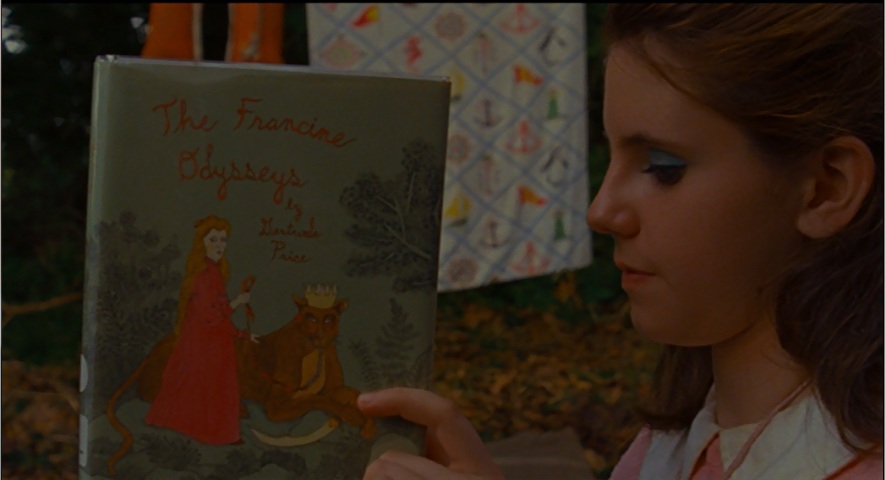
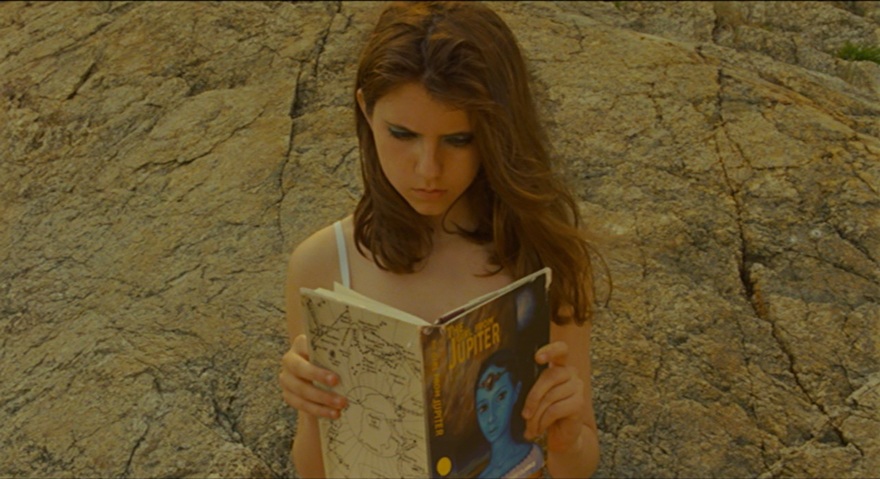
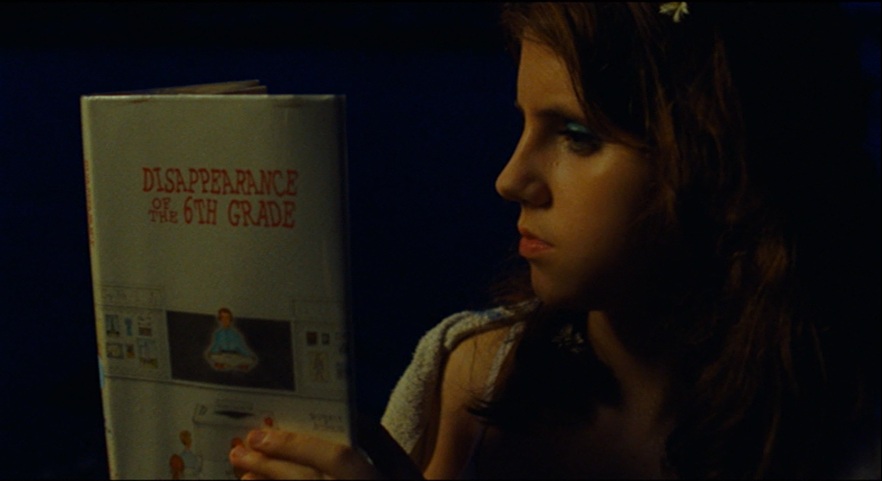
My favorite props have to be the books that twelve-year-old Suzy Bishop (Kara Hayward) read. Of course, it would be the fictitious books with titles like Shelly and the Secret Universe and awesome old-style covers that stoked this book nerd’s sense of nostalgia.
These are my books. I like stories with magic powers in them. Either in kingdoms on Earth or on foreign planets. Usually I prefer a girl hero, but not always.
Suzy: I always wished I was an orphan. Most of my favorite characters are. I think your lives are more special. Sam: I love you, but you don’t know what you’re talking about.
There are six books in this movie, and I took screen caps of them all. But did you know, not only did Wes Anderson have artists make book covers, and wrote passages that are attributed to each book, but there are also animations for each book? According to the Internet, Anderson considered putting the animations in the movie, but instead used them in a promotional short. It is quite awesome and worth a watch.
Sam: These are all library books. In my school you’re only allowed to check-out one at a time. Some of these are going to be overdue.
Sam hesitates. He suddenly realizes something. He asks bluntly:
Sam: Do you steal?
Silence. Suzy nods reluctantly. Sam looks confused.
Sam: Why? You’re not poor.
Suzy stares at the books. She absently brushes some dust off them. She rearranges them slightly. She says finally:
Suzy: I might turn some of them back in one day. I haven’t decided yet. I know it’s bad. I think I just took them to have a secret to keep. Anyway, for some reason, it makes me feel in a better mood sometimes.
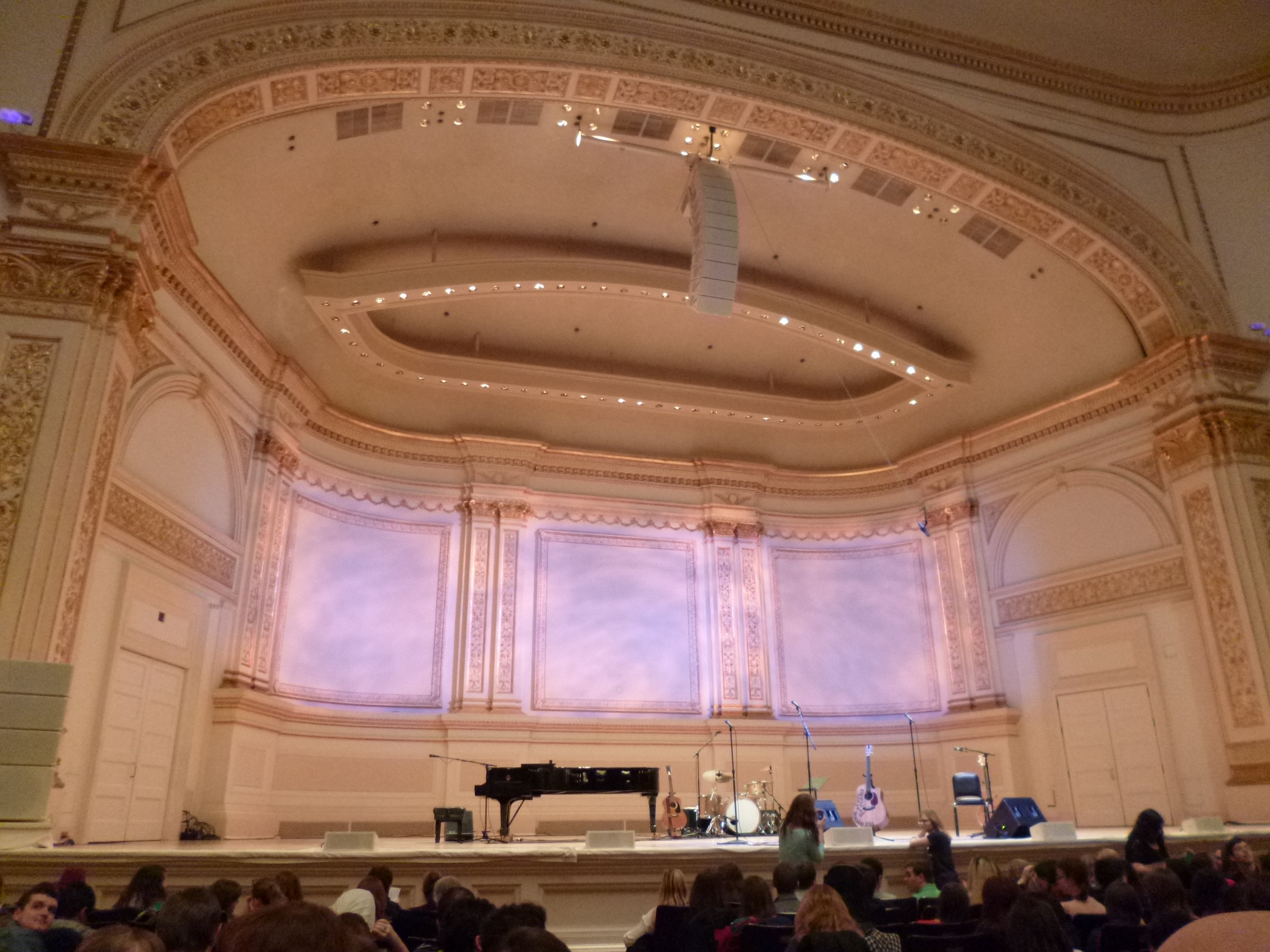
Carnegie Hall – the sound in here is pretty amazing.
I’ve been avidly following The Lizzie Bennet Diaries for a long time now and I got my husband watching the series too. Through Lizzie Bennet he got hooked on the vlogbrothers, read Looking For Alaska, and then promptly bought us two tickets to An Evening of Awesome on the day they went on sale.
I am very pleased with what I have wrought.
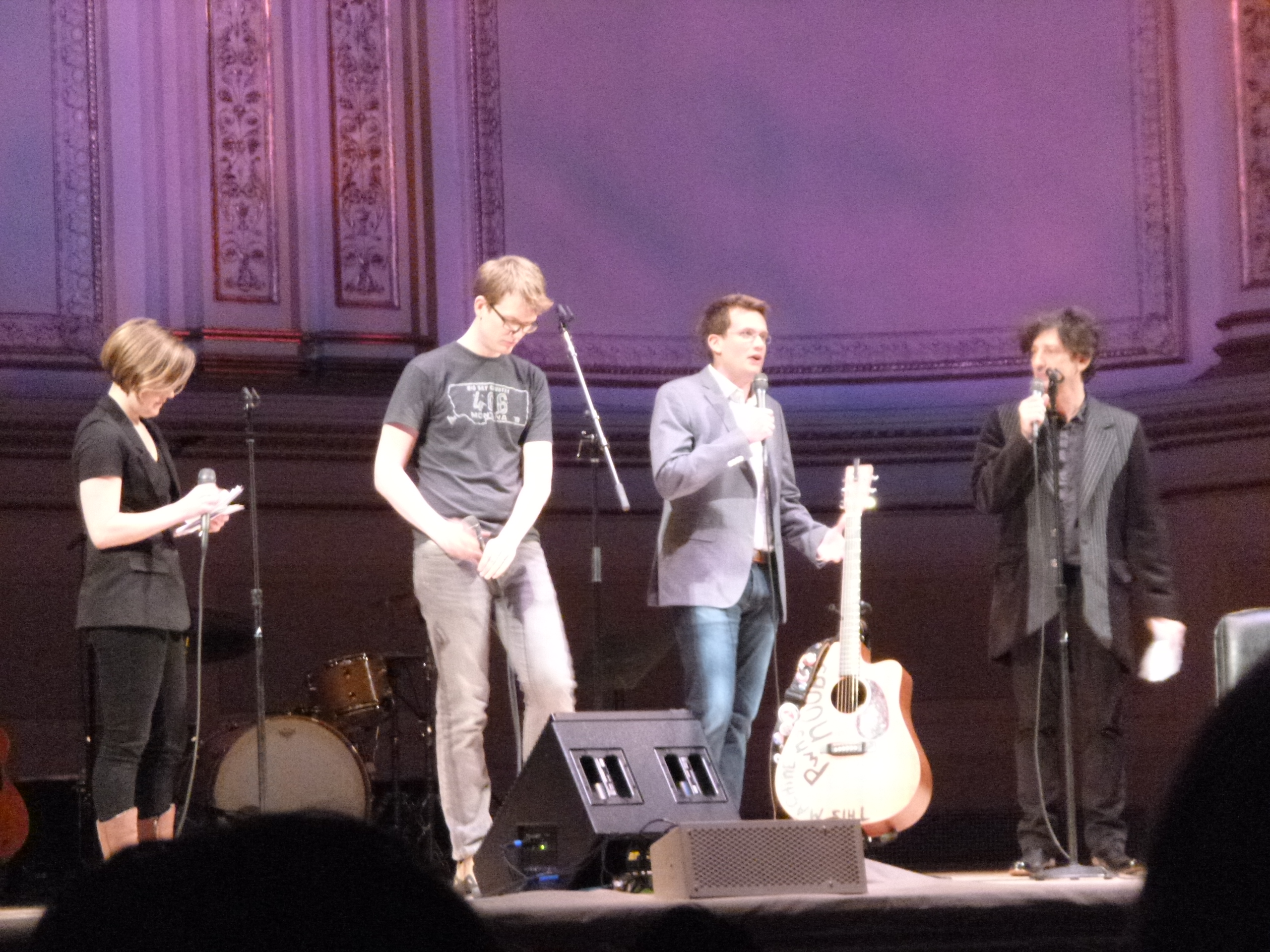
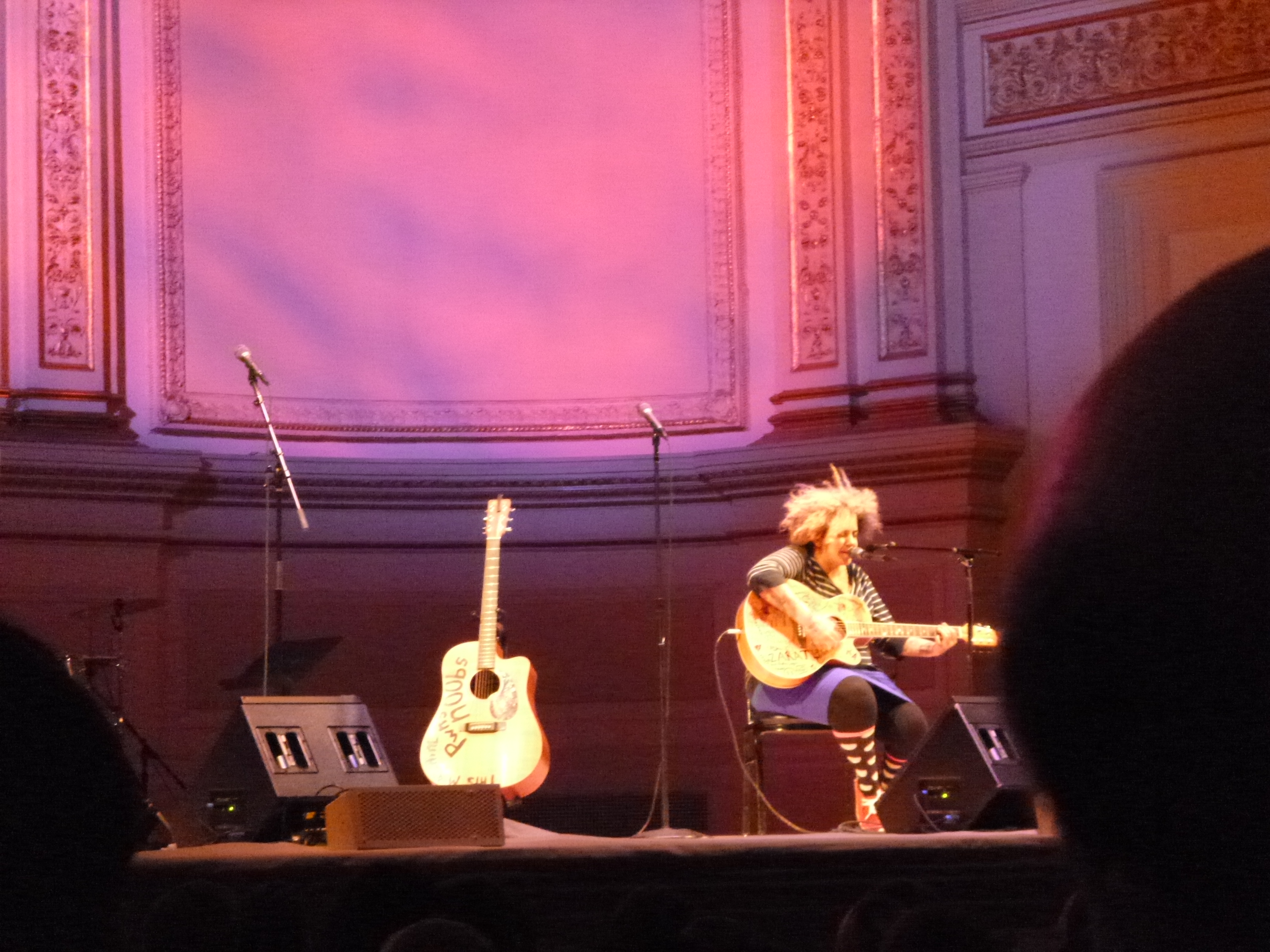
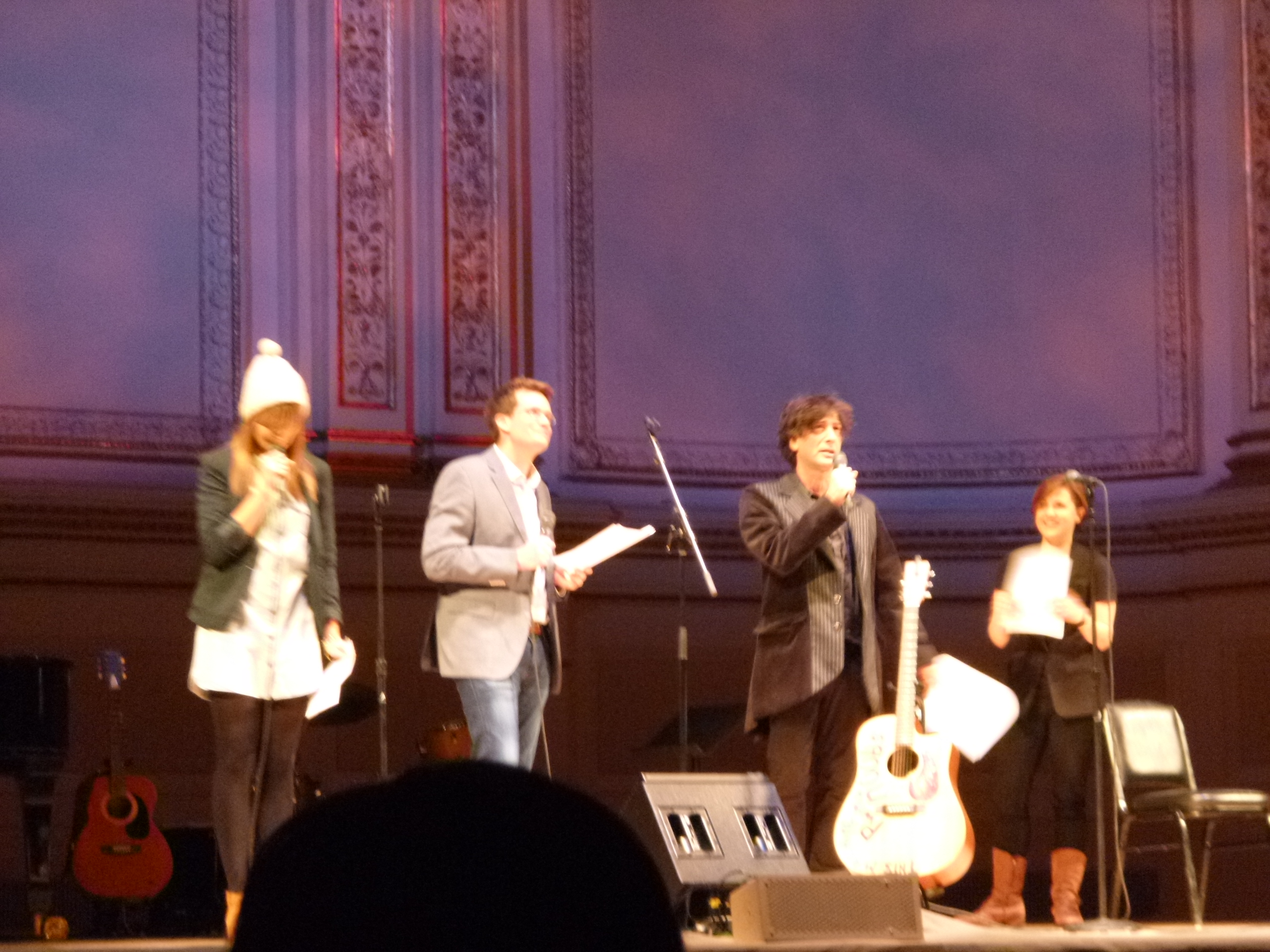
We had some nice seats (row K in the main pavilion), and we both had a lovely time. I took a lot of pictures, but the low light, no flash rule, and distance with my little camera made for a lot of blurry shots. I still got a couple of nice ones though, so I’m going to post them here.
Ashley Clements and Daniel Gordh (who play Lizzie and Darcy in The Lizzie Bennet Diaries), reading from The Fault In Our Stars
Hank Green sings
The Mountain Goats sing
John and Hank Green answering questions rapid-fire from Hannah Hart and NEIL GAIMAN
Kimya Dawson sings
Grace Helbig, John Green, Neil Gaiman and Hannah Hart read from Paper Towns
Good-bye dancing
Yay! So was this evening awesome? Yes. Very geeky in a good way: different, overlapping kinds of geekery in a big fun show. 🙂
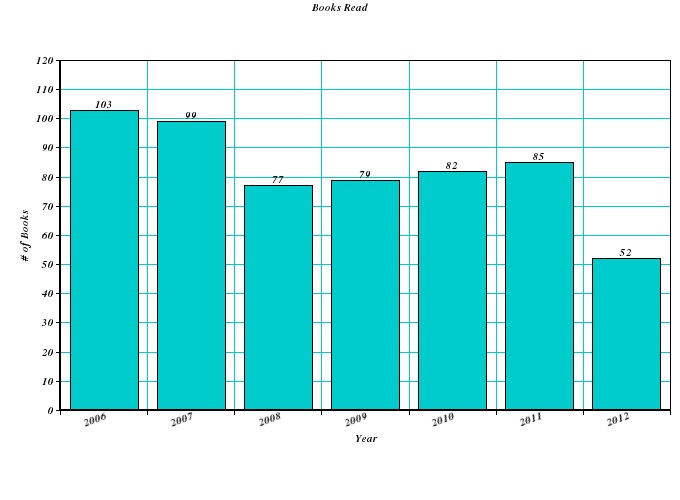
I had just as many books on my favorites list this year as in previous years, but 2012 wasn’t what I’d call a stellar year in reading quantity. I read 52 books, which is low for me Here is a visual aid (click to embiggen):
Upward trajectory halted! But that’s OK. Over 50 is pretty good when I think back and remember what 2012 was like.
Here are my excuses:
Rampant TV watching. I know, but I can’t help it. Last year Spring-Summer was all cycling and the Olympics, Fall was rediscovering Friends, and Winter involved little Holiday movie addiction I have. I’ll try to get some help, but we just bought a snazzier, fancier, bigger TV recently. Wish me luck for 2013.
Job. This is a valid reason and the biggest one – long meetings held at night really did a number on my free time and my reading routines. I was also very busy in general.
A certain ennui brought on by excuses 1 and 2 and by all the drama that went on in the middle of 2012 (I think that took up some head space because it made book blogging less of a “happy place” it used to be for me. I’m beyond that now though).
I still haven’t figured out how to be faster at writing reviews. If anything, it takes me longer. Reviewer time management fail. It’s a work in progress.
NOW:
Well it’s 2013, I have a brand new job. I think the big problem I had last year with work hours and personal time won’t be such an issue in this one. So far it is looking good, but we shall see. And I had a really nice long break in December between jobs in which I did NOTHING. I have no regrets about that because it means I feel a lot more invigorated about reading and reviewing now.
The goals for this year are.. well maybe “general idea” rather than goals, but here’s what I’m thinking:
Keep going for 100 books read per year
Work on SERIES reading. I have a lot of series I am very behind on but I have all the books. I think I’m going to maybe start getting on reading those things.
Finish up those reviews I’m behind on from last year
Oh, so those reviews I need to do. This is the list below. I have a few to write and I was thinking if people gave me the puppy-dog eyes about certain books, I’ll probably work on those first. Anything take your fancy? Let me know!
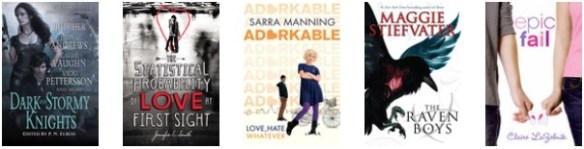
Heart’s Blood by Juliet Marillier Gunmetal Magic by Ilona Andrews Ashes of Honor by Seanan McGuire Polymer by Sally Rogers-Davidson Yours to Keep by Shannon Stacey Epic Fail by Claire LaZebnik The Raven Boys by Maggie Stiefvater Adorkable by Sarra Manning Dark and Stormy Nights anthology Seeing Me Naked by Liza Palmer
Last year was a busy time work-wise. Over the past couple of weeks it’s been a bit quiet over here as I took some time off, but I think things will be better now that things have settled down for the new year and I‘ve had a breather. This is a long overdue review!
My copy of Fairy Tales from the Brothers Grimm was provided to me for review from the publisher.
The Premise: The Grimm Brothers’ Kinder-und Hausmärchen (Children’s and Household Tales), which we know today as Grimm’s Fairy Tales, is a collection of 210 stories first published in 1812. Now, 200 years later, Phillip Pullman retells a subset of these – 50 fairy tales which he calls “the cream” of the collection.
My Thoughts: Philip Pullman is known for His Dark Materials and other books (like the Sally Lockhart mysteries) so I thought that maybe his retelling of Grimm’s Fairy Tales would mean creative reinterpretations of the stories. I was a bit surprised, but also relieved, that these retellings are straightforward and keep the original stories intact. In his introduction, Pullman writes:
“[…] my main interest has always been in how the tales worked as stories. All I set out to do in this book was tell the best and most interesting of them, clearing out of the way anything that would prevent them from running freely. I didn’t want to put them in modern settings, or produce personal interpretations or compose poetic variations on the originals; I just wanted to produce a version that was as clear as water. “
So there you have it. Fairy Tales from the Brothers Grimm is exactly as the subtitle to this book, A New English Version, suggests: 50 stories told in a clear manner. This makes it a little harder for me to review because these stories are true to the originals, and you can’t really review a classic fairy tale – they just are. So instead the focus of this review is going to be how they were presented. To tell you the truth, I found very little to complain about.
Pullman’s selections are good ones. He chose a lot of old and familiar stories, like Little Red Riding Hood, Rumpelstiltskin, and Hansel and Gretel, but he also selects some that are less well-known like The Girl with No Hands and Hans-my-Hedgehog. There are also stories that I had personally never heard of at all, like The Singing Bone and The Donkey Cabbage. I also felt like there was some thought that went into where the stories were placed in the compilation, with stories that were of a similar sort of type grouped together, but not so much that you had too much of one kind of thing. For example, some of the more pious stories were near one another, at least enough for me to see a theme, but they weren’t all in the same place, and The Juniper Tree was close enough to Snow White for me to notice the similarity of children with lips as red as blood and skin as white as snow, even if Pullman doesn’t really mention the link.
At the end of each of the stories, Pullman devotes a couple of paragraphs for notes and observations. This is probably my favorite thing about the collection. When I was growing up, I remember going to the library and reading a lot of fairy tales, but I approached them as a reader. Pullman does this too, commenting on whether a story works and his take on holes in the stories (like characters that were mentioned once and then we never find out what happened to them). I could completely relate to this, and had the same reaction to many of the things Pullman points out (it feels very good to be on the same page as Philip Pullman). But Pullman also approaches the stories from a more scholarly standpoint. From his notes, I could gather that he read the original editions of the Grimm books, as well as later ones, commenting on the translation of the German into English, and how a mother in an earlier version became a step-mother in a later one. He also prefaces each note with the ATU number of each of the stories, the source, and a list of similar stories. It was fascinating to learn some tidbits about these stories through those notes, and the people who passed these stories along to the Grimm’s. I was also a little fascinated by the glimpse of a system for cataloging these fairy tales (I’d never heard of ATU types before this).
Because of the shortness of the stories, reading is hardly a chore. Anytime I sat down with Fairy Tales from the Brothers Grimm I would gulp down several stories. This book is perfect for picking up whenever the mood strikes to sink into a story, knowing that you can also set it aside quickly after a story or two.
Here are some of the highlights for me in this collection:
The Mouse, the Bird and the Sausage – A trio of unlikely friends live harmoniously together until one day the seed for discord is planted in their midst. This was equally hilarious (in most part due to the sausage) and horrifying. I greatly enjoyed Pullman’s notes where he informs the reader that the sausage was a bratwurst.
The Girl with No Hands – One of the stories where piety is rewarded, a miller makes a deal with the Devil where he signs away his daughter in the bargain. Because his daughter is so Good she escapes the trap and lives happily ever after. My reaction to this story was that it is ridiculous. Pullman calls it “disgusting”, and his notes say, “The most repellent aspect is the cowardice of the miller, which goes quite unpunished. The tone of never-shaken piety is nauseating, and the restoration of the poor woman’s hands simply preposterous.” I agree. The mental image of a despondent girl eating fruit with no hands haunts me somewhat.
Strong Hans – This story starts off telling the tale of a woman and her son (Hans) being kidnapped by bandits, but then ends up being the tale of Hans, who grows up strong, sets out to have adventures and rescues a princess. It struck me as one of those odd stories that begins one way, starts to look like something else, then ends up a third thing entirely. Basically, I agreed with Pullman that this story was all over the place. Things were introduced but then never utilized, which feels typical of fairy tales, but even more so here.
The Juniper Tree – This is a lyrical story about an evil step-mother who does a macabre deed but in return is driven to the point of madness as she gets her just desserts. This story struck me as being particularly well-written, and because of this it was one of my favorites. Pullman notes that it was sent to the Grimm brothers by Philip Otto Runge. I loved The Fisherman and his Wife, which was also sent in by Runge and has a similar well-put-together story style. Again I found myself nodding along with Pullman’s notes where he says, “For beauty, for horror, for perfection of form, this story has no equal.”
The Three Snake Leaves – This one I liked for its weirdness. It has a princess who has a “strange obsession” – that if she dies before her husband, he must be willing to be buried alive with her. Except this princess turns out not to be as loyal as she wants her husband to be. This was a new-to-me story, and delightfully bizarre. Pullman makes an interesting observation about the number of pieces a snake is cut into in this story that I would have missed without his note.
Overall: This feels like the perfect gift book for someone who likes fairy tales. It is a well-curated subset of the Grimm’s stories, and the notes by Pullman at the end of each adds just the right amount of perspective. This felt like it would work equally well as a reference book for someone who collects fairy tales, or as an introduction to folk tales for a young reader. I enjoyed this collection a lot. It’s definitely going onto my keeper shelf.
Other reviews: Charlotte’s Library – “Reading Pullman’s retellings was like coming home to find the walls of my house repainted–fresh and bright and like new again, with the added bonus of some new rooms that I’d never been in before” The Book Smugglers – 8 (truly excellent)
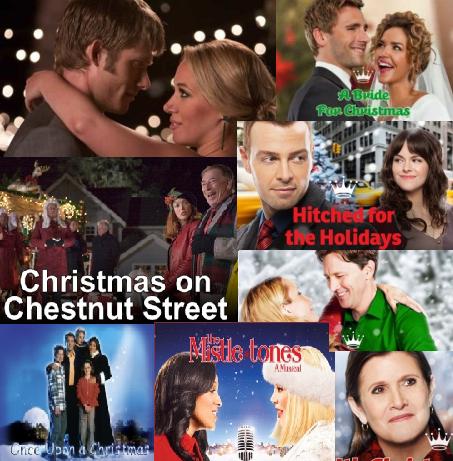
In case you wondered if I was a giant dork, but you weren’t ENTIRELY sure, I reveal the proof in my guest post over at Alyssa’s blog, Books Take You Places, with a post entirely devoted to my November-to-December addiction: made-for-TV Christmas movies. They are my ultimate in guilty (but not really that guilty) pleasures.
My post is devoted to 10 holiday movies I’ve seen so far. Let it be said that I could have easily written about 10 more. Very easily. Something about this time of year makes me positively gleeful about my TV watching options and what’s going to be on on Lifetime, ABC Family, and the Hallmark Channel.
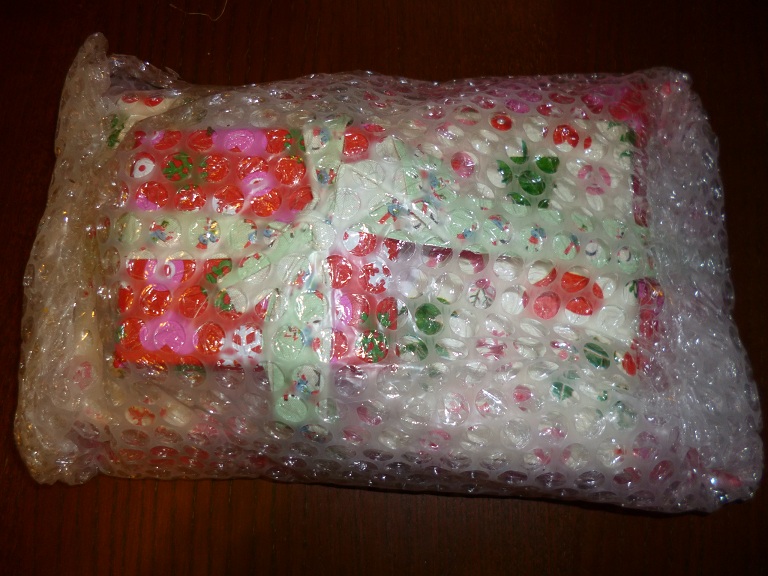
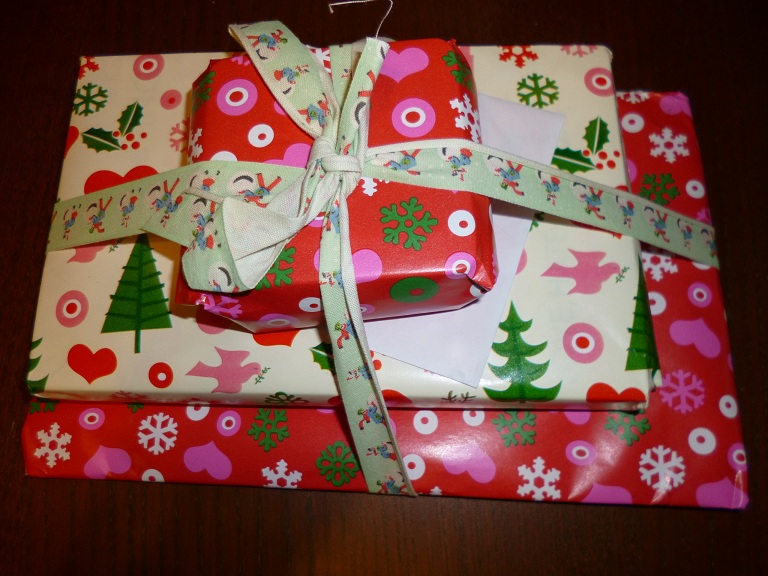
There was a little YAckers Secret Santa this year and I just got my package today. I was thrilled by the thoughtful packaging – double bubblewrap and individually wrapped presents. This was so much fun to open!
Just look at that presentation.
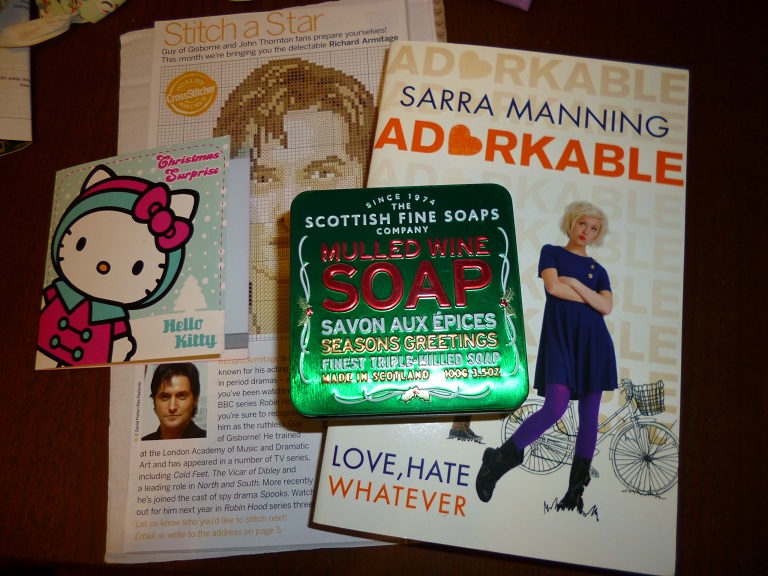
Here’s what was inside:
Scottish Mulled Wine soap (smells AMAZING)
Adorkable by Sarra Manning (this made me very happy!)
CROSS-STITCH pattern of Richard Armitage!!! I could make a little pillow with his face on it. Why hello, best thing ever.
It’s almost the end of another year, but this means that it is also time for another Smugglivus celebration over at The Book Smugglers. I am guest posting again with my top five reads of 2012 and my most highly anticipated of 2013. Please head on over to check out my picks. On the list are: one urban fantasy, one romantic comedy, and three young adult books (historical, contemporary Gothic, and fantasy). 🙂
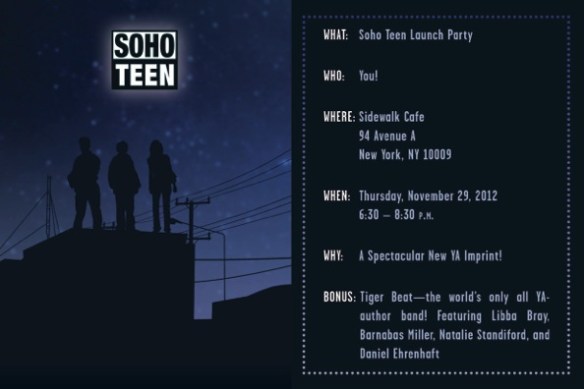
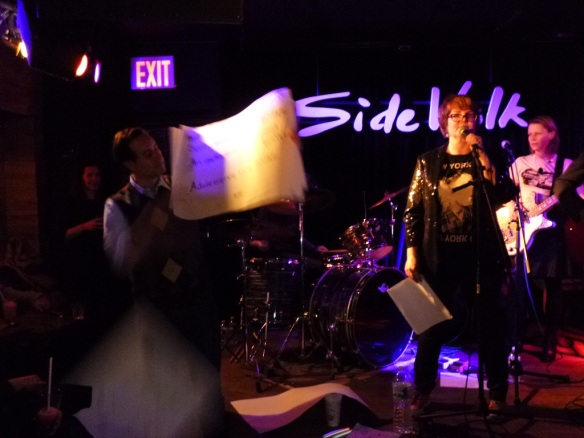
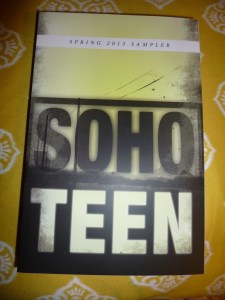
Last night was the Soho Teen Launch Party. Soho Teen is a new imprint from Soho Press, and it looks like it has some exciting new books coming out. I was invited via my YAcker buddy Nicole from Word for Teens (and I also got to meet her for the first time). The place was packed with people. A little overwhelming, but I still had a nice time. Highlight was seeing Libba Bray rock it with her band Tiger Beat (especially when she sang YA song, accompanied by David Levithan holding up placards with the lyrics on them). I had a hard time getting non-blurry pictures because of the lighting, and I may have been laughing… there are videos of this song on youtube if you want to hear it.
Also picked up a sampler of what’s coming out in 2013.
In an unprecedented vote, the YAckers unanimously chose Jepp, Who Defied the Stars for this month’s pick. To see how we all eventually reacted once we read Jepp, you can check out our chat here.
The Premise: This is the story of young dwarf Jepp, who grew up in Astraveld, a crossroads between the Spanish Netherlands and the Protestant North. Loved by his mother, who runs a bustling inn, Jepp is treated like a prince and is fiercely protected. It is a good life, but when he is fifteen years old, a man comes by the inn, offering to bring Jepp to the court of the Infanta Isabella Clara Eugenia and her husband, Archduke Albert of Austria. Eager to see the world beyond the narrow one he knows, Jepp agrees. He has always held a dream of one day meeting his father and he believes that the man offering to take him away is part of his fate. This begins Jepp’s journey away from childhood and all its innocence and into the big world, where perhaps he can
My Thoughts: Before reading Jepp, Who Defied the Stars, I didn’t really know what this book was about or what category of young adult it belonged to. I actually thought Jepp was YA fantasy at first because it begins at a inn at a crossroads (familiar Fantasy territory). I soon figured out that I was reading historical fiction when Jepp says he lives in the Spanish Netherlands and mentions the Infanta Isabella, its sovereign from 1598 to 1621. There’s an author’s note at the end of the book that explains the real life people and events that inspired Jepp, (which is fascinating and worth reading), and basically Jepp did exist, but little is known about his life. Marsh took the question of who Jepp was and extrapolated that into this story. Jepp is divided into three “Books”, and each “Book” seems to correspond to a change in scenery and a new direction in Jepp’s life.
Book I begins while Jepp still lives in his mother’s domain, but not for long. A man named Don Diego comes to the inn and invites him to he court of the Infanta Isabella, and that’s where Jepp stays for this part of the story. Jepp is still rather innocent and unsure of himself so he is mostly an observer, doing what he is bid by the others around him. We get Jepp’s impressions of the specially designed rooms for the court dwarfs, the gardens where they arranged themselves in a tableau for the Infanta’s pleasure, and the performances where he has to play the fool for a few laughs. As for the people at court, Jepp focus is narrow: Don Diego; the other dwarfs, Sebastian, Lia, and Maria; the court jester Pim, who arranges the entertainment; and Hendrika, the mistress who oversees them. These people are the ones he interacts with most, and everyone else is hazy and not so well-defined.
Despite Jepp’s faithful descriptions, there’s the sense that there’s a certain naivety in what Jepp observes. He sees things that trouble him, but does not fully comprehend them until later. He dislikes his treatment at the palace, but doesn’t immediately see the same misery in others. His youth is part of the story, but I found some of this innocent observation and floating along very passive. Basically, Jepp wasn’t really doing anything, and this didn’t make him easy for me to connect to. The only goal he seemed to have was to one day find out the identity of his father, but there seems no way of doing so away from his mother, and so I felt like there wasn’t much of a direction to the story. Sometimes there are other things that saves a story for me in this situation, like a romance I could sink my teeth into, but even here, Jepp disappoints. He thinks he’s in love, but he barely knows the girl. When things do finally pick up, it is instigated by a situation someone else is in, and Jepp is pulled into it by his sweet nature and wanting to help. Of course this changes his life, and propels his fate along in a way he doesn’t expect.
There’s some drama as the story segues into Book II, but the story stalls for a second time as Jepp repeats what he’s done before: letting things happen to him, and observing rather than doing. The eccentricities of his surroundings is where the entertainment lies, not in Jepp’s own actions. Of course Jepp, Who Defied the Stars gets better – Jepp does start to take his fate into his own hands, if you will, and it’s nice that when I think back now, I see how Book I is reflected in Book II, but with an older and wiser Jepp, one who begins to take part in his own life – but reading was a slow process (I’m sorry to report that I kept putting the book down and sighing for at least the first half). The last third of the book (Book III) ended up being the best third for me, but it takes some patience to get there. The change in Jepp from passive to active removes a lot of the issues I had with reading, and with his relationships with other characters.
Jepp, Who Defied the Stars essentially becomes a story about fate versus free will, but this isn’t a clear message for me until the author’s notes at the end. I liked Marsh’s own personal relationship with this theme that she described in the addendum, but I’m not sure if the idea that Jepp was fighting against some fate was really something I picked up on while reading this story. I think the history itself was a little bit more interesting. Despite being set in the past, this story does a good job of keeping the focus on Jepp’s personal experiences rather than on History. However, Jepp’s voice has a formality to it that is a deliberate reflection of the time (Marsh notes she was careful to choose words in use before 1600 when writing Jepp), and the language contributed to feeling like I couldn’t comfortably sink into the story.
Overall: I have a sort of “middle ground” reaction to Jepp. I wasn’t wowed while I was reading it, and Jepp’s passivity and the formality of his narration made me feel impatient with the story. On the other hand, I can see that these were deliberate choices in the writing because of the theme of “fate versus free will” and because of the time period that Jepp is set. I think my visceral response usually determines how I feel about a story and for much of this book, I felt like I was plodding along, but when I think about it analytically, it comes off much better. So: this may be more for the “thinkers” than it is for the “feelers”.
Other reviews: The Book Smugglers – 7 (Very Good) The Book Harbinger – positive (“it wasn’t only the engaging history but also the character of Jepp himself which drew me in from the start.”) Word for Teens – DNF Book Nut – “Overall, it’s a bit uneven” but also, “found it to be a wonderful bit of historical fiction”
(Also may I say, this book was BEAUTIFULLY designed? I loved how the inner pages were NAVY with pretty endpages and chapter headings, and the cover had shiny bits on a matte background, silver font, and those stars. Gorgeous.)
We had a healthy number of entries for this one, but random.org picked lucky entrant #5, and that was Opal. Congratulations, Opal! I’ve sent along your information to the publisher. Enjoy your book.















 specficromantic