The Magicians by Lev Grossman

The Magicians
Lev Grossman
This is a book that has been on my radar for a couple of years. Actually, ever since I noticed a friend reading it. I’ve known this friend for over 15 years, so I trust his opinion and he was pretty enthusiastic about The Magicians. When Penguin contacted me about possibly reading The Magicians and The Magician King, I checked back with that friend, who was just as enthusiastic and had pre-ordered the second book.  That was good enough for me, and off I went to email Penguin with a “yes, please”.
 
The Premise: Quentin Coldwater is a mopey but brilliant seventeen year old, preparing to enter some Ivy League school and already a little depressed by how predictable his prosperous life is going to be. To escape, he obsesses over a series of children’s books, Fillory and Further, about five British children who cross over to a magical world called Fillory.  Then one day, Quentin crosses over himself – but not to Fillory. Instead he is on the grounds of Brakebills College of Magical Pedagogy, somewhere in upstate New York. So begins Quentin’s new life – one in which magic exists.
 
Read an excerpt of The Magicians here
 
My Thoughts: Quentin is a teen-aged “ridiculously brilliant” overachiever with a melancholy air, who lives in Brooklyn with his parents. His life seems set until an incident at a college interview derails him from his expected path and sends him wandering into the grounds of a school for magic, where Quentin is one of twenty students selected for the new freshman class. Suddenly, delightfully, everything Quentin knew has been turned on its head. Magic is real, but it’s also extremely difficult to do – requiring not only talent but the right circumstances and tedious repetitive study. But obsessive Quentin, a person who enjoys practicing a thing until he has a perfect grasp of it, and who rereads his favorite series of books, Fillory and Further every chance he gets, it is the perfect fit. So too are the other students, just as smart as Quentin and just as  dissatisfied, if not more, by the world they inhabit. Magic seems like just the right thing for these kids. Quentin finds himself happy for the first time in his life, and easily leaves his parents and old friends behind to spend as much time as Brakebills as possible.
 
The first 200 pages are a sugar high of the strange and unexpected, taking us through a series of vignettes that highlight the years at Brakebills. It was a lot of fun living vicariously through Quentin’s experiences – from the exam that he passes to get into school to the semester in fourth year that involves a never-talked-about rite of passage. This went by at a happy reading clip, but there are glimpses of a dark underbelly throughout the first pages, like a disturbing death at the school and ominous comments about whether humans were ever supposed to know magic.  Then I hit the midway point of the book, which is the start of Book II – after graduation from Brakebills. The sense of wonder and amusement that Quentin had becoming acquainted with Brakebills seems sucked away by the idea of trying to find a goal in life, and Quentin returns to that aimless unhappy state again. He and his friends have it all – youth, endless money, magic, and no responsibilities, but for the most part they act like over-privileged, miserable, jackasses. I felt a cold lump of disappointment in the characters, and I wasn’t sure I could continue. And I remembered that my friend’s favorite Harry Potter was my least favorite, because of the angst (Order of the Phoenix by the way). But a new distraction appears – the existence of Fillory and the possibility of actually getting to it.  The second half of the book brings the story back up from its downward trajectory, but with the reader and Quentin both wiser about the flaws in his character and the real danger of magic.
 
Throughout the book, the writing is absorbing. Even when things were dismal, they were dismal because the story had me so involved in the characters. And the story has the habit of taking unexpected little detours along the way to telling the whole story that I was always entertained. Many of these turned out to be important later on, but a lot of it seemed like the strange detail that makes up the world of magic. And what’s also fun about it is how much of the story references other books. Since this is a story in which a unhappy boy stumbles into a world that coexists with ours, but has real magic, Harry Potter is the first place the mind goes, which probably explains the “Harry Potter with college students” one-line summary, but that’s the most obvious comparision.  I saw more allusions to the Narnia series than Harry Potter, but it seems to nod at a lot of classic children’s fantasy books. Besides Narnia, I thought I saw whiffs of Alice In Wonderland, The Once And Future King, and Peter Pan, and I’m sure, many more. But this is not really a children’s book – it takes the warm memories of childhood that those books represent and then wipes away the innocence.
 
The Magicians is marketed under “fiction” but I think it crosses genre boundaries. It could be considered contemporary or urban fantasy, but with a literary, non-escapist feel. Sometimes I felt like it could be a candidate for the Horror shelves. I wouldn’t call it young adult (although Quentin is seventeen when the story begins), or New Adult Literature (although it spans Quentin’s years at college).  The portrayal of human nature in this tale makes it feel more “adult”.
 
Overall: This is a tough one. I’ve been telling everyone my personal reaction, which was: blown away by the beginning, dismayed by the middle, and a mixture of those two by the end, but I think The Magicians is a book where I’d find it hard to call who is going to like it and who won’t. I think most people will find this book really well-written and unique, and if you are a reader who enjoyed books where a child protagonist discovered real magic when you were growing up, you’ll appreciate all the allusions The Magicians makes to those stories. But! Along with the sense of wonder and amusement, there is also a very dark undertow, and this is not a comforting read.
 
P.S. Since Brakebills is mentioned as being on the Hudson, somewhere in the Poughkeepsie-West Point area (an area I know), I’ve been obsessing over its exact (theoretical) location this past week.
 
Buy: Amazon | Powell’s | The Book Depository
 
Other reviews:
bogormen – 4/5
Fantasy Cafe – 8/10
Stefan Raets for Tor.com – positive
fashion_piranha – 3.5 out of 5 stars
temporaryworlds – 3 stars (out of 5)
 
Interesting Links:
A Brief Guide to the Hidden Allusions in The Magicians by Lev Grossman

Winners and tumblr and timesucks

cuteoverload.com

The random number generator at random.org has spoken. Congratulations to the winners of last weeks giveaways:

Lobo won Shut Out (an international winner!)

and

Sabrina won Naamah’s Blessing

The giveaway of the Relic Master series is still ongoing.

In the meantime, I seem to be slacking on the reviewing this week because uh.. well besides being addicted to the USA channels summer lineup (White Collar, Covert Affairs, Necessary Roughness, I’m watching it all. Also Eureka started again, and PBS has an excellent show called Zen..), I started a tumblr last week and my god, I start browsing over there and 6 hours later I look up and it’s dark outside!  My id there is NOT janicu, it is specficromantic (someone else grabbed janicu and is just sitting on it. My best friend thinks I have a nemesis, which is hilarious). Anyway, I’m still getting used to it. The way to communicate on there is weird to me.

I also have a google+ account. Which is “Eh, alright”. I like it better than facebook.

Also – livejournal is mostly down this week. I am not sure I can even cross post over there today. I’ll try. For people following me on LJ who are sick of LJ: this blog is mirrored on wordpress. Feel free to update your RSS feeds to wordpress.

Love Story by Jennifer Echols

Love Story
Jennifer Echols
This is a review of an ARC copy I got in a contemporary romance spending spree (won from the author at a charity auction).
 
The Premise: Erin grew up in a wealthy environment. She was raised by her grandmother who wanted Erin to major in business so she could take over the family’s racehorse farm one day. When Erin decides instead to follow her dream of being a writer, she’s summarily cut off. Hunter Allen, the son of the stable hand is given Erin’s inheritance and her tuition, while Erin has to work her way through school. Knowing that Hunter will be going to the same New York university is on Erin’s mind, and so for her first assignment in her honors creative writing class she writes a romance between a horse farm heiress and a stable boy. She’s mortified when Hunter joins her class at the last minute and reads her story.  Then he writes his own story, “responding” to hers.  Thus begins a game where the two begin to communicate to one another through their class assignments.
 
My Thoughts: I loved the premise of the story. It seemed like this was a “boy and girl act like they hate each other but they really like each other” story. What I ended up getting in Love Story was much more complicated than that. I like complexity and depth in my stories, but something here didn’t quite work and I’m having trouble saying what it was. I’m writing this review as I’m sorting through what that missed connection was.
 
First of all, I am not sure if it was my expectations getting in the way, but I found Erin and Hunter’s interactions a little strange from the get go. When Erin’s story is presented to the creative writing class Erin expects Hunter to make fun of her, but instead she can tell that Hunter is angry and hiding it from the class. His reason for this anger? That either she’s making fun of him, an idea he quickly dismisses since she wouldn’t know he was going to be in her class, or that she must have liked him in middle and high school, but still let the kids there call him her “stable boy”.  It wasn’t easy to follow the jump from secret crush to ‘if you liked me you have should have stopped other kids from making fun of me’ (I’m paraphrasing here) and then actually being angry about this, but I held on. Similarly, Erin’s response to that is that if Hunter can come up with only two explanations for her story, then he is oversimplifying her and this is to make things easier for him to steal her entire life. Another wild jump that I found difficult to follow, and again, I accepted it and continued on.
 
So I moved on, but I think these hang-ups that Erin and Hunter had about each other clouded the story quite a bit. On one hand I think that we’re seeing the obstacles between Erin and Hunter and the baggage each has from their past, and this baggage must be overcome for them to be together, but on the other hand, I don’t really know about their past history. When they react to each other, as a reader without the history to draw on and having to infer it based on what’s being said, it’s difficult. I don’t have a clue why Erin didn’t talk to Hunter throughout their school years or why Erin is so convinced that Hunter is stealing her life rather than being angry with her grandmother for giving it to him. So when I read their conversations, there’s several times where I’m not sure if the logic is off or I’m just not following a jump the characters have made because of their past history.
 
I much preferred their relationship when it is not overshadowed by the past. Their tentative relationship that stems from their belonging to the same circle of friends and live in the same dorm is much easier to follow. Everyone else is forming new relationships so when Erin and Hunter aren’t alone, but surrounded by Jørdis, Summer, Manohar, and Brian, things flowed extremely well.  The setting of New York City and dorm life was extremely vivid and believable, and in this setting and restricted to reacting to the present (at least amongst their friends), I liked how things were moving along. Hunter and Erin circle one another within their group of friends, and communicate as if they’re across enemy lines. One of the ways they communicate is through their class assignments and once it becomes known amongst a select few that Hunter and Erin knew each other growing up, their little skirmishes gets an audience that sometimes noses it’s way in.
 
When Hunter and Erin finally seem to hit a truce, I had high hopes. It seemed like these two were finally admitting their feelings for each other to one another and that they were communicating this. Then one last obstacle gets in the way. Suddenly the story that I thought was ending very satisfactorily was going down the tubes. I think that what aggravated me most about this final misunderstanding and how the main couple acted was the believability factor.  I just couldn’t believe how Erin would react the way she did when it jeopardized what she said over and over was her fervent goal. The drama soured the end of the story for me, and it left me with a feeling of disconnect from the relationship. I wish the book continued a little further past the point it stopped so I could move on from the sour taste, but it does not.
 
Overall: I feel like I went on a journey with this book. I started with high expectations, had a bit of a bumpy ride while reading it for various reasons, started to love the ending, then did not love the ending. I wanted to love this story and there are many things I liked about it including excellent sense of place (both in New York City and on the horse farm), and an extremely readable writing style, but in the end there were too many things that left me with my feathers ruffled.
 
Buy: Amazon | Powell’s | The Book Depository
 
Other reviews:
christina_reads – rocky start, ended up enjoying it
chachic’s book nook – didn’t fall in love with it
the reading date – 3.5 out of 5 stars
La Femme Readers – 4 out of 5 flowers

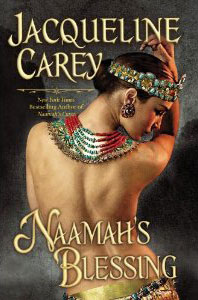
Naamah’s Blessing by Jacqueline Carey

Naamah's Blessing
Jacqueline Carey
I won a copy of this book at the last readathon I did (Dewey’s 24 hour readathon) plus got a copy (unsolicited) from the publisher. [Psst! Since I was sent two copies of this book, I’m giving the unread one away this week!] Naamah’s Blessingis the third book of this trilogy.
 
Book 1: Naamah’s Kiss  https://i0.wp.com/i58.photobucket.com/albums/g254/jayamei2/livejournal_com.gifhttps://i0.wp.com/i58.photobucket.com/albums/g254/jayamei2/wordpress.jpg
Book 2: Naamah’s Curse  https://i0.wp.com/i58.photobucket.com/albums/g254/jayamei2/livejournal_com.gifhttps://i0.wp.com/i58.photobucket.com/albums/g254/jayamei2/wordpress.jpg
 
***** This review contains spoilers for the earlier two books *****
 
 
The Premise: Moirin mac Fainche has returned to Terre D’Ange from her adventures in the far away lands of the East. She’s found and brought back her lover (now husband) Bao, but while she was away. Moirin’s beloved Jehanne de Courcel, the D’Angeline queen has passed away, leaving a grief stricken king and a very young daughter. The city of Elua is left without an attentive king, and Desirée, Jehanne’s child is a lonely, isolated little girl. In the meantime, Prince Thierry has left on an expedition to Terra Nova for exploration and glory, and hasn’t returned. Moirin sees Jehanne in her dreams, again tasking her with a Destiny. Things have come around full circle and this time Moirin must fix a disaster of her own making. For when Moirin was younger she naively used her powers granted by the Maghuin Dhonn to further the ambitions of Raphael de Mereliot and the Circle of Shalomon. It has consequences Moirin never imagined, but Moirin must make things right.
 
My Thoughts: Like it’s two predecessors, Naamah’s Blessing is not a short story (this one clocks in at 610 pages), but for its length the story is very readable. I was grateful that the first couple of chapters are ones where Moirin looks back over her adventures, and whenever her past touches on the present, the relationship is summarized. I have a pretty decent memory of what happened in Naamah’s Kiss and Naamah’s Curse but it was nice to have my memory gently jogged without it becoming an info dump.
 
I felt like Naamah’s Blessing was easing me back into the story, which was good. After all that Moirin has been through, especially in the last book, it was nice for this one to begin back in familiar territory, not with Moirin discovering new people and traveling somewhere on an arduous journey (not that that doesn’t happen, but it happens later).  It was nice to see how Elua has changed since Moirin has been away, but more importantly how Moirin has changed. She has an idea of how to comport herself and what people expect of her, and most importantly she is now wiser about how her actions have consequences. If she wants to help certain people, (particularly the king and princess Desirée), Moirin has to take care.  There’s some court intrigue and machinations in Naamah’s Blessing, but Moirin is not so naive that she is unaware of them, and I loved reading about this less oblivious Moirin who wisely seeks advice on what to do about the problems she sees. Moirin’s maturity is a big part of what made this a very good third installment in my eyes.
 
Moirin’s character may be less naive, but she still keeps her open personality and her faith in her gods. As always she consults her diadh-anam which she has as a worshipper of the Maghuin Dhonn, as well as the signals of Naamah, the Bright Lady. Although Moirin wants to stay in Elua and protect Desirée from the ambitions of others and the grief-caused neglect of her father, her diadh-anam calls her away. Compounding that are dream visions of Jehanne that tell Moirin news about Prince Thierry. As before, Moirin follows as the gods will it.
 
Naamah’s Blessing has two distinctive parts followed by an epilogue. The first would be in Terre D’Ange and second, Terra Nova, where the Nuhautl Empire and the Quechua kingdom reside. Both parts of the story are tied together by Moirin’s task to fix things in Terre D’Ange and to fix the disaster she created in her youth. There are (as there always is in these books), fascinating new people and places where Moirin encounters new cultures. I enjoy reading of the lush new worlds Moirin discovers and about the new peoples. One big theme seemed to be “sacrifice” as the people of Terra Nova worship bloodthirsty gods in ways that the D’Angelines and Aragonians find barbaric. As the story progresses, Moirin learns to appreciate the idea of sacrifice being the price to pay to make things right.
 
I really like the epic nature of this series and the world building is fascinating. I liked how Moirin’s religion and the religion and cultures of the people she meets are a big part of the story and how the world is an alternative fantasy version of our own. Particularly tickling – having the D’Angelines alter the course of history by innoculating the natives of the Nuhautl Empire from a disease brought over by the Aragonians. But I have some minor problems with the story as well. I’ve commented on this in previous reviews –  on one hand it is just part of Moirin’s character to be so faithful, but on the other I never really felt like there was any danger of Moirin making a tragic choice because she just has to follow the path set for her. The only difficulty is getting others to follow along with what the gods have told her.  Another problem I had was that although minor characters from the first book return and are more fully fleshed (Balthazar Shahrizai and former King’s poet Lianne Tremain in particular), some felt less so. Bao, Moirin’s husband was one. I don’t know what it is but I couldn’t connect with him.  I had the same problem in Naamah’s Curse because he wasn’t in the story very much. Now that he is, he’s still not really there. I found him a cardboard “perfect husband for Moirin”. The other character I had problems connecting with was Raphael de Mereliot, who was completely unrecognizable in this story. There was no satisfying reason for it other than to have him fit an archetypical role, and I was disappointed that there wasn’t more. I think that for the length of the story, I’d like to have seen more in depth characterizations of these two.
 
That said, this still was my favorite installment of the series. I liked how Moirin’s story was wrapped up in a satisfying way that brought everything full circle and I really liked the growth of Moirin’s character over the three books and how that affected the story. I closed this one without feeling disappointed.
 
Overall: Probably the strongest installment in this epic fantasy series, Naamah’s Blessing concludes the adventures of Moirin mac Fainche with one last journey across the world. Moirin has learned and become a more mature heroine, and I liked her the better for it. Except for minor complaints about secondary characters in this story and the reliance on deus ex machina, I found this one satisfying.
 
Buy: Amazon | Powell’s | The Book Depository
 
Other reviews:
The Discriminating Fangirl – 5 stars (out of 5)
Fantasy Book Critic – A++
Dear Author – B (I feel like this is the review I most agree with)

Shut Out by Kody Keplinger

Shut Out
Kody Keplinger
The DUFF is one of my favorite reads of this year; I loved the real and unvarnished voice of the main character, a teen distracting herself from her problems by having a physical relationship. When I found out that Kody Keplinger had another book in the works, based on Aristophanes’ play, Lysistrata, I mentally put it on my list as a book to look for in the fall.  But I didn’t have to wait that long – Shut Out was one of the offerings at BEA. Yep, I was so there. This is an early review of an ARC copy. This book doesn’t come out till September but I am planning a giveaway of my extra copy in a day or two!
 
The Premise: (taken from the back blurb) “Most high school sports teams have rivalries with other schools. At Hamilton High, it’s a civil war: the football team versus the soccer team. And for her part, Lissa is sick of it. Her quarterback boyfriend, Randy, is always ditching her for go pick a fight with the soccer team or to prank their locker room. And on three separate occasions Randy’s car has been egged while he and Lissa were inside, making out. She is done competing with a bunch of sweaty boys for her own boyfriend’s attention.
Lissa decides to end the rivalry once and for all: She and the other players’ girlfriends go on a hookup strike. The boys won’t get any action from them until the football and soccer teams make peace. What they don’t count on is a new sort of rivalry: an impossible girls-against-boys showdown that hinges on who will cave to their libidos first. And Lissa never sees her own sexual tension with the leader of the boys, Cash Sterling, coming.”
 
My Thoughts: What I liked about The DUFF was that its main character felt like a real teenager, and I was glad to see that the same is true about Shut Out. Lissa Daniels is a normal girl with a fairly typical life. She lives with her father, a counselor at an elementary school, and with her older bother, Logan . She’s a good student, has a steady boyfriend who fits in with her family, and she works at the local library as a part time job. Fairly normal stuff, except for losing her mother a few years ago in the same car crash that left her father in a wheelchair.
 
Then there’s dealing with her boyfriend’s obsession with the feud between the football and soccer teams at her high school. From Lissa’s point of view (a view shared by many), the feud is pointless; the teams belong to the same school, and hardly any of the boys can remember why they are fighting.  When Lissa tells her boyfriend Randy to stop before someone gets hurt, Randy doesn’t take her seriously. He is oblivious that Lissa’s problem with the feud has to do with how it affects their relationship, and Lissa finds it difficult to articulate her feelings. As it is, he brushes off her repeated requests to stop. That’s when Lissa gets fed up and organizes the hookup strike with girlfriends of players on both sides of the fighting.
 
This is where things begin to get interesting. The boys are in an uproar, and relationships weaken, particularly Lissa and Randy’s. The boys begin to band together against the girls. Suddenly it’s a war of the sexes.
 
Amongst the fallout, the strike opens up a dialog, particularly amongst the girls. It becomes an opportunity for the girls to get closer and to talk to each other about sex.  I loved that the girlfriends – all very different from one another, had a chance to air out individual experiences and hear from the rest of the group. Things like what the “normal” level of intimacy is, using sex to manipulate people, and what the line is with what they’re doing. What I particularly liked was that the realization that there is no such thing as normal. I found that the message that everyone goes through feeling inadequate just because they don’t think they conform to an idealized normal, is a similar message that was in The DUFF. The DUFF just focused on the appearance side of the message, and Shut Out focuses on experience. This is a positive message, and I think it’s great that Shut Out speaks frankly about sex and teens, but  the “lessons” about sex also lent the story a very obvious moralistic slant, and there are a lot of these lessons. Lissa talks through sexual rights and wrongs with other characters on several occasions.
 
I’m far from being a teen so these messages do little for me now, but I think I’d have liked to read a book like this when I was in my early teens. The only small issue I really had was about one of Lissa’s friends who has a cavalier sexual lifestyle. I didn’t think much of it until she explains it as a need to have some control in her life after her dad moving out (but doesn’t want anyone to psychoanalyze her). Maybe the message was not to judge people for their private decisions, but it didn’t The DUFF illustrate what a bad idea it is to deal with your problems this way? The contradiction bugged me.
 
Anyway, on to the romance in this story, which was big subplot. While Lissa and Randy’s relationship falters, her relationship with Cash Sterling becomes stronger. Not only does Cash now work at the library with Lissa, but it’s revealed that they have a little bit of a back story. Things being as they are, there are a lot more opportunities for these two to be thrown together, and of course sparks fly. It’s a bit of a love triangle, but not really. I think the story makes things very clear cut so Lissa can’t be accused of cheating. Without going into it, it becomes very obvious who the right person for her is, while at the same time not making anyone a cardboard villain without any redeeming features. I understood the qualities that drew Lissa to the guy she doesn’t end up with.
 
Lissa’s role as the leader also gives the story an opportunity to touch on sex as a weapon. Lissa begins to get very caught up in the “war” and goes a little overboard in her “attack”, so there’s a scene that covers teasing and when the term is used unfairly and when the term really applies. Excellent scene, although the response of the guy involved felt a little unreal for a teen-aged guy, it was great to see how mixed up and emotionally invested the whole thing is making Lissa. I really liked how Lissa’s progression from going too far to figuring out the right thing to do went, although I did feel like the final smoothing over of misunderstandings between Lissa and her chosen guy was missing something, which was an apology from Lissa for how she acted.  I didn’t see that and it left me with a nagging feeling when I got to the end.
 
Overall: Like The DUFF, Shut Out is a very real, very readable young adult story that doesn’t shy away from the topic of sex and teens. While I think that this is a book that has a lot of great messages, it’s more obvious than The DUFF as a Topic Book. I sometimes I felt like it tries to cover too much in what it tackles: I’d have preferred that it stuck to one or two important points and left the rest for some other story. But even with its agenda, Shut Out is still an engaging story. Lissa was an easy-to-relate-to narrator, the story was well-written, and the romance was a sweet one. I didn’t love this one like I loved The DUFF, but I liked it.
 
Shut Out comes out in September.
 
Buy: Amazon | Powell’s | The Book Depository
 
Other reviews:
It’s a little early yet.
Hounded by Kevin Hearne

Hounded
Kevin Hearne
The Iron Druid Chronicles have been on my radar since Chelle’s cover feature on them. Nice covers, but want to shave that soul patch thingy. Anyway, when I found a copy of Hounded for sale at my library’s sale area, I grabbed it.
 
The Premise: Atticus O’Sullivan is a two thousand year old Druid, but he looks anything but. In fact he looks like a young twenty-something kid and that’s the way he likes it. No one suspects that the young occult bookshop owner in Tempe, Arizona, is hiding from the Old Ones.  A god named Aenghus Óg holds a grudge against Atticus because of a magic sword, and has been searching for him for hundreds of years. Whenever Atticus feels Aenghus get close, he usually moves, but this time Atticus is tired of running. Arizona is home turf, and a good place as any to take a stand against a god who is hellbent on destroying him. Atticus has made preparations and allies, but even so, it’s impossible to guess what tricks his longtime enemy may have up his sleeves.
 
Read an excerpt (the first 6 chapters) of Hounded here
 
My Thoughts:  Atticus O’Sullivan has been laying low for centuries, and he’s good at it. He’s over two thousands years old and the last living Druid. His latest residence is in Tempe, Arizona, which is as far from those hunting for him as possible, and blessedly low on gods and the Fae. Of course, given time, his enemies find him yet again, forcing Atticus to decide to run or make a stand. The sword Aenghus Óg is after is a big prize, and Atticus is visited by other gods and creatures with a stake in the outcome of the upcoming battle and who muddy the waters on who to trust.
 
Despite all that hangs over his head, this is a fun main character. Atticus narrates with a keen awareness of the humor in almost every situation.  It’s a constant source of amusement and an inside joke with the reader that he’s older than everyone he knows, including the local paranormals (a coven of witches and a pack of werewolves), while he pretends to be a “young-Irish-lad” (he hasn’t survived this long by being incautious). Helping to maintain this sense of humor is Atticus’ beloved Irish Wolfhound Oberon, with whom Atticus can speak to mind to mind. I love a dog sidekick (one of my favorite tropes), and the relationship between Atticus and Oberon is quite amusing and heartwarming. Here’s a sample mind-to-mind conversation between the two (Atticus is in italics, Oberon in <angled brackets>):
 

[…] I don’t trust witches.
<You think she’s going to try something? Should I move behind her?>
No, she knows you’re here. She can see through the camouflage. But I think she’s hiding something from me, and I’m waiting for the other shoe to drop.
<When did she drop the first shoe? I missed it.>
Never mind. Just listen. Once she drinks the tea, she will try to surprise me with something. She is waiting for the contract to be fully in effect before she says anything.
<Well, then give her back the check and send her packing! We don’t need to play her witch’s games. They always want to get you and your little dog, too.>
I knew I never should have let you watch The Wizard of Oz.
<Toto didn’t deserve that kind of trauma. He was so tiny.>

 
As the conversation shows, the humor in Hounded has a lot of pop culture references (but not obscure ones). This is big part of the humor in the book, as well as a sort of “foiling the bad guys is fun” schtick. What I mean by this is that Atticus goes though these trials and tribulations but you always end up feeling like he’s going to come out of it relatively unscathed, a “Phew, still alive” grin on his face. If I were to compare it to anything, I’d say that Atticus is like the urban fantasy version of Michael Westen from Burn Notice (if Michael Westen was a kick-ass Druid undercover as a twenty-one year old). It’s hard to believe that anyone is going to get the best of him. He’s so paranoid and he’s seen it all, plus he has his backup. Hounded has of several attempts by Atticus’ enemy to box him in, but Atticus survives because he plans ahead and thinks on his feet. And he has friends who will help him bury the bodies. After a reading string of darker urban fantasy, it was nice to sit back and just enjoy Atticus handling the latest debacle, which runs the gamut from goddesses to giants, getting knocked down in the process, but rallying pretty quickly (thanks to his Druid powers).
 
Being a Druid is a pretty nice gig, particularly when it’s combined with Atticus’ accumulated knowledge. He’s figured out how to stay young for an extremely long time and how to ward off most attacking spells without selling his soul. Part of the world building in the story is explaining what being a Druid entails, but the other part is describing the supernatural world Atticus is aware of. In this series, all pantheons exist at the same time. It isn’t directly explained, but I understood the existence of deities and other mythical creatures to be a result of human belief. If an idea is worshiped by enough people, it will exist. This means that there may even be different versions of the same god (Thor is an example), in existence at the same time. There’s a mix of supernatural creatures and ideologies, but in Hounded the pantheon Atticus mostly deals with is from his own Irish upbringing. As for the setting, I have a lot of family who live in Arizona and Hearne captures the Tempe area like a true Arizona native. It was well done and made me look forward to my next visit (and also eager to check out some of the places referenced in the book).
 
I don’t think Hounded really sets out to be serious, so when I think of my one complaint about the story (that I wish that there were deeper relationships between the characters), I’m not really sure I can make that complaint really stick. There are plenty of side characters, but hiding his past and his power is Atticus’ modus operandi. So far, the deepest relationship is the one between Atticus and Oberon, and I wish there was more than that, but the events in Hounded may have created an opportunity for relationship development in later books.
 
Overall: Hounded is a refreshingly lighthearted urban fantasy. I liked the mix of action and improvisation, presented by a narrator who appreciates the comedy of pretending to be innocuous while being much, much older and more powerful than he appears. It made me smile often, which is quite a nice pick-me-up, and I’m looking forward to enjoying the next one.
 
Buy: Amazon | Powell’s | The Book Depository
 
Other reviews:
My Favourite Books – positive
Karissa’s Reading Review – 5 out of 5
The Book Pushers – B
Star Metal Oak – positive
Ticket to Anywhere – positive

Enclave by Ann Aguirre

Enclave
Ann Aguirre

Ann Aguirre is one of my favorite authors, particularly for her Sirantha Jax series, which is a science fiction romance. I’ve been eagerly awaiting Enclave since I first heard that Aguirre would be trying her hand at YA dystopia. This is the first installment of the Razorland series.

The Premise: In the enclave, children have numbers, not names, unless they live till their fifteenth birthday. Then they’re given a naming ceremony and a place as a Breeder, Builder, or Hunter in the society. Deuce (formerly Girl15), has just been named and given a spot amongst the Hunters – an honor she’s been training for as long as she can remember. Now she can leave the enclave, and bring her people food, and she can protect them from the Freaks – creatures that live in the tunnels that would like nothing more than to feast on human flesh. All her life, Deuce has only known a world that is underground, where the oldest is in his early 20s, and where people don’t live for more than that. It’s a world with very little, but it’s the only world Deuce has ever known. Deuce is partnered with Fade, the only Hunter who wasn’t born in their enclave. Fade has never really fit into the enclave, but he’s the best fighter they have, and Deuce is eager to prove herself worthy of being assigned to him. But being a Hunter brings a different perspective to all that Deuce knows. During their patrols Deuce and Fade encounter Freaks with more organization and intelligence than the norm. When their warnings about this eerie Freak behavior are ignored or suppressed, Deuce begins to question the leadership of the enclave.

Read an excerpt of Enclave here

My Thoughts: Enclave is basically three parts. At first the focus is narrow. The story revolves around Deuce’s small sphere and all that is familiar to her. When Deuce begins to think beyond the small borders of the enclave, the spotlight expands. She discovers where her partner, Fade originally came from. The last part expands the world even further beyond that.

For the size of this book, a lot happens. I liked that the story manages to blend in action, a gritty world, and a budding friendship into the story, and I think this is what made the beginning of Enclave particularly strong for me. When Deuce’s narrative begins, we’re introduced to the daily life of a semi-primitive tribal culture. It has three basic roles (Hunter, Breeder, Builder), a leadership structure based on age (over twenty makes you an elder, as this is a very small group), and a painful initiation ritual into “adulthood” (cuts made on the arms that are seared closed by hot metal).  Deuce knows only the limited scope of this enclave, which is in the Underground. Only after she becomes a Hunter and assigned a partner can she see what’s outside her home. It’s not clear what the year is or what has happened to make the world it is in Enclave, but there are enough hints to say that it is our world that has been hit by some apocalyptic event that has reduced the world to rubble and society into small tribes like the enclave, and created monsters like the Freaks.

Because Deuce is a Hunter, that brings plenty of action and the story goes at a fast clip. Deuce is eager to prove her mettle, but she is also learning about Fade and about her the Underground. The action adds drama to the story, but the plot moves along because of Deuce’s path of discovery. Fade isn’t very talkative but as time goes on Deuce begins to trust him, and she knows he doesn’t like the current leadership. Their relationship evolves through time and trials, but Fade keeps a lot close to his chest. What he does tell her, Deuce has trouble believing, but she begins to question. She debates the need for rules and leadership, against inhumane punishments to keep the enclave in line. A leadership that keeps tight control is particularly dangerous when there is important information being suppressed.

But before anything really happens in the enclave, the story changes gears. Fade and Deuce move on together, away from what Deuce is familiar. Deuce continues to learn about her world, and along the way other teen characters are introduced. The shift is a little abrupt for me and left some dangling threads. I think as a series it’s more interesting for Deuce and Fade to travel outside the enclave, but the way this story was presented, it felt like some set up was abandoned. As a result, the second half of the book felt like a restart. Again a new setting and new characters are introduced to us, but thankfully Fade and Deuce stay constant. On the other hand, with new characters introduced late in the story, I didn’t feel like there was much time to get to know them.

There’s a hint of a love triangle with Fade, Deuce, and one of the new characters as well, but it is an odd choice. One of the things I like about Aguirre’s writing is the darkness she brings into her stories. Sometimes this is in the form of dark heroes – people who have done unlikeable things in their pasts but who I still root for. In Enclave the darkness is primarily in the world building, but it’s also in Fade’s past and Deuce’s choices for self-preservation. However, in the potential love triangle, I found the third person VERY unlikeable and a better choice as a villain than a romantic interest. Depending on what happens with this character, it could either be a show stopper or a deal breaker in a later book. I have my fingers crossed.

Overall: My reaction is that I was entertained. Aguirre’s writing keeps me interested in what’s going on and there’s enough darkness in this story to add depth, but the concepts themselves feel familiar. The underground setting after a post-apocalyptic event, the humanoid creatures craving human flesh, and society broken down and ignorant of the past are familiar tropes. But this series has a lot of potential. I think the slowly evolving relationship between Deuce and Fade and their fighting partnership is what has me hooked. I also suspect that now that the world has been established, the characters will have more room to grow. I would actually want to read the second book, and there’s are a lot of other YA dystopian series I’ve started where I couldn’t say the same.

Buy: Amazon | Powell’s | The Book Depository

Other reviews:
Steph Su Reads – didn’t like this one
Babbling about Books and More – B-
Scooper Speaks – very positive
See Michelle Read – positive
Fantastic Book Review – 4.5 out of 5

Sharing the Awesome Awards – Day 2: The Characters


Here we go, Day 2 of the Sharing the Awesome awards hosted @ inkcrush is all about the characters.  (P.S. This is a fairly open and relaxed set of awards. I don’t see a deadline, nor any real rules other than whatever books you choose for your awards be books you read this year. I urge you to join in on the fun if you’re thinking about it)!  🙂

1. Best female POV – Bianca Piper from The Duff for sounding like a real teenager. Sarcastic, smart, and a little buttkicked by Life (but learning how to deal with it).

2. Best male POV – Eugenides from The Thief by Megan Whalen Turner. I really loved the first person point of view of this book. Just the right bit of cheeky. A close runner up was R from Warm Bodies by Isaac Marion.

3. Best couple ❤ – After all my obsessing over Grace and Vaughn from Unsticky, it really would be strange not to see them win this one from me, wouldn’t it? Yes, they win. I love this couple for being individually quite dysfunctional, but together, quite amazing.

4. Who i so want to be best friends with – Hmm, this is one that took some thought. There are a lot of tough, cool ladies, but I think my choice is going to be Cat from Cold Magic, who can be counted on when someone she loves is in trouble.  A very important trait in a friend.

5. Who I fell completely in love with (new literary crush) – Oh please. Eugenides of course.

6. Worst (best) villain – the villain from Double Cross by Carolyn Crane. To tell you more may spoil it.

7. Best character twist (who you loved then hated or vice versa) -See above.

8. Best kick-arse female – Irene from The Queen of Attolia. An overlooked, underestimated female who seizes power and rules with a will of iron? Shiver me timbers.

9. Best kick-arse male – For his sheer crazysauce and preternatural fighting skills (never wearing any kind of armor), this goes to Whirrun of Bligh, also known as Cracknut, a secondary character in Joe Abercrombie’s The Heroes. In the beta male category, this goes  Eldric (from Chime by Franny Billingsley) who kicks butt for saying something when Briony is wrong (like when she says she’d be better if she was someone else), and for also recognizing (and regretting) when he’s an idiot.

10. Broke your heart the most – I would have to say Rowan Mackenzie from Spellcast by Barbara Ashford. He broke it in a way it needed to be broken though. It felt right. I know that sounds strange, but it makes sense, really.

11. Best/worst character names – Best character name is a toss-up. It’s either Atticus O’Sullivan from Hounded by Kevin Hearne (Atticus is a great name), or Dreadnought Stanton from The Native Star by M.K. Hobson. DREADNOUGHT! Love it.

As for Worst character name.. sigh, I’m afraid I have to go with Deuce from Enclave by Ann Aguirre.  I like it within the context of the book, but it does not have the best colloquial meaning.