The Broken Kingdoms by N. K. Jemisin

The Broken Kingdoms
N. K. Jemisin

I enjoyed A Hundred Thousand Kingdoms so much that I specifically asked Orbit for a copy of The Broken Kingdoms. You may be able to read this book without reading the first book, The Hundred Thousand Kingdoms, but if you want to read these books in order, skip this review because there may be minor spoilers for the first story.
Go check out my review of The Hundred Thousand Kingdoms here: https://i0.wp.com/i58.photobucket.com/albums/g254/jayamei2/livejournal_com.gifhttps://i0.wp.com/i58.photobucket.com/albums/g254/jayamei2/wordpress.jpg

The Premise:
It’s been 10 years since the events of the first book, when the palace of Sky was transformed and the universe was changed forever. Oree Shoth, is a blind woman who moved to Sky (now called Shadow), from the small Maroneh village of Nimaro. She spends her days selling her art in Art Row and enjoying the magic of the city, which is everywhere now that godlings roam the streets (Shadow is the only place they’re allowed). The abundance of magic is particularly beneficial for Oree because she can see it — it’s the only time she is not blind. One day she finds a strange, homeless man and takes him in. This silent man, who she names Shiny, seems human enough (despite his general arrogance), except for an odd ability to come back to life every time he dies. That is, until Oree finds a murdered godling in Shadow. Other bodies begin to turn up, and Shiny is somehow tied in with this string of horrific deaths.

Read an excerpt of The Broken Kingdoms: Chapter 1, Chapter 2, Chapter 3

My Thoughts: You could read this book without reading the first book, but I think some of the background information regarding The Three (the first three gods and creators of the known universe), may be a little hard to follow. The information is there, but because Oree is the narrator, and she is a commoner, she knows little about what really happened 10 years ago; only that the Order of the Light has suddenly allowed the worship of gods beyond Itempas. She finds out more as the story goes along, but if you haven’t read The Hundred Thousand Kingdoms, you need to wait for Oree to catch up, and if you have read The Hundred Thousand Kingdoms, you’ll have more knowledge than she does about the shift in power, why godlings roam the streets, and who ‘Shiny’ really is.

Although the reader has an edge over Oree about the general back story, Oree introduces us to what’s happened to the streets of Sky (now Shadow), since then. The most significant change is of course the godlings. Oree explains:
” I am, you see, a woman plagued by gods.
It was worse once. Sometimes it felt as if they were everywhere: underfoot, overhead, peering around corners and lurking under bushes.  They left glowing footprints on the sidewalks (I could see they had their own favorite paths for sightseeing.) They urinated on the white walls. […] Sometimes they followed me home and made me breakfast. Sometimes they tried to kill me. Occasionally they bought my trinkets and statues, though for what purpose I can’t fathom. And yes, sometimes I loved them.”

Oree seems to be a magnet for gods (or godlings as they are sometimes called), and because she finds Shiny in a muckbin, her life changes. He’s a silent and arrogant jerk, but they work out an amicable living arrangement and life goes on at first. Until Oree discovers a godling in an alley, her heart cut out. There’s a big uproar – immortal creatures aren’t supposed to be murdered like this, and this draws unwanted attention on her by the Order. Shiny is upset, chaos ensues, and Oree shows up on the radar of people she really doesn’t want noticing her – the murderers.

In this series so far, the protagonists have been mortal females thrust into events caused by gods. In the first book, what I remember being the big theme was that of revenge. Revenge on many different levels:  between the gods and humans, and even in Yiene’s heart, revenge was a driving force. In Oree’s story, she feels the echos of what happened ten years ago, but the story feels like it’s more of a murder mystery (who are killing godlings and why?) and about taking the first few steps to move on from the past, than it is about revenge. So, while there are some commonalities between the books, I found them very different. Oree and Yiene share a relatively pragmatic point of view, at least compared to that of the gods, and are both caught in the general maelstrom created by them, but they aren’t the same person and this isn’t the same story. I found Oree a little more innocent than Yiene regarding her knowledge of politics, but more intuitive about people. She also was raised Maroneh, and was a follower of Itempas, with a healthy fear of the Night Lord, which is a different religious background as Yiene. It was interesting to see how their perceptions of the Three were different.

I also found myself believing more in her relationship with the gods than I could believe in Yiene’s relationships with them. I think that there’s three reasons why – the relationships were developed over time, they developed in ways I believed, and I found these gods not beyond the reach of mere humans. Part of the equalizing in the relationships was who Oree was, part of it was who the gods were, part of it seeing how being immortal made the gods almost immature compared those with an expiry date, and part of it was seeing how these gods were not all-seeing and knowing – they had no idea who the killer was or how they were killing. (By the way, I know I am saying relationships, but I want to point out that this is still a fantasy and not a romance and the relationships are not like romance relationships.)

In many ways, I think I found The Broken Kingdoms better than The Hundred Thousand Kingdoms. I think that the gods were more relatable and less powerfully alien than the last book and it made the story work better in terms of my disbelief in their relationships with the narrator, and I liked how thoughtfully the story brought us forward in time ten years from the last book. There were a few cameos of characters from the first book and it was really fascinating to see them through Oree’s perceptions (pretty much all my favorites showed up). It’s also really differently paced – I was really turning the pages with The Hundred Thousand Kingdoms because treachery and death seemed to be around the corner of every page, and it is that way from the get go, but while murder and conspiracy is compelling too, The Broken Kingdoms took more time to get us there, so it took me longer to really get into the story (maybe fifty pages in), but I didn’t mind this difference – I knew it would get there.

Overall: I’m really enjoying this fantasy series. It’s entertaining and thoughtful, I really like the (female! POC!) narrators, and I love (love, love) the world building with it’s pantheon of flawed gods and the consequences of those flaws. The Broken Kingdoms adds more dimension to a fascinating world, and I’m rather sad that this is supposed to be just a trilogy, but I’m happy these books exist. Cannot WAIT for book 3.

(I am gleeful to hear the author has a new series coming out in 2012)

Buy: Amazon | Powell’s | The Book Depository

Other reviews:
Fantasy Cafe – 9/10 (I had a really similar reaction to hers)
Gossamer Obsessions – A+
Babbling about Books, and More – DNF (I think she has a valid point about storytelling style. It’s probably a style more seen in fantasy and worked for me, but may not be for everyone)
Dear Author – B
Fantasy Book Critic – A+
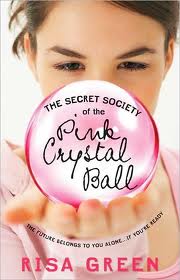
The Secret Society of the Pink Crystal Ball by Risa Green (w Giveaway!)

Book Girl of Mur-y-Castell did a review of this book a while ago and I filed it in my mind as a rather sweet, fun book to look out for. When I was offered the book for review, I was quick to say yes. 

The Premise: Erin Channing is a tenth-grader with the “most boring, normal, regular life ever”, until her aunt Kiki dies and leaves her a pink plastic ball with a set of cryptic instructions. Erin doesn’t believe in magic. She’s known as an “inside the box” thinker, but her two best friends, Lindsay and Samantha convince her to try the ball, and when it seems to actually get results, it begins to change Erin’s outlook.

My Thoughts: I liked Erin. She’s a good kid — that girl in school who works hard and listens to teachers. She follows the rules and has the highest GPA in tenth grade. But because she doesn’t really have any interests outside of school and doesn’t have any quirky traits, she considers herself boring. So boring, in fact, that she worries she has nothing interesting to say in her essay to apply for a coveted position for a school sponsored trip to Italy. And she really, really wants to go to Italy.  Two things stand in her way – the essay, and making sure she gets at least an A- in the class.

Writing the essay is something Erin obsesses over, but she can’t think of anything interesting to say. She’s well aware of her “in the box”, “follow the rules” persona, but she doesn’t know how to get out of it, but her aunt’s death and the Pink Crystal Ball is a start. Her friends are the ones who push her into even trying it, and pointing out that she needs to expand her horizons. In the meantime, the A- grade in her AP Art History class also depends on her end of year project which is worth one third of her final grade. Unfortunately, she gets partnered with Jesse Cooper, the last person in class she wants to work with. Jesse used to be a close friend, until his father died at the end of eight grade. Suddenly, the guy who was her first kiss stopped talking to her and started dressing like an art school punk kid, leaving Erin wondering: “What happened?” and what Jesse’s neutral expressions and his offhand comments mean. It’s clear that she’s not exactly over the crush she had on him.

The story is full of thoughtful layers. Although Erin, Lindsay and Samantha seem to fit a particular mold at first (Erin is the brainy one, Lindsay is the nice one, and Samantha is the cool one), they aren’t cardboard characters.  Each of them has their own lives and problems, which Erin explains as the story progresses. Lindsay has a bully at school, and her father has begun dating a young, twenty-something girl. To escape, she spends her money on new-age, metaphysical objects like voodoo dolls and crystals. Samantha is chasing after Aiden, a boy who can’t stand her, and her parents are always fighting.  She may be the beautiful and cool rebel, but when coming home at 3am gets noticed by the Portuguese housekeeper, not her parents, you know there’s something wrong there. But these girls aren’t in their own personal bubble. They play off each other and affect one another”s lives.  The dynamics of their friendships is laid out throughout the story, and the reader is catches glimpses of how well they know each other:  when Lindsay is upset she’s known to take it out on whoever is nearby, Erin can’t stand disappointing authority, and Samantha knows how to get the girls to follow her lead.

This attention to detail extended to the plot. With a magic ball, the story could have become something that conveniently took shortcuts and relied on suspension of disbelief, but it doesn’t. There are always consequences or reasons for what happens.  The main focus of course is on Erin’s problems, and on how the pink plastic ball from her dead aunt begins to affect her life, but she is loyal to her best friends and tries to help them. These leads to consequences that the girls don’t expect. I liked that this story eventually led to some growth for everyone, rather than the it being just a entertaining romp involving magic. The ending left us with the possibility of a continuation, perhaps from Samantha’s point of view, and I’d love to find out what happens next.

Overall: Before reading this book, I think I had expectations that matched the cover – a story that’s young, a little girly, cute and fun. You know: a Disney movie aimed at teens with three best friends who discuss boys and do somewhat silly things and then work together to fix some problem. This book takes that formula but produces something with much more depth. I thought I would like this book, but I ended up being very pleasantly surprised by how much I liked it when I was done. It left me feeling much like I felt about Polly Shulman’s Enthusiasm: like I’d read something sweet but not fluff.

Buy: Amazon | Powell’s | The Book Depository

Other reviews:
Book Girl of Mur-y-Castell – 3.75
(please let me know if you’ve reviewed this and I’ll add it to my list)

GIVEAWAY:
I have ONE extra copy of this book to giveaway (generously sent to me by a publicist). For a chance to win it:

1. Email janicu[at]gmail[dot]com with the subject PINK CRYSTAL BALL GIVEAWAY, and with “please enter me” or something like that, and that should be it.
2. One email per person please.
3. This giveaway is INTERNATIONAL
4. This contest ends midnight EST December 9th.
— that’s three days from now!

Scott Pilgrim graphic novels (Volumes 1 to 6) by Bryan Lee O’Malley

Over the weekend I’ve been reading all 6 volumes of the Scott Pilgrim graphic novels:

1. Scott Pilgrim’s Precious Little Life
2. Scott Pilgrim vs. The World
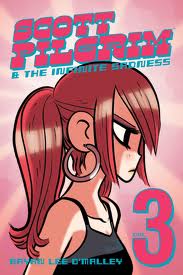
3. Scott Pilgrim & The Infinite Sadness
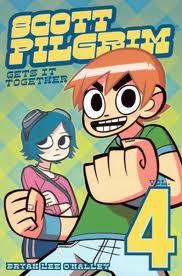
4. Scott Pilgrim Gets It Together
5. Scott Pilgrim vs. The Universe
6. Scott Pilgrim’s Finest Hour

These are my husband’s books which he nagged me to read because.. heh, I didn’t want to watch the movie without reading them first, and he’s been dying to watch the movie.

The series is about Scott Pilgrim, a 20-something slacker, living in Toronto, Canada.  He falls for a mysterious American girl, Ramona Flowers and has to defeat her seven evil exes in order to continue dating her (this is neither her idea or Scott’s. It seems to be something concocted by the League of Evil Exes).

1: Scott Pilgrim’s Precious Little Life
I was a little concerned in reading Scott Pilgrim’s Precious Little Life that I would ultimately be rather annoyed by this series, because I thought that Scott was a big fool. I mean, he’s got the adorably clueless thing going on, but he’s twenty-three and he’s dating a seventeen year old innocent who is still in high school (Knives Chau). And then he sees another girl (Ramona), and becomes obsessed with her, but continues to date Knives, who is falling in love with him. Even though he’s not blatantly malicious, he sure is incredibly oblivious. Luckily, he is the only one, and everyone around him has more sense.  Part of the humor comes from Scott’s doe-eyed blundering and inability to take care of himself while his friends watch him with exasperation.

The story is full of video game and some music references (Scott is both in a band and plays a lot of video games), with lots of odd, off the wall going-ons thrown in. There’s little hints throughout the story that there’s a reason for some of the oddness, but it’s hard to say. I wasn’t sure if I was just missing some video game reference, or if this was a story clue, but these hints actually do go somewhere (you have to wait for later volumes to find out).


2 & 3: Scott Pilgrim vs. The World and Scott Pilgrim & The Infinite Sadness
These two volumes have Scott fighting the second and third evil exes, and also shed a lot of light on Scott’s dating past, including a past relationship with Kim Pine, who is now the drummer in his band, Sex Bob-omb. There’s also some fallout from his dating two girls at once. I liked his roommate Wallace because he’s the one to tell Scott he has to break up with Knives if he wants to date Ramona. In fact, Wallace is my favorite character – what a friend, he pays for EVERYTHING for Scott – he’s practically a surrogate parent. I think that in these two books, there are the seeds for some growth in the characters, including Knives. My husband thinks that Knives gets annoying in these two books, but although I thought she went a little uh, strange, I felt rather sorry for her despite not quite connecting with how she acted. My favorite book in the whole series ended up being volume 3 – Scott Pilgrim & The Infinite Sadness, because it focused on his most recent ex, Envy Adams. There’s something about their bad breakup and the aftermath for Scott that was strangely compelling, and I liked how things got resolved when she returned to his life.


4: Scott Pilgrim Gets It Together
This is the Scott Grows Up volume. The previous books kind of got Scott to the point where he’s willing to be more than a moocher, and he also begins to move forward in the relationship with Ramona. This is also the book where we get a significant clue about Ramona’s recent Big Ex. He’s been mentioned before (she even names her cat, Gideon after him), but this hint moves the story towards the climax.


5 & 6: Scott Pilgrim vs. The Universe and Scott Pilgrim’s Finest Hour
These last two volumes are where Scott fights the last three exes (two of which are twins, and the last is, like video games the final Boss he has to defeat). It’s also where Ramona’s breakup with Gideon and this whole league of evil exes and all the odd things to do with Ramona are explained. Things sort of fall apart, there’s introspection, then things come to a head.

I don’t know how I feel about the ending. Sigh. To tell you the truth, it got a little too weird for me, and the weirdness seemed rather… I don’t know, it took a metaphor a little too far and it ended up feeling like it was weird to be weird. I don’t think I really got it. And just about everyone in Scott’s world – all his friends, had big life changes. The wrap up jarred me, even if it happened over two or three volumes. I’m not really sure why, but I felt somewhat dissatisfied by how everything played out. When I compare the books to the movie, I missed some of the details that were in the book but not in the movie (and I missed the storylines from volume 3 in particular), but I preferred how the movie ended because it didn’t have the metaphysical weirdness of the book or the bittersweetness I suppose.

Overall: I enjoyed reading it. It has geek humor and I liked the interactions between Scott and his friends and I could identify with the twenty-somethings hanging out and living their lives, although I suppose I was a lot more focused than this group is. But there was something that didn’t work, and I haven’t put my finger on it, but I just wasn’t satisfied by the way these books ended. I think maybe it was the use of unreality mixed in with the relationships. I just didn’t connect with the concept. I don’t want this issue to dissuade others from reading these graphic novels though because they were otherwise quirky and charming.

Dark Road to Darjeeling by Deanna Raybourn

Dark Road to Darjeeling
Deanna Raybourn

This is a review of an eARC I received from the publisher.

Dark Road to Darjeeling
is the fourth book in one of my favorite series. Here are my reviews of the first three books:

Book 1: Silent in the Gravehttps://i0.wp.com/i58.photobucket.com/albums/g254/jayamei2/livejournal_com.gifhttps://i0.wp.com/i58.photobucket.com/albums/g254/jayamei2/wordpress.jpg
Book 2: Silent in the Sanctuaryhttps://i0.wp.com/i58.photobucket.com/albums/g254/jayamei2/livejournal_com.gifhttps://i0.wp.com/i58.photobucket.com/albums/g254/jayamei2/wordpress.jpg
Book 3: Silent on the Moorhttps://i0.wp.com/i58.photobucket.com/albums/g254/jayamei2/livejournal_com.gifhttps://i0.wp.com/i58.photobucket.com/albums/g254/jayamei2/wordpress.jpg


***** There are minor spoilers for earlier books in this review ****


The Premise: Lady Julia Grey and her now-husband Nicolas Brisbane have been honeymooning for 8 months, when her sister Portia and brother Plum cross paths with them in Cairo. Portia’s former lover Jane has written from India with the news that she’s pregnant and now a widow. She doesn’t explicitly say it, but Portia senses that there is something wrong in her letters and suspects foul play in the death of Jane’s husband Freddie Cavendish. So of course, Julia and Brisbane, Portia and Plum journey to India, to give Jane support during the last few months of her pregnancy and to secretly investigate the possibility of Cavendish’s murder.

Read an excerpt of Dark Road to Darjeeling here

My Thoughts: As with the earlier books, the writing beautifully describes a setting that’s in a different place and time, in this case a valley isolated from the world where Jane now resides in a tea estate: “The Peacocks is the name of the estate, a tea garden on the border of Sikkim, outside of Darjeeling, right up in the foothills of the Himalayas.”

Here, a small English community lives – the Cavendishs who own the plantation (Harry is the late Freddie’s younger brother, and Camellia Cavendish is their aunt and runs the household), the White Rajah (a mysterious older man who lives in a ruined monastery above the valley), the Pennyfeathers (a clergyman, his free-spirited artist wife Cassandra and two children Primrose and Robin), Dr Llewellyn (a grieving man who lost his wife after a tiger attack), and finally Lucy and Emma Phipps, cousins to the Marches (last seen in the second book of the series). Surrounding these are their numerous servants, including twins sisters Lalita, a cook, and Miss Thorne, governess to the Pennyfeather children.

As Julia and the others make acquaintances with those around them, it becomes clear that the mystery of Freddie’s death is going to be a tough one. Almost everyone could have had a reason or the means to have killed him, if in fact he was murdered. Officially he died of an infection after being bitten by a small, usually harmless snake, not something that would typically kill a healthy man, but India is a place where such things happen. In fact, as I kept reading this book, it began to feel like the valley is not kind at all to those who settle there.  One tragedy or another seems to have befallen everyone there, particularly the English.

In the meantime, the honeymoon is over for Brisbane and Julia, and the two are trying to figure out the compromises that make up married life, without being the one who actually makes the compromise! These two are as as in love as ever, but they’re clearly human. Julia wants to be a partner in Brisbane’s investigations, while Brisbane wants his wife to stay away from danger. This is probably the first book where I really thought about the problems in both of their perspectives, and I felt like neither was truly right or wrong. I think before this book, I was with Julia in expecting that she should be able to investigate, but now I see where Brisbane comes from. On the other hand, both characters also do things that probably aren’t best for their marriage when they try to exert their will over the other. Brisbane continues with his mind games to keep Julia out of trouble, while Julia hides things from Brisbane in order to “win” the race to figure out the mystery and prove she’s an equal. Clearly these characters are imperfect and I like that they have a lot of room to grow, but I the previous books didn’t leave me as frustrated with Brisbane and Julia as much as Dark Road to Darjeeling did. It left me with a generally perturbed feeling to uncover their shortcomings the way they were presented here.

Overall: As I’ve come to expect, I liked the book: it has all the Raybourn hallmarks (lovely writing, unique characters, beautiful setting), but I didn’t close the pages with the same feeling of happy satisfaction as the earlier books, so it’s not my favorite of the series. Conflict and the overall tragic events put this volume into a “bittersweet” category. Compared to the earlier books I felt unsettled after reading this one, but I still love and recommend this series, and I am looking forward to what happens next.

Buy: Amazon | Powell’s | The Book Depository

Other reviews:
See Michelle Read – positive review
Tempting Persephone – positive review
Monkey Bear Reviews – B- (I’m surprised by how similar I feel to this review – read it after writing mine)
Book Harbinger – positive
Babbling about Books, and More – B

Song of Scarabaeus by Sara Creasy

I originally reviewed Song of Scarabaeus over at Jawas Read, Too! for her Book Uno feature a couple of months ago. The format of this review is a bit different from my usual reviews since it actually has a numerical rating.


Song of Scarabaeus
Sara Creasy

This book first appeared on my radar when Linnea Sinclair recommended it on her yahoo group: ” Far-far future Earth SF with terraforming, high-tech, rebellions, pirates, a nice romantic subplot. I’d classify it as RSF and if you like Aguirre’s GRIMSPACE, you’ll love this”. Yep, sounded right up my alley. Good reviews started coming in and I’d been feeling the pull of this book for a while.When Erika threw down the gauntlet for Book Uno she gave me the challenge of finding a book with a female protagonist because she read and reviewed Jay Lake’s Green, which had a female protagonist, for the last Book Uno review.  I think this book not only has a female protagonist (and a lovely one at that), but look at the cover! It’s GREEN. That’s right, I am a genius at Book Uno.

The Premise: Edie Sha’nim is a biocyph who can interface with machines mentally. Her training is primarily for terraforming worlds for human habitation, but she’s unhappy in her current situation, which is akin to being in an indentured position under the Crib Empire. Her next assignment is one she is not thrilled by (although it will be a coup for her ambitious sponsor), so she drags her feet by taking a lowly temporary assignment as op-teck in maintenance. Unfortunately, that’s when Edie is kidnapped by a group of pirates who steal terraforming seeds for Fringe worlds that can’t afford the Crib’s high prices for maintaining the Fringe worlds’ environments. Edie is shackled via a wet-teck leash to Finn, an escaped convict with a dark personality and a past as a Fringe freedom fighter.

Read an excerpt of Song of Scarabaeus here

My Thoughts: From the beginning, the book immerses the reader in Edie’s universe. Unknown terminology is casually tossed into the narrative and a little brainpower is needed at first, but it gets easier as the book goes along. It helps that the story is full of action from the get go with Edie’s kidnapping, and it continues to stay compelling once Edie is captured. First, she’s shackled with Finn, an escaped con with a chip in his head that’s been modified so that if he is too far away from Edie, his head explodes. This makes Finn Edie’s involuntary bodyguard, and awkward relationship which is complicated by Edie having the power to send a crippling jolt to his system via his chip.

Finn and Edie are brought onto the Hoi Polloi, whose crew consists of Haller, the executive officer, Cat Lancer, the navpilot, Zeke, the op-teck, and Captain Rackham, a cook, and two engineers. Although the mercenaries say they have altruistic goals to help Fringe planets, money is obviously part of it. Not to mention that the crew has already broken laws and wrecked havoc to capture Edie. I think that the secondary characters were very subtly set up. At first there are quick impressions of each of them from Edie’s point of view, and then as the book continues, their actions give us more clues as to who they are. It’s very realistic and done nicely. The two I noticed most were Cat and Zeke, who try to be friendly, but they’ve also shown some qualities which put their trustworthiness into question. Trying to figure out how to escape when the allies are slim is a very precarious situation for Edie and Finn, who don’t even know if they can trust one another.

I liked that Finn and Edie are strangers and treat each other as such. This is not one of those books where sparks fly and there’s lust at first sight. I know the cover looks quite romantic, and I’m going to talk about both characters because they’re the protagonists, but let me assure you that the romance is pretty understated.

Finn has just spent years as a convict – treated as a “serf” and less than human, controlled via his chip. Now, in an attempt to get free, he’s found himself in another form of slavery. And while Edie’s morals maker her value human life, Finn is a much, much harder person because of his experiences. As a serf, he’s seen how people treat his kind, and whether he decides that Edie is cut from the same cloth as everyone else is in question for much of the book. If he didn’t need Edie to live, he’d be a lot more dangerous to her, and of the two characters, we’re in Edie’s head, not in his. His actions are truly hard to read and unpredictable, and I liked that. He’s not a formulaic hero by any means.

Edie, on the other hand, is a sympathetic character with some unique problems because of who she is. She needs an implant of neuroxin to stay alive and as a biocyph she’s a target of violent environmentalists who want to stop planets from being terraformed. And she’s seen as a very valuable tool by others, so her life never seems to be fully her own. You could say that she’s used to being unique and dealing with the focus this brings. She’s not what I would call “kick-ass” (she’s had bodyguards to protect her) and she’s a good person even to those who may not deserve it, but she’s not spineless, and knows how to defend herself. Her talents are of course more mental, being a biocyph. Creasy is seamless in referring to Edie’s back story and her job without it feeling like an information dump. How Edie joined the Crib and her first terraforming mission are brought up is they affect her current situation or as brief flashbacks, italicized to separate them from the main storyline. Her biocyph skill is explained on the fly as Edie utilizes it.

The biocyph, and the other -cyph type technology involves people interfacing with machines via chips in their brains and very specific training. The actual interface is described very nicely in the book in an artistic interpretation which I would compare to how the movie Hackers interpreted coding visually. I don’t think you could relate it with coding today, but I still liked the imagery used in explaining it. This creativity is everywhere in the world building from the description of the space ship to the planets that it flies to. I particularly loved the menacing plant life on Scarabaeus, which is subtly suggested on the cover (it looks like there’s a tree on the cover, but that’s really a wall between two windows looking into space).

The comparison to Ann Aguirre’s Grimspace is one that I understand. Grimspace was about a heroine with a unique ability as a jumper but after a horrific accident, she is confined by her government until the hero busts her out. There are a lot of imperfect characters, lots of action and it’s a rather gritty beginning to a space adventure series. Song of Scarabaeus may not share its plot or characters, but the spirit is similar. This book has dark parts, but I didn’t think it was quite as dark, and Edie is a more likable character than Jax initially is, but the ragtag group of mercenary space pirates, high-tech ability with a price, and unpredictable problems make this a book I’d recommend for fans of Aguirre’s fantastic series.

Overall: The more I think about this book, the more I liked it. I think that the writing was very thoughtfully done. It’s got action and a dangerous universe. it’s got space pirates. It’s got well written world building and a suspenseful plot. And it’s got a believable relationship that starts off between two 3-dimensional characters that are utter strangers. I’m not really sure what more I could want in a story. Highly recommended, particularly for Ann Aguirre fans. I’m eagerly awaiting the continuation – Children of Scarabaeus, which comes out March, 2011.

For the purpose of Jawas Read, Too!‘s rating system, I’d give this one an 9.

Buy: Amazon | Powell’s Books | The Book Depository

Other reviews:
Tempting Persephone – positive
SciFiChick – positive
Tez Says – positive

Firelight by Sophie Jordan

Firelight
Sophie Jordan

This is a review of an ARC copy of this book that I picked up at BEA.

The Premise: Jacinda is a draki – a dragon descendant who can shift into human form.  She’s also the only fire-breathing draki of her pride, and because of this, they have her earmarked as a pride asset whose genes they want bred with Cassian, the leader’s son. When Jacinda impulsively breaks pride rules and sneaks out for a flight, and subsequently is almost killed by hunters, the punishment promises to be severe. Rather than continue to let her daughter be controlled, Jacinda’s mom takes her twin daughters and escapes their secret draki town in the middle of the night. However, where they relocate to (a desert town miles away from the mountains and rivers that sustain the draki), may prove to be more dangerous. Not only is this where Jacinda’s abilities begin to fade, but it’s also where a draki hunter family lives, and Jacinda can’t seem to stay away from Will, who is one of them.

My Thoughts: I’ve been a little bit wary of the young adult shape shifting dragon subset of fiction ever since I read MaryJanice Davidson’s Jennifer Scales and the Ancient Furnace (https://i0.wp.com/i58.photobucket.com/albums/g254/jayamei2/livejournal_com.gifhttps://i0.wp.com/i58.photobucket.com/albums/g254/jayamei2/wordpress.jpg). I had huge, ranty problems with the way the parents acted and many of the characters, but it’s been a while since that experience, and I was drawn to the subtlety of the Firelight cover. In comparison, Firelight comes out as the better book, but it’s not without its problems.

The story begins promisingly enough, with Jacinda narrating to us about her (restricted) life within the tribe, giving us some back story about her being a draki. She was aware that ever since she manifested as a draki (her twin Tamra never did), that everyone has looked at her differently. Rather than Jacinda, they now see The Only Fire-Breathing Draki In Generations, and so they’ve been suffocating her with their expectations. They’ve  all decided that to preserve her unique genetics she must be married off to the strongest young male, the Alpha’s son, Cassian. Jacinda chafes at this because she doesn’t particularly want Cassian, but she’s started to resign herself to this fate. When Jacinda breaks the rules and almost gets caught by hunters (a certain death), her worth to the tribe promises a particularly ugly punishment. Fortunately, her parents aren’t sitting idly by while their daughter gets treated like chattel. Jacinda’s mother packs up and sneaks out of town with her daughters.

Jacinda goes along with this, but unlike them, she fears leaving her home. Her sister Tamra has always wanted to be normal, and is sick of living in Jacinda’s shadow ever since Jacinda manifested, and Jacinda’s mom has voluntarily let go of her draki side. For them it’s easy to live among humans, but for Jacinda, who LOVES being a draki, it’s extremely difficult to let her draki die. This conflict within the family was pretty interesting. Although I did find the family dynamics frustrating at times (there seem to be a lot of arguments where Jacinda and Tamra didn’t really try to understand each other or just shut down),  her relationship with her mother and her sister feel realistic. Jacinda can come off as a little whiny around them, but I don’t particularly fault her for it because of what she’s been going through, and I don’t fault her mother or her sister’s reactions or feelings either.

What I did have a problem with in this story is Jacinda’s relationship with Will. It’s overly-dramatic for me. When Jacinda finds him at her new school, she practically has an attack and changes into a draki in front of a crowded hall of students, and from then on their reactions to each other are along this same vein, with Jacinda hyper-aware of Will and longing stares between the two of them. Will is some kind of fantasy boy: rich, good-looking and has never shown interest in a girl before. Jacinda’s mom and sister don’t approve of a guy who makes her so emotional she could the manifest, and that’s without knowing he’s a hunter. And Will doesn’t want anyone near him so he can keep them away from his creepy killer family. Will and Jacinda sneak around, imagining that they are Romeo and Juliet, but an incredibly indecisive Romeo and Juliet.  They swing back and forth between “no, I must stay away” and “Oh no, I can’t stay away” so much that I was really irritated – particularly because there is all this hand-wringing when I have no idea why Will and Jacinda even like each other. Jacinda and Will barely speak and when they do it’s about how they shouldn’t be together or how much they want to be together. I think this idea of an impossible love is why it’s touted as something that will appeal to fans of Twilight (the hunter falls for his prey in Firelight, the lion with the lamb in Twilight), but there’s something missing in the formula here which Twilight had. (And Jacinda didn’t win any points when she finds herself musing on Cassian’s attractiveness when he reenters the picture!)

If not for this forbidden love, the people around Jacinda and Will, and the consequences of who they both are make for an intriguing plot. I had questions about what the reaction of Will’s cousin would really be if he found out what Jacinda was, what really happened to her father, and what would happen to her if she was dragged back to her pride. There’s plenty of room for more revelations here, and I wish some of it was explored further, but the Jacinda/Will relationship took much of the room.

Overall: I liked the ideas in this one, it has thoughtful world building, and the writing isn’t bad either. I’d call this a solid read, but I had really big problems with the superficiality of the relationship between Jacinda and Will, so the romance brought down my enjoyment. The ending leaves the reader wanting more, but I’m not eager for more of Jacinda’s love life (I feel like a cynical curmudgeon, but there you have it), so I’ll pass on book 2.

Buy: Amazon | Powell’s Books | The Book Depository

Other reviews:
Lurv a la Mode – 1 scoop (out of 5)
The Vampire Book Club – 4/5
Jawas Read, Too – 6 (out of 10)
My Favourite Books – positive review
Chachic’s book nook – mixed
All Things Urban Fantasy – 4/5
Debbie’s World of Books – 4/5
Books and Things – 4/5
YA Book nerd – positive

Book Trailer:

Although my review shows I had problems with this story, I know others may not have the same kind of reaction. I’d like to pass it forward. I’ve done this before and just asked that whoever got the book write a review for it, but it’s Thanksgiving so this time – no need for a review. If you think you’ll like this one, let me know, and I’ll send along my copy which is a ARC signed by the author. Open to everyone, but first come, first served! Taken

Silent on the Moor by Deanna Raybourn

Silent on the Moor
Deanna Raybourn

I’ve been meaning to read this, the third installment of one of my favorite series for a while but I’ve been gated by the fact that there are no mass market paperback copies. More on that side rant later.
Book 1: Silent in the Gravehttps://i0.wp.com/i58.photobucket.com/albums/g254/jayamei2/livejournal_com.gifhttps://i0.wp.com/i58.photobucket.com/albums/g254/jayamei2/wordpress.jpg
Book 2: Silent in the Sanctuaryhttps://i0.wp.com/i58.photobucket.com/albums/g254/jayamei2/livejournal_com.gifhttps://i0.wp.com/i58.photobucket.com/albums/g254/jayamei2/wordpress.jpg

**** Minor spoilers for the earlier books in this review ****

The Premise: In the last book, Brisbane disappears, as usual, leaving Lady Julia Grey again with the sense of unfinished business regarding their relationship, so when her sister Portia is invited to Brisbane’s new home on the northern moors, Julia decides to take matters into her own hands and come along, uninvited or not. Julia doesn’t expect a warm welcome by a man who is clearly hiding something, but she’s surprised to find the previous tenants of Grimsgrave, the Lady Allensby and her two daughters, Ailith and Hilda, still in residence, while Brisbane acts as slippery as ever.

Read an excerpt of Silent on the Moor here

My Thoughts: Julia gets more and more impetuous in each book. I think the first impression she made on me has stayed in my mind (a woman who knows the societal rules of her time and abides by them despite feeling the constraints), so whenever Julia does or says things that are distinctly unladylike, I feel a little surprised. I wasn’t sure how to feel about Julia’s decision to just show up at Brisbane’s house, despite her sister Portia and brother Valerius coming along, because there are members of her family (including her father) who call it what it is – throwing herself at a man who of late has shown an insulting lack of interest.  I did cringe a little, wondering what Brisbane’s reaction would be.

When Julia gets to Grimsgrave, the sparring with Brisbane begins again, and their interactions highlight how much Julia’s character has evolved. Do not fear though – this is the best thing ever. I find their relationship even more delicious because Julia is comfortable with who she is. Brisbane is a dark horse; he manages to stymie Julia even when she thinks she has the upper hand, but Julia isn’t afraid to keep pushing.  I understand her character (it helps that she’s the first person narrator), but Brisbane holds his cards very close to his chest. I know he loves her, but he has strange ideas about honor, relationships, and protecting people. If Julia hadn’t changed into who she is now, I don’t think their relationship would work because she’d be too afraid to break down his barriers. This Julia gives as good as she gets, and I was cheering for her every time she managed to chip his armor.

Every book in this series involves a mystery.  In Silent on the Moor, the biggest mystery is Brisbane himself. He clearly has a past that is tied to Grimsgrave, and Julia learns as much about him as she does about the strange Allensbys. At first, it’s Julia’s nosiness that prompts her questions about the Allensby family. Is there something between the beautiful Ailith and Brisbane? Then there is the question of Redwall Allenby, Ailith’s brother, recently passed. Was there more to his death and his disgrace in Egyptology circles? These are things Julia is curious about, but it’s only when she makes a macabre discovery that the sleuthing begins in earnest. Julia knows that this is the window for her chance at happiness, and if she doesn’t figure out what’s going on, she’ll lose Brisbane forever.  Although the mystery feels somewhat secondary to the relationship troubles, I found it rather satisfying that the focus was where it was. I wanted what Julia does when she goes to Grimsgrave: to settle the thing between her and Brisbane once and for all.

It’s all very atmospheric. The Allenbys sit proud, closed off in their broken down home, remembering glory of generations long past, while the nearby villagers bear them no good will. Julia and her family stumble awkwardly into this situation, not exactly wanted but tolerated nonetheless, while Brisbane stomps in and out, dark and broody as ever. Brisbane perfectly suits the crumbling Grimsgrave and the wild and dangerous moor. I loved the setting, particularly at this time of year, when things get wet and gloomy, and dark clouds hang above.  With Brisbane’s gypsy past and the moor setting, it’s clear that there’s a nod here to Wuthering Heights, but in this case there’s a happier outcome.

Oh man, the ending. The story took it’s time getting there (my trade paperback is 465 pages), but it was well worth reading because the final pages are sigh-worthy.  For those of you who are peekers – just believe me that it ends well and try not to skip ahead.

Overall: This may be my favorite Lady Julia Grey installment yet. Wholly for the ending, although the dramatic setting on the moors, the strange Allenbys and the broody Brisbane aren’t too shabby in making this a lovely story. The mix of romance, mystery and the Victorian setting are perfect. I love this series. So good.

Buy: Amazon | Powell’s | The Book Depository

Side rant!
OK, I must say that I’ve been waiting for this book to be published in Mass Market because my copies of the earlier books are MMPBs. But, although this book was published in trade paperback in March, 2009 (as of this post 1 year and 8 months ago), there seems to be no plan to release this book in mass market? What’s up with that?

Other reviews:
See Michelle Readpositive review
Aneca’s World – 4/5
The Good, the Bad, and the Unread – B
Angieville – positive review

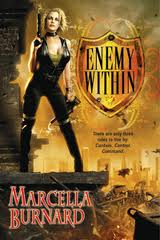
Enemy Within by Marcella Burnard

Enemy Within
Marcella Burnard

This book has been on my radar due to it being Science Fiction Romance from a new to me author. This is a review of an ARC that was passed along by a fellow blogger.

The Premise: Captain Alexandria Rose Idylle (Ari), is working on her PhD thesis on her father’s ship, the Sen Ekir, when it is commandeered by pirates lead by a man who calls himself Cullin Seaghdh. As a recent survivor of months of capture and torture under the Chekydrans, Ari lost her crew and then her command, and her father, friends, and the Tagreth Federated Command are all unsure she came back whole.  But this hijacking by Seaghdh, followed by one surprise after another, suggests that Ari may be right in questioning everything and everyone.

My Thoughts: Ari is a heroine with an interesting background. She’s been captured and released by the Chekydrans, had a distinguished military career, holds a degree in xenonanobiology, and ranks in energy blade competitions. On paper she’s borderline perfect, if not for how broken she is from her captivity. Most of the time, Ari is determined in and strong in adversary, but she also is prone to flashbacks and crippling insecurities.  Cullin Seaghdh’s character on the other hand, is sort of the handsome stranger, full of secrets that he keeps from Ari, but he’s not alone in doing that. I liked the idea of a relationship that develops along with the secrecy, however I have mixed feelings about how the romance was written alongside the space opera elements.

This science fiction romance definitely falls under the “sexy” umbrella. There’s lots of sexual tension between Ari and Seaghdh. For that reason I think that this book would appeal to romance readers who enjoy speculative fiction world building (I would compare the ratio of romance to world building and action to Nalini Singh’s Psy-Changling series). For space opera/science fiction fans unused to romance reading,  your mileage may vary on the lusty parts. Ari and Seaghdh’s attraction is a large part of the story. I personally tend to go for a low level of heat, and although there was not much actual sex in this story, the descriptions the hero and heroine’s physical reactions to each other are numerous. That’s usually OK with me, but I found that some of the situations felt a little forced or repetitive, such as stripping down naked in front of each other for a decontamination shower in the first 20 pages, or Ari’s frequent flip outs about Seaghdh’s true feelings and her the descriptions of Ari’s response to Seaghdh. This feeling that the story is being forced extends also to the space opera parts, and I think the overworked feeling I get from the story, is my biggest problem with this book.

The book is chock full of space opera goodies. Aliens, space fights, hijacking, there’s always some action going on, and plenty of conspiracy to go with it. The way Ari and Seaghdh look at every situation from the angle of people familiar with Military Intelligence can be dizzying to follow. Most of this is good and I would usually eat it up with a smile, but there were some parts where the logic jumped a little fast for me (I think one day I’d like to do a reread to see what I missed the first time), or parts where right after one near missed disaster, another occurs, followed by yet another. If I take each event individually, they are fine, more than fine in fact, but there is just so much going on.  If the book had been fiercely edited to remove the chaff, we’d be left with a book I’d love – with a great mix of romance and action, but as it is, there are actually too many ideas and extra scenes because of it.

Overall: Enemy Within takes science fiction romance and makes it it’s own. It shares tropes I’ve seen before, but the mix of breakneck action, a bit of angst and lots of lusty tension is a combination that feels unique in this genre. There was a lot I liked about this book, but there were also things I found problematic – mostly the parts that felt forced – one twist after another, Ari’s mood swings regarding the relationship, and the general feeling that too much is going on. I have hopes that this will improve, and am game to try the second book in this series, Enemy Games (May 2011), which features a hero and heroine introduced in Enemy Within.

Buy: Amazon | Powell’s | The Book Depository

Other reviews:
The Good, The Bad, and the Unread – A
The Book Lush – 4
Babbling about Books, and more – B+

Interview @ Babbling about Books, and more
Guest Post @ Galaxy Express – Parallel Universe: Extraordinary Heroines by Marcella Burnard

Land of the Burning Sands by Rachel Neumeier

Land of the Burning Sands
Rachel Neumeier

This is the second book in the Griffin Mage trilogy. I think you could probably read this book without reading the first one, as the main characters are different and it focuses on a different country (Casmantium rather than Feierabiand), but there are reappearances from characters in the first book and it does continue a wide-reaching story arc. Land of the Burning Sands was sent to me for review by Orbit books.

My review of the first book, Lord of the Changing Winds can be found here:

https://i0.wp.com/i58.photobucket.com/albums/g254/jayamei2/livejournal_com.gifhttps://i0.wp.com/i58.photobucket.com/albums/g254/jayamei2/wordpress.jpg

The Premise: The story begins with Gereint Enseichen, a geas-bound man in Casmantium,  who, when his master’s town is being evacuated, sees an opportunity to escape his magical bounds. Eventually his escape through the desert around the town of Melentser creates consequences that reach further than he would have expected.

My Thoughts: Since Land of the Burning Sands starts its focus with Gereint rather than any of the characters from the first book in this series, it initially doesn’t feel like a continuation and more like a separate standalone. Gereint has a layperson’s idea of what happened in Feierbiand, but it’s only relevant to him because it means the evacuation of Melentser, and a means to escape his geas. What we focus on when we begin Land of the Burning Sands on isn’t the griffins, but whether Gereint is going to escape or even survive.

Because I’m more drawn to character-driven stories, this focus on Gereint’s journey made the first half of Land of the Burning Sands faster read to me than Lord of the Changing Winds. I think the more limited scope just appealed to me more, at least from this writer, and while I did like the dreamy descriptions of the searing desert and alien griffins in the first book, they do their job too well sometimes, and can wear me down as a reader. There was less of that here. I enjoyed reading about Gereint, who despite his status came off as well read and educated (it made me smile that he included the theft of a book in his survival supplies!) I was curious about his human problems – whether he’ll be identified for what he is and caught, and what will happen to the people who helped him. I also liked that along the way we learn more about the magic system. This book sheds light on the Casmantium affinity for making (the people of Feierbiand have instead an affinity for animals, and Linularinum for words), the geas binding that Gereint tests every chance he gets, and further along, the Casmantium’s Cold Mages.

Of course, this isn’t just the story of Gereint. Over the course of the book his path merges with the larger story of Casmantium and the griffins, and the scope of the story begins to widen. He meets Tehre Amnachudran Tanshan, a brilliant but absentminded maker/scientist, and after this, the focus shifts back and forth between their two characters. It is after her character is introduced that the King of Castmantium, and the last Cold Mage, Beguchren Teshrichten, both characters that first appeared in Lord of the Changing Winds are brought into the story. They bring Tehre and Gereint into the ongoing issues brought on by what happened in Lord of the Changing Winds. Gereint and Tehre’s stories split up. They both make separate journeys, Gereint with the Cold Mage, and Tehre, frustrated with being labeled ineffectual when she is not, follows with Lord Bertraud, the Feierabiand king’s advisor and principle character in the first book.

At this point of the book, where the focus is once more on the wider scope of a country rather than an individual’s problems, that the book began to slow down for me. I found it obvious where the book was going. There were hints throughout, but the author takes the long route to reveal the repercussions of the end of Lord of the Changing Winds to the main characters in Land of the Burning Sands, and I felt really impatient with that.  I thought the details of their days journeying to save their country were somewhat tedious, but  the climax, which involve the griffin mages in book one, caught my interest again. I really liked that we got to see Kes and the griffins from a different point of view in this installment. There was a stark difference in who I was rooting for here, and I was struck by how well the author changed my perspective. I also liked how things were ultimately resolved. I’m not sure what will happen in the third book but there was a teaser for it at the end of this one which has piqued my interest. My guess is we will be learning about Linularinum. The third book, Law of the Broken Earth, is coming out in December.

Overall: This is shaping up to be a solid, well-written fantasy series. I’m enjoying the world building and the characters in this story, and the pacing in comparison to the first book was much better, with less parts I found slow. I think that you could probably read this out of order from the rest of the series, even though there are reappearances by characters from the previous book, they are not the principle ones.

Buy: Amazon | Powell’s | The Book Depository

Other reviews:
My world.. in words and pages – positive review

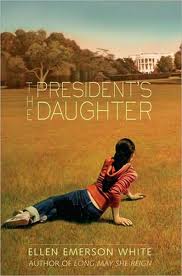
The President’s Daughter by Ellen Emerson White

The President's Daughter
Ellen Emerson White

Angie is continuously pimping Ellen Emerson White so I finally took the plunge and bought the whole President’s Daughter series this year. This is the first book.

The Premise: “Sixteen-year-old Meghan Powers likes her life just the way it is. She likes living in Massachusetts. She likes her school. And she has plenty of friends. But all that is about to change. Because Meg’s mother, one of the most prestigious senators in the country, is running for President. And she’s going to win.”

My Thoughts: I had to steal the blurb for The President’s Daughter because when I tried to come up with the premise myself, all I could think of saying was: “Meghan’s mom, a senator, runs for president. The title gives you a clue to how that turns out.” The premise is simple, and the plot is straightforward. There aren’t any crazy plot twists, or drama that keeps you on the edge of your seat wondering what happens next. Although the election happens throughout the book and Meghan is politically aware, the book follows Meg, not her mom, so the political life is conveyed by someone in the periphery. It’s fascinating to see glimpses of the election process from someone close to a candidate and to see how the media treats Meg’s family (and how Meg herself deals with it),  but it’s not what I feel the heart of the book is about.

What the focus of this book is Meghan and her family. At the first glance, the Powers are incredibly All-American and privileged. When the book begins, Meghan (or Meg), is at a country club meeting her mother to play tennis. The other members of the club greet her mother as “Senator Powers” and afterward, they go home to a housekeeper, Meg’s two precocious brothers, and her lawyer dad. It’s all very American Dream, but the dynamics within this family that are universal. If you’ve ever smart mouthed at a parent to get a laugh, or said something cutting which you immediately regretted, then you’ve been a teenager and you will understand Meg.

I found Meg to be one of those girls you admire in high school. She knows how to present herself well and she has a quick wit and her mother’s looks. She’s aware that people are watching her for any mistakes she may make, and she is smart about how she acts, but on the other hand, she isn’t thrilled she has to keep herself in check. Knowing that she looks like her mom, and that boys are suddenly asking her out after her mom started running, Meg isn’t above secretly wanting her mother to lose the election so her life can go back to normal. The years growing up with a mom who has a job that keeps her away from home is another bone of contention.  These are the undercurrents that run throughout the book, and yes, something comes out of them, but the drama in this book is over quickly.  Meg is a kid with a certain amount of sense, and when she makes a mistake, she recognizes it fairly instantly. This includes boys. Meg is not immune to a pretty face, but she sorts through who the good guys and the not-so-good guys are in a way I found very satisfying.

Overall: I had a hard time with this review. After I finished, if someone asked me what happened in this book, I’d find it difficult to make the plot sound exciting, but I really enjoyed it for the humor in the day-to-day lives of the Powers family. Don’t read the book for pulse pounding action, read this book for the interactions between people. When Meghan is with her family, they play off each other. They zing.

(This is a review for the reissued version of the book, not the original that came out in the 80s. I believe it has been updated to make it more modern).

Buy: Amazon | Powell’s | The Book Depository | Book Closeouts (currently 99 CENTS!!!)

Other reviews
Robin McKinley reviewed it! (and liked it quite a bit)
The Book Harbinger – positive
Chachic’s Book Nook – had a lukewarm reaction