The Dead Travel Fast by Deanna Raybourn

The Dead Travel Fast
Deanna Raybourn

I was thrilled to get an autographed copy of this book at BEA last year and I’ve been saving this read for a few months. I finally got around to it last weekend, and it was a relatively fast, atmospheric read.

The Premise:
Theodora Lestrange is left with little prospects after the death of her scholarly grandfather, and despite her sister and her husband’s good intentions, she has no desire to live with them. Theodora longs for passion and adventure and to be able to continue writing her books.  So when an old school friend writes to Theodora asking her to come to Transylvania to celebrate her betrothal and stay for a little while, Theodora jumps at the chance to be bold and to have her creativity sparked. When she gets there she falls in love with the mysterious countryside and the man who is lord of it, despite the disturbing beliefs of it’s people.
 
Read an excerpt of The Dead Travel Fast here
 
My Thoughts: The Dead Travel Fast is a book that is separate standalone from the Lady Julia Grey series, with a very different heroine and a very different tone.  Rather than a Victorian mystery, this is a tale spun in sensational Gothic fiction tradition, starting with it’s horror setting: a crumbling castle set imposingly above a rustic village in the Carpathian mountains. This is where Theodora arrives and meets an eccentric bunch: an aging but haughty countess, a stoic group of servants, a jovial family doctor, Theodora’s school friend Cosmina, and the handsome, enigmatic Count Andrei Dragulescu. Stories of vampires and werewolves abound, and Theodora is thrilled to have so much fodder for her writing. She doesn’t believe any of it’s true at first, but as she experiences more of this place, it’s difficult to disbelieve that there are not evil creatures roaming the night. As she falls under the spell of the castle, she also falls for the seductive count.
 
This story felt like a tribute to the Gothic genre and thus certain “rules” of that genre were followed, which I think lent this story a simpler feel compared to Raybourn’s other books, both in plot and character. Theodora felt like your typical intrepid but still innocent Gothic romance heroine. She has a high level of imagination and a romantic heart.  She tells her sister she wants to feel passion and will settle for nothing less, and when she meets the count, despite his improprieties, she just can’t seem to help herself. Over and over she resolves to stay away, and over and over she does not.
 
The count on the other hand is a despoiler, and it’s very obvious that he’s seducing our heroine. He even explains to her that there are “only three types of women that matter in a man’s life –those he marries, those he seduces, and those he takes. I have only to tailor my behavior to become whatever the lady in question wants me to be and I’m assured of success.” I think this sentence explains why I found his character unlikable. While he may be genuinely attracted to Theodora, the calculated way he got her attention rubbed me the wrong way. What softened the dislike was that his character fit the Gothic tale – is he the hero, or the villain? I hoped he was the hero because Theodora (the narrator) sees him through rose-colored glasses, but I questioned her judgment severely.
 
The first part of The Dead Travel Fast builds up the melodrama of the story, and I wasn’t sure whether a supernatural being would appear or not or if this would be just a romance or something more. Thankfully, the typical Raybourn mystery does appear (albeit in a smaller dose than in previous books). While this was a quick read, I was relieved by the mystery because that’s where I feel Raybourn shines. Theodora may not be as sharply observant as Julia Grey, but once she does put her mind to it, she’s just as quick to see the possibilities. As a result, the book ends on a satisfying high note.
 
Overall: This is a story which nods it’s head towards the Gothic fiction tradition and mixes that with a romance and a mystery. In the end I liked this one, but I wanted to like it more than I actually did. I understood where the author was going, but the Gothic affectations of the characters stopped me from really connecting to them. If it wasn’t for the satisfying ending this would have fallen into my “OK” category, but if I was an English Literature major or someone interested in the Gothic genre, I think I’d probably have appreciated this more.
 
Buy: Amazon | Powell’s | The Book Depository
 
Other reviews:
Angieville – positive
See Michelle Read – mixed feelings
fashion_piranha – positive/some criticisms
The Book Harbinger – positive
Dear Author – B-
 

Cold Magic by Kate Elliot

Cold Magic
Kate Elliot

Ever since KMont posted a glowing review of Cold Magic on her blog, I’ve been really interested in reading it. So despite my teetering TBR, when I saw it in my local library I made an impulsive decision to grab it.

The Premise: (taken from the blurb) “It is the dawn of a new age…The Industrial Revolution has begun, factories are springing up across the country, and new technologies are transforming the cities. But the old ways do not die easy. Cat and Bee are part of this revolution. Young women at college, learning of the science that will shape their future and ignorant of the magics that rule their families. But all of that will change when the cold mages come for Cat. New dangers lurk around every corner and hidden threats menace her every move. If blood can’t be trusted, who can you trust?”

Read an excerpt of Cold Magic here

My Thoughts: This is one of those books that just throws you into the world and you glean information as the characters make their way. The story begins on a relatively typical day in Catherine and Beatrice’s (Cat and Bee’s)  life in Adurnam.  Cat lives with Bee, who is her cousin, and with her aunt and uncle. Along with her cousin, she’s a student at the local university. There is a feeling of excitement about industry and human innovation, and about the airship for the “Great Expedition”. The two girls, who are very close, have a great chemistry and I loved reading scenes with them together. All seems as usual, even Cat and Bee’s mischief, but when they go home, and their day turns dark.  A cold mage, Andevai Diarisso Haranwy, from Four Moons house, arrives at the family’s home, asking for the eldest Hassi-Barahal girl as per some agreement. By the end of the night, Cat is married to this arrogant mage, and taken away.

This seems like a set up for a captive-bride romance, but the story doesn’t really go there. There’s a twist which brings down a whole world of trouble, but Cat reacts and survives. She refuses to be used, nor will she let her beloved cousin be used. Luckily for her, her true lineage gives her an edge that no one realizes.

This is a fantastic story in terms of world building. There are steampunky elements in this book, but it also throws in an alternate history and hints at a well-built magical world. It’s clear that the two forces of magic and science are at odds, not only among cold mages, the ruling aristocrats and the common man, but among men and other creatures. The part of me that loves that stuff was very happy.  At times I worried that things were going over my head, but I’m not sure if it was my fault for reading the book when I was tired or if this was to be expected, as things made more sense as the story progressed. Anyway, the book is chock-full of details about a world that is like ours, except not. The icy climate, the spirit world, the history of the cold mages and how Cat’s people adapted after Roman rule are all mixed in with Cat’s adventures. As is Cat’s personal history which she realizes isn’t what she thought.

Cat is a great heroine. As the narrator she has a strong grasp on recent history and a pride in her people, the Kena’ani (called Phoenicians by the Romans). I liked that she was interested in technology and in science, but although magic is an accepted part of the world, it’s not something she’s very knowledgeable in. As a result, when he fate intersects with that of cold mages and spirit worlds, Cat has to rely on her wits and instinct to survive. The world seems to be reaching an impasse, and it’s not certain which way things will go, but Cat is in the center of big changes.

My favorite secondary characters were Cat’s husband Andevai and her cousin Bee. Bee is someone Cat loves and wants to be safe, and who shares similar feelings for Cat. I really enjoyed the relationship between the two girls and I liked how they had their own distinct personalities – Bee being more the winsome and artistic one, but who is just as quick as Cat. I loved their close relationship, as I loved how well that immediate recognition of family that was elsewhere in this story (saying more would spoil the fun). Their antics and banter had me grinning. I also ultimately liked Andevai although he starts off as someone who I couldn’t pin down as someone I should like. Cat isn’t sure if he’s ally or an enemy.  It’s not obvious how he feels because he blindly follows the instructions given him, and his arrogance and vanity makes him rather unlikable. I felt somewhat irritated that Cat would note how handsome he was at the same time she was complaining about his faults, but as the book went along he showed more depth. There’s an obvious set up for romance between the two but it’s definitely something for that’s not going to be simple and will likely develop over multiple books.

Overall: This was a solid fantasy story with a really imaginative world (alternative history, hints of steampunk, cold magic). My favorite things were the world building and the relationships between characters, two important things in my checklist for liking a book. My only criticisms would be that the pacing felt uneven and things went over my head, problems that not everyone may share. In the end, I really want to know what happens next, and do look forward to the second book, Cold Fire, so I can experience all these characters again. I recommend it for fans of straight fantasy who like independent female heroines.

Buy: Amazon | Powell’s | The Book Depository

Other reviews:
Lurv a la Mode (ARC review) – The Biggest 5 Scoops ever (out of 5)
Charlotte’s Library – mixed review, “here’s much to admire […] didn’t quite come together”
Dreams and Speculation/Dirty, Sexy Books Dueling Review – 4 stars (DSB) / 6 out of 10 (D&S). I tend to have similar opinions DSB, and I agree with this one
Chachic’s Book Nook – positive review (I share her opinion on this one too!)
Smexy Books – B-
SFF Chat – some problems but ultimately positive
Got Schephs – 8 out of 10
The Book Smugglers – 8 (Excellent)
Dear Author – A-
Starmetal oak book blog – A

Books on Film: Brick

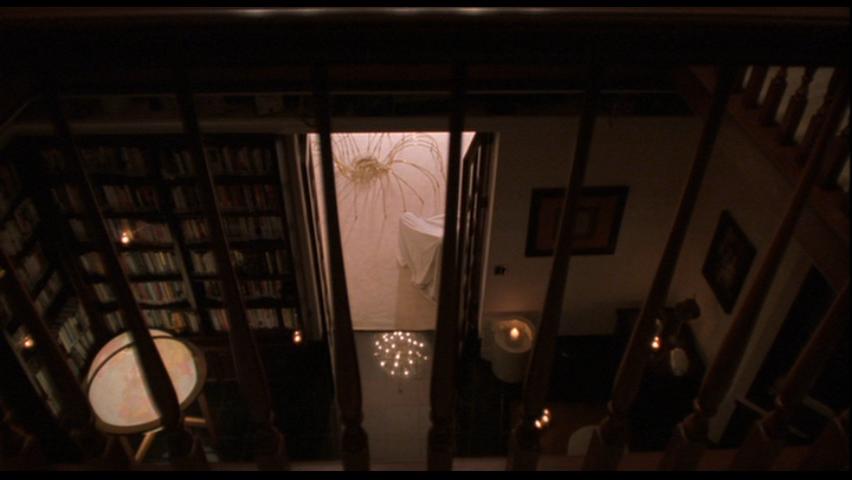
Brick (2005) is a film with a modern twist on detective noir. Set in high school, it stars Joseph Gordon-Levitt as Brendan Frye who takes it upon himself to solve the murder of his ex-girlfriend, Emily. In the middle of the movie, Brendan goes to a party at a house that has THIS library. Oh how I would love to have an office that extended to the floor above via spiral staircase where my books waited for me. But I would turn on more lights.


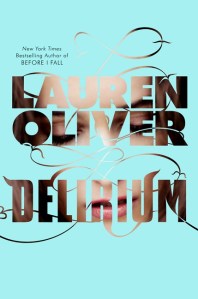
Delirium by Lauren Oliver

Delirium
Lauren Oliver

This is a review based on an ARC copy I received from the publisher.

The Premise: In a unspecified future, the United States government has identified love as a disease and has administered a cure for over forty-three years. Lena is terrified of getting amor deliria nervosa and can’t wait till her eighteenth birthday when she can get the procedure and be safe. She doesn’t want to become like her mother, who was so affected by love that she left Lena and her sister behind, to be cared for by their Aunt Carol and Uncle William. That is, until Lena meets Alex and begins to question whether it’s a good thing to lose the ability to feel excess emotion.

Read an excerpt of Chapter 1 of Delirium here

My Thoughts: The set up for this story is that sixty-five years before it begins, the United States identifies love as a disease that encompasses “stress, heart disease, anxiety, depression, hypertension, insomnia, [and] bipolar disorder”. This disease, so they say, begins with symptoms like difficulty breathing and preoccupation, slides into euphoria and despair, and then spirals into paralysis and death. The country is so rigidly run by this idea that the Safety, Health, and Happiness Handbook (aka Shhh), is a new Bible, and cities are enclosed for their protection behind high electrified fences. Patrols and raids are regularly carried out. All citizens are required to be cured at eighteen, and are ever villigent should their friends or neighbors show signs of the disease. Of course Lena believes in all of this because she’s grown up in this society. The author does a good job conveying Lena’s frightfulness, particularly in the beginning of the book. Lena is the narrator, and she often uses words like “anxiety”, “blur”, “dizzy”, “suddenly dazzled” and “flashing” when she describes a situation that isn’t her norm, so much so that I began to feel like I needed a Dramamine reading about her experiences.

As a reader, however, I know that the whole basis for this society: “love is a disease”, is a lie, and that Lena’s fears are unnecessary. In order for me to accept this dystopian scenario, I needed more than the descriptions of Portland gripped by bureaucracy and fear. I needed to understand how something generally accepted as good could be seen as something bad. This book didn’t deliver that. All I had was Lena’s point of view, and she was clearly misinformed. There are infinitesimal snatches of information (a religion founded by scientists, the blitz), which has something to do with how things became the way they are, but it’s not clear how it fits with Lena’s present. It may be that book two will delve into the past, but I have no guarantee of it. As it is, I felt like I was missing the foundation to accept the premise that love came to be classified as a deadly disease. How was the population convinced? But by who and for what reason? How did this dystopia come to be? I don’t know, and I think that weakens any message about society that Delirium may be trying to convey.

To continue reading, I decided to trust that explanations would be forthcoming, and just focus on Lena’s story. The writing is very good. There are plenty of lovely passages just describing Lena’s day to day teenage life and how it’s been affected by amor deliria nervosa. It’s clear that it has touched every aspect of Lena’s life from her all-girl schooling to her careful choice of words in public. It hangs over every relationship. Conversations with her best friend, Hana involve dealing with phone tapping and checking for eavesdroppers. The biggest impact on her life however, is the procedure, when she will finally be cured, which means she will be Paired off with a boy selected by the government. On that day, Lena and all other teens will forget any feelings they had for friends or family. Until then, Lena experiences all the highs and lows of being a teenager, which includes a closeness with the charismatic Hana and a regimented home life with her aunt and uncle and their other wards, Jenny and Gracie.

Then there is of course, the relationship she begins with nineteen year old Alex.  He’s a boy who seems very different from everyone she knows. In the process of falling for Alex, Lena discovers what love is and how twisted her society has become because it has suppressed it. The romance here was very clandestine and intensely described, but while I could appreciate Lena’s and Alex’s feelings on a logical level, and I wanted them to beat the odds, there was something that held me back in believing the romance viscerally. I think that my problem was that their initial attraction felt off.  Lena seemed like a scared rabbit to me, but as someone “awake” to Alex. That he has been interested in her from afar didn’t fly, so I stayed unmoved about their initial connection. After this there was a scene when Alex and Lena are first alone together which I found compelling, followed by a montage of summer days spent together. All nice, but it was only at the end of the story that Alex really stepped up as a hero and convinced me of his feelings. Although Delirium ends on a bittersweet note, it was the perfect good-bye.

Overall: It’s very well written and it has an interesting premise, but overall I’d mark Delirium as “very good”, not “excellent”. I think that love as a disease was not believable enough for me – I ended up wondering what the REAL reason for a society built on this lie was, and feeling frustrated that I couldn’t see one. I hope that the idea is expanded more in the next book, so that we can see the history behind Lena’s world. Otherwise, I really liked how this story progressed, how Lena grew and changed, the careful way Portland under a totalitarian regime was constructed, and the bittersweet ending that leaves no illusions about what it means to love.

Buy: Amazon | Powell’s | The Book Depository

Other reviews (there are A LOT!):
The Book Smugglers – DNF
The Hiding Spot – positive
Debbie’s World of Books – positive
Imperial Beach Teen Blog – positive
One Librarian Reviews – comparison of Delirium with Scott Westerfeld’s Uglies – 5 stars
The Compulsive Reader – positive
All Things Urban Fantasy – 5 bats (out of 5)
Book Reviews by Jess / The Cozy Reader – Perfect Score
Princess Bookie – 5/5
S. Krishna’s Books – positive
Karin’s Book Nook – positive
Book Sake – positive
Reading with Tequila – 2 out of 5
Ink and Paper – positive
Presenting Lenore – 5 out of 5
Need_tea – C grade

Song inspired by the book. Written & performed by a fan:

Videos of Lauren Oliver discussing Delirium on Amazon.com: One & Two

A Discovery of Witches by Deborah Harkness

A Discovery of Witches
Deborah Harkness

I received a finished copy of this book via the publisher, Viking/Penguin.

The Premise: Diana Bishop has a degree from Oxford and tenure at Yale. She specializes in the history of science, primarily on alchemy. During a research trip to Oxford’s Bodleian library, Diana requests a manuscript from the Ashmole collection: known as Ashmole 782, and when she sets eyes on it she realizes that it’s enchanted. Diana is a witch, albeit a non-practicing one.  She’s avoided magic after her parent’s death. Yet the enchanted manuscript opens for her, igniting both her powers and a storm of supernatural creatures curious about the manuscript and the person who unlocked it. First and most formidable of the daemons, witches and vampires who show up is Matthew Clairmont, a professor of biochemistry, member of the Royal Society, and vampire.

Read an excerpt of A Discovery of Witches: @Fantasy Cafe or @Deborah Harkness’ website

My Thoughts: Before starting A Discovery of Witches, I saw that it was likened to “Twilight for adults”. I spent a lot of time mulling over this while I was reading the book. I think that comparisons, particularly to a book like Twilight may do more to turn readers off than to draw them in. At first,  I didn’t think that the comparison made sense. The narrator is a witch, the setting is academia, and nothing reminded me of Twilight, except the detailed prose. I thought: “Is Twilight the first thing that comes to mind when there’s a vampire romance?”, but as I got further into the story, I began to see where the comparison came from: Matthew is protective of Diana; he breaks into her rooms while she sleeps; he feels conflicted over his feelings; the Congregation wants to keep them apart. But is this book like Twilight? Well… no, not really. There are plenty of differences between the two books, and the concepts that feel similar feel only superficially similar. In fact, I feel like A Discovery of Witches sidesteps a lot of the problems with why people didn’t like Twilight. Diana Bishop is a more independent character than I found Bella, and overall the romance felt more mature (I could see what drew these two to each other despite their age differences), and the plot itself was more complex.

The subtitle “a novel” also threw me off as to what to expect. Was this something in the literary fiction sphere, or something that is essentially a paranormal romance? While the story has a lot of historical references, the protagonists drink the finest wine and practice yoga, it’s accessible to fans of the paranormal romance and urban fantasy genres. There are paranormal creatures, a slow moving romance that is a big part of the plot, and I didn’t feel like it took itself too seriously. There is an escapist side to the writing. And when it came to history, I think the author indulged a little, because Matthew owns a Gutenberg Bible, a bound copy of “Will’s plays”, a 1795 wine from Madiera, a 500 year old Tudor Manor house, and a castle. It tickled me to run into these things though, so don’t take that as a negative.

The one aspect of the writing in this book that could be seen as negative however, is how detailed it was. A meal could be cover several pages because each course is thoroughly recounted, down to individual tastes in the wine and Diana and Matthew’s reactions to everything. If you don’t like this thick, descriptive writing, you’ll be stopping this book early.  On the other hand, if you enjoy having a really lush picture of what’s going on, this book delivers. I found the details so intertwined with the slow courtship that I felt like I was enjoying something comforting and extra-wordy that I wouldn’t normally savor in large doses: like rich chocolate.  This writing style (all 579 pages of it), makes A Discovery of Witches the kind of book you read in installments, not cover to cover in one sitting.

Most of the first half of this hefty volume is a lengthy courtship between Matthew and Diana, with the discovery of the enchanted Ashmole manuscript as the initiator. Diana is the main narrator of this story, so most of the book is told from the first person point of view, although there are a couple of instances when the story follows Matthew and switches to third person. Once it’s clear there’s something the two protagonists, the consequences of inter-species dating, Diana’s powers, and the Ashmole manuscript come to the forefront. That’s when the story widens from the focus on Matthew and Diana to the people around them. On Diana’s side there are witches, on Matthew’s there are vampires. Witches are born, vampires are made. Then there is a third race, daemons who are not the demons you typically see in paranormal fiction. These are born from humans but possess genius and/or madness that sets them apart. Once the plot thickens, I was pleasantly surprised how much enjoyed the seamless mix of action and conspiracy against the romance. The author adds secret societies, power-hungry factions, paranormal forces, conspiracies, a house with it’s own personality (I loved this house, I want to live in this house), and lots of grumpy vampires with long lives and long grudges. This looks to be the beginning of an epic battle between good and evil, and while there’s a satisfying ending to A Discovery of Witches, it is clear that there’s more. I hadn’t realized this when I got the book, but A Discovery of Witches is part of a trilogy and sets the scene for Matthew and Diana’s continued adventures.

Overall: This is a book that I think is supposed to be shelved in fiction, but it has a lot of cross-over appeal for urban fantasy and paranormal romance fans. Don’t let the Oxford setting and protagonists with long academic credentials dissuade you, this is an accessible story with a slow moving romance that’s a guilty pleasure to read, but the romance isn’t all — the story is shaping up to be a great good versus evil tale. I’d recommend this one with reservations however — there’s a lot of description and exposition in this story which isn’t for everyone. If you aren’t bothered by the writing style, then I think it’s a good one to try.

This looks to be the first in a 3 book series.

Buy: Amazon | Powell’s | The Book Depository

Other reviews:
The Book Smugglers – DNF

Book Art: folding sculptures

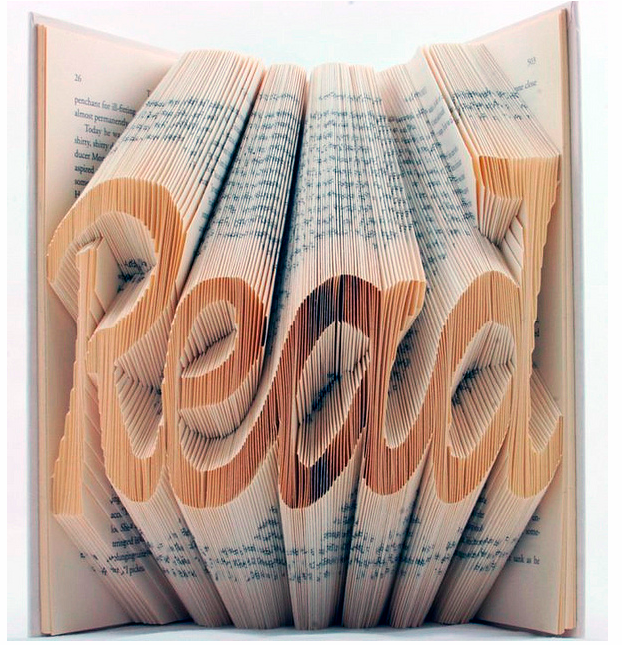
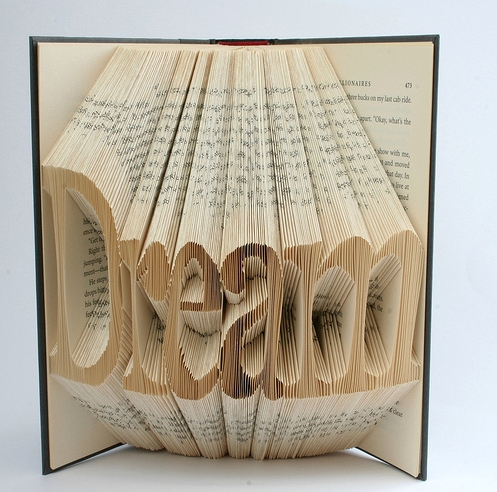
I love this and had to post it. Isaac Salazar creates works of art by folding pages of old books:

“I see my work as a way to display a meaningful piece of art onto a book that would otherwise sit on a shelf and collect dust; it’s also my way of recycling a book that might otherwise end up in a landfill. The words or symbols I use are drawn from anything that invokes inspiration or encouragement, such as “Read”, “Dream” and the Recycle symbol. If my work also makes people look at a book and even art in a new light then the piece has done its job“

For more pictures, check out bookofart on flickr, or you can purchase his work on etsy.

(Via recyclart.org)

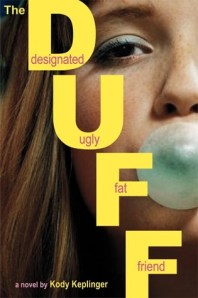
The DUFF (Designated Ugly Fat Friend) by Kody Keplinger

While I saw a lot of positive reviews for this book, I wasn’t in love with the premise — a girl begins a sexual relationship with a guy she pretty much hates? Hmm. What made me decide that I would give this book a try was this review from Debbie’s World of Books. I’m glad I did.

The Premise: Bianca Piper is a cynical high school girl who spends her time with her two best friends, Casey and Jessica. One night at the local teen hangout, Wesley Rush, the resident “man-slut”, who Bianca cannot stand, begins a conversation with her. His purpose? To get to Bianca’s friends via their weakest link — the Duff, aka the Designated Ugly Fat Friend. Thoroughly disgusted by Wesley’s hurtful label and slimeball plans, Bianca throws her Cherry Coke in his face, gives him what for, and storms off. That probably would’ve been the end of that, except that soon after, Bianca discovers that her often absent mom wants a divorce. So Bianca seeks escape in a physical relationship with Wesley. What was meant to be a distraction has complications that Bianca never intended.

My Thoughts: It blows my mind that this author is 18 years old. Eighteen! The writing doesn’t suffer for it. I think that instead, her age is a strength — the teenage voice in The Duff was more honest and believable than many of the YA books I’ve read lately. Bianca, the narrator, is full of snark and bluster, particularly around her friends (and Wesley who she never holds back from), but she feels like a real teenager. Sure, not all teens are as free with their expletives or as sexually experienced as Bianca, but I could relate to his girl and where she was in her life.

OK. Sneaking around to have sex with the boy you hate is not the healthiest way to deal with your problems. In fact, it is the opposite of healthy. But I could believe Bianca’s need to be distracted from her personal problems (what is reading if not a distraction?), and Wesley is an easy distraction. Bianca manages to ignore what’s going on for a little while,  but it all catches up with her. There’s a clear message that there are consequences for what she does: the distancing from her friends that she’s hiding things from, the emotional entanglements, and the possibility of pregnancy or disease (touched lightly, but it’s there). And Bianca isn’t not the only one who learns that you can’t run away forever.

On the other hand, Bianca is really lucky how things ultimately worked out. Wesley easily could have been the bastard she calls him, and the emotional repercussions of their numerous sexual encounters while messy, could have been much more messy. I liked Wesley by the end of this book, but a small (practical) part of me stayed resistant. I think this is where life experience colors the story, but I’m willing to see him as a character with flaws and I could let my disbelief go enough to enjoy the ending, particularly because I wanted these two to work things out. The chemistry between Bianca and Wesley was quite perfect, and I did love their semi-disfunctional, trading-insults relationship.

The secondary characters in this book all had what felt like realistic relationships with Bianca. Her relationship with her parents showed an awareness of their flaws but they do care about their daughter. Her father’s relapse may have been on the dramatic side, but Bianca’s reaction to it was believable. I also loved Bianca’s friendships with Casey and Jessica. The three girls have differing personalities but they each fit a role within their group.  There’s a lot of love and loyalty amongst the three, and when Bianca realizes that she’s the Duff of the group, it doesn’t make her search for new, less attractive friends to make herself look better. And realistically, there is worry and hurt feelings when Bianca distances herself from them because of her problems.

The idea that you are not your label is probably the Big Message of this book, but I think it’s an important message, and one that really affects self-esteem. The fact that everyone feels like the Duff, and that one should look beyond a label is something I wish more girls would believe. I liked that Bianca’s choices lead her to these truths.  

Overall: While I don’t agree with how the main character initially dealt with her problems, I liked the lessons she ultimately learned, and there was something refreshing in reading a book that embraced sexuality and expletives. I’d recommend this one if you feel like you can look past the idea of a teen’s using sex as an emotional outlet, because this story has a snarky teen voice that I loved because it felt real and honest.

Buy: Amazon | Powell’s | The Book Depository

Other reviews:
Debbie’s World of Books – positive
Karin’s Book Nook – 5 out of 5
Steph Su Reads – 4.5 out of 5
Book Fare Delights – 4 out of 5
Sophistikated Reviews – 4 out of 5
Pop Culture Junkie – 4.5 out of 5
The Story Siren – 5 out of 5
The Hiding Spot – A+
Book Crazy – 5 mushrooms (must read)

Deborah Harkness on her book, A Discovery of Witches (w/ Giveaway)

I’m currently reading A Discovery of Witches (coming out February 8th), and hopefully my review will be out sometime next week. In the meantime, I have something special today: a few words about the book from it’s author Deborah Harkness. Viking has also generously offered a copy of the book to giveaway (US and Canada only), so be sure to scroll down for the details after reading her words.


Why does a history professor decide to write a novel about witches? It’s a good question!

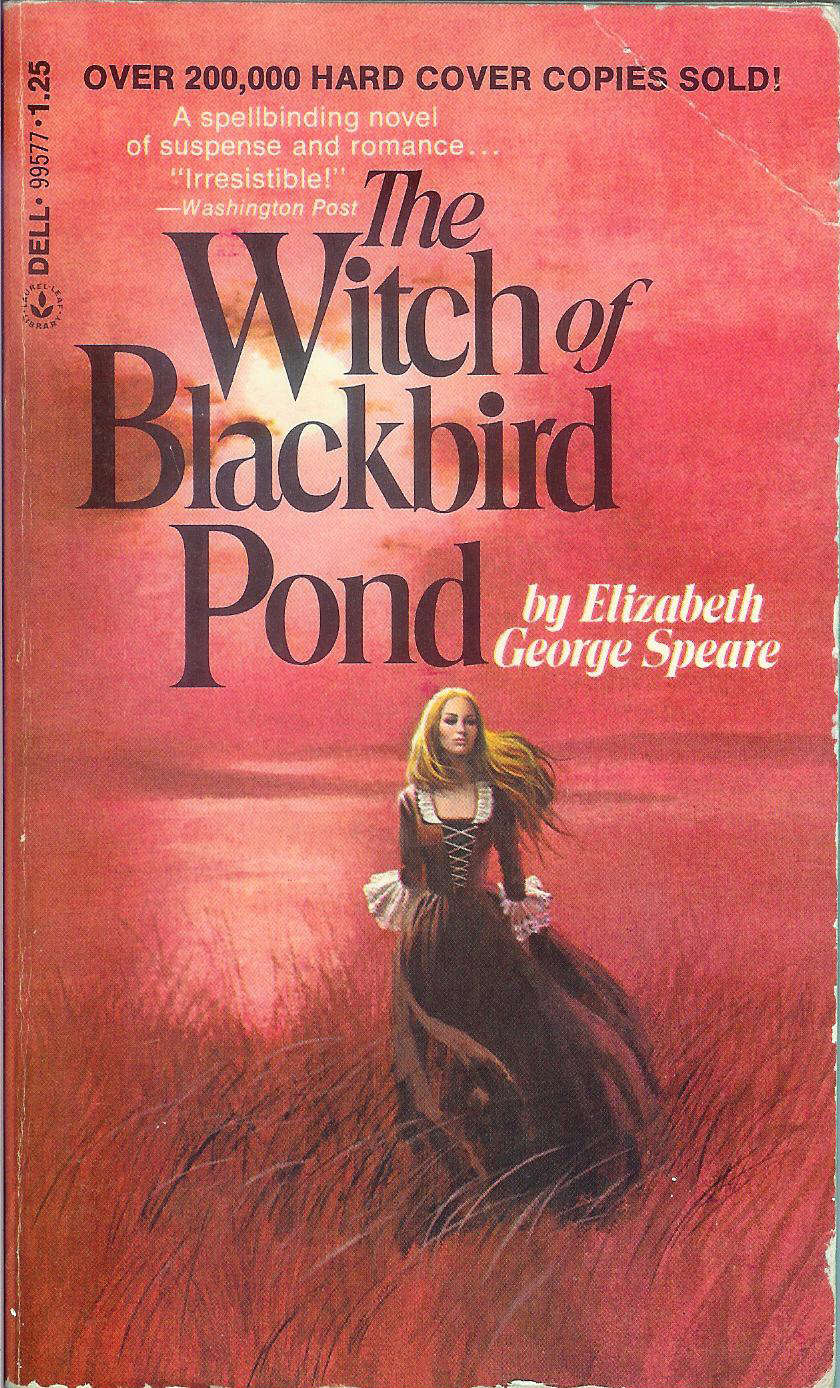
Writing a novel is a mysterious process and many of my life experiences went into A Discovery of Witches. One of my favorite books as a child was Elizabeth George Speare’s The Witch of Blackbird Pond. The history of alchemy and magic caught my interest as an undergraduate, and I’m still fascinated by these subjects today. And, once upon a time, I discovered a lost alchemical manuscript—although it was not (so far as I know) enchanted.

A Discovery of Witches tells the tale of a reluctant witch named Diana Bishop and her discovery of a long-lost alchemical manuscript at Oxford’s Bodleian Library. There, Diana meets Matthew Clairmont: a geneticist who happens to be a very old, secretive vampire. Witches and vampires are traditional enemies, but Diana and Matthew grow closer as they try to puzzle out the manuscript’s significance. Their search for answers takes Diana and Matthew from Oxford, to his ancestral home in France, to her family’s farm in upstate New York. But they are not the only creatures who want to solve the mystery of manuscript, and their fellow daemons, vampires, and witches frown upon their unorthodox relationship. Are these just old prejudices, or is it something more?

Our culture’s renewed obsession with witches, vampires, and other things that go bump in the night has been fascinating to me as a historian. I’ve gone from needing to explain what alchemy is to having my students all nod wisely whenever Nicholas Flamel is mentioned. Parents have confessed that they’ve been staying up late to read their kids’ copy of the latest Harry Potter. Our reading habits reveal that even grownups need a little magic—with the limitless possibility, unpredictability, and even chaos that inevitably comes with it. My goal with A Discovery of Witches was to write a fairy tale that was mesmerizing but spoke to adult issues and concerns. I tried to create characters who were strange—yet strangely familiar. Many of us will recognize ourselves in Diana, who has so much power but is afraid to use it. Others will empathize with Matthew’s inability to let go of his 1500-year past—even though we have less of a past to worry about! And still more will wonder, while riding the train or sitting in a meeting, if that strange creature opposite just might be a daemon or a vampire.

It it’s magic you need this winter, I hope that you find some in A Discovery of Witches.


Giveaway details:

1. Email janicu[at]gmail[dot]com with the subject A DISCOVERY OF WITCHES GIVEAWAY, and with “please enter me” or something like that, and that should be it.
2. One email per person please.
3. This giveaway is US and Canada only
4. This contest ends one week from now: midnight EST February 1st.

For a second chance to win, along with an excerpt of the book check out this post at Fantasy Book Cafe!