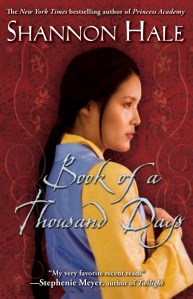
The Book of a Thousand Days by Shannon Hale

This is a retelling of a lesser-known fairytale (Maid Maleen) that I have been meaning to get my hands on for some time. I finally found a copy while perusing a new used bookstore in Sedona, AZ (where the parents and in-laws live) and read it over the end of last year.
 
The Premise: Dashti is a mucker girl who gets a job as a lady’s maid on the very day that her lady is imprisoned in a tower for seven years. This is because Lady Saren refuses to marry Lord Khasar, claiming a prior engagement with another nobleman – Khan Tegus. While Lady Saren’s father shouts and the other maids run away, Dashti vows to stay beside her lady. The two girls are holed up in a small tower, and Dashti begins a journal detailing their days. Both Lady Saren’s suitors come by: Lord Khasar to taunt and torment them, and Khan Tegus to speak, but Lady Saren commands Dashti to impersonate her with Khan Tegus. As months go by and turn into years,  the food supply dwindles and Lady Saren settles into a dark depression. Only Dashti’s no nonsense attitude and faith in her gods keeps her from losing all hope herself.
 
My Thoughts: This is a epistolary novel told through Dashti’s entries in her journal, which she names “The Book of A Thousand Days”. From the get go, Dashti proves to be a heroine familiar with having to persevere when times are tough. She is a mucker – used to a nomadic lifestyle that depends on things beyond human control. She’s weathered a few hardships before selling her last animal for a job in Lady Saren’s household.  When Lady Saren, a young girl like Dashti herself, is put in a tower by her own father, Dashti is the only servant willing to take care of her lady.
 

    My lady was squeezing my arm so tightly now, my fingers felt cold. One of her cheeks was pink from his slap, her brown eyes red from crying. She reminded me of a lamb just tumbled out, wet all over, unsure of her feet and suspicious of the sun.
She’d be alone in that tower, I thought, and I remembered our tent when Mama died, how the air seemed to have gone out of it, how the walls leaned in, like to bury me dead. When Mama left, what had been home became just a heap of sticks and felt. It’s not good being alone like that. Not good.
Besides, I’d sworn to serve my mistress. And now that her hair was fixed and her face washed, I saw just how lovely she was, the glory of the Ancestors shining through her. I felt certain that Lady Saren would never disobey her father lightly. Surely she had a wise and profound reason for stubbornness, one blessed by the Ancestors.
“Yes,” I said. “I’ll stay with my lady.”
Then her father up and slapped me across my mouth. It almost made me laugh.

I liked Dashti a lot. Not only does she have skills for survival, but she also knows how to write and how to sing mucker healing songs. She’s self-sufficient, unlike her lady, who falls apart inside the tower. Dashti is the one looking at how much food they have and rationing it, worrying about the mice, cleaning, fetching water, and going about the day to day tasks of survival. Faced with a problem, Dashti doesn’t sit around – she does something. She’s just as worried as Lady Saren is that they may not survive, and yes, every so often she cries and despairs, but she picks herself up and carries on.

Day 528
Today I thought I would like to die, so I went into the cellar and smacked a few rats with the broom. It helped some.

As much as Dashti has skills that her lady does not, Dashti considers herself a servant and of a lower class than her lady. The class boundaries are very clear in her mind, and while others would think ill of Lady Saren for her uselessness in the tower, Dashti does not. Dashti believes in the gods and that the gentry have the mark of the Ancestors on them. It is Dashti’s job as a servant to obey and make her lady’s life easier. In many ways, Dashti’s unwavering belief make her something of an innocent, but I found her faith and heart endearing. It made her character very pure of heart, which fit well within the fairytale structure of this story.
 
When Lady Saren’s suitors pay them a visit at their tower, Dashti begins to realize why Saren refuses to marry Lord Khasar and prefers Khan Tegus. While Khan Tegus is likable, Lord Khasar is terrifying. Lord Khasar is a power hungry ruler who wants to take over all the Eight Realms. In this fairytale retelling, Lord Khasar is very clearly the bad guy while Khan Tegus is the Prince Charming of the tale, but the story puts a little twist to both the concepts. There is both a romance and a vanquishing in this story, and I don’t want to go into it and spoil anyone’s fun, but I have to say that both had me cheering.  I think that the structure of the story, as a series of journal entries, forces the narrative to sometimes focus on the mundane details over action, but I never found myself bored. Instead I was charmed by Dashti’s voice and her evolution from an ordinary lady’s maid into someone who could be the Hero of the story. I couldn’t predict what way the story was going to go, but I loved the way it unraveled.
 
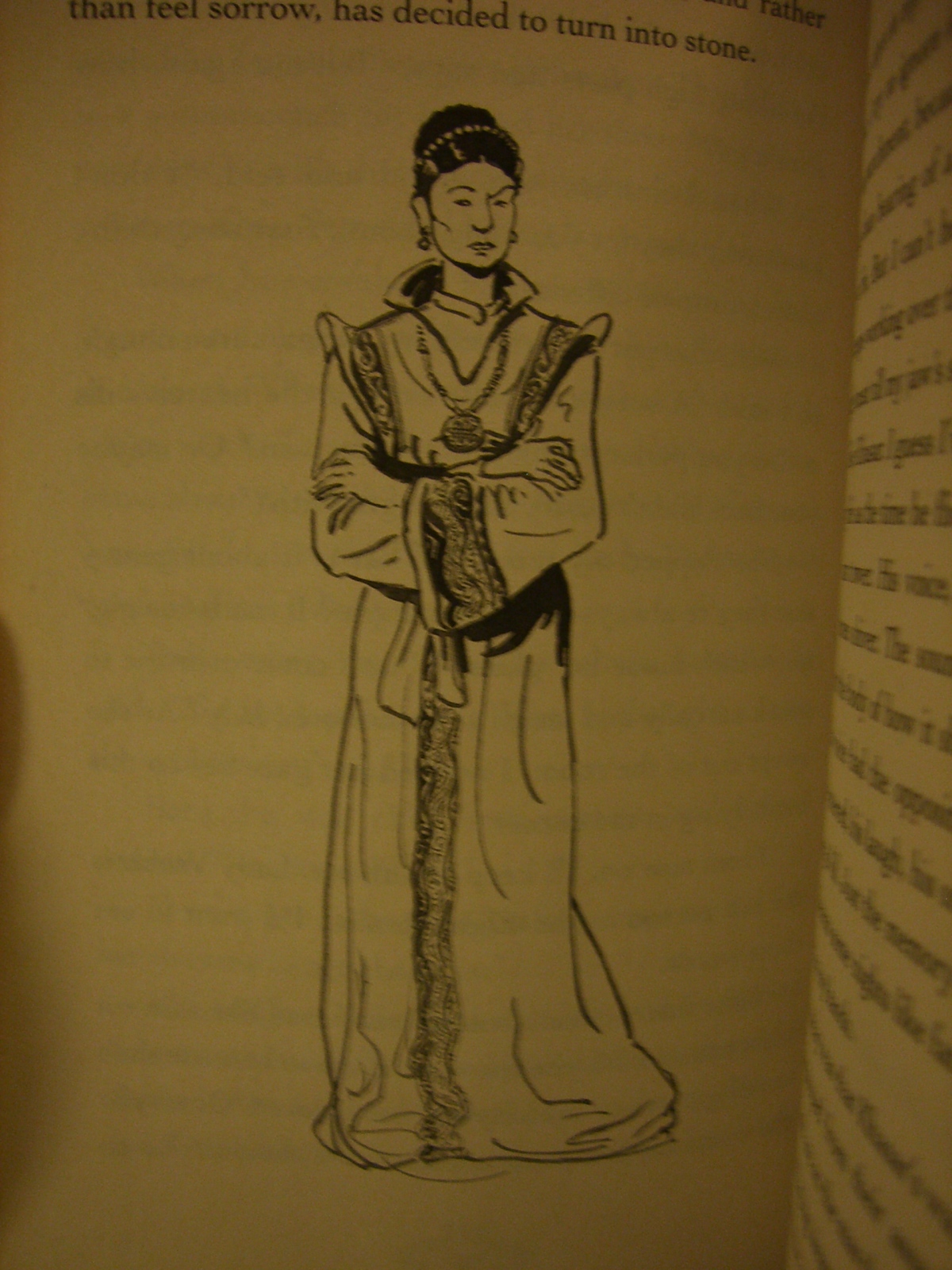
I also loved that this story had a Mongolian influence. The Eight Realms and the Gods as Dashti knows them are clearly from Hale’s imagination, but the clothing, the animals and landscape, and many other details are very Asian.  There are also a lot of charming drawings that pepper the text which underline that these characters have Asian features. I really enjoyed reading a story that was so steeped in this sense of place.


Overall: This could be my favorite Shannon Hale story. I like a lot of Shannon Hale’s stories, but The Book of a Thousand Days had such an endearing heroine: a maid with a big heart who is determined to take care of her lady. It was heartwarming to see such a good character get her happy ending. This hit the right “fairytale” note while mixing in fantasy and Mongolian inspired story elements. I’m calling it a keeper.
 
Buy: Amazon | Powell’s | The Book Depository
 
Stephanie’s Written Word – positive
SFF Chat – positive
My Favourite Books – positive
need_tea – B
christina-reads – positive
temporaryworlds – 5 out of 5 stars
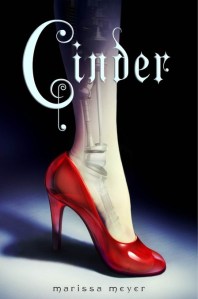
Cinder by Marissa Meyer

Cinder
Marissa Meyer
As a fairytale retelling with a cyborg Cinderella, and set in “New Beijing”, Cinderpromised to deliver a story containing some of my favorite themes. I’ve had high hopes for this one so when I saw a contest for an ARC, I made sure I signed up. This review is based on an ARC copy I won from the publisher.
 
The Premise: It’s now 126 T.E. and in the teeming city of New Beijing, Linh Cinder is a talented mechanic who works out of her stall at the Weekly Market. While she’s a teen-aged girl, not your typical store owner, she’s also a cyborg, and thus the property of her stepmother Adri,  who uses Cinder’s income to run the household and keep her two daughter’s Pearl and Peony in relative comfort. Adri has no love for Cinder, and the feeling is mutual. Cinder’s life is not easy, but even the limited peace she has is gone when the plague comes to her home. While things are at their lowest point with her step-family, Cinder finds herself entangled in international politics and in the life of Prince Kai, heir to the Eastern Commonwealth. Somehow this is all tied to her own past and the ruthless Lunarians poised to take over the planet.
 
Download the first 5 chapters in Kindle format here
Download the first 5 chapters in eBook (nook) format here
 
My Thoughts: This story starts off very well. It begins with Cinder at her usual stall in the market, a space that is obviously her own.  I loved the way Cinder’s skill as a mechanic and her ostracization as a cyborg are incorporated with the sights and sounds of the New Beijing marketplace. When Prince Kai arrives, incognito and carrying an android for Cinder to work on, he has no idea that Cinder is part machine. Cinder, faced with a cute boy that every girl in the city has a crush on, isn’t eager to reveal something that she’s vilified for on a constant basis. It was a great opening scene and the tension of secrets between the two characters added something to the whole meeting. Another great dose of drama is added when there is an outbreak of letumosis nearby, and the reader is made aware of this deadly and horrifying disease and how its victims are treated.
 
That was all on the first chapter. I was happy with just the thought of a story that contained Cinder, the prince, and letumosis, but the story becomes much larger in scope. Beyond Cinder and her step-family (whom we are introduced to soon after Cinder and the prince), are world-wide machinations. It isn’t long before Cinder’s world is upended and she is involved in a frantic see-saw between trying to save a loved one from letumosis and trips to the palace where she continues to run into Prince Kai and discovers surprising things about both herself and the Lunarians. All the while, Kai has his own problems. His father has the plague too, and the diabolically evil Queen Levana wants the seize power through marriage to an inexperienced young monarch.
 
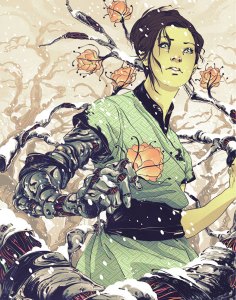
I really liked Cinder’s character. She is a girl who doesn’t have many supporters but she makes the best of what she has. She knows how to fix things, she has a realistic attitude, and she’s rather scrappy when things go south. I adored all the little reminders of her cyborg status like readouts and her leg compartment that liberally peppered the story. Kai struck me as a generally nice guy trying to do the right thing under trying circumstances. There are brief sections of this book told from his point of view.  Overall, he’s not as well fleshed out as Cinder, but his frustration at his father’s sickness and the way the Lunarians are exploiting the situation is palpable.
 
There’s an obvious intent for there to be a romance between the two characters but the romance is not quite there yet. I had the impression that there was an instant like between Kai and Cinder, but that’s as far as it goes. With the weight of the world on their shoulders and with moments in each other’s company, it was a stretch to believe Kai would have any interest in Cinder being at his ball. Thankfully, the book didn’t try to sell me on a full-blown love between the two, which saves things somewhat, but it does skirt on the edges of disbelief without really going over. I think that the real romantic development is being saved for later books. I hope that the characters can spend more time with each other before the romance really happens.
 
Actually, a lot of this story felt like it was set up for later books. There are several ongoing threads that deal with Cinder’s past and her true identity which obviously won’t be resolved in this book. Unfortunately, there was a bit of frustration with having Cinder kept ignorant until the book’s climax. I could see where the story was manipulated there. I think that with the intent for this to be the series, it also necessitated that the Cinderella formula wasn’t adhered to in Cinder and the introduction of the ultimate bad guys – the Lunarians, in particular their evil queen. As bad guys go, I much preferred Cinder’s stepmother, who misdirects her anger and grief at her losses toward Cinder. Andi was a villainess with a motivation I understood. The Lunarian queen is just felt evil for no reason. Yes, fairy-tale bad guys are usually like that, and taken from that perspective, she is typical, but I wish Cinder could have stuck more to the original than it did.
 
I also was hoping to have a better sense of place in this story than I did. Other than the marketplace introduced all the way at the start of the book, there was little to show that the story was set in New Beijing. The only thing to indicate where everyone lived was their names. Even while preparing for the ball, the ballgowns sounded western: satin and tulle, big and fluffy, rather than silk and embroidered. I felt like the author had a missed opportunity in not making New Beijing a presence in the narrative.
 
Okay, so I have my complaints about this story, but none of them were deal breakers. There were things that I think affected my enjoyment of the middle part of the story, even though Cinder is well written and flowed well. I just found the middle part of the story not as compelling as the beginning and the end. There were parts that dragged because I felt like I could see what was going on behind the curtain. The ending was a good one though – it sealed my like of Cinder’s character and I enjoyed how the fairytale elements showed up. We’re left with plenty to look forward to in the sequels. Cinder continues with Scarlet (inspired by Little Red Riding Hood), Cress (Rapunzel), and Winter (Snow White). I will be interesting to see how the series plans to keep Cinder’s story within the frame of stories meant to be about other characters.
 
Overall: I loved the premise of a cyborg Cinderella so much that I wanted this story to really wow and excite me the way the premise did. The execution was good, but it didn’t thrill me like I wanted to be thrilled. The beginning and the end were great, but the middle suffered under the weight of being set up for a series and I had several qualms with the setting, romance, and antagonists. In the end, I liked Cinder, but it wasn’t a home run. I’d recommend this with reservations.
 
Buy: Amazon | Powell’s | The Book Depository
 
Other reviews:
The Book Smugglers – 6 (Good, recommended with reservations)
Good Books and Good Wine – loved it
Books and Things – 3 and a half stars (out of 5)
Pirate Penguin reads – positive
Giraffe Days – 4 giraffes (out of 5)
The Cozy Reader – a perfect score
On the Nightstand – “highly readable blend of science fiction and fairytales”
The Canary Review – 3 canaries (out of 5)
The Book Pushers – C+
Inkcrush – “It would have sucked me in big time when I was a teenager. I liked it as an adult.”
 
Other links:
Glitches” — a short story that prequels Merissa Meyer’s CINDER

The Scorpio Races by Maggie Stiefvater

The Scorpio Races
Maggie Stiefvater

So I have never read Maggie Stiefvater before. Despite the lovely trailers and generally good reviews, I just haven’t been interested in the teenagers and werewolves or the teenagers and the faerie. But, killer seahorses? I am interested in that. I picked up a copy of The Scorpio Races as BEA, and still, for some reason or another, I held off on reading the book until the reviews started to trickle in and everyone whose taste I trust loved this book. Finally, finally, I started to read it, and was so happy to find that it lived up to all the hype. I loved this one.
 
The Premise: Every November on the wild and remote island of Thisby, there is a race. Every year, tourists and locals watch riders race deadly water horses known as the capaill uisce on a small strip of beach. And every year, someone dies. The Scorpio Races can mean a lot of money if you are lucky and skilled enough to win, but injury, or more likely, death, occurs for the not-so-blessed. For three of the last four years, Sean Kendrick has won the race for his employer, Benjamin Malvern, the most wealthy man on the island. Sean’s father died at the races, but Sean has worked at the stables since he was ten and is the island expert when it comes to the capaill uisce.  This year, Puck Connolly has also decided to join the race, even though she never had an interest in the races nor any love for the creatures responsible for her parents’ deaths. No interest until her brother Gabe announced his intention to leave the island, making Puck desperate for any excuse to keep him around. Puck has no experience, no capall uisce, and no idea what she is in for.
 
My Thoughts: The Scorpio Races begins with a prologue where Sean Kendrick is a ten year old boy who watches as his father is trampled in the annual races. The images of crowds of men and flesh-eating capaill uisce, then his father’s body lying on the beach are violent and memorable. Sean’s reaction, that fear was his father’s mistake, lingered in my mind long afterward. Clearly, Thisby is not a place for the weak of heart.
 
The island is a harsh and unyielding locale, and those who live on Thisby are no strangers to death and heartache. People often move to the mainland, where work is safer and more profitable. Sean lost his mother to the mainland, and his father to the Races, and has been working at the Malvern stables ever since. A man of little words, Sean keeps to himself but is respected for his way with the uisce and for being the returning champion. There is only one living thing he really loves: Corr, the water horse that he rides for his employer. On another part of the island, Puck Connolly elks out a meager living with her older brother Gabe and younger brother Finn. Her story has a similar tale of loss – both her parents were out fishing when they were killed by the uisce. Puck just wants to keep what’s left of her family together, but making a decent living is hard, and Gabe wants to leave. That’s when desperation takes over and Puck announces she’ll be riding in the Races.
 
The story takes its time, alternating viewpoints between Sean and Puck. Usually, I am not a great fan of alternating viewpoints but in The Scorpio Races it was done very well. I loved how this place is reflected in Sean and Puck’s characters and in so many people in Thisby. This wasn’t a story where I’m told something is dangerous but nothing dangerous ever happened. No, here, people die, bad things happen, and you hold your breath while reading because the story is often a hairbreadth away from something awful. The capaill uisce are the real deal. Yet, these terrifying creatures are a part of Thisby – the only place in the world where these creatures come to shore. Sean muses that it is because this is the only place where they are loved. I think that Stiefvater succeeds in creating an atmospheric setting, one that feels magical but also very real and dangerous, but also made me believe people would pick the island and flesh-eating water horses over safety.
 
As Sean and Puck prepare for the races, their reasons for wanting to win become more serious, and both have big obstacles in their way. I won’t get into these reasons or obstacles, but let me say: I couldn’t decide who I wanted to win more. And as they meet and get to know each other, I don’t think Sean and Puck know who they want to win either. Along the way, they’ve begun an attachment that is of the quiet but deep variety. Theirs is a romance of little words but their gestures speak volumes. A single touch or a family dinner carries great meaning and had me swept up in their relationship. When Sean does speak and make his move, it hits you like a ton of bricks.
 
All of this atmosphere and quiet romance and struggle culminates in one thing: the Scorpio Races themselves. This is the part of the story where I was feverishly flipping the pages, and it is over quickly, but oh, is it awesome. I finished off this story with a mix of elation and contentment.
 
Overall: The Scorpio Races is quiet perfection. It was one of my top reads of last year (honestly, it ties for number one). This is an incredibly well-crafted tale set in a fierce and beautiful island, with just the right touch of the otherworldly and steadfast characters that persevere. It’s a story that is thoughtful and gradually builds up it’s characters and relationships, and it’s not for those that require instant gratification. My kind of story.
 
Buy: Amazon | Powell’s | The Book Depository
 
Other reviews:
Angieville – “perfect”
Chachic’s Book Nook – “One of my favorite books read this year”
The Book Smugglers –  8- Excellent and leaning toward 9
Escape In a Book – 4 (out of 5)
Jane of All Reads – positive
Book Harbinger – “in the running for my favorite book of the year”
 
Book Trailer:

Brightly Woven by Alexandra Bracken

Brightly Woven
Alexandra Bracken

The Premise:  All Sydelle Mirabel has known her entire life is her village, a place far from the beaten path and suffering under ten years of drought. Then one day a rogue wizard named Wayland North arrives in her desert, bringing with him rain and warnings. Sydelle’s village is caught on the cusp of a war, and Wayland has to return to the capital to prevent their country being drawn into needless fighting. When asked for what he wants in return for ending their drought, Wayland chooses Sydelle. Before she knows it, Sydelle is traversing the country with the somewhat disreputable and secretive wizard and trying to dodge the efforts of Wayland’s enemy. Despite a rocky start, Sydelle begins to discover all of Wayland’s secrets, including the ones about herself, and she’s not just the simple weaver she thought she was.

My Thoughts: I went into this book expecting a fantasy story with adventure and perhaps romance and while this is enjoyable and has these elements, it doesn’t quite meet my expectations. But before I go into what didn’t work for me, let me go into what did. The world building was of your typical fantasy fare (and a very wholesome one at that), but the magic systems and beliefs of Palmarta and its neighbors were nice ideas. It liked discovering how magic worked alongside Sydelle as Wayland use his different colored capes to cast spells. It was interesting to have Sydelle’s perspective – that magic is a gift from their goddess, clash with Wayland’s, who doesn’t pray or think that his gift is for defeating wicked things. I also liked the idea of ranking amongst wizards and how the wizards they met upon their journey would more often than not pompously declare their ranking number. The non-ranked, hedge witches who came into existence because women were not allowed to be ranked was another thoughtful detail, as was Sydelle’s own connection with magic.

The big problem was that although I found the story enjoyable, it always felt a little superficial – like I was catching glimpses of what the story could be, but wasn’t. It just didn’t feel like the execution matched the promise.  Maybe part of that is the pacing of the story – Wayland and Sydelle are on a journey and have little time on their pit stops to their final destination. Instead we get a blurry impression of places before their goal or their pursuer pushes them to rush to the next place. Still, I should expect to feel a connection to Wayland and Sydelle from following them on their journey, and I don’t. I got the impression that Wayland is supposed to be something of a mischievous charmer, but instead he came off as just young and irresponsible. Yes he can do magic and is trying to prevent a war, but he also gets drunk at the drop of a hat (in the middle of his mission), can’t be straight with Sydelle about what’s going on, gets sullen when confronted with his mother and goes off to sulk when Sydelle hugs another man. When Wayland’s secrets are revealed in the story, for me, they didn’t quite explain away his behavior. For her part, Sydelle tries to be Wayland’s conscience and proves to be a heroine who acts bravely in bad situations, but she also get upset in ways that felt more than the situation warranted. She got annoyed at Wayland at one point and ran into the rain by herself in a strange town. I should understand why she is so upset and feel a connection to her feelings when she is going through this, but I don’t. Instead I feel like she’s overreacting because it seems to happen out of the blue. Maybe she’s only sixteen and Wayland is just eighteen and it shows, but I don’t think that it’s just that I’m too old to relate to them. I think there just isn’t enough there to relate to.

While I found Wayland and Sydelle difficult to connect to, the secondary characters were just one dimensional. There’s the jolly friend, the evil (and physically scarred) bad guy, the young queen, some throw-away side characters. I felt like they were mostly there for convenience to carry to story forward and none left me with much of an impression.  I wanted more there, especially Wayland’s mother, who I think could have an interesting back story is just as cardboard – horrible one minute, then having a convenient change of attitude the next.

The romance felt like it lacked that initial spark. I think that I’m supposed to infer some attraction when Wayland swoops into Sydelle’s life and whisks her away within his cape, but it felt like his magic was magical to her, not his presence.  When Sydelle gets angry at Wayland, it is not the banter of two people falling in love. It is a scared, half-hysterical girl redirecting her anger at only person she can. Still not romantic. Then suddenly,  Sydelle likes Wayland, and Wayland is touching her hair and getting possessive. I wished I could have seen more behind this relationship, but if I put that aside, there are sweet moments, and the story does end on a nice romantic note. I just (again) wished for more there.

Typing out this review, I feel more critical of the book now than when I was actually reading it. While I was in the middle of Brightly Woven, I found it a pleasant read even though I wasn’t connecting to the characters. The writing is good and there’s a lot of promise. It’s not there yet, but the bones are. I liked the concepts and what there was, I just wanted more.

Overall: This is a young adult fantasy that is a light and a pleasant diversion, but it didn’t fully meet my expectations. While enjoyable, it felt underdeveloped in many ways and I felt a lack of connection to the main characters. That said, there are a lot of people that loved this one, and I do see enough in this book that I liked to understand why.

Buy: Amazon | Powell’s | The Book Depository

Other reviews:
Karissa’s Reading Review – 4/5 stars
The Crooked Shelf – loved it
Sophistikatied – positive
christina_reads – “not bad, but it’s not great either”
The Allure of Books – loved it
Debbie’s World of Books – “disappointed”
SFF chat – “a disappointment”
The Hiding Spot – B
Books and Other Thoughts – “enchanting”
Chachic’s Book Nook – “satisfying fantasy read”
The Book Harbinger – “a fun and light YA fantasy”
Brooke Reviews – “really fun read”
Angieville – “a lovely surprise of a story”

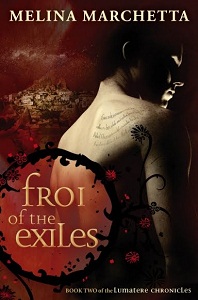
Froi of the Exiles by Melina Marchetta

Froi of the Exiles
Melina Marchetta

It was a few weeks ago that I read Finnikin of the Rock, and although I found the book dark, there was enough light bits in the story for me to finish without trouble and overall would say I enjoyed it. Since Froi of the Exiles was up on Netgalley, I decided to request it to see how the story would continue. Since I’d already known the second book would be about Froi, I paid attention to his character in Finnikin and I was curious if I would like a story about a character I found darker than Finnikin or Evanjalin.
 
This review will have minor spoilers for the first book, so if you are interested in this series, I suggest you start there (https://i0.wp.com/i58.photobucket.com/albums/g254/jayamei2/livejournal_com.gifhttps://i0.wp.com/i58.photobucket.com/albums/g254/jayamei2/wordpress.jpg). I also warn you that this is an advance review for a book that doesn’t come out till March 2012.
 
The Premise: A few years have passed since Finnikin lead his people back to their beloved homeland, but Lumatere is still struggling with the horrors its people have seen.The new King and Queen focus on rebuilding and starting afresh, but have a desire for justice still burning in their hearts. They know that the ones behind their country’s ‘five days of the unspeakable’ and the ten year aftermath is the kingdom of Chayrn. So when Charynite refugees and resistence fighters say they have a plan to kill their despot king, Lumatere sends in one of their favorite sons – Froi, to do the job.  It seems that Lumatere is not the only country with a curse, for Charyn is suffering its own form of hell which may or may not be broken by its loony princess Quintana. Not quite understanding this curse, but seeing an opportunity, Froi impersonates a Last Born and infiltrates the palace. In the meantime, there is unease in Lumatere as those closest to the border, the Monts, deal with a slow and steady influx of refugees from Charyn and must battle with their own latent hatreds.
 
My Thoughts:  In this second book, things are somewhat different from the first. It’s much longer (a little over 600 pages on my nook) and wider in its scope.The main character is Froi, but the book constantly switches its focus from him back to individual Lumaterians in Lumatere – mostly Lady Beatrice, Lucian of the Monts, and Phaedra, Lucian’s Charynite wife. This is a book that’s about Charyn and Lumatere.
 
But since the book begins with Froi, I’ll start with him. His character is that of a unlikeable boy-thief rescued from the streets who has now grown into an accomplished young man. He still has trouble with his temper, but he is loved by those who raised him and eager to prove his loyalty to his Queen. When the opportunity to kill the Charyn king who was behind Lumatere’s years of grief presents itself, Froi is the one to go.
 
It’s from Froi’s point of view that we are introduced to Charyn, and it is a dark place. The people are desperate, the king is a tyrant, and it has a recent history of a terrible genocide. When I read Finnikin of the Rock, rape was alluded to, but not directly shown. Here, rape and sex with questionable consent is a common trope. In order to alleviate Charyn’s curse, princess Quintana, an obviously mentally ill girl must have sex with the last born sons of Charyn. I was pretty disturbed by this. I continued to be disturbed when I read the description of Quintana’s lack of care (unwashed hair, often wearing the same dress), coupled with her childlike airs and the voices she hears. The prologue described in heartbreaking detail her penchant for disconnecting during the sex act by making shadow figures on the wall. To warn those who avoid rape in the books they read: Quintana is raped in a scene that squicked the heck out of me, and she is of course, hated and called a whore by her whole country. I don’t think I can begin to describe the way reading this affected me.
 
While Quintana is introduced as a character who is abused, she is also clearly set up to be Froi’s love interest. This is a very difficult thing to achieve, because on her side, we have an abused, mad child, and on his side, Froi is the person who in the last book tried to rape Evanjalin/Isaboe. Part of me has a very, very hard time rooting for Froi after this act, but this story does not try to rewrite history or deny that Froi is a dark character. He is a person tainted with the darkness of his past, and in many ways his darkness makes him a match for Quintana’s own demons. But it was very difficult for me to connect personally to these characters and their romance. I think that while I rooted for their happiness, I could never really love them. They were too alien for me. Quintana is too shifting in her moods and manner, and Froi too self-serving. I did believe Froi’s attraction to a dirty, mad princess with dark calling to dark, but on a logical, not visceral level.
 
I also think that the romance was difficult to get lost in with all that happens in the story. This was an incredibly heavy book. A sense of either shocked horror or utter despair pervaded my whole experience. As the story continued, I hoped for better things to come, but one calamity seemed to follow the next. When innocents are not being killed in Charyn, we’re treated to the problems in Lumatere and its border. This includes the drama of unfinished business between Beatrice and Trevanion, who are letting their pain stand between them, and the constant friction between Monts and the Charyn refugees.  Lucian of the Monts struggle as a leader and husband through an arranged marriage was particularly compelling and at times heartbreaking.  I think that there is room here for things to eventually turn out right, but as a reader I felt the balance of this installment of the story slide more towards hopeless over hopeful. When things started on an upward swing, it wasn’t for long. And if you are someone sensitive to rape, this book is a hard hitter.  While Quintana’s rape is on the page, she is not the only one. There are at least 4 other characters that have had this experience, and it is common for the females to be labeled as sluts and whores. This left me full of anger, which I think is the point. I don’t think that Marchetta wants to keep the reader cocooned from the horrors of war and strife, but I was pretty worn out emotionally. There ARE bright spots in the story (like when Finnikin and Isaboe make cameo appearances), but overall, I found this to be a grim book.
 
As with Finnikin of the Rock there are revelations in Froi of the Exiles which are alluded to by prophecy. Again, these secrets weren’t too difficult to guess, but I did have fun being right. The truth of what brought about Charyn’s curse wasn’t as much fun though. More horror and needless killing by the corrupt, basically. It got to the point where I was numb and unsurprised by the evil of those behind the curse, but it was disheartening to read about the past pains of the characters who lived through Charyn’s dark history.
 
OK, so I’ve talked a lot about how dark this book was. Is this a dealbreaker? I think it depends on the reader. Froi of the Exiles ends on an unfinished note, but I am glad I have a year to recover for the next one. I do plan to read it. I wouldn’t have found this story so dark if I wasn’t so caught up by these people and their struggles, and I really want to see all of this end in something good. I’m not eager to reread this book, but I am eager for a happy ending. I hope to see one in the next book, Quintana of Charyn.
 
Froi of the Exiles comes out in March 2012
 
Overall: Compelling but not for the faint of heart. Froi of the Exiles continues where Finnikin of the Rock left off but brings more heartache and strife to the tale, making this story more painful than enjoyable. It widens the scope to focus not just Froi and the kingdom of Charyn, but also on multiple characters still coping in Lumatere. Now the story is no longer standalone and the darkness will hopefully make way for better times, but we’ll have to wait for the next installment to get to them.
 
Buy: Amazon | Powell’s | The Book Depository
 
Other reviews:
No one in my circles have reviewed this yet. Let me know if you have and I’ll link to your review.

Wolves, Boys, & Other Things That Might Kill Me by Kristen Chandler


I’ve been interested in reading Wolves, Boys, & Other Things That Might Kill Me ever since I read Holly’s review where she said her “expectations held up from the first page until the last”. Yup, it was grabbed on an impulse at this bookstore when I was in Southern New England, and I settled into it quite happily when I got home.
 
The Premise:  When the wolves were reintroduced into Yellowstone National park, it was to put the park’s ecosystem back into balance, but for the locals that live around the park, many of them farmers with herds of animals to keep safe, the wolves are a threat to their livelihood. KJ grew up in West End, Montana, and has always been the gawky girl who kept her head down, but lately that has changed. KJ is suddenly getting noticed – both for growing out of her awkwardness, and for speaking out about the wolves.  Everyone has an opinion on this hot topic, and not everyone is happy with KJ’s involvement. Even KJ’s taciturn father, and Virgil, the boy she has a crush on, don’t always see eye to eye with her on the wolves. The more KJ tries to make things better, the worse it seems to get.
 
My Thoughts: Wolves, Boys & Other Things That Might Kill Me is a YA that stands out from the pack. Yes, it is a coming of age story like a lot of YA out there is, but I felt like there was a different air to KJ’s character than your typical teen-aged girl. Maybe it was her upbringing in Montana with a gruff and outdoorsy father, or maybe it’s the many embarrassing experiences already under her belt, but in this story KJ has a quiet assurance that she never seems to lose. For example, when she comes back to school her junior year looking less “like a Peppermint Patty” and gets comments from friends, she may be perturbed at first, but soon moves on. It was so nice NOT to read about a teen girl who sweats over what other people think or want. That’s not to say that KJ doesn’t come across as the young and inexperienced kid she is – she does that plenty. It’s just that being self-sufficient and following her own council are not things she needs to work on.
 
Instead, for KJ, growing up involves discovering her passion for the wolves reintroduced into Yellowstone.  It’s not really KJ’s intention to be associated with the debate, but she has no choice on the matter when she’s assigned to write a column about the wolves for her school’s newspaper. Her innocuous article that doesn’t condemn the wolves’ presence (and may instead romanticize them), creates a stir from the local farmers. As more livestock is killed, the anger and frustration increases. Wolf-friendly overtures are met with violence.  It’s easy to paint the farmers as narrow-minded hicks, and that’s something KJ thinks at first, but the more she gets involved the more she has to look at the story from the other side and understand where the anger is coming from.  KJ’s straight-talking voice captures the complexity of the whole situation. A cast of characters from Virgil’s wolf researcher mother to the class jerk whose family owns a farm bring perspectives from all sides. There’s even some friction between KJ, Virgil, and her own father over the whole thing
 
Wolves, Boys & Other Things That Might Kill Me doesn’t have pat and perfect answers. It simply shows the muddle that is human life. Even KJ’s romance with the zen new kid, is not immune.  It was nice to see KJ and Virgil’s relationship blossom amongst the wolves and controversy, but they’re also two kids in high school. Like all things in this story, their interactions manage to be special and yet grounded in the real world.
 
I also have to make a mention of the special relationship KJ had with her dad. I loved all the shades of their relationship. He’s tough on KJ and is difficult to have a conversation with (KJ has learned to read her father based on body language and the occasional monosyllable), but he’s also protective. I adored their unique partnership, and for me one of the strongest father-daughter relationships I’ve read in YA. I actually wished there were more scenes with them alone.
 
I’d say that this book was one that quietly laid out the situation and left it at that. Much like KJ, it has no big flashy agenda, it just tells it like it is. I liked this, but it is a subtle sort of strength, not one that makes a obvious impression. For that reason, I feel that not everyone is going to be affected by this story. The other minor criticism I had is that KJ read much younger to me than sixteen.  I had her pegged as a pretty independent twelve or thirteen until I was corrected by the jacket copy which says she’s a junior in high school. I think I would have liked this book a tad more if KJ felt more like a sixteen-year old to me while I read it.
 
Overall: You know the saying “still waters run deep”? I feel like if you take that and apply it to a teenage girl, you have KJ, and that is funneled into the story told in Wolves, Boys, & Other Things That Might Kill Me. I was charmed by the unassuming style of this one, and I liked that it told a self-discovery story that felt real and nuanced. But I also feel that its strength is subtle, easing back from rather than lingering on the dramatic and emotional scenes.
 
Buy: Amazon | Powell’s | The Book Depository
 
Other reviews:
Book Harbinger – positive
Book Fare Delights – 5 out of 5

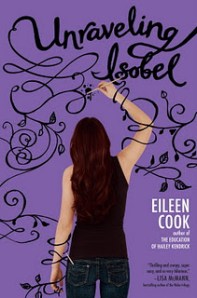
Unraveling Isobel by Eileen Cook

Unraveling Isobel
Eileen Cook

This is a review of an eARC obtained through GalleyGrab.
 
The Premise: When Isobel’s mother meets a man on the internet and marries him three months later, “appalled” doesn’t begin to cover Isobel’s reaction, especially since it means uprooting in her senior year and moving into his creepy estate. Isobel misses her friends, finds her step-father Richard smarmy, and her gorgeous new step-brother Nathaniel hates her. Then weird things start to happen and Isobel begins to think she has bigger problems: either her she’s seeing ghosts, or she’s starting to show signs of the schizophrenia that runs in her family.
 
My Thoughts: Isobel is a grumpy teen narrator, who has nothing but snark when it comes to describing the adults around her.  Next to her mother’s sunny, somewhat oblivious outlook on her new life, Isobel is a dark little cloud, and she recounts her mom’s new marriage and their move to Nairne Island with an amusing lack of enthusiasm.  I understand that can be a very fine line between sounding like a typical teen questioning authority and sounding like a snotty brat, but for me, Isobel comes down on the right side of that line because of the adults around her. The biggest red flag is one that we get practically on page one: Richard (Isobel’s stepfather) had a wife and daughter who died seven months ago.  Isobel’s mother seems willing to overlook this, focusing more on her new marriage as a chance to remake herself with little thought to Isobel’s feelings on the matter.
 
Yes, this is a book with Bad Parents. On one hand, this trope works here because without Isobel’s parents’ choices, there would be no story. We wouldn’t read about Isobel’s trials and tribulations on Nairne, including a stint trying to fit in at school with the popular crowd, or her run-ins with Nathaniel, the other teen in the same dysfunctional boat. On the other hand, their characterization was very convenient to the story. Isobel’s mother was incredibly unaware while Richard was just so self-serving.  While I wished for some more depth to Isobel’s mother and step-father, at least their interactions with Isobel rang true, especially between Isobel and her mother.
 
Isobel and her time adjusting to her new life felt realistic, and the mystery/ psychological thriller aspect of the story was seamlessly interwoven into it. At one moment, Isobel may be calling her best friend to rant about her new life, the next she is having a strange experience that she can’t explain. Things begin to appear in her room which her mother and step-father insist are put there by Isobel herself. She doesn’t know if they are right and begins to investigate the house while fearing for her own sanity.  This felt like a modern version of a Gothic thriller complete with the haunted mansion and secrets in the attic, but it was a very simple story without any huge, surprising twists in the plot. I think the biggest strength was the interesting mix of the Gothic, psychological element with the modern teenage voice.
 
The problem I think was that the story didn’t feel like it went far enough. The beginning was very promising, but by the end I wanted more to Isobel’s adjustment to school and her relationship with her step-brother, and at the same time, I wanted more on the mystery of what Isobel was seeing in her new house. These two plots began with great promise but took a very safe and ultimately very bland route. I never really feared that Isobel was sinking into madness, and there was no real mystery of who the bad guy was. Nor is there any emotional depth in the secondary characters. I enjoyed Isobel’s growth in dealing with her genetic predisposition, but I lamented the way in which Nathaniel went from a brooder with issues to becoming a rather generic character. He lost his personality somewhere along the way.  If this story was deeper and darker, I think it would have pushed it to a higher level.
 
Overall: A really quick, entertaining read. I found the narrator amusing and I liked the mix of contemporary YA with Gothic thriller in Unraveling Isobel, but I think it loses something by not pushing the envelope more. It was fine brain candy for an afternoon.
 
Unraveling Isobel is slated for publication 1/3/2012
 
Buy: Amazon | Powell’s | The Book Depository
 
Other reviews:
I didn’t see any up yet. Let me know if I missed you!

Finnikin of the Rock by Melina Marchetta

Finnikin of the Rock
Melina Marchetta
Ah, the awesomeness of the internet. I bought Finnikin of the Rock at that Greenwich Library sale I went to earlier this month, and Chachic commented that she had the book too and we should do a readalong. Before long, Hollyjoined in. So last week we all read Finnikin and used goodreads and twitter to discuss the book as we read it. So much fun, you guys. Who says reading is a solitary activity? 🙂
 
The Premise: When Finnikin was a boy, he lived an idyllic life in the kingdom of Lumatere. His father Trevanion, was heroic Captain of the King’s Guard. His childhood friends were Prince Balthazar and the prince”s cousin, Lucian of the Monts, and they dreamed of being heroes and ruling the kingdom. Then ‘the five days of the unspeakable’ happened. The royal family is murdered, Balthazar is missing, a false king is placed on the throne, and Travanion is imprisoned. A curse hangs over Lumatere, closing it off from the outside world. Half the kingdom is trapped inside a dark and impregnable force. The people who escaped before the kingdom was sealed are miserable refugees left wandering in lands where they are not welcome. Ten years later, Finnikin is apprentice to Sir Toby, who was once advisor to the murdered king and now looks out for the Lumaterian refugees. One day, they get a message to travel to a remote temple. There they find the novice Evanjalin who claims she walks the sleep of the people still living within Lumatere and who may be the key to bringing Lumaterians back home.
 
My Thoughts:  There was a little bit of a learning curve getting into the story (the prologue took me a little time to understand), but by the time I reached the ‘five days of the unspeakable’, I was up to speed. Present time is now ten years after Lumatere was shut closed, and Finnikin, Sir Topher, and Evanjalin find themselves traversing the neighboring kingdoms as they progress in their desire to help Lumatere. The world building is fairly generic (mostly semi-Medieval societies with the exception of the tribal Yuts) with religions and magic that isn’t explored with great detail. What sets Finnikin of the Rock apart was its unique take on displaced people.
 
With such a serious message, Finnikin of the Rock has some aspects that are darker than your typical YA – rape, torture and suffering are things alluded to, if not directly described. The story tended to hold back from going to far on most things, but the plight of the refugees was very affecting. In particular, there is a pretty surreal scene within a fever camp that is mind-numbing.  There is also an attempted rape which left me cold. Do not let this dissuade you from reading the book! I tend to avoid these things and didn’t find this book as disturbing as I think it could have been. And on the flip side there is a lot of love and hope in this story too. Finnikin was raised by his father and his men when his mother died in childbirth, and the love and protectiveness that the hardened killers feel for this boy as he grows into a man is a reoccurring theme. Finnikin is a product of their hope for Lumatere – outwardly cynical because of what he’s seen, he is still soft when it comes to what he loves. It takes some time to see his character, but it is one of the stronger ones in the book.
 
Evanjalin on the other hand, is not always so easy to read. Secretive but sharp, she feels no remorse in holding back or bending the truth to “do what needs to be done”.  What she hides eventually comes to light, but while I understood the need to keep some things a secret, by the time I was halfway through the book I was tired of her hiding things after there didn’t seem to be a reason to. I found her strong for keeping her own counsel, but on the other hand, too much of it made her overly secretive when she didn’t always need to be.
 
There was a similar problem with the romance being more complicated than was necessary. I could allow for a little less getting-to-know-each-other time than I’d like because the romance was rather sweet, but I couldn’t overlook the number of unnecessary roadblocks. There were hang ups and hesitations when just talking to one another would have solved the issue. It is disappointing not to see deeper communication because it took away from a romance that was thisclose to being very good.
 
Another problem I had was that the story seemed to propel forward during the traveling portions so the characters would be in a new country or town without a sense of how far they traveled or how long it took. I understand that this was to condense the story to the important parts, but the transitions felt too sudden.
 
Maybe I’m sounding very critical of this story, but I did enjoy it. Following the fulfillment of the curse/premonition and the struggle of the characters was compelling stuff. There’s something about Marchetta’s writing that makes me eager to read more. I want to see what happens in the next installment, Froi of the Exiles, which will follow the adventures of a character introduced in this book, and I do plan to read more Marchetta.
 
Overall: This is a fast moving young adult fantasy with a romantic subplot that I liked, but hesitate to recommend it to others because of its sometimes abrupt transitions and over complication of certain parts of the story. If there was time spent on developing intimacy between characters I would have been a lot happier. I did end up enjoying the serious Finnikin and self-assertive Evanjalin, loved the way Finnikin’s father loved his son, and was invested in Lumatere’s survival. Your mileage may vary.
 
Buy: Amazon | Powell’s | The Book Depository
 
Other reviews:
Angieville – “There was so much potential that just never found a grounding point.”
 
Chachic’s Book Nook – “[…]definitely a worthwhile read if you’re an epic fantasy reader or a Melina Marchetta fan but it’s the kind of book that would make you pick up something light and fun afterwards”

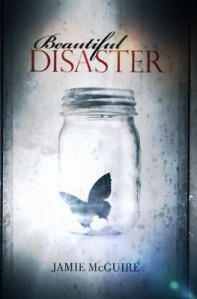
Beautiful Disaster by Jamie McGuire

Beautiful Disaster
Jamie McGuire

Emily and her Little Pink Notes recently called this book “LIKE CRACK”. Needing some sort of book crack, I checked out the Goodreads reviews and discovered a staggering number (over 1270 as of today) 5 stars. Pretty great for a self-published effort. Looking more closely I also saw a lot of criticisms for the story – cheesy characters, a man-whorish love interest, a lot of ridiculous drama. Despite this, people admitted feeling addicted to turning the pages – and hating themselves afterward.
 

Well. I had to see for myself.

The Premise: Abby Abernathy is a freshman at Eastern University, where her plan is to stay off the radar and be a upstanding college student. Only her best friend America, another transplant from Abby’s hometown, knows who Abby is, and that’s how Abby wants it. Everything is going according to plan until Abby is noticed by the legendary Travis Maddox: genius, tattooed bad boy, fight champion, and the biggest player on campus. Abby takes one look at Travis and is not impressed. She’s not going to be another one of his conquests. Unfortunately, her lack of interest only makes Travis more intrigued. Somehow the two become friends, but things get complicated when Travis and Abby make a bet. If Abby loses she has to live with Travis for a month, and if he loses, he will be abstinent for that amount of time. After this wager, the drama truly begins.

You can use Amazon’s Look Inside feature to read the first few pages here

My Thoughts: OK, I understand those reviews in Goodreads now. The book begins with Abby and Travis meeting in a dramatic way that sets the scene for the rest of the story. Abby is a spectator at an underground fight with America and America’s boyfriend, Shep. In the chaos, she’s pushed forward toward the fighters and her pink cashmere sweater is sprayed with blood as Travis’ opponent is KO’ed. As the crowd continues to surge around her, Abby comes face to face with Travis:

“A pair of heavy black boots stepped in front of me, diverting my attention to the floor. My eyes traveled upward; jeans splattered with blood, a set of finely-chiseled abs, a bare, tattooed chest drenched in sweat, and finally a pair of warm, brown eyes.  I was shoved from behind, and Travis caught me by the arm before I fell forward.
“Hey! Back up off her!” Travis frowned, shoving anyone who came near me. His stern expression melted into a smile at the sight of my shirt, and then he dabbed my face with a towel. “Sorry about that, Pigeon.”
Adam patted the back of Travis’ head. “C’mon, Mad Dog! You have some dough waitin’ on ya!”
His eyes didn’t stray from mine. “It’s a damn shame about the sweater. It looks good on you.” In the next moment he was engulfed by fans, disappearing the way he came.

The next time Abby sees Travis, it’s at the cafeteria where he’s:

“[…] followed by two voluptuous bottle-blondes wearing Sigma Kappa tees. One of them sat on Travis’ lap, the other sat beside him, pawing at his shirt”.
“I think I just threw up a little bit in my mouth,” America muttered.
The blonde on Travis’ lap turned to America. “I heard that, skank.”
America grabbed her roll and threw it down the table, narrowly missing the girl’s face. Before the girl could say another word, Travis let his knees give way, sending her tumbling to the floor.
“Ouch!” she squealed, looking up at Travis.
“America’s a friend of mine. You need to find another lap, Lex.”
“Travis!” she whined, scrambling to her feet.
Travis turned his attention to his plate, ignoring her. She looked at her sister and huffed, and then they left, hand in hand.
Travis winked at America, and as if nothing had happened, shovelled another bite into his mouth.

I think those snippets give a pretty good idea of what the writing is like. On one hand I’m scoffing at the dialog and the actions of the characters (and the nickname ‘Pigeon’), on the other, the drama of what’s going on is riveting. Reading this feels like the literary version of watching a Jerry Springer show. I’m fascinated in a sick way. It’s like I’m doing anthropological research on a culture where strange double standards and inconsistencies abound. Travis comes off as some sort of stud who disrespects most woman (because it’s easy to get into their pants), and respects a select few (basically America and Abby).  Abby is affronted by Travis, but he explains that it’s not like he’s tricking anyone before they “spread eagle on my couch”, so this makes it somehow excusable. America sneers quite a bit at the girls who throw themselves at Travis, but not really at Travis. On one page she warns Abby to keep away, but on the next says they should be together.

Abby insists that she and Travis will never get together, but to the reader, it’s inevitable. It doesn’t happen quickly of course, and there’s plenty of drama along the way. The story finds some ways to conveniently push the two characters together, then in similarly, pulls them apart again. Abby continues to insist that she and Travis are just friends even after the bet where has to sleep in Travis’ bed (necessary because there’s no where else to sleep, of course). Abby begins to date a clean cut guy who doesn’t like her arrangement with Travis, but a bet is a bet! In the meantime Travis stops sleeping around and gets very moody, but Abby has no idea why.  Rumors fly and so does Travis’ temper. He beats up a guy for teasing Abby and there are no consequences.

If the story so far sounds on the crazy side, that’s just the tip of the iceberg. Abby and Travis’ relationship is a trainwreck. Travis proves to be manipulative, stalkerish, and codependent. Abby goes back and forth between actually liking this and running away, which makes Travis flip out.  Then there is the out of right field subplot of Abby’s past that involves Luck, Las Vegas, and The Mob. Dude. I could not look away.

Overall: Serious OMGWTFBBQ territory. I feel the same sense of shame in reading this in it’s entirety as I feel in watching episodes of Rock of Love or eating a quart of ice cream by myself¹. It’s bad and I know I should stop, but I can’t. I think it only took me three hours to read. When I think about how much is wrong with this story, from the dysfunctional relationship and cheesy dialog to the poor portrayal of women, I feel regret that I paid money to read it. On the other hand, the drama was so compelling.  Don’t blame me if you read this and can’t look yourself in the mirror afterward.

Buy: Amazon (kindle) | B&N (nook)

Other reviews:
Let me know if you’ve reviewed this and I’ll link it

¹Just as an example. I haven’t actually eaten a pint of ice cream by myself. Nor do I watch Rock of Love, really. But same principle.

A Kiss In Time by Alex Flinn

A Kiss In Time
Alex Flinn

I enjoyed Beastly when I read it last year (my review: https://i0.wp.com/i58.photobucket.com/albums/g254/jayamei2/livejournal_com.gifhttps://i0.wp.com/i58.photobucket.com/albums/g254/jayamei2/wordpress.jpg), so was happy to find a copy of another YA modern fairytale retelling by Alex Flinn, this time a riff on Sleeping Beauty.
 
The Premise: Princess Talia is the sheltered daughter of the King and Queen of Euphrasia, gifted with beauty, musical talent, and intelligence, but also burdened by a curse. She will prick a spindle on her sixteenth birthday and she and the whole kingdom will fall into a magical sleep until True Love’s kiss awakens her.  All her life, Talia has been cautioned against spindles and her terrified parents have made sure she’s never alone. Talia may be cossetted, but she’s also confined. Then the day comes when despite all her parents’ efforts, the inevitable happens. Almost three hundred years pass before Talia wakes up to find Jack, a American  teenager (from Florida) standing over her. Talia is horrified to find out how much has changed: boys can kiss girls without meaning to marry them!
 
Read an excerpt of A Kiss in Time here
 
My Thoughts: The perspective in this book goes back and forth between Talia and Jack, and while both have humorous voices, neither make the best first impression. Talia comes off as somewhat spoiled in the sense that she knows that she’s a princess and smart and pretty and accomplished, and she has a chip on her shoulder about her treatment because of her curse. Jack comes off as ungrateful about his luck as well: his parents have sent him off on a trip to Europe by himself over the summer, and all he can do is complain about how bored he is, how his girlfriend just dumped him, and how little his parents want him around. Jack convinces his friend Travis (also sent on the same trip) to sneak out of the tour and go to the beach. Of course, being rather obnoxious to the locals, they get deliberately wrong directions and end up looking at a wall of brambles.
 
When Talia and Jack meet, the huge culture and generation gap lies between the two: Jack doesn’t understand Talia’s old-fashioned values, while Talia is shocked by Jack’s casualness about a kiss. Dungeons and armor are alien to Jack, while technology like watches, cell phones, and air planes blow Talia away. Jack just wants to go home and has no intention of marrying Talia, while she is sure he’s her destiny – how else could he wake her? So Talia sneaks off with Jack to his world, telling him she just needs a guide to ease her into the modern age, but really planning to make him fall in love with her. Their escape was a bit of a stretch to my suspension of disbelief, but I think this is the part of the story where I began to warm to the two characters as they alternatively clashed and bonded on their adventures.
 
For the first time, Talia is free from restrictions as a princess and can speak to people without her rank being an issue. I liked that her upbringing was brought into the story as she uses her diplomatic skills to win over Jack’s family, who are surprised by her arrival at their home. She also brings a fresh outsider viewpoint into Jack’s life and helps him evaluate his relationship with parents and with a manipulative ex-girlfriend. Talia shows how perceptive and thoughtful she is while Jack proves to be a nice guy who has interests which he stifles for fear of his parents’ disapproval. Both seem to share a similar tense relationship with their parents, but while we get to see some resolution to Jack’s issues, Talia’s are not returned to, which added to the general feeling that the plot could have been a bit tighter.
 
My favorite part of the book ended up being the climax, where the curse and all that lead up to it come back to haunt the young couple. I liked the way magic and fairytale traditions were brought back into the story here. The backstory of the curse was introduced in an interesting twist, and we get some perspective from the so-called evil fairy/witch. I really wish the book had stopped there and not continued onto an epilogue. I want to remove the epilogue, which felt like took this magic and stuffed it into a cheesy commercialized package, from my memory.
 
Overall: I ended up not enjoying this one as much as Beastly (for some reviewers, the opposite is true). While this had a lot of elements that I liked about that book, including some great twists to the original fairytale and a relationship that wasn’t InstaLove, the story felt like it could have been more tightly plotted. I wished the characters hadn’t made a bad first impression because it seemed at odds with how they behaved the rest of the book, I wanted a bit more character depth, especially with the secondary characters, and there were some fridge logic, but I really liked the climax of this one, which sort of makes up for some of these detractors (and I’m going to pretend that epilogue didn’t happen).
 
Buy: Amazon | Powell’s | The Book Depository
 
Other reviews:
The Hiding Spot – C-
One Librarian’s Book Reviews – 3 stars (out of 5)