Outside In by Maria V. Snyder

Outside In
Maria V. Snyder

I really enjoyed Outside In when it came out last year so I’ve been looking forward to the second book for a while. I snapped this one up on Netgalley.

*** The premise of this book has spoilers for the ending of Outside In, so if you don’t want to be spoiled, go check out the review for the first book: https://i0.wp.com/i58.photobucket.com/albums/g254/jayamei2/livejournal_com.gifhttps://i0.wp.com/i58.photobucket.com/albums/g254/jayamei2/wordpress.jpg ****


Have they gone yet? OK.

The Premise: Trella and her band of Sheep have managed to overthrow the dictatorship of the Pop Cops and the Insiders now know they are in a giant spaceship and that Outside is really Outer Space. The good news for everyone is that their ship has many more levels than they previously thought – plenty of room to expand, but the whole ship suffers from growing pains as a result of the recent changes and revelations. A committee has been created to lead the ship, but it can’t seem to agree on anything, scrubs and uppers still treat each other with the same disdain, and Trella wants nothing more than to explore and let others take care of the current mess.

Read Chapter 1 of Outside In here

My Thoughts: The story begins again with Trella trying to get back into her old habits – which are to do her own thing and let others fend for themselves. Although Trella notes that the committee is having difficulties and that there is a general sense of dissatisfaction on the ship, all she wants to do is let someone else take care of the problems for once. She doesn’t feel comfortable making decisions responsible for the people of the ship, but when saboteurs appear, Trella doesn’t hesitate to jump in and help. That Trella is willing to risk her life for people on the ship, but not willing to lead them, frustrates Riley. This frustration is compounded by Trella’s usual reluctance to let him know what is going on.

I thought that the first half of this book was promising, albeit without the same sort of pull that the first book had on me. I felt like there was a little awkwardness in its execution – a lot of dialogue and a plot that feels oddly episodic (a string of events following each other with cliffhanger-ish endings to each that segue into the next event). I had mixed feelings about Riley’s character in this book as well – his reaction to being unhappy with Trella didn’t sit well with me, but I was willing to see where their relationship went.  I still felt that the story had some interesting ideas that I was willing to follow where the plot led. I liked that things were not easy for the Insiders – after what happened in Inside In, things aren’t all solved. Instead there’s chaos as people try to figure out what to do next and what their roles are. Although the story wasn’t as strong as the first book’s, the science fiction concepts are interesting enough as an introduction to the genre, and comparing it to a similar book with people in a spaceship (Across the Universe), I felt like I liked this book better. There are a lot more secondary characters which influence the running of the ship and the conflicting personalities made me hope for some compelling drama. The mystery of who was behind the explosions and why also captured my imagination. I wondered what it would take to fix these problems and to get the people of the ship to band together.

Then the concept of Outsiders is introduced. (This is not a spoiler, it’s mentioned in the back blurb).

At first I was still relatively optimistic about this. It seemed to be just the igniter for Trella’s determination to save her ship and for the Insiders to band together. But then the plot sort of dissolved into a bunch of vignettes in which Trella moves forward only to find another setback. One disaster followed another but they happened so quickly, without pause between each that there was no room for Trella to do any self-analysis or any contemplation before she’s moving on into the next fray.  The constant action felt forced, and it made events blur into one another in a meaningless jumble. By the time the end came, I found myself disappointed in the direction of the story.

To be honest, in the midst of reading this book, I read a review of it over at the Book Smugglers where Thea pointed out “once the outsiders become known, they change the trajectory of the story, shifting the focus from internal strife to banding together against an external threat – which feels like a writerly cop-out”. I don’t think I am one to be influenced by others opinions but I did read this before the Outsiders began to really influence the plot – take that as you may. I still don’t dislike this book as much as Thea ended up disliking it, but I did end up agreeing with her on the above point.

What compounds my disappointment beyond feeling like using the Outsiders was an easy way out is that with this addition to the story we have the first book all over again. All you have to do is replace the Outsiders with the Pop Cops and the Trava family. Trella begins with her usual exploration, she ignores others, she is pulled into current events, she and others unite against a common enemy.  I don’t see anyone else remarking on this, so I am definitely in the minority in seeing this pattern. At any rate, I wish I didn’t see it, because I’d prefer if Outside In was more distinct from its predecessor. When I compare this book to the first one, it makes me wonder if the series was planned beyond book 1. There doesn’t seem to be a long-running story ARC, just a sort of repetition of the same concepts.

Overall: I have mixed feelings.  This is still a fine story for newcomers to the science fiction genre. If you loved Beth Revis’ Across the Universe, I’d recommend this – I like it as much if not better. It has plenty of urgency and action as well as a twisty plot. However, Outside In suffered from an awkwardness that I didn’t find in the first book, and the direction of the story was disappointing. I wanted things to be less pat, and more complicated. I wanted harder lessons. I’m not sure how others would weigh the mix of likes and dislikes I had, but they sort of balanced each other out and put this book under “it was OK” in my mind. So I recommend the first book but feel that your mileage may vary on the second.

Buy: Amazon | Powell’s | The Book Depository

Other reviews:
All Things Urban Fantasy – 4 bats (out of 5)
Galleysmith – mixed review (I had similar feelings to hers)
Squeaky Books – 5/5
Presenting Lenore – 4 zombie chickens (out of 5)
Yummy Men and Kick Ass Chicks – 3.5 (out of 5)
Good Books and Good Wine – positive
Tez Says – positive
Larissa’s Bookish Life – 4 Loveys (out of 5)
Reading with Tequila – 5 shots (out of 5)
The Book Smugglers – 4 (Really Bad)
Genrereviews – 3.5 pints of blood (out of 5)
Calico_reaction – Like, not love


Jane Eyre 2011

I’ve been dying to see the new Jane Eyre adaption for a while now, and when it came out, I was bummed to find that it wasn’t playing nearby. I live near NYC, but taking a train for 40 min to an hour each way, getting on the subway to get to a theater, etc etc = dude, too much work for a movie, even if it is Jane Eyre.  So after ranting sadly to the Mister, he pointed me at this list of theatres, and I saw that the movie would be playing in a town only 15 minutes away on 3/25.  YES!  I’m so glad that we tend to get lucky with the limited release movies over here.


Anyway. I liked it. I think this version did a really good job with the creepy parts of the story, and the locations used were spot on. There was a dark gloominess in the visuals in this version of Jane Eyre that I liked, but it wasn’t overbearing – it contrasted nicely to the scenes with light.  There was a time or two where there were hand-held camera shots, which is not my favorite device to show agitation of the characters, but thankfully it was only used a time or two.

I thought that Micheal Fassbender did a good job in his Rochester. Grumpy and a little intimidating yet with a glint of humor and pleased surprise when he interacted with Jane. I was (like many I think), worried about Mia Wasikowska’s portrayal of Jane after her performance in Alice in Wonderland, but her blankness worked when it came to Jane’s reserve. If I were to nitpick I would have preferred to see a little bit more nuance in her facial expressions. She can’t seem to convey more than a sort of outward calm, slight confusion, or utter crying upset. I thought the actor who played the younger Jane Eyre was better, to tell you the truth. Wasikowska had some great lines though – I think Jane got the most laughs in this movie for her deadpan responses to Rochester.


The move was 115 minutes (just under two hours), and it did well in showing the story, although there was a scene that was hoping to see that I didn’t, and I wished it was a bit longer because I felt like although it did show Jane and Rochester falling for one another, it still felt a bit truncated.

I have to say I don’t have the 2006 Masterpiece Theatre miniseries version of Jane Eyre to compare it to. I suspect I will like the miniseries better just because with these adaptations, I find that I like the longer versions better. And for the response of a total Jane Eyre newbie, my husband liked it too. I was afraid he wouldn’t, since he fell asleep during North & South (the horror).

ETA: Husband says that because the movie began with Jane hearing her name being called in the wind, he thought she hearing voices and thus crazy. He also felt like the movie didn’t show enough of Rochester/Jane falling in love, but this only served to prove that Jane was insane. HAH. I’m so amused.

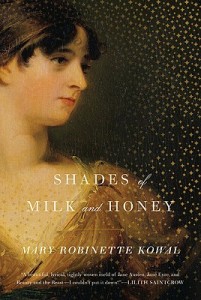
Shades of Milk and Honey by Mary Robinette Kowal

Shades of Milk and Honey
Mary Robinette Kowal

I’ve been eying this book since last year, particularly after this review at The Book Pushers when I basically realized that this was a regency romance with magic in it. When it was nominated for the Nebula Awards, I joined the Nebula Readathon at The Book Smugglers as an excuse to read this.
 
The Premise: (I’m going to go with the book blurb on this one) Shades of Milk and Honey is an intimate portrait of Jane Ellsworth, a woman ahead of her time in a version of Regency England where the manipulation of glamour is considered an essential skill for a lady of quality. But despite the prevalence of magic in everyday life, other aspects of Dorchester’s society are not that different: Jane and her sister Melody’s lives still revolve around vying for the attentions of eligible men.
 
Jane resists this fate, and rightly so: while her skill with glamour is remarkable, it is her sister who is fair of face, and therefore wins the lion’s share of the attention. At the ripe old age of twenty-eight, Jane has resigned herself to being invisible forever. But when her family’s honor is threatened, she finds that she must push her skills to the limit in order to set things right–and, in the process, accidentally wanders into a love story of her own.”
 
Read an excerpt of Shades of Milk and Honey here
 
My Thoughts: This book really feels like a big ol’ homage to regency romances of Jane Austen’s era. From the get-go I was struck by how regency-eque Shades of Milk and Honey was and how often it uses the same conventions as Jane Austen’s stories. We begin by being introduced to the Ellsworths, a respected family with two daughters, a hysterical mother, and a doting father who would like nothing more than to see his daughters happily settled. Jane is the sensible and somewhat plain older sister, and at twenty-eight she’s resigned herself to being on the shelf. Melody is the pretty one, and at eighteen she has a much higher chance of getting married, but as the younger sister, she’s also more impulsive and reckless than Jane. The Ellsworths spend most of their time visiting their friends nearby and going to parties, and proper manners are always assumed. Sounds familiar no? Yes, it’s like a mix of every Jane Austen novel out there. Jane Austen era spellings like ‘shew’, ‘chuse’, ‘teaze’ and ‘nuncheon’ to add to that feel.
 
What makes Shades of Milk and Honey not just a remix of Austen, is the idea of glamour, a type of small magic that is used for pretty illusions. With glamour, a lady may create a subtle scent in the air, embellish a painting, record and play music, and even enhance her own appearance. There is no end to its uses, although it is considered mainly an artistic skill, not a dangerous one. It is a skill of high merit in well-bred ladies of society, much like the ability to play music or paint.
 
Jane is particularly skilled at glamour. I was hoping that Jane’s skill in glamour would be more essential to the story than it was, but it seems to be merely there as an interesting skill that gains Jane admiration from those around her. In fact, it is the quality that she is most admired for, and her sister harbors some jealousy because of it, despite her own pretty face and easy grace, which Jane lacks. There’s a bit of sisterly competition when it comes to men because of the their differences. Both girls share an admiration for a neighbor, Mr. Dunkirk, and he is a point of contention, despite never giving either sister a reason to hope. At times, the little jabs at each other got a little nasty, at others they are remorseful for their previous behavior. It was a bit of a see-saw, which I suppose shows the complications of sisterhood, but I wish their relationship was delved into a little further, beyond their little squabbles.
 
On the other hand, none of the relationships in this book were delved into. The story is very readable and I was easily drawn into Jane’s world, but beyond the social obligations and underlying drama of who may be courting who, I felt a lack of connection between Jane and the other characters. Jane feels more like an observer than a participant in this story. She watches as her sister flirts with gentlemen such as Mr. Dunkirk, and the newly returned Captain Livingston. She sees her mother go into yet another fit of hysteria and commiserate with similarly afflicted Mrs. Marchand. She wonders what secrets her friends Beth and Mr. Dunkirk are hiding. She wonders at the surly Mr. Vincent who creates beautiful works of glamour but doesn’t seem to like her very much. Internally she has a lot of thoughts about her glamour and what people around her are doing, but she doesn’t voice them. She doesn’t act until she is forced to by others, and about 75% into the book, I realized that I wasn’t really sure where the story was going. I felt like Shades of Milk and Honey was circling the airport. I wondered aloud “When are you bringing this baby in?”.
 
It’s not until she is drawn in by an unexpected suitor and by the threat of family ruin that the story really gets anywhere, and this happens far into the story. I did like where it went, but some of the excitement and interaction at the end of the book would have been nice to see in the rest of the story. I also felt like the romance Jane had was trying to replicate a Darcy and Elizabeth romance, with what looks like initial dislike becomes something more, but I must have missed the subtle growth of their relationship, because when the declarations of love happened, I really wasn’t sure why. Jane spends so little time with her eventual paramour, that the romance, while very sweet, didn’t feel backed up by emotional growth.
 
Overall: Shades of Milk and Honey reminds me of the stories of Jane Austen in that it has characters that spend their time visiting one another and going to parties, and proper manners are expected. It also has a lot of plot points that hark back to the Jane Austen books: sisterly bonds, strawberry picking, men after dowries, and secret engagements. I think that my love for this stuff kept me reading at a happy clip. For this alone, I’d call the book “good”, but beyond the Jane Austen trappings, I wanted more out of the characters and plot (and more out of the concept of glamour), so it didn’t move past being merely entertaining for me.
 
P.S. Does anyone know the significance of the title of this book? Is it a reference to the biblical phrase ” “a land flowing with milk and honey“? OK, that would make sense…
 
Buy: Amazon | Powell’s | The Book Depository
 
Other reviews:
Jawas Read, Too! – 8 (out of 10)
The Book Smugglers – 6 (good)
SFF Chat – “didn’t turn out to be exactly what I had been hoping for, it was a pleasurable way to pass a couple of hours”
The Book Pushers – 5 stars (out of 5)
Fantasy Book Critic – A- (“a very light novel that epitomizes “beach reading” for me”)
Christina_reads – Didn’t live up to expectations
Stella Matutina – 3.5 stars (really liked it)
I love this book trailer


Children of Scarabaeus by Sara Creasy

Children of Scarabaeus
Sara Creasy

I think that thanks to a couple of influential bloggers, this series is on more people’s radars, and that makes me happy. I really enjoyed Song of Scarabaeus when I read it in September last year (https://i0.wp.com/i58.photobucket.com/albums/g254/jayamei2/livejournal_com.gifhttps://i0.wp.com/i58.photobucket.com/albums/g254/jayamei2/wordpress.jpg), and when I heard that it’s sequel, Children of Scarabaeus was available on NetGalley, I requested it ASAP.
 
**** mild spoilers for Song of Scarabaeus ****
 
The Premise: In this continuation of the story that follows Edie Sha’nim and her bodyguard Finn, Edie has freed herself from her kidnappers and her goal is to use what she’s recently learned to help Fringe worlds with their reliance on Crib technology to keep their environments viable. Unfortunately, her freedom is short-lived, as the Crib government catches up with Edie and her friends, and reclaims her as their property. Edie has to cooperate or Finn suffers, so she reluctantly goes back to work as a biocyph for Liv Natesa’s pet project on a new terraformed world named Prisca. During the project she makes some startling discoveries about what the Crib is up to, including the use of children as their new breed of cypertecks. In the meantime she’s also asked to return to the place where it all began for her: the planet Scarabaeus.
 
Read the first chapter of Children of Scarabaeus here (pdf)
 
My Thoughts: I was anticipating this read so much that it leaped over all others in my TBR and landed on the top of my queue, and then I read it all in one day. I’m happy to say it felt very readable and I had no inclination to put it down once I started. This book had much of the same sort of twists and turns as the first, with escapes and captures, spaceship crashes, deadly planetary disasters and wild animals. Not to mention the manipulations of Natesa, who wants Edie on her project, which promises terraforming at a much faster pace than ever before and of Colonel Theron who wants Edie to work for him on Scarabaeus. Like the first book, Children of Scarabaeus has a lot going on. In fact, it surprises me how much happens in it within a relatively short number of pages (my eARC is numbered at 322 pages).
 
Edie and Finn begin the story with the same relationship they had when Song of Scarabaeus ended, which was a place where they trust each other completely, but things are still new and Edie isn’t quite sure where she stands. It doesn’t help matters that the chip in Finn’s head (the one that could kill him if he’s too far from Edie) causes emotional feedback that makes romantic entanglements complicated, or that Finn is a hard man for Edie to read. Edie wants Finn by her side, but she also wants him to be free, and not have to be by her side, especially when her skills make her a resource everyone wants. I wasn’t sure how things were going to go for them with their general lack of communication, but this book moves them forward a lot more than the first did, and the romance was not as understated as the first installment.
 
The descriptions of the biocyph and cyperteck technology as Edie sees it continues to be fascinating. I really love how it’s described visually instead of trying to explain the technical details behind it. When the cyperteck children are introduced, I liked how they related to the code differently from even Edie and other ‘tecks. Instead of understanding things visually, they go by sound and by feeling. The code is something living that needs fixing so it can be “well”, and the children instinctively work as a team to patch the code up. They have no idea what the code does, all they are interested in is the feel of the code itself.
 
Children of Scarabaeus does a very good job in tying up all the loose plot strings left over from Song of Scarabaeus. There were a few times where I thought the story was going to go one way (and this probably would have lengthened the plot), but Edie and Finn instead are steered towards their destinies. The way things are satisfyingly tied up leads me to believe that this series is now complete, which is in a way disappointing. This is a case where I would be really happy for more books and more adventures with Edie and Finn. I don’t really think that Children of Scarabaeus rushes to a conclusion, but it upon me before I wanted it to be. I wanted to spend more time, leisurely exploring the galaxy and watching the relationship develop between Edie and Finn. I could have used a book or two between book 1 and the conclusion here, and I think that would have also sidestepped the feeling that the plot twists and deaths in the story were a means to get to the appropriate ending within the pages allowed. I hope that the next series Sara Creasy writes next gets to be longer. And this is from a girl who balks at long series, so do not take my words lightly.
 
Overall: I really loved Song of Scarabaeus, and this is a worthy sequel that has the same action and awesome world building as it’s predecessor. It comes pretty close to pleasing me in the same way the first book does, but it has one handicap – it has to complete the story in one book, which means the romance and the complex plot are tied up before I was ready. I think the author did a good job at making these things satisfying (particularly the ending), but I would have been fine if I had to wait one more book (or two) for it. Thumbs up for this series – get both books.
 
Children of Scarabaeus comes out on March 29th.
 
Buy: Amazon | Powell’s | The Book Depository
 
Other reviews:
It’s early yet..

Ghosts & Echoes by Lyn Benedict

Ghosts & Echoes
Lyn Benedict

I’d read Sins & Shadows about a year and a half ago (https://i0.wp.com/i58.photobucket.com/albums/g254/jayamei2/livejournal_com.gifhttps://i0.wp.com/i58.photobucket.com/albums/g254/jayamei2/wordpress.jpg) and have been meaning to read the second book, Ghosts & Echoes for a while, but didn’t get around to it until the recent Border’s bookstore closings where I picked up a copy. This is the rare urban fantasy where the POV was not in first person, but in third!


The Premise: Sylvie Lightner is worn out after what happened in Chicago recently, and she’s taken a long vacation, but she’s back in Miami now and back to work. Unfortunately for her, her desire to take on an easy case, one without complications and potential heartache is thwarted by two new clients. One says he is possessed by a ghost, and the other what’s Sylvie to catch a band of thieves. Both cases are more closely linked to Sylvie than she is happy with.
 
Read an excerpt of Chapter 1 of Ghosts & Echoes here
 
My Thoughts: This is an urban fantasy series with a very human heroine. Human but for a special ancestor, which leaves Sylvie with a secret voice in her head that tells her what to do to survive. Otherwise, she is normal, and has to use human means to track down problems in the Magicus Mundi, the supernatural world that most people don’t know exists. She is the one people come to if they want strange problems solved. It’s a very specialized P.I. service, and one that barely covers the bills, but Sylvie knows a lot about the dark magics and woo-woo that exists in the world. Due to this expertise, she gets two new cases that no one else would be able to figure out. Adam Wright, a Chicago beat cop finds Sylvie through a dream – he has a ghost inside him and wants the ghost out. The other case is a series of robberies, where the thieves seem to be able to walk through walls and doors. Sylvie uses a mix of legwork and special contacts (mixed with a bit of threatening) to solve these cases.

In the first book, Sylvie struck me as an angry heroine. There are reasons for this – it’s because of what was happening around her, and because of her own particular genetic legacy. In Sins & Shadows, this worked for me within the story and I wondered how Sylvie would grow over the series. In Ghosts & Echoes, this anger is still there, and yes, it still works when her anger is due to her frustrations in being one step behind in stopping the evil around her, but there were times when her attitude rubbed me the wrong way (and more than it did in the first book). I’d noted before that Sylvie is perfectly willing to be rude for someone’s own good (like preventing her assistant from being in danger), but maybe in her home territory, I wasn’t expecting her to be like this to everyone. I do think that she tries to hold herself back, but when she is pressed for time, she doesn’t have the patience for niceties. Somehow her lack of empathy towards people who weren’t her friends and family felt more pronounced in this installment, and I found it more difficult to empathize with her.
 
This darkness extends to Sylvie’s cases. Both of them turn out to be related to her personally. The ghost that is possessing her client is someone Sylvie knows. One of the thieves that are robbing local stores is someone Sylvie knows. Her moral dilemma here is who deserves her loyalty more – the people that she loves, or her clients who need her help. Her choices aren’t easy. There was a balancing game, and I think that the consequences reflect real life: it never goes as planned. There is definitely a high amount of emotional charge in this story because of Sylvie’s conflict and the personal slant of her cases. I really identified with Sylvie’s frustration in dealing with the people involved. This is all good, I want to be involved in the characters lives and to be emotionally connected.
 
The problem I had with Ghosts & Echoes is that I was ultimately unhappy with how dark it became, which is a very personal reaction. I understood what Sylvie was trying to do and from a logical point of view, I’m not really sure how she could have changed how things turned out, but from a visceral point of view, I like to end a story feeling like although there is bad, the good outweighs it, and in Ghosts & Echoes I’m not sure I liked where the scales stopped. There was a resolution and I’m sure it’s a resolution that worked for many readers, if not most, but I was left feeling unsettled.
 
Overall: A really well-written and gritty urban fantasy. I recommend this series for UF fans who want a realistic story and don’t mind a flawed and abrasive heroine. I would put this book in the “like” column for the writing and world building alone, but my emotional reaction to the overall plot (more bitter than sweet for me) puts it in the “OK” column. I’m wavering between my heart and mind on how to rate the book.
 
I want to know what happens next to Sylvie, but I’d be reluctant to read Book 3 if I find out that the story continues to be this disconcerting.  A review on Amazon suggests that there is a third book coming out but I haven’t seen any news about it’s title or publication date. Thanks to Scooper, I learned the third book is Gods & Monsters, out next month.
 
Buy: Amazon | Powell’s | The Book Depository
 
Other reviews:
Literary Escapism – positive
Fantasy Literature – 5/5

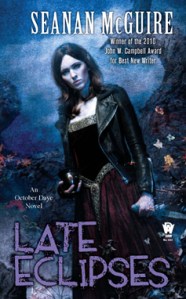
Late Eclipses by Seanan McGuire

Late Eclipses
Seanan McGuire

Ahh, October Daye. This is one of my favorite series, and each time I read a book, I want to read the next one right away.

Late Eclipses is the fourth book of the series:
Book 1: Rosemary and Rue – https://i0.wp.com/i58.photobucket.com/albums/g254/jayamei2/livejournal_com.gifhttps://i0.wp.com/i58.photobucket.com/albums/g254/jayamei2/wordpress.jpg
Book 2: A Local Habitation – https://i0.wp.com/i58.photobucket.com/albums/g254/jayamei2/livejournal_com.gifhttps://i0.wp.com/i58.photobucket.com/albums/g254/jayamei2/wordpress.jpg
Book 3: An Artificial Nighthttps://i0.wp.com/i58.photobucket.com/albums/g254/jayamei2/livejournal_com.gifhttps://i0.wp.com/i58.photobucket.com/albums/g254/jayamei2/wordpress.jpg

**** There may be mild spoilers for earlier books in this review ****

The Premise: Toby has had barely any time to settle down after the events of the last book when she is ordered to appear before the Queen of the Mists, and since Toby has annoyed the queen before, this request sounds like trouble.  Soon after that she receives news that Lily, her friend and The Lady of the Tea Gardens is sick. When more people are stricken, it becomes apparent that Toby and all that she holds dear are a target. When Toby detects the scent of an old enemy, Oleander de Merelands, in the wind, she thinks she knows what’s going on.  Unfortunately, things are never simple for Toby, and this time she may have very few options to save both her friends and herself.

My Thoughts: When I think about the October Daye series, I think about structures that are built piece by piece and brick by brick.  The first book, Rosemary and Rue was the cornerstone, and every subsequent book has built upon that. It’s not just the worldbuilding (where there are pockets of worlds through secret doorways and fae creatures live parallel to the ordinary world – love it), but the way Toby’s back story has informed and continues to inform the current plot. This is why I don’t recommend reading this series out of order (it can be done, but it wouldn’t be as much fun); without the first books, the places Toby has been and people she has met wouldn’t be as significant in the current story.

I love how there are always hints throughout the books about Toby and her situation. It’s like some kind of delicious game between the reader and the writer. I try to guess what’s coming, I spend time mulling over what happens in the books and what some remarks may mean, and I wait for the next book. Then I’m either rewarded by being somewhere in the ballpark or I’m completely and utterly wrong. In Late Eclipses I was happy to have some of my suspicions answered, but not the way I expected. Of course I can’t speak of it here, but let’s just say that it is good stuff. In fact, this book manages to be the best in the series so far because of all the revelations within. It’s not unusual in urban fantasy to find a main character that investigates otherworldly crimes, but the guessing games set this series apart.

In Late Eclipses the newest disaster is a mysterious sickness which strikes Toby’s friends (friends who cannot get sick), right when Queen of the Mists begins her machinations involving Toby. As usual there’s a lot of action and Toby spends much of the book breathlessly running from one place to the next in an attempt to stop bad things from happening. In the past Toby gets knocked around quite a bit. This book is no different, even with Toby making smarter decisions and with friends backing her up.  I was at the edge of my seat, mentally yelling at Toby to watch out because it seemed like someone was out for her in particular. There was more of an anticipatory feeling throughout this book than in the past because it wasn’t as simple as finding a murderer. This felt like a conspiracy.

I was expecting characters that until now have been off the page to finally show up (not a spoiler, since this is on the back blurb), but Toby has many more allies now than she did when the series started. They rally around her, even when it could result in adverse consequences for them. I really like that Toby’s circle of friends has grown over the course of the past three books, and it’s very touching to see the rewards of her being her usual Hero self.
The side characters in this series are great, and we get to learn a little bit more about them in Late Eclipses, especially Toby’s Fetch, May, and her liege, Sebastian. There’s also some new information about people who don’t love Toby, including Raysel. The only problem I had with the characters was that I noticed there were a lot of them who hate Toby for failing as a Hero. It was odd for this motivation to pop up repeatedly, but before I got too perturbed by this, the characters differentiated themselves from each other, making the observation moot. Your mileage may vary on this pattern.

Of course one of my favorite secondary characters is Tybalt, King of the Cats. I’m always hoping that there will be romance between him and Toby. The romance in this series is never in the foreground, but there are some interesting developments here. I think fans of both Tybalt and Connor will be happy with how things go in this book. It does complicate things for the next one though. I was already looking up the release date for the next one, One Salt Sea while I was midway through Late Eclipses (September 2011).

Overall: If you are an urban fantasy fan, you should read this, but don’t stop at the first book, because the overarching storyline builds up as the books go along. It is rewarding to keep reading the series – if I think over what was revealed in this book, I become positively gleeful. I need to run out and find someone who has read it so we can discuss. To me, this series just gets better and better, and this is the best installment yet.

Buy: Amazon | Powell’s | The Book Depository

Other reviews:
Fantasy Cafe – 8.5 out of 10
Scooper Speaks – positive (“the bom-diggity-dog”).
Lurv a La Mode – 5 scoops (out of 5)
All Things Urban Fantasy – 4 out of 5
Fantasy Literature – 4 out of 5

Clever advertising for a book sale in SC


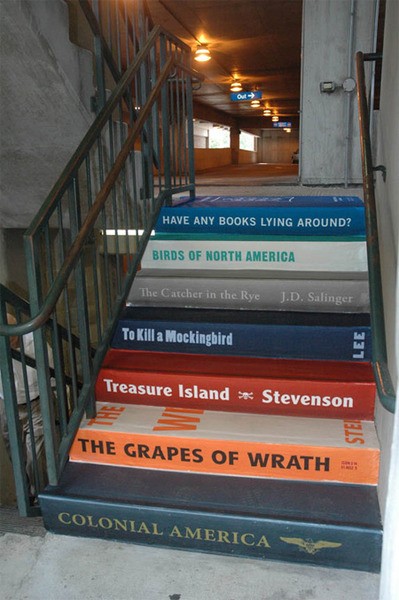
I saw this image of steps made to look like books on tumblr today, and I was so taken by the idea that I had to use my google fu to find out more!

Turns out this is the work of the bounce agency, an advertising firm which was tasked to drum up interest in a charity book sale for the Greenville Literary Association. They wrapped things like the stairs above, as well as junction boxes, elevator doors and a fountain around Greenville, South Carolina with images of books to create awareness for both donating and buying books for the sale. Click here for more images and video (be sure to keep clicking the arrows to see all the pictures).

I particularly love the idea of covering post-it notes with book jackets:

Video spots:

Ohh, book loving nirvana!

(more cute videos at slc33’s channel on youtube)

Masques by Patricia Briggs

Masques
Patricia Briggs

Patricia Briggs’ Mercy Thompson series is one of my favorite urban fantasy series out today. When I started getting into them I naturally looked into her backlist, which is in the fantasy genre. I’ve read both Hob’s Bargain and the Hurog duology, and the Raven duology is in my TBR pile, but the one book I could not get my hands on was Masques, her first book. In a post I wrote in 2007, I noted that I wanted it, but “This book goes for at least $60 on eBay, $120 to over $600 elsewhere. Which I think is CRAZY.” I didn’t think it was worth paying so much for a book which the author herself admitted was her first effort and thus had a lot of weaknesses! Thankfully, Masques was re-released after a rewrite by Briggs. Even better: its sequel, Wolfsbane, is now available.
 
This review is for the rewritten Masques.
 
The Premise: Aralorn is a mercenary who “doesn’t take orders” and “will occasionally listen to suggestions” which makes her ideal as a spy for the city of Sianim. Her latest assignment is to check out rumors of an assassination attempt on the ae’Magi, the much beloved Archmage of the land. It isn’t until she is at his castle does she realize that the ae’Magi is not the good, kind man the world thinks he is. He’s pure evil, but his influence over people’s hearts makes any opposition near impossible. The only people who realize the true nature of the ae’Magi are persecuted by him.  These include Wolf, a grey beast with yellow eyes who can speak, the young King Myr of Reth, and a small but growing group of rebels hiding in the Northern Woods.
 
My Thoughts: This book begins with an introduction by the author which explains that Masques was a book she started in college when she knew nothing about writing. This means that in looking at it again as a more experienced writer, there was a lot of “squirming uncomfortably” and the first attempt at a rewrite was so extensive that it changed the story completely. So this edition of Masques is a compromise: it keeps the original story but makes things fit better, leaving the “cliches and oddities” intact.
 
I kept Briggs’ introduction in the back of my mind while reading the book, and I can see what she alludes to as the “cliches and oddities” in her story. Yes, there are a lot of things in Masques that feel very familiar. Aralorn’s background alone made me wonder if I’d read Masques before: the plain-looking lord’s daughter, more interested in swordplay than etiquette, runs away from home with her warhorse and joins a mercenary guild. Her shapeshifter bloodline and quick wits keep her alive, and along the way she gains a wolf companion.  Add to this the evil sorcerer in his castle, a scarred hero, an army of mindless minions, a spymaster, a dragon, and magic items, and you have a rather common set of tropes. Yet I never felt that these things were trite. Instead I felt like I was reading a story where the plot had a charming enthusiasm, while the writing itself was polished by experience.
 
I didn’t think the polish covered all flaws, but there were qualities in this story that reminded me of what lured me into the fantasy genre during the nineties, and that was worlds I wanted to visit. I really enjoyed the settings, particularly the fantastic rooms described in the story. I loved imagining the secret places these characters went and the grand palace that the ae’Magi lived in. I also liked the idea of the green versus human magics, and how shapeshifters and magical creatures fit into this. The explanation of how the magic works could have been better, but there was still a sense of wonder while reading about magical creatures and old stories that I enjoyed.
 
There’s a lot thrown into the 294 pages that was this book, but story is essentially a good versus evil tale. After Aralorn discovers the true nature of the ae’Magi, King Myr of Reth has to flee his palace, leaving his throne open for the ae’Magi to usurp. Aralorn and Wolf join him in the Northlands. Here, the power of human magics like the ae’Magi’s are not as affective, but green magic, the magic of Aralorn’s shapeshifter people, have no problems. A ragtag band of people impervious to the ae’Magi’s magical influence trickle into the hidden camp, called my some unknown power. Together they begin to work out how to overthrow the ae’Magi.
 
There are a few secondary characters within this rebel camp, but besides King Myr and the ae’Magi (who were very good and very evil respectively), no one really made much of an impact on me. The focus is primarily on the two heroes (Wolf and Aralorn) and they stood out while others faded into the background. I found myself uninterested in the camp’s day-to-day life and more drawn in by Aralorn and her relationship with the the enigmatic Wolf.
 
Although I feel like Aralorn is the main character, Wolf steals the show. Aralorn rescued him from a pit trap, and over the years he’s slowly revealed more about himself, including the fact that he’s not just a wolf. He’s your basic scarred hero, but he and Aralorn have developed a bond which has become something more for them both. I loved reading about his past and their conversations while they researched spells in Wolf’s private library (I wish this library was real). Aralorn is a good match for his prickliness because she can cheerfully ignore it, and she uses her humor to chip away at his shell. As you can imagine, this is the set up for a romance. I was expecting something slow moving from the way the book began, but the complications I thought I’d see were superficial ones. It was sweet but not intense. I am looking forward to reading the second book to see how their romance continues and I hope to see better developed secondary characters that play a larger role in the plot.
 
Overall: Masques is a little bit dated because it’s a book originally written in the nineties, but it has a lot of charm. It reminds me of books about female heroines having adventures written by Robin McKinley and Mercedes Lackey that I read in my teens and still hold a fondness for today. It has its flaws but it also has charisma, and it kept me pleasantly entertained for the few hours it took me to read it. I think would do well with YA readers interested fantasy, particularly girls.
 
Buy: Amazon | Powell’s | The Book Depository
 
Other reviews:
Dear Author – C
 
(This review was cross-posted to the paperbackswap blog)

Reading Challenges & News

I suck at reading challenges. I have no idea why I keep entering them because I’ve never been successful with any of them, but I have the best intentions. I always think, “Yes! This is just the thing to keep me honest!” and imagine myself actually reading books within the time frame of the challenge successfully, the TBR melting before me as I stand victorious and smiling before it. Of course, somehow time slips past me, I end up having other things to do that get higher priority and suddenly I am no where near where I wanted to be with a challenge, and the TBR looks bigger than when I first started the whole doomed exercise.

I know I’m not the only one. Right?

On that note, I’ve entered the following this year! They all have the benefit of being “participate when you can” sort of things.

***

Calico Reaction’s Book Club:

This one is a club where participants read the monthly selection (selected via poll & calico_reaction) which is presented in alphabetical order. So far the books have been:

January: Lois McMaster Bujold: The Curse of Chalion
February: Octavia E. Butler: Fledgling
March: Patrick Ness: The Knife of Never Letting Go
April: Robert A. Heinlein: The Moon is a Harsh Mistress

Reason for joining: I go to calico_reaction’s reviews for the nitty-gritty low-down on a book if I’ve read it, or I glance at her rating if I haven’t.  I signed up for this club because the book selections aren’t what I’d normally try on my own and I’ve enjoyed the selections I’ve given a go. Also – love that I can participate as much as I am able. I participated (somewhat dismally), last year and enjoyed it.

***

The Book Smugglers’ Nebula Readathon:

Schedule:
March 13: The Native Star / Hereville: How Mirka Got Her Sword
March 26: Blackout / Ship Breaker / Behemoth
April 9: All Clear / White Cat / Mockingjay
April 23: The Hundred Thousand Kingdoms / The Boy From Ilysies / Who Fears Death
May 7: Echo / A Conspiracy of Kings
May 21: Shades of Milk and Honey / I Shall Wear Midnight + Our Final Nebula Readathon Ballot (in which we Smugglers and fellow readers pick the novels we believe should win the award)

 
Reason for joining: I really want to read Shades of Milk and Honey! Yes, that is it, joining this challenge is an excuse to read one book. So after I joined, I just HAD to buy the copy of Shades of Milk and Honey I found on Bookcloseouts for $4.99 (only 2 left!). I’ve also already read The Hundred Thousand Kingdoms and The Native Star so I feel like I am actually a little ahead on this challenge. It doesn’t take much with me.

***

Jawas Read, Too! Women of Fantasy Book Club

Schedule:
January: One Hundred Thousand Kingdoms by N.K. Jemisin
February: Elfland by Freda Warrington
March: Prospero Lost by L. Jagi Lamplighter
April: Four and Twenty Blackbirds by Cherie Priest
May: War for the Oaks by Emma Bull
June: The Dark Mirror by Juliet Marillier
July: All the Windwracked Stars by Elizabeth Bear
August: Indigo Springs by A. M. Dellamonica
September: Firebird by Mercedes Lackey
October: Tooth and Claw by Jo Walton
November: The Gaslight Dogs by Karin Lowachee
December: Readers Choice

 
Reason for joining: I love the choices in this book club. Indigo Springs and The Gaslight Dogs are on my TBR. I want to read Tooth and Claw and Elfland and Firebird and.. ok I want to read all of these. Also I’ve already read One Hundred Thousand Kingdoms and War for the Oaks so I have two down. It kills me that I have Elfland in the TBR but didn’t get to it for the February selection though. I will try to read that ASAP and join the discussion late.

***

Dreams and Speculation Women of Science Fiction Book Club:


Schedule:
January: Dust by Elizabeth Bear
February: The Dispossessed by Ursula Le Guin
March: Darkship Thieves by Sarah A. Hoyt
April: The Doomsday Book by Connie Willis
May: Mappa Mundi by Justina Robson
June: Lilith’s Brood by Octavia Butler
July: Cordelia’s Honor by Lois McMaster Bujold
August: China Mountain Zhang by Maureen McHugh
September: Remnant Population by Elizabeth Moon
October: Farthing by Jo Walton
November: The Handmaid’s Tale by Margaret Atwood
December: City of Pearl by Karen Traviss

 
Reason for joining: I’ve read 3 out of the 12 books. That’s like a quarter, no? Also I’ve wanted to read The Doomsday Book so I thought this would kick my butt into gear. So far, not really. I feel some regret in not reading Dust for the January selection.


In other news, I’m now one of the fantasy reviewers over at the Paperback Swap Blog. I will be posting there monthly, and my first review should be up tomorrow. It will be a review of Masques by Patricia Briggs. But never fear, I’m allowed to cross-posts my reviews over here so you’ll be seeing the same number of reviews from me.