Unknown's avatar

About janicu

I'm a book blogger who reads lots of speculative fiction, young adult and books with romantic elements.

Anniversary


There’s something about these dog days of summer that put me in a really lackadaisical mood. This past week I’ve written one paragraph for a review. That’s OK, I am sure the motivation will come eventually. In the meantime I’m reading and enjoying the warm weather. And I’m interrupting my regularly scheduled book blogging with some photos of the wedding anniversary present my husband and I got ourselves: a balloon ride (more pictures behind the jump).

Continue reading

Shadow of Night by Deborah Harkness

This review is of a book sent to me by the publisher, Viking (Penguin).

Shadow of Night is the second book in the All Souls trilogy. This is a series that begins with the discovery of a lost manuscript at Oxford’s Bodleian library, by Diana Bishop, a witch and scholar. Pretty soon, the world of daemons, witches, and vampires is following Diana, and she has to ally with vampire Matthew Clairmont, with whom sparks fly. I reviewed the first book, A Discovery of Witches here: https://i0.wp.com/i58.photobucket.com/albums/g254/jayamei2/livejournal_com.gifhttps://i0.wp.com/i58.photobucket.com/albums/g254/jayamei2/wordpress.jpg , and it proved to be one of my more popular reviews last year. This series has a lot of fans.

**** This review will have spoilers for Book #1, A Discovery of Witches!
If you haven’t read it yet, please click the icons above to read my earlier review(I do recommend you read this series in order) ****

Shadow of Night
Deborah Harkness

The Premise: Picking up right after A Discovery of Witches left off, Shadow of Night begins with Diana and Matthew’s search for two things: the elusive manuscript Ashmole 782 (in particular three missing pages), and a witch who can teach Diana how to use her unpredictable magic. With their enemies closing in on them, their solution is to use Diana’s timewalking ability to go to Elizabethan England, thinking they will find what they need there. But when they arrive, it’s clear that Diana does not fit easily in with the locals, and her strangeness during a time when witches are persecuted does not bode well. Then there are Matthew’s friends, the School of Night, and his family — all of whom are used to a very different Matthew than he is in modern day. Accepting of his new wife and the differences in his behavior is not an easy task for everyone. And this is all before Diana and Matthew have begun to do what they set out to do.

My Thoughts:  Much like A Discovery of Witches, Shadow of Night is a hefty volume, weighing in at 584 pages, but it has a very different feel than the first book.In Discovery, the burgeoning romance between Matthew and Diana is a big part of the story, and then the stories focus widens into a greater conflict between supernatural creatures. In Shadow, the romance and the conflict are still there, but they are impacted by the era the hero and heroine are living in. Time’s effects are felt almost from the first page, when the couple arrive at Matthew’s Old Lodge. The year is 1590 and Diana and Matthew are immediately presented with servants (vampires) and a succession of guests — all who happen to be well-known members of the School of Night. Diana meets Christopher (Kit) Marlowe within moments of their arrival, swiftly followed by George Chapman, Thomas Harriot, Henry Percy, and Walter Raleigh. These men and the time period bring out old chauvinistic habits in Matthew that Diana does not like, but it won’t be the first time in this story that Diana sees a different side of Matthew. As the story continues, his relationships and responsibilities of the Elizabethan era come up time and again. His family, his friends, his position amongst the Congregation and in current politics, all come to bear.

While being in the past is a dream for a History aficionado like Diana, she wasn’t expecting it to be as hard as it is, and she feels sorely out of place. It all starts off badly: as much as she tries, her speech and mannerisms are immediately flagged as unusual, and she has to stay hidden to keep her from raising everyone’s suspicions. There is some consolation in being able to meet a lot of historically famous people, but she’s immediately disliked by Kit Marlowe, who is insanely jealous that she married Matthew, and wants only to cause trouble for the woman who married the love of his life. Diana’s troubles are added to when she realizes that her magic is more difficult for her in the past and she needs a witch help her control her power.

This feels like a well-researched book, written with a lot of regard for history and this time period. There were interesting tidbits and scenes between Diana and the people of the past, but I think there will be mixed responses to the amount of history that infuses the book. When it was relevant to the story and to the setting, I enjoyed it, but I struggled with trying to find the plot in the parts where Shadow of Night overindulged. I do think that someone more interested in the Elizabeth period would enjoy the history lessons, I wanted the narrative to focus on the plot and I was frustrated by the added bulk. I wondered if it was really necessary for Diana to meet so many members of The School of Night, for example. They were a window to Matthew’s character as a vampire with his thumb on the pulse of history, but this could have been done without having to meet them all. I had the same issue with other characters and scenes. I felt that they weighed the story down making it move less fluidly than the last book. Transitions felt abrupt, as if the story was written in snippets and then stuck together. This is in stark contrast to A Discovery of Witches which I thought had a better balance between the action, conspiracy, and romance.

Speaking of the romance, there is something of a change in Matthew and Diana’s relationship in Shadow of Night. There is some focus on relationship bumps caused by Matthew’s personal pain and the particular stresses in being a vampire and witch in love. I enjoyed the way being in 1509 gave Diana a unique viewpoint to who Matthew was, and how this was incorporated into the story. The book is divided into six parts, each each part set in a different location. The section that involved France and Matthew’s home was particularly interesting. But, again, I had trouble following the transitions here. It seemed that in every location there was some new revelation about Matthew’s personality which added angst to the story, but they felt out of the blue. I think this was because usually Matthew and Diana seemed happy and in love until some issue would suddenly appear. Maybe the issue is that the story was from Diana’s point of view and Matthew keeps his emotions well-hidden, but the hints that there was anything wrong were too subtle for me as a reader and it made Matthew seem very inconsistent.

As for the main plot and Diana and Matthew’s goals of finding the three missing pages of Ashmole 782 and of educating Diana on witchcraft, there is some progress here. Shadow of Night answers some questions I had at the end of A Discovery of Witches, and the book flashes forward to the future/present (in short interludes between the six parts of this book), and tell the reader how it has been affected by Matthew and Diana’s trip. I liked having some sort of update on the characters we met in A Discovery of Witches and seeing some new-to-me members of Matthew’s family, so I enjoyed those interludes (I especially liked Marcus and Phoebe). I just wish that there was more to say about the series plot from this book, because overall, I felt like while there were a lot of scenes and situations, there was little forward movement in the overarching plot.

Overall: My reaction is lukewarm. I felt like Shadow of Night was the story equivalent of hitting pause on the series while the hero and heroine go off to strengthen as a married couple and prepare to go back into the fray. There is good reason for going into the past — to find out more about Ashmole 782, and for Diana to get help with her witchcraft, but once they are there, these goals faded into the background and being in the Elizabeth era came to the forefront. There was a lot of churn in this story caused by the timeline and I think a reader’s reaction to it will determine how much they like the book. While I felt some of it was necessary, I was disappointed with how much felt like chaff. I had trouble with the focus and flow of the story, and with how little forward movement there was to the series plot, and because of this, I preferred the first book over this one. I hope I’ll fare better when Diana and Matthew return to present day.

Buy: Amazon | Powell’s | The Book Depository

Other reviews:
S. Krishna’s reviews – “Harkness sets the stage for a brilliant and explosive conclusion to the series”
The Adventures of an Intrepid Reader – 3.5/5 ” I closed the book and wondered what precisely the point of everything that the characters had gone through was.”
Books Without Any Pictures – “If you liked the first book, then by all means continue with the second.  I think that it’s the better of the two”
Devourer of Books – “Shadow of Night picks up exactly where A Discovery of Witches left off and, is perhaps even the better book.”

Melina Marchetta, Kristin Cashore, and Gayle Forman at Books of Wonder

books of wonder logo

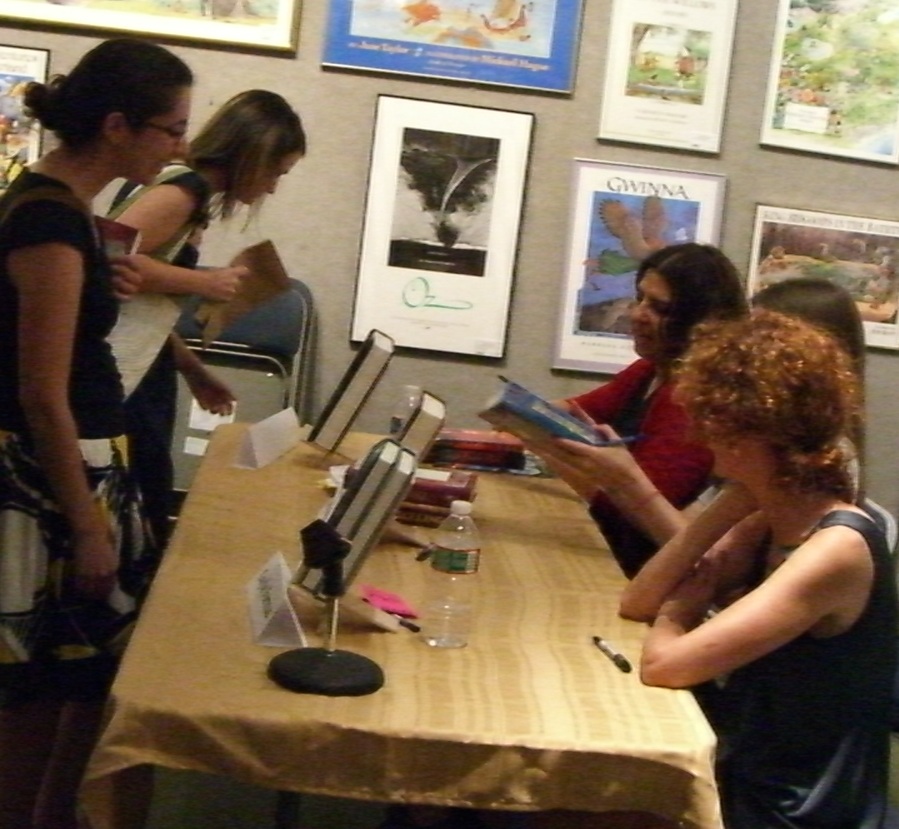
Last Tuesday evening there was an Author Interviews Author event at Books of Wonder featuring YA authors Melina Marchetta, Kristin Cashore, and Gayle Forman. Luckily for me, I live close enough that I was able to go and attend the event after work!

I was good too — I took copious notes for the blog during the interviews. Here’s the lowdown of two hours of authorly goodness. Please note that I don’t write that fast, so this shouldn’t be considered verbatim — just the general gist of the conversation. And sorry about my blurry photos, I politely turned off the flash and I think my 5 year old camera just isn’t that great in with low light.

Companion Novels
All three authors (who are all friends) noted that they have one thing in common besides writing young adult: they all wrote “companion novels”. Companion novels aren’t true sequels because they were told from a different point of view from the first book in the same world, and in some cases, could be read out of order. All three authors had a similar experience with their companion novels–they weren’t planned. Gayle Forman said she had no intention of writing Where She Went, and Melina Marchetta said she didn’t know there would be a sequel, she thought she was finished when she wrote Saving Francesca. The same with Finnikin of the Rock. Melina didn’t like Froi at first, she just thought he was a tool in her story. She didn’t realize that Froi would get a book until the next year. On the other hand, Quintana was always going to be in a sequel, once she had written 500 pages for Froi and realized there was no way she could end it just yet.

Ways you can “screw yourself” doing things this way
Cashore had to slow things down in Graceling because her characters were moving too quickly, so she created an impenetrable forest, but in Bitterblue, when her characters had to move fast, there was the forest!
Marchetta had a tricky area to deal with because she had a character who loved musicals in one book, but in the other he flipped out over having to listen to Jesus Christ Superstar during a car trip. She says if anyone asks, she explains the discrepancy by saying the character grew out of liking musicals.
Forman says she wished she’d chosen a different name for Adam’s band.
Speaking of names, Cashore noted that names mean different things in different languages. Po means “butt” in German, and Katsa is Italian for penis.

Negative reactions from readers
Cashore talked about getting some backlash because her book Graceling was seen as anti-marriage and anti-having kids. She notes that the author is not the same as the characters (her phone has a picture of baby as the wallpaper and is “full of babies”), but while she got a lot of positive messages from readers, every so often she got abusive emails. Now she stays off goodreads and no longer accepts comments on her blog posts, and she also doesn’t have a public email address anymore. She decided to do this for peace of mind, but on the other hand, she met Melina Marchetta through an email, so she acknowledges she is missing out on the positive connections from having a public email.
Marchetta’s comment on reviews was that the author is not the audience of the review and that she keeps separate from the negative reviews.
Forman said that she got backlash from the swearing in her books. She says that her family swears at home, even her mother swears, but that doesn’t make them bad people.

Sexual Tension
This is where each of the three authors read a small passage from their books in which the sexual tension between characters was shown. Cashore read a very small scene from Bitterblue in which Bitterblue and Saf have a moment. Forman read a scene from Where She Went where Adam and Mia were wandering around New York together, and Marchetta read letters from The Piper’s Son between Tom and Tara. [note: for video clips of these readings, check out the recap on The Readventurer!]
Marchetta: With sexual tension, it is the insecurities and vulnerabilities that come through. The reader picks up on these and realizes that these characters are broken and are the only two people who can put each other back again.
Cashore: Conflict and the power dynamic are also important. These two people are the only two people who can take each other on. They go back and forth, but they are an even match. Also, what you don’t say is important.
Forman: an adversarial relationships heightens the sexual tension, there is a delicious dynamic.

Switching points of view
Marchetta discussing how Froi arrived, talked about her friends and an long-running joke in which they play “You Raise Me Up” to her. She had just written a scene in Finnikin in which the captain and the guard had put people up on their shoulders, including Froi. Hearing the song soon after that, Marchetta realized that Froi was a player in the story.
Cashore: It was fun to write a book with Bitterblue, who is a character that is more aware of other people’s emotions. Katsa is more of a doer and doesn’t see things in the same way.
Forman: Switching point of view to continue a story is such a good way to do it because you learn things about the characters.
Cashore: didn’t realize how awful Leck was until she wrote his journals and in his point of view. It helped flesh out how horrible he is. Leck is the only character in all three books.
Marchetta says she didn’t understand why she was asked whose POV the book was from, because in Finnikin the book was mostly from his point of view. So she introduced quite early the different point of views in Froi of the Exiles so people wouldn’t be alarmed by the switches to multiple points of view.
Cashore: Switching points of view also helps with boredom. It’s more interesting with a different point of view.

Fantasy Contemporary
During the discussion it was revealed that Kristin Cashore is working on a contemporary story (!), and this led to a discussion on how the transformation happened between Fantasy and Contemporary YA and vice versa.
Marchetta was staying in New York City for two months after writing Jellicoe Road and she was in the subway one day when she saw a poster with a picture of a refugee camp in Africa. Everyone in the car was speaking a different language and she realized that so many people are not in their homeland. By 2007, she had a novel in her head, but she didn’t want it to be too political, so she decided to write it as a Fantasy. Her grandparents were immigrants and had always talked about going back to visit their homeland, so that became part of the spark for Finnikin. But she feels like Finnikin is not so different from her last novel just because it is a Fantasy.
Cashore said that her very first work was realism, and it was the characters that dictated the story and made it a Fantasy.

Q&A: How did you create characters that are abrasive and difficult to like and then make us love them so much it hurts?
Forman: Because you love them.
Cashore said her crankiest character is probably a librarian character in Bitterblue. When you are having fun, readers will pick up on it and like a character.
Marchetta: People start off not liking a particular character of hers, but they see that he uses the name “Anabelle’sbrother” online. This is a clue that he isn’t that bad. Marchetta uses little things like this as a promise that everything will come out right.
Cashore remembers at this point that her cranky librarian has a cat, which underlines what Marchetta just said.

Q&A: Most Helpful Advice from an Editor
Cashore: “Would you consider starting from scratch?” was what her editor said to her after an 800 page draft that took three years. The change of mindset made a difference.
Forman couldn’t come up with a specific piece of advice and says that her editor was key through edits.
Marchetta: “The word ‘said’ is a good word”. So don’t try to use “mocked” and other words like that when “said” will do. Also, “don’t be a thesaurus, use a thesaurus.”
Cashore: “Don’t let fear make your decisions.”

Q&A: Reviews
Forman: You can’t control anything in publishing except the book you are working on in the moment.
Cashore: The reviews that bother her are when the reviewer speculates what the author was trying to do. When people try to guess who the author is, it irks her.
Marchetta advises to stop reading a review when you read “I really wanted to like this book..”

Q&A: Creating Characters
Marchetta: the story begins with the characters. She waits for them to come to her and “observes” them and “listens” to their conversations with who they bring along.
Cashore: has a similar process to Marchetta. She observes. Some characters are easier. They’re talkative. Some aren’t, for example, Saf, who was taciturn. There’s a lot of conversation and dialoging that happens. You’re trying to reveal the characters through words.
Forman: You think you know a character up until you write. The process is endlessly surprising. Characters seem to have a mind of their own.
Marchetta: did not understand Quintana at first. Quintana changed her personality a lot, and Marchetta didn’t understand her for a year, then, during a walk with her dog, it came to her. Too much thought messes up the process — don’t fight them and try to make them into something they’re not.

Q&A: Intent of a book
Forman: It’s what she calls the Perfect Song Conundrum: she listens to an album and asks what the band/artist was thinking. Don’t they know they should do this and this to have the perfect song? there’s a chasm between the book you now it should be, and what it is. The best reading experience for her is cathartic, and leaves her different from how she was when she started.
Cashore: is trying to make a small, simple, emotional point. She tries to write for herself, writing as a writer, and later goes back as a reader. She tries to convey a feeling, and after a bunch of getting it wrong, in the end she gets to the place she wanted to.
Marchetta: Don’t think too much about it. The purpose is to entertain, but make sure you are always in love with the world. She knows it will work out when she’s still in that state when she finishes writing. Also she loves to think that she writes to make a connection.

Q&A: Worldbuilding
Cashore: With Graceling she didn’t build the world first. She did it as she went along, and she thinks this was something of a mistake. Fire is different — she used landscape more carefully in her second book.
Marchetta: Half-planned her world and half-didn’t. Froi hit the ground running because she had set it all up in Finnikin. Her personal travels gets used in her world building.

Q&A: What happened to Jimmy Hailer?
Marchetta: “I don’t know.” Jimmy didn’t come back to her. He was based on a real person, and when she knew him, he was an angry person, but now he is happy. You can’t force a character back to hear his story.

Q&A: Race in Cashore’s series
Cashore: The inhabitants of Dell seem darker skinned in Bitterblue, but not so in Fire. The reason is that in Fire, she made the characters darker-skinned, but she did it so subtly that readers missed it. Now that she has a chance to correct that in Bitterblue. Cashore feels like she failed a little bit in making the race difference too subtle.
Forman: Maybe you need to be less nuanced in Fantasy (about race).

Q&A: Cursing
The authors spent a little bit of time talking about cursing in Fantasy and how fun it was to make up swear words or to use quaint ones. Marchetta’s favorite was “swiving” and Cashore’s was “weaselbugger”.


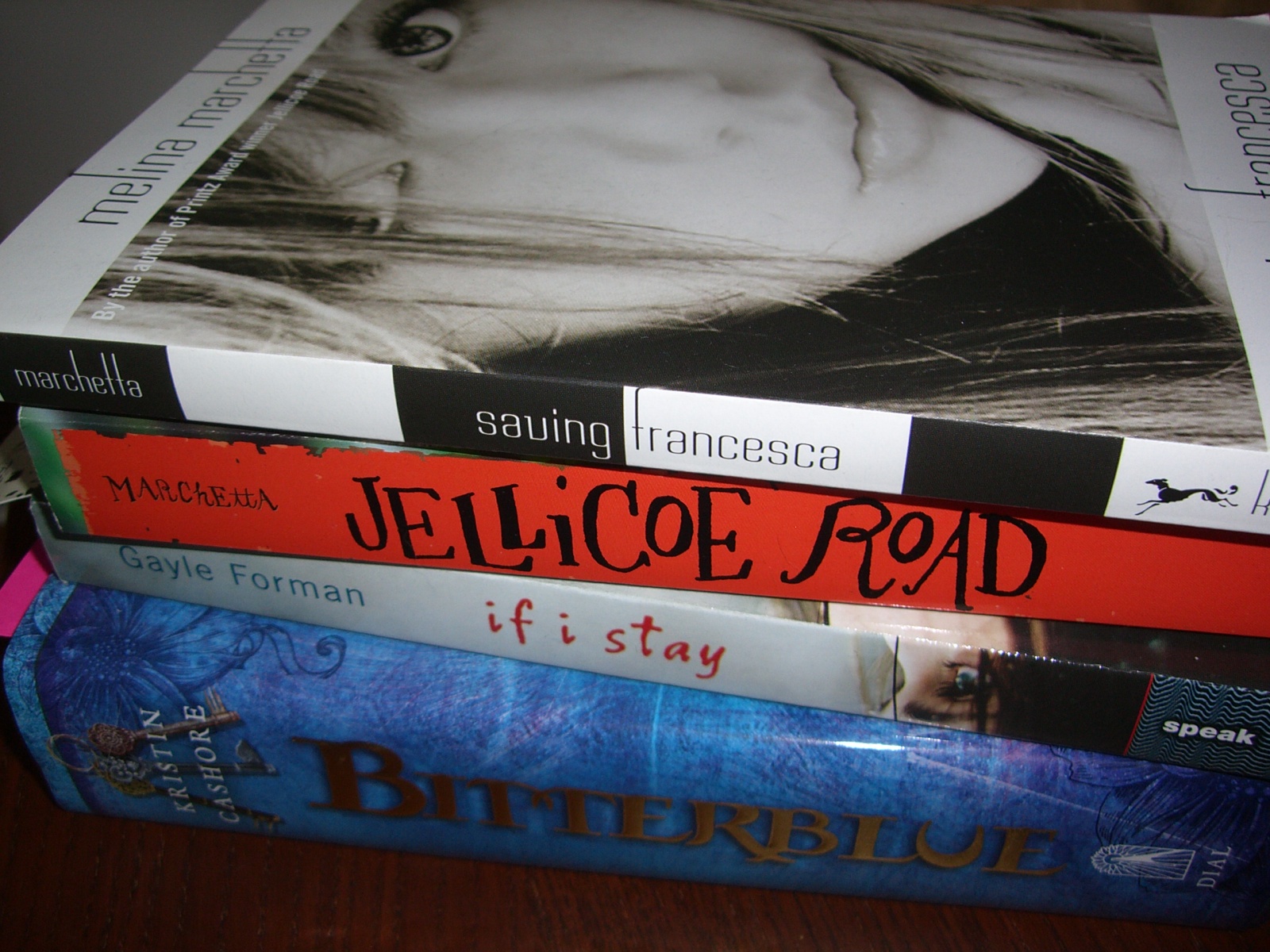
So that was a really fun event, and I did run into a couple of other bloggers there (Catie from The Readventurer, Heidi from Bunbury in the Stacks, Sasha from Sash & Em, and Grace from Books of Love). I also got a few books signed:

  • If I Stay by Gayle Forman – I hadn’t tried this author before and decided I would give the first book of this series a go. (bought at Books of Wonder)
  • Bitterblue by Kristen Cashore – I was sort of unsure of buying the hardcopy because my other two copies of books in this series are trade paperback, but I couldn’t wait. (bought at Books of Wonder)
  • Saving Francesa by Melina Marchetta – I am ready to try one of Marchetta’s contemporaries and this series appealed to me. Really wanted a copy of The Piper’s Son too, but couldn’t find one. (bought at Books of Wonder)
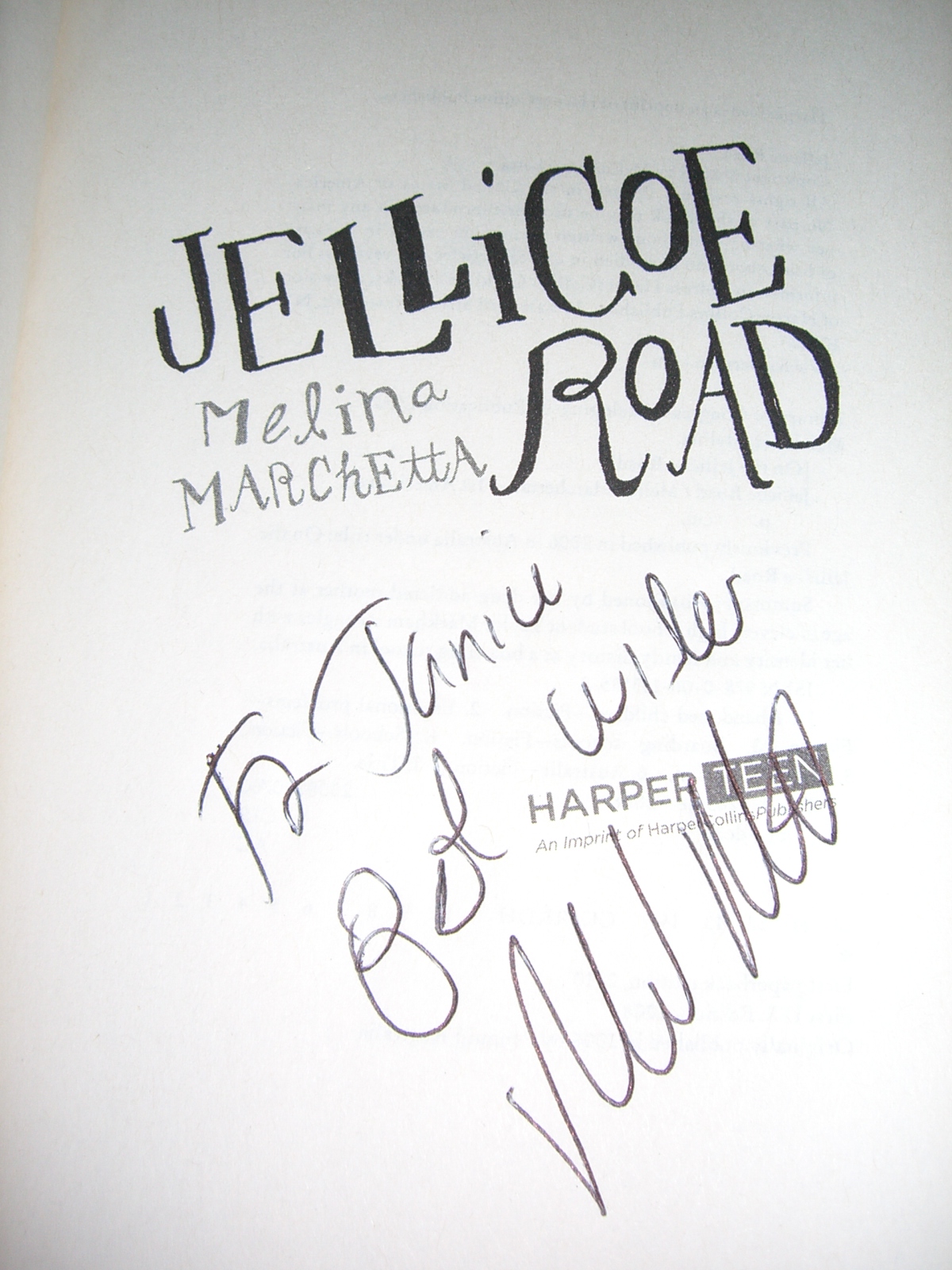
  • Jellicoe Road by Melina Marchetta – This book has been recommended all over the place and I WILL read it one day! (brought from home)

Other recaps (check these out for more pictures and other details of the event):
Bunbury in the Stacks
The Readventurer

Shadow of Night Giveaway

Thanks to the generosity of Viking/Penguin, I am giving away a finished copy of Shadow of Night, and a specially designed “Ashmole 782” temporary tattoo and a set of 6 buttons!

Shadow of Night is the second book in Deborah Harkness’s popular All Souls Trilogy and it was just released last week (July 10th). I’m working on a review, but in the meantime, you can check out my review of the first book, A Discovery of Witches here.

The buttons each represent an alchemical symbol that you can learn more about in the book. 🙂  (click on images to embiggen).


To Enter
Just click this link and fill out the google form (I just need a name and an email)

Rules:

  • Sorry, this contest is just for U.S. addresses this time
  • One entry per person please
  • Contest ends Thursday, July 26th (midnight EST)

Readercon Report, 2012

Readercon was just held this weekend in Burlington, MA. According to their website it is “an annual conference or convention devoted to ‘imaginative literature’ — literary science fiction, fantasy, horror, and the unclassifiable works often called ‘slipstream.'” and “A typical Readercon features over 150 writers, editors, publishers, and critics, attracting prominent figures from across the U.S., and from Canada, the U.K., and occasionally even Australia and Japan. They are joined by some 600 of their most passionate and articulate readers for a long weekend of intense conversation.”

I found out about Readercon through Lunacon‘s program book (these cons seem to advertise at other cons), and since it was relatively near me (4 hours away isn’t too bad), the husband and I made a weekend road trip out of it – leaving Friday night and coming back Sunday afternoon. Husband spent his days on his bike and watching the Tour de France, I spent my days at the con. Unlike Lunacon, this was a convention that was distinctly all about the books, so everything in the program was on a bookish track, although I did see some panels that looked to be more for writers, and some panels that were more for readers (there was overlap of course). I went for the panels that interested me as a reader.

SATURDAY
The first cool thing after registering was that I got to meet Chelle from Tempting Persephone! Oh so very lovely in person, she was. We got to spend a good chunk of the day together, and it was really nice to have someone else to go to panels with and talk to about what we sat in on.

I suspect there were other bloggers there because I spied the Penguin classics bag (that I had too) that was given out at the Book Blogger Con at least twice, but maybe that’s just a popular bag? I was too chicken to ask people about it. 😛

Here are the panels and readings I went to. CAVEAT: I didn’t take any notes and it’s been a couple of days so these are going to be simple overviews of my general impressions. I was planning on posting to my blog, but I took a casual approach and just enjoyed what panels looked interesting without any real blog-y agenda.

Book Learning (Gregory Feeley, Kathleen Ann Goonan, Katherine MacLean, Kathryn Morrow (leader), Ann Tonsor Zeddies) – This was a panel discussing a 2008 article in the Guardian by James Wood about the nature of characters in books. I hadn’t read this article prior to the panel so I was a bit out of the loop for some of the discussion, but it was interesting. They talked about the idea of flat/cardboard characters versus well-rounded characters, and it wasn’t what you would expect. It was more about whether someone’s idea of well-rounded or flat was valid. At one point they talked about if people in real life ever grow or change. It was a very different approach than I as a reader take because I do like characters that feel like they have more depth (well my idea of depth that is). Felt like an interesting window into writing, and how some “flat”, “one-note” characters are used in the story versus characters that “grow” or “change”. (Here’s the link to the Guardian article).

[Interlude] This is where we popped over to the dealer’s room (aka Heaven) and wandered for a bit and had lunch.

Un/Orthodox Genre (Jeanne Cavelos (leader), Michael Dirda, Yves Meynard, Robert V.S. Redick, Peter Straub, Gary K. Wolfe) – This was a panel about genre conventions. The jumping off point was about how some books fit squarely into a genre, and other books don’t seem to quite fit inside a genre and that on one hand Lev Grossman says “Conventions aren’t a prison that genre writers are trying to escape” and the other Peter Straub: “I dislike the sense of necessary limitations lots of people go for. I don’t want to live in a dollhouse”. The talk sort of flowed around writing and working with conventions. What conventions were, how to write something original if you have these conventions, approaches by different writers and so on. I liked the way this one was organized, with questions from the leader and everyone in the panel putting in their two cents. Another interesting panel. My opinion as a reader: I always love the books that tweak at genre conventions or straddle more than one genre.

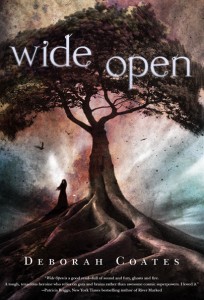
The City and the Strange (Leah Bobet, Amanda Downum, Lila Garrott (leader), Stacy Hill, Ellen Kushner, Howard Waldrop) – This was a really well attended panel. The room was packed and there were people standing because they were unable to get seats (and this wasn’t a small room). Definitely the most popular panel I went to at this con. This was a panel about worldbuilding, and specifically: cities. There’s the cities that are completely made up, and then there are the cities in contemporary and urban fantasy that do exist in our world, and then, there are cities where magic is out in the open, and cities where the strange is hidden from plain sight. With the books that try to capture real cities the panelists discussed the difficulty of capturing the essence of a place so that a local would recognize it, and how it’s difficult (if not impossible) to do that because everyone sees a place in a different way, but that if a book is set somewhere, a writer should try to add something to the story that is from that place, otherwise if you don’t remember what city the book is, what was the point? There was a discussion of why cities, how urban fantasy differed from rural fantasy, the idea of neighborhoods within cities, and collaborative cities (the Borderlands). I went away really wanting to read the rural fantasy Wide Open by Deborah Coates.
[Interlude 2] This is when Chelle and I had to say our goodbyes. There wasn’t much else I wanted to sit in on (and I was pooped with being in a crowd) until 8pm, so I went back to my room, read and relaxed and had dinner and then came back.

Book Covers Gone Wrong (Daniel Abraham, Liz Gorinsky, Caitlín R. Kiernan, Katherine MacLean, Lee Moyer (leader), Jacob Weisman) – This was a panel about book covers. It had 3 authors, a couple of people in publishing, and a cover artist. The panel began with everyone contributing their own horror story that had to do with a book cover. This ran from covers that had NOTHING to do with what was in the book (the biggest complaint), to 6 different fonts used, to arguments with the publisher, to the blurb from George R. R. Martin being extremely small and hard to see. On the publisher’s side there were the problems of time constraints and artists just not producing something that they wanted. I laughed so much during this panel, especially when Lee Moyer passed around some bad covers he’d printed out from the internet and when members of the audience brought out their examples of bad covers. A lot of the examples where just really CAMPY and dated (aka, so bad they become good again).
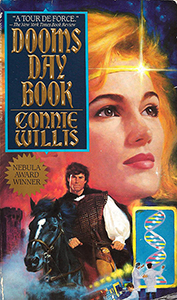
Dancing Around Time Travel. Athena Andreadis, Grant C. Carrington, Helen Collins (leader), John Crowley, Jeff Hecht – This was the brainiest of the panels I sat in on. There was some discussion about how time travel was basically impossible (one thing everyone seemed to agree on). So everything that has time travel in it could be, it was argued, not really Science Fiction, but instead Fantasy. And then there was discussion about if you were to put time travel in a book, how would you do it. A couple panelists said you could get yourself into trouble if you added too much science to the story and this can date it, and there seemed to be a few people in favor of putting as little explanation of time travel as possible and moving on (don’t look at the man behind the curtain). There was also a lot of science discussion (about what time actually was and how it behaved) that was fascinating but I couldn’t repeat it here even if my life depended on it.
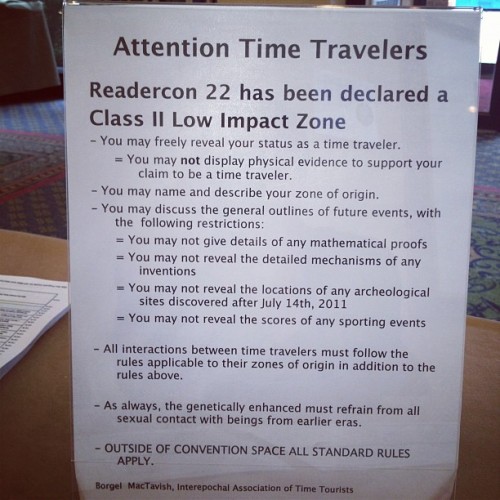

image courtesy of Michael Janairo (posted here with permission)

SUNDAY
Sunday was a shorter day (I think programming ended around after 3pm) and I had to drive back to New York, so I only went to a couple of things before we had to check out and be on the road.

Uncanny Taxonomies (Daniel Abraham (leader), Ellen Datlow, Caitlín R. Kiernan, John Langan, Jeff VanderMeer) – This was another panel about categorizing of books, but instead of the constraints/conventions of a genre, this was more about the idea of labeling books as being this versus that. There was a lot of discussion about the need to put books into genres, and since there were a lot of writers in this panel, there were comments about the writing process and how they don’t set out to write IN a particular genre, they write the story and then it gets placed somewhere. There was some discussion on how different books placed within the same genre could be and what makes a book put somewhere like in science fiction instead of literature. Kiernan commented that she would like to see everything just shelved by author instead of genre.

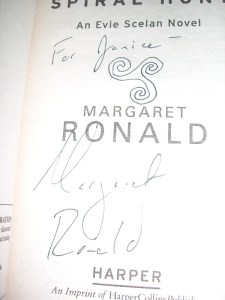
Reading: Margaret Ronald – So this was the ONE and only reading at Readercon I went to (and in hindsight I think I should have gone to more), because I had read and liked the first two books in Ronald’s Evie Scelan books (I have reviewed them both here). Book three is on the TBR (I spent an hour looking for this instead of packing on Friday and never found it. I bought another copy).
This reading was from “The Governess and the Lobster” from the online webzine Beneath Ceaseless Skies. The story can be found online here. It was delightful – a steampunk story about a city where some automatons have gained awareness and live side by side with humans. In this story a governess has just been assigned to the Cromwell children, who do things like hand their governess jars of spiders and mechanical lobsters. From what I could tell there are other stories set in this world including one about a brain in a jar? And a Professora? There is a book written about this Professora, but no news on a publish date yet. I would like this book please Universe.

And here’s the haul:

Picked up at the dealer’s room: The Best of Talebones, edited by Patrick Swenson (I recognized a lot of the writers in the anthology so I was curious to give it a go) and Rapunzel’s Daughters and Other Tales (what happens after the Happily Ever After of fairytales – I was sold on just the description of the Rapunzel’s Daughter story – about her daughters that inherited her uncontrollable hair and the consequences of this attribute).


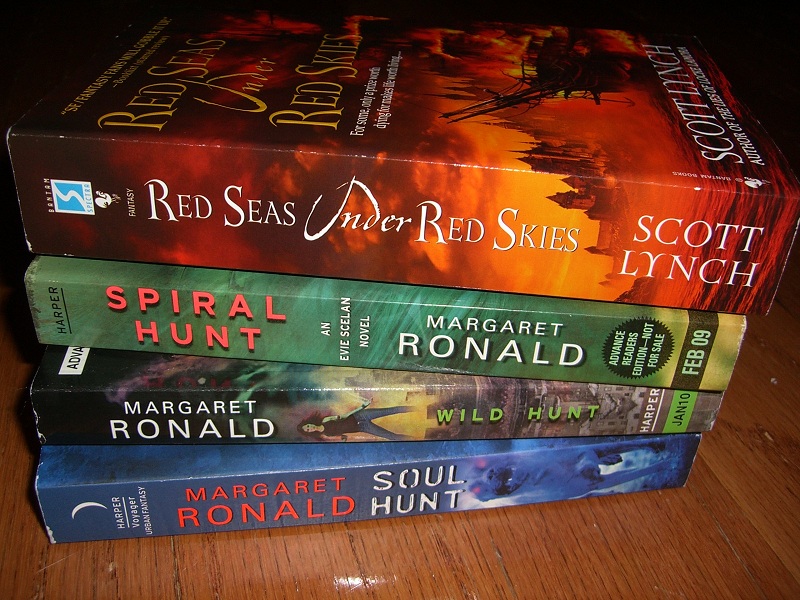
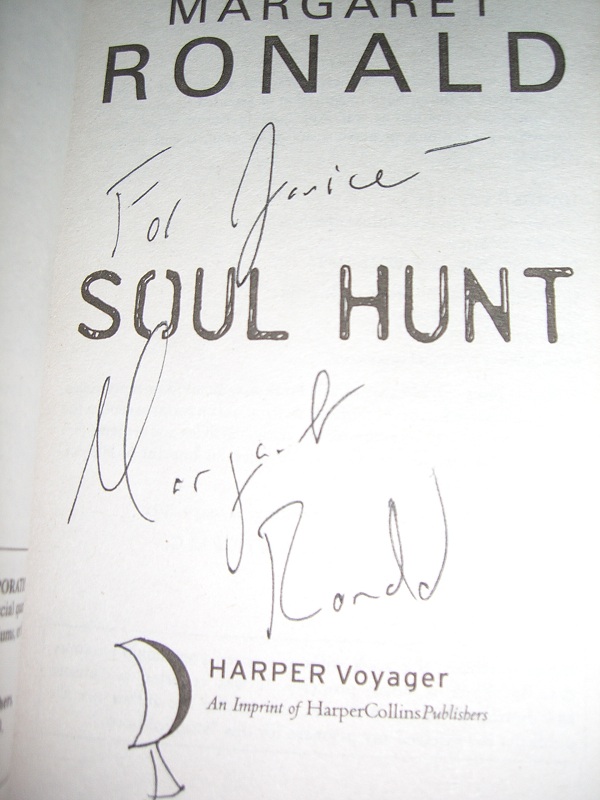
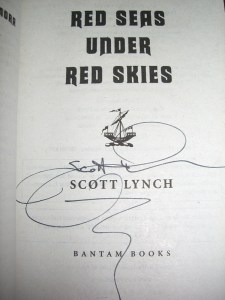
The Husband wanted his copies of his Scott Lynch books signed but we missed the author’s signing and reading on Friday and I still don’t understand how Kaffeeklatsches work, so I was happy I found a signed copy of Red Seas Under Red Skies in the dealer’s room. The other three books are my copies of the Evie Scelan books (Soul Hunt bought at the dealers room).

Not pictured: the signed hardcover of The Outback Stars by Sandra McDonald that I bought. I forgot to bring my personal copies of Sandra McDonald books to Readercon! Next time maybe I’ll bring them and try to get them signed. Lurved The Outback Stars. My favorite!
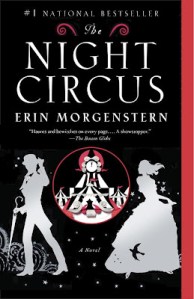
The Night Circus by Erin Morgenstern

Erin Morgenstern was signing the new paperback edition of The Night Circus at BEA, and I picked up one for myself based on the good reviews I’ve seen online.

The Night Circus
Erin Morgenstern

The Premise: (from the back blurb) “The circus arrives without warning. No announcements precede it. It is simply there, when yesterday it was not. Within the black-and-white striped canvas tents is an utterly unique experience full of breathtaking amazements. It is called Le Cirque des Rêves, and it is only open at night.
But behind the scenes, a fierce competition is underway: a duel between two young magicians, Celia and Marco, who have been trained since childhood expressly for this purpose by their mercurial instructors. Unbeknownst to them both, this is a game in which only one can be left standing. Despite the high stakes, Celia and Marco soon tumble headfirst into love, setting off a domino effect of dangerous consequences, and leaving the lives of everyone, from the performers to the patrons, hanging in the balance.”

Read an excerpt of The Night Circus here

My Thoughts: This story is all about the magical atmosphere of the Le Cirque des Rêves (aka The Circus of Dreams), which is a circus unlike any other circus in the world. This is a circus of Wonder, swathed in black and white. One tent holds a garden made entirely of ice, another holds a vast labyrinth of rooms. The carousel animals breathe, and the food always tastes better than one remembers. Guests move from tent to tent, sampling performances and marvels, but one visit is never enough to see everything. Adding to the special atmosphere of the circus is that it appears as if from no where and is only open at night.

Of course, if the Night Circus seems impossible, that’s because it is. Unbeknownst to the regular people who visit the circus and even to the people that work in it, the Circus is actually a dueling ground for two magicians from opposing schools of thought. Their weapons are their students, Celia and Marco. Since childhood, these two were trained by their respective teachers in the art of magic. Celia’s teacher is her father, Hector Bowen, who goes by the stage name “Prospero the Enchanter”. Marco is an orphan chosen by a mysterious man in a grey suit and the initials “A. H.” Each is taught by an indifferent (and sometimes cruel) father figure, and each is told that one day they would use their knowledge against an unknown other. All they know is that they are bound to someone, and when the circus comes, the game begins.

The Night Circus is a different kind of story, mostly because this is one of those books that actually feels setting-driven. It is all about the circus. All the character’s stories revolve around or are pieces of the circus’s history. The battle between the two magicians is the propellant for its birth, but once it starts to grow, that’s when the cast of characters surrounding it grow too, and they are often as surprising as the circus. First there are the creatives that gather at midnight dinner parties at the eccentric Chandresh Christophe LeFevre’s house planning its execution — a retired prima ballerina with exquisite taste, two fashionable sisters with fine-tuned observational skills, a renowned architect/engineer, and Marco and Mr. A. H–. When the circus is opened, Celia becomes part of the endevour as the Circus’s illusionist, and she is joined by the circus folk. Some of these people seem to have a touch of magic as well, including a mysterious contortionist, a fortune teller who reads the future, and twins born on either side of midnight on opening night. Celia and Marco’s relationship grows alongside the circus itself in a complicated game of one-upman-courtship.

The sign proclaims something called the Ice Garden, and Celia smiles at the addendum below which contains an apology for any thermal inconvenience.
Despite the name, she is not prepared for what awaits her inside the tent.
It is exactly what the sign described. But it is so much more than that.
There are no stripes visible on the walls, everything is sparkling and white. She cannot tell how far it stretches, the size of the tent obscured by cascading willows and twisting vines.
The air itself is magical. Crisp and sweet in her lungs s she breathes, sending a shiver down to her toes that is caused by more than the forewarned drop in temperature.
There are no patrons in the tent as she explores, circling alone around trellises covered in pale roses and a softly bubbling, elaborately carved fountain.
And everything, save for occasional lengths of white silk ribbon strung like garlands, is made of ice.
Curious, Celia picks a frosted peony from its branch, the stem breaking easily.
But the layered petals shatter, falling from her fingers to the ground, disappearing in the blades of ivory grass below.
When she looks back at the branch, an identical bloom has already appeared.

The timeline of The Night Circus spans several years. It starts with a wager in 1873, and the bulk of the story spans a few decades after that. The narrative jumps back and forth in time, and dates and locations are provided at the beginning of each chapter. Very cheekily, there are interludes between chapters, without a date, but the point of view is secondary — “you” are in one of the tents of the circus (perhaps the date is now?) experiencing the anticipation, the pool of tears, the house of mirrors and other circus tents yourself. There is also a secondary story, beginning 11 years after the circus opens, about Bailey — a dreamer and one of many that loves with the circus. His story dovetails nicely into the main narrative as the story expands.

So remember how I said this was a setting-driven story? It’s so focused on atmosphere that The Night Circus is like a wonderful, comfortable dream. Like a dream, I was spirited off to a place where amazing things happened, but there was a buffer between me and what was going on. I was having a grand ol’ time marveling over the very visual descriptions of the circus and being charmed by the unique and likable characters, and while I did care when bad things happened, but I wasn’t gutted by them. I do not think that this is a failing of the book — it just felt to me that this book was more an imaginative treat than it was something real that I was supposed to connect to emotionally. That’s OK. Sometimes I want to read something that just takes me away to a beautiful place for a while and be told a pretty story. It was a fairytale basically.

Overall: Very lovely story where the circus is the star. Reading this book was like gorging myself on a buffet of artisan chocolates, marzipan, and Turkish Delights. It was just so lush in description, and it felt like the story had much the goal of a circus: to entertain and amaze. The Night Circus was a fairytale steeped with visual wonder, but like all fairytales, even though there was love, loss, and even impending doom, I felt removed, like I was reading it through the lens of “this couldn’t possibly be real”. It really is a circus of dreams.

Buy: Amazon | Powell’s | The Book Depository

Other reviews:
The Book Smugglers (joint review): 9 (damn near perfection), and 8 (excellent)
Books Take You Places – 5 out of 5
Fantasy & SciFi Lovin’ News & Reviews – 4 out of 5 (“Whether or not one enjoys “The Night Circus” will likely have a lot to do with whether or not the reader prefers a story that enjoys a romantic dreaminess”)
Once Upon a Bookcase – “It’s not just a story, it’s an experience”
The Canary Review – 3 canaries (out of 5) (“It sounds wonderful, and dreamlike, which is the intent, but after a certain point I am jaded enough to have my doubts”)
Sophistikatied Reviews – DNF
The Hiding Spot – “If this magial place was real, I think I’d run away to join the circus.”
Babbling about Books and More – A
The Allure of Books – “I definitely recommend picking up this novel if you’re a fan of fantasy”
For Love and Books – 5 hearts (out of 5)

Extras:
The Night Circus Deleted Chapter
The Night Circus game

Spellcrossed by Barbara Ashford

I have been looking forward to Spellcrossed ever since I learned that there would be a sequel to the first book, Spellcast. In Spellcast, Maggie Graham, a plucky New Yorker is thrown for a loop when she’s laid off and her apartment ceiling collapses on the same day. She heads out to recover and stumbles on a theater in the middle of nowhere and basically has a life-changing summer with and a touch of the otherworldly. My review of that first installment is here: https://i0.wp.com/i58.photobucket.com/albums/g254/jayamei2/livejournal_com.gifhttps://i0.wp.com/i58.photobucket.com/albums/g254/jayamei2/wordpress.jpg

The second book starts up two years after the last one left off (so I recommend you read these in order). Disclosure: I’ve met the author in person and I received this book for review from the publisher at her request.

**** There will be minor spoilers for the first book in this review! If you haven’t read it, either skip down to the ‘Overall’ section or read my review of book 1 ****

Spellcrossed by Barbara Ashford
Barbara Ashford

The Premise:  It’s been two years since Maggie Graham’s first summer at the Crossroads Theatre. A lot has changed in two years. The theater has become nonprofit, and Maggie is its new executive director and artistic director. There are professional actors as well as amateurs in the cast, and the Crossroads even works with groups of children in some of its selections. Maggie is now the owner of the local hotel, the Golden Bough, and has slowly begun to update its look. A lot of things have changed, but one thing stays the same for Maggie — her feelings for the lover who walked away. Rowan was freed of his curse and returned to Faerie two years ago, and even though her it’s time to move on, it’s not that easy.

My Thoughts: Spellcrossed was a surprise. The surprise was it took me a lot longer to read this book than I was expecting to. According to goodreads I started it June 11th and finished it July 4th. Now, I didn’t expect Spellcrossed to be an action-packed adventure — the first installment is more character driven than anything else and I enjoyed that quite a lot, but from the get go I understood the premise: Maggie needing to figure out her life — along the way she falls in love and gets involved in the personal dramas of the Crossroads Theatre cast. The romance was quiet but tinged with mystery, and the struggles of the other actors brought a new layer of meaning to their work at the theater.

In Spellcrossed, the direction of the story felt less clear in its first few pages. It’s almost two years down the road from when Rowan left her and Maggie spends her time working on the Crossroads and the Golden Bough. It’s the beginning of summer and she’s starting rehearsals for a production of Annie. New characters are introduced (child actors and professionals as well as some amateurs), and a typical summer of theater at the Crossroads begins — full of the trials and tribulations of putting on a show. There are plenty of vignettes about things going wrong but I wasn’t sure where the story was headed until 75 pages in. Until then, the story spends quite a lot of time with the minutia of Maggie’s job as director. I am not really a fan of musical theater, and maybe that’s the reason why I questioned what the point was. In the last book it made sense that the reader knew the details of the productions and of the actors’ struggles because this was part of character growth, especially Maggie’s, but here it felt less vital.

Since I liked the first book so much I decided that Spellcrossed was just a quiet book and it was taking it’s time to ramp up, but in hindsight 75 pages is a long time to get the ball rolling, and I wouldn’t be surprised if readers stopped reading before the story really begins because of the lack of direction. The problem is that once there is something to chew on, Spellcrossed is still ramping up. Even after Rowan returns, bringing with him Maggie’s long lost father (highlight for spoilery things that happen in the first one hundred pages of the book), when I wanted to explore what was happening to Maggie, the theater kept taking up her time and the pages of the book. I felt like the theater and the other characters didn’t add much to the pacing or the story and I mentally wanted to cut swaths from this book and skip ahead to the meat: Maggie and the important relationships in her life.

When the book does hit its stride it is exactly what I wanted it to be, but the tragedy is that it takes a good three quarters of the book to get there. Until then I was mentally writing a “this book didn’t meet my expectations” review. When I hit the last one hundred and fifty or two hundred pages? That was when I really was there, getting caught up in what would happen next and empathizing over Maggie’s tough choices. The ending of this book, with it’s mix of sorrow and happiness was what I loved so much about Spellcast and had been hoping to see here. This is where the story delves into the messiness of love and relationships. Again this wasn’t an ending that was rainbows for everyone, but I think it ended the way it should. Just like when I finished the first book, it felt right. In the end I was very glad I kept going.

Overall: As with Spellcast, Spellcrossed is contemporary fantasy, but the contemporary parts ground the fantasy. Magic and the otherworldly are present, but everyday human connections are the real glue of the story. I liked this one, but it may not be for the impatient because it starts slowly and takes its time ramping up before its strong finish.

Buy: Amazon | Powell’s | The Book Depository

Other reviews:
Smexybooks – C

On writing reviews…


(image: Mar.tin)

This is a question for other book bloggers. I’ve been curious about this for a while: how do you write your reviews? I know that I can agonize over a sentence or a word, and worry that one paragraph doesn’t flow nicely into the next. I have my system, but it still takes me a while to write a review because I don’t seem to have that ability to sit down and write something for half an hour to an hour and be done. It takes me some timeand I can’t seem to do it all at once.

These are some of the things I do:

  • I type all my reviews into emails and save them in draft form in gmail. I work on them in bits and pieces throughout the day. That “check spelling” option of gmail is awesome. I also like the formatting capabilities there.
  • My thoughts are fresher as I read a book, so starting reviews while I’m in the middle of the book works out really well for me. I fell out of the practice of doing this, but I’m trying to start again.
  • I’m more coherent in the morning, so my best working-on-the-blog time is after my coffee has kicked in.
  • I jot down thoughts I want to remember to communicate. I should do this as I read a book, but I don’t. 🙂
  • If I can’t remember a name or a place I use a placeholder that I bold or capitalize so I can look it up later. I also do this with words that don’t come to me.
  • Sometimes I will just type something quickly, just to get the thought out there before it disappears, and then check back later to fix it.
  • I move sentences around until I’m satisfied.
  • I scan my review looking for parts that are too stilted, have passive voice, grammar problems, and mixed tenses.

I could never have been an English major: writing takes me too long! Focusing and analyzing while reading are no problem. Communicating what I think? Yarg.

What do you find works for you? Do you have tips for getting your reviews done? For writing better? I am very curious what your process is!

Anyone going to Readercon?

Readercon is an annual “conference on imaginative literature” in Burlingon, MA. This year will be the 23rd Readercon and it will be held from July 12th till the 15th. And I’m definitely going (hotel has been booked and everything). If you are a speculative fiction fan, just check out all the guests who will be at this thing (scroll down and you will see over 170 guests). Yup, authors like Scott Lynch, Kelly Link, Ellen Kushner and Elizabeth Bear. Not to mention the guests of honor: Peter Straub and Caitlín R. Kiernan. The schedule was just posted too!

So. I’ll be driving in to be there Saturday and at least Sunday morning. Anyone else going?