Ghosts & Echoes by Lyn Benedict

Ghosts & Echoes
Lyn Benedict

I’d read Sins & Shadows about a year and a half ago (https://i0.wp.com/i58.photobucket.com/albums/g254/jayamei2/livejournal_com.gifhttps://i0.wp.com/i58.photobucket.com/albums/g254/jayamei2/wordpress.jpg) and have been meaning to read the second book, Ghosts & Echoes for a while, but didn’t get around to it until the recent Border’s bookstore closings where I picked up a copy. This is the rare urban fantasy where the POV was not in first person, but in third!


The Premise: Sylvie Lightner is worn out after what happened in Chicago recently, and she’s taken a long vacation, but she’s back in Miami now and back to work. Unfortunately for her, her desire to take on an easy case, one without complications and potential heartache is thwarted by two new clients. One says he is possessed by a ghost, and the other what’s Sylvie to catch a band of thieves. Both cases are more closely linked to Sylvie than she is happy with.
 
Read an excerpt of Chapter 1 of Ghosts & Echoes here
 
My Thoughts: This is an urban fantasy series with a very human heroine. Human but for a special ancestor, which leaves Sylvie with a secret voice in her head that tells her what to do to survive. Otherwise, she is normal, and has to use human means to track down problems in the Magicus Mundi, the supernatural world that most people don’t know exists. She is the one people come to if they want strange problems solved. It’s a very specialized P.I. service, and one that barely covers the bills, but Sylvie knows a lot about the dark magics and woo-woo that exists in the world. Due to this expertise, she gets two new cases that no one else would be able to figure out. Adam Wright, a Chicago beat cop finds Sylvie through a dream – he has a ghost inside him and wants the ghost out. The other case is a series of robberies, where the thieves seem to be able to walk through walls and doors. Sylvie uses a mix of legwork and special contacts (mixed with a bit of threatening) to solve these cases.

In the first book, Sylvie struck me as an angry heroine. There are reasons for this – it’s because of what was happening around her, and because of her own particular genetic legacy. In Sins & Shadows, this worked for me within the story and I wondered how Sylvie would grow over the series. In Ghosts & Echoes, this anger is still there, and yes, it still works when her anger is due to her frustrations in being one step behind in stopping the evil around her, but there were times when her attitude rubbed me the wrong way (and more than it did in the first book). I’d noted before that Sylvie is perfectly willing to be rude for someone’s own good (like preventing her assistant from being in danger), but maybe in her home territory, I wasn’t expecting her to be like this to everyone. I do think that she tries to hold herself back, but when she is pressed for time, she doesn’t have the patience for niceties. Somehow her lack of empathy towards people who weren’t her friends and family felt more pronounced in this installment, and I found it more difficult to empathize with her.
 
This darkness extends to Sylvie’s cases. Both of them turn out to be related to her personally. The ghost that is possessing her client is someone Sylvie knows. One of the thieves that are robbing local stores is someone Sylvie knows. Her moral dilemma here is who deserves her loyalty more – the people that she loves, or her clients who need her help. Her choices aren’t easy. There was a balancing game, and I think that the consequences reflect real life: it never goes as planned. There is definitely a high amount of emotional charge in this story because of Sylvie’s conflict and the personal slant of her cases. I really identified with Sylvie’s frustration in dealing with the people involved. This is all good, I want to be involved in the characters lives and to be emotionally connected.
 
The problem I had with Ghosts & Echoes is that I was ultimately unhappy with how dark it became, which is a very personal reaction. I understood what Sylvie was trying to do and from a logical point of view, I’m not really sure how she could have changed how things turned out, but from a visceral point of view, I like to end a story feeling like although there is bad, the good outweighs it, and in Ghosts & Echoes I’m not sure I liked where the scales stopped. There was a resolution and I’m sure it’s a resolution that worked for many readers, if not most, but I was left feeling unsettled.
 
Overall: A really well-written and gritty urban fantasy. I recommend this series for UF fans who want a realistic story and don’t mind a flawed and abrasive heroine. I would put this book in the “like” column for the writing and world building alone, but my emotional reaction to the overall plot (more bitter than sweet for me) puts it in the “OK” column. I’m wavering between my heart and mind on how to rate the book.
 
I want to know what happens next to Sylvie, but I’d be reluctant to read Book 3 if I find out that the story continues to be this disconcerting.  A review on Amazon suggests that there is a third book coming out but I haven’t seen any news about it’s title or publication date. Thanks to Scooper, I learned the third book is Gods & Monsters, out next month.
 
Buy: Amazon | Powell’s | The Book Depository
 
Other reviews:
Literary Escapism – positive
Fantasy Literature – 5/5
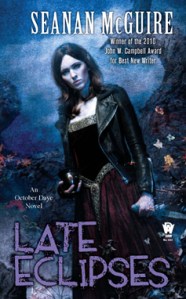
Late Eclipses by Seanan McGuire

Late Eclipses
Seanan McGuire

Ahh, October Daye. This is one of my favorite series, and each time I read a book, I want to read the next one right away.

Late Eclipses is the fourth book of the series:
Book 1: Rosemary and Rue – https://i0.wp.com/i58.photobucket.com/albums/g254/jayamei2/livejournal_com.gifhttps://i0.wp.com/i58.photobucket.com/albums/g254/jayamei2/wordpress.jpg
Book 2: A Local Habitation – https://i0.wp.com/i58.photobucket.com/albums/g254/jayamei2/livejournal_com.gifhttps://i0.wp.com/i58.photobucket.com/albums/g254/jayamei2/wordpress.jpg
Book 3: An Artificial Nighthttps://i0.wp.com/i58.photobucket.com/albums/g254/jayamei2/livejournal_com.gifhttps://i0.wp.com/i58.photobucket.com/albums/g254/jayamei2/wordpress.jpg

**** There may be mild spoilers for earlier books in this review ****

The Premise: Toby has had barely any time to settle down after the events of the last book when she is ordered to appear before the Queen of the Mists, and since Toby has annoyed the queen before, this request sounds like trouble.  Soon after that she receives news that Lily, her friend and The Lady of the Tea Gardens is sick. When more people are stricken, it becomes apparent that Toby and all that she holds dear are a target. When Toby detects the scent of an old enemy, Oleander de Merelands, in the wind, she thinks she knows what’s going on.  Unfortunately, things are never simple for Toby, and this time she may have very few options to save both her friends and herself.

My Thoughts: When I think about the October Daye series, I think about structures that are built piece by piece and brick by brick.  The first book, Rosemary and Rue was the cornerstone, and every subsequent book has built upon that. It’s not just the worldbuilding (where there are pockets of worlds through secret doorways and fae creatures live parallel to the ordinary world – love it), but the way Toby’s back story has informed and continues to inform the current plot. This is why I don’t recommend reading this series out of order (it can be done, but it wouldn’t be as much fun); without the first books, the places Toby has been and people she has met wouldn’t be as significant in the current story.

I love how there are always hints throughout the books about Toby and her situation. It’s like some kind of delicious game between the reader and the writer. I try to guess what’s coming, I spend time mulling over what happens in the books and what some remarks may mean, and I wait for the next book. Then I’m either rewarded by being somewhere in the ballpark or I’m completely and utterly wrong. In Late Eclipses I was happy to have some of my suspicions answered, but not the way I expected. Of course I can’t speak of it here, but let’s just say that it is good stuff. In fact, this book manages to be the best in the series so far because of all the revelations within. It’s not unusual in urban fantasy to find a main character that investigates otherworldly crimes, but the guessing games set this series apart.

In Late Eclipses the newest disaster is a mysterious sickness which strikes Toby’s friends (friends who cannot get sick), right when Queen of the Mists begins her machinations involving Toby. As usual there’s a lot of action and Toby spends much of the book breathlessly running from one place to the next in an attempt to stop bad things from happening. In the past Toby gets knocked around quite a bit. This book is no different, even with Toby making smarter decisions and with friends backing her up.  I was at the edge of my seat, mentally yelling at Toby to watch out because it seemed like someone was out for her in particular. There was more of an anticipatory feeling throughout this book than in the past because it wasn’t as simple as finding a murderer. This felt like a conspiracy.

I was expecting characters that until now have been off the page to finally show up (not a spoiler, since this is on the back blurb), but Toby has many more allies now than she did when the series started. They rally around her, even when it could result in adverse consequences for them. I really like that Toby’s circle of friends has grown over the course of the past three books, and it’s very touching to see the rewards of her being her usual Hero self.
The side characters in this series are great, and we get to learn a little bit more about them in Late Eclipses, especially Toby’s Fetch, May, and her liege, Sebastian. There’s also some new information about people who don’t love Toby, including Raysel. The only problem I had with the characters was that I noticed there were a lot of them who hate Toby for failing as a Hero. It was odd for this motivation to pop up repeatedly, but before I got too perturbed by this, the characters differentiated themselves from each other, making the observation moot. Your mileage may vary on this pattern.

Of course one of my favorite secondary characters is Tybalt, King of the Cats. I’m always hoping that there will be romance between him and Toby. The romance in this series is never in the foreground, but there are some interesting developments here. I think fans of both Tybalt and Connor will be happy with how things go in this book. It does complicate things for the next one though. I was already looking up the release date for the next one, One Salt Sea while I was midway through Late Eclipses (September 2011).

Overall: If you are an urban fantasy fan, you should read this, but don’t stop at the first book, because the overarching storyline builds up as the books go along. It is rewarding to keep reading the series – if I think over what was revealed in this book, I become positively gleeful. I need to run out and find someone who has read it so we can discuss. To me, this series just gets better and better, and this is the best installment yet.

Buy: Amazon | Powell’s | The Book Depository

Other reviews:
Fantasy Cafe – 8.5 out of 10
Scooper Speaks – positive (“the bom-diggity-dog”).
Lurv a La Mode – 5 scoops (out of 5)
All Things Urban Fantasy – 4 out of 5
Fantasy Literature – 4 out of 5

Masques by Patricia Briggs

Masques
Patricia Briggs

Patricia Briggs’ Mercy Thompson series is one of my favorite urban fantasy series out today. When I started getting into them I naturally looked into her backlist, which is in the fantasy genre. I’ve read both Hob’s Bargain and the Hurog duology, and the Raven duology is in my TBR pile, but the one book I could not get my hands on was Masques, her first book. In a post I wrote in 2007, I noted that I wanted it, but “This book goes for at least $60 on eBay, $120 to over $600 elsewhere. Which I think is CRAZY.” I didn’t think it was worth paying so much for a book which the author herself admitted was her first effort and thus had a lot of weaknesses! Thankfully, Masques was re-released after a rewrite by Briggs. Even better: its sequel, Wolfsbane, is now available.
 
This review is for the rewritten Masques.
 
The Premise: Aralorn is a mercenary who “doesn’t take orders” and “will occasionally listen to suggestions” which makes her ideal as a spy for the city of Sianim. Her latest assignment is to check out rumors of an assassination attempt on the ae’Magi, the much beloved Archmage of the land. It isn’t until she is at his castle does she realize that the ae’Magi is not the good, kind man the world thinks he is. He’s pure evil, but his influence over people’s hearts makes any opposition near impossible. The only people who realize the true nature of the ae’Magi are persecuted by him.  These include Wolf, a grey beast with yellow eyes who can speak, the young King Myr of Reth, and a small but growing group of rebels hiding in the Northern Woods.
 
My Thoughts: This book begins with an introduction by the author which explains that Masques was a book she started in college when she knew nothing about writing. This means that in looking at it again as a more experienced writer, there was a lot of “squirming uncomfortably” and the first attempt at a rewrite was so extensive that it changed the story completely. So this edition of Masques is a compromise: it keeps the original story but makes things fit better, leaving the “cliches and oddities” intact.
 
I kept Briggs’ introduction in the back of my mind while reading the book, and I can see what she alludes to as the “cliches and oddities” in her story. Yes, there are a lot of things in Masques that feel very familiar. Aralorn’s background alone made me wonder if I’d read Masques before: the plain-looking lord’s daughter, more interested in swordplay than etiquette, runs away from home with her warhorse and joins a mercenary guild. Her shapeshifter bloodline and quick wits keep her alive, and along the way she gains a wolf companion.  Add to this the evil sorcerer in his castle, a scarred hero, an army of mindless minions, a spymaster, a dragon, and magic items, and you have a rather common set of tropes. Yet I never felt that these things were trite. Instead I felt like I was reading a story where the plot had a charming enthusiasm, while the writing itself was polished by experience.
 
I didn’t think the polish covered all flaws, but there were qualities in this story that reminded me of what lured me into the fantasy genre during the nineties, and that was worlds I wanted to visit. I really enjoyed the settings, particularly the fantastic rooms described in the story. I loved imagining the secret places these characters went and the grand palace that the ae’Magi lived in. I also liked the idea of the green versus human magics, and how shapeshifters and magical creatures fit into this. The explanation of how the magic works could have been better, but there was still a sense of wonder while reading about magical creatures and old stories that I enjoyed.
 
There’s a lot thrown into the 294 pages that was this book, but story is essentially a good versus evil tale. After Aralorn discovers the true nature of the ae’Magi, King Myr of Reth has to flee his palace, leaving his throne open for the ae’Magi to usurp. Aralorn and Wolf join him in the Northlands. Here, the power of human magics like the ae’Magi’s are not as affective, but green magic, the magic of Aralorn’s shapeshifter people, have no problems. A ragtag band of people impervious to the ae’Magi’s magical influence trickle into the hidden camp, called my some unknown power. Together they begin to work out how to overthrow the ae’Magi.
 
There are a few secondary characters within this rebel camp, but besides King Myr and the ae’Magi (who were very good and very evil respectively), no one really made much of an impact on me. The focus is primarily on the two heroes (Wolf and Aralorn) and they stood out while others faded into the background. I found myself uninterested in the camp’s day-to-day life and more drawn in by Aralorn and her relationship with the the enigmatic Wolf.
 
Although I feel like Aralorn is the main character, Wolf steals the show. Aralorn rescued him from a pit trap, and over the years he’s slowly revealed more about himself, including the fact that he’s not just a wolf. He’s your basic scarred hero, but he and Aralorn have developed a bond which has become something more for them both. I loved reading about his past and their conversations while they researched spells in Wolf’s private library (I wish this library was real). Aralorn is a good match for his prickliness because she can cheerfully ignore it, and she uses her humor to chip away at his shell. As you can imagine, this is the set up for a romance. I was expecting something slow moving from the way the book began, but the complications I thought I’d see were superficial ones. It was sweet but not intense. I am looking forward to reading the second book to see how their romance continues and I hope to see better developed secondary characters that play a larger role in the plot.
 
Overall: Masques is a little bit dated because it’s a book originally written in the nineties, but it has a lot of charm. It reminds me of books about female heroines having adventures written by Robin McKinley and Mercedes Lackey that I read in my teens and still hold a fondness for today. It has its flaws but it also has charisma, and it kept me pleasantly entertained for the few hours it took me to read it. I think would do well with YA readers interested fantasy, particularly girls.
 
Buy: Amazon | Powell’s | The Book Depository
 
Other reviews:
Dear Author – C
 
(This review was cross-posted to the paperbackswap blog)

A Lot Like Love by Julie James

A Lot Like Love
Julie James

Julie James is on my auto-buy list now. I had a friend say it’s surprising how much I like these books because they seem more fluffy than what I usually go for. Tsk, people.  Sometimes I need the light and fluffy.  I like to mix it up. (Although I don’t necessarily consider these books fluffy).


The Premise: FBI agent Nick McCall is used to going undercover and pretending to be someone else for months at a time, but his latest assignment starts off short and simple. He has to pretend to be the date of billionaire heiress and wine store owner Jordan Rhodes at the annual wine tasting and fundraiser at Bordeaux restaurant. All he needs to do is plant a few bugs in the office of Bordeaux’s owner and suspected mob money launderer, Xander Eckhart, and that will be that. Unfortunately, an unforeseen circumstance turns a one day job into one with no end in sight.
 
Read an Excerpt of A Lot Like Love here
 
My Thoughts: The plot is in the same ballpark as James’ earlier book, Something About You (which I reviewed here: https://i0.wp.com/i58.photobucket.com/albums/g254/jayamei2/livejournal_com.gifhttps://i0.wp.com/i58.photobucket.com/albums/g254/jayamei2/wordpress.jpg), we watch as an FBI agent falls in love with the woman he’s supposed to protect. This was a straightforward contemporary suspense romance: boy meets girl; there’s some friction and banter, but sparks fly; bad guy gets in the way;  love prevails. It’s not a overly complex plot, but it’s oh so much fun. A Lot Like Love reads like a nice romantic comedy that is perfect for a rainy day.
 
This story begins with Nick finishing up another long stint undercover and ready to spend a few days off to visit his family, when he’s called in by his boss to consult on another case. An agent new to the undercover business needs Nick as backup as he takes heiress Jordan Rhodes to the exclusive, 5000 dollar a head charity fundraiser at Bordeaux. Jordan is well known within Chicago because of her very rich, billionaire father, not to mention her infamous twin brother who is in jail for a computer-related crime. Nick expects a spoiled rich girl, but Jordan really doesn’t live off her father’s money — she makes her own money via her wine store.  I loved that Jordan is a business owner and her knowledge of fine wine is a large part of the book (she may not be a lawyer like past Julie James heroines, but her job is still very important to the story). When Nick first meets Jordan, he has his initial assumptions, and neither is happy that Nick has to replace the original agent assigned to be her date. Nick learns very quickly though that Jordan is not a snob. I liked that Jordan really is unpretentious. Her friends aren’t all wealthy socialites and she owns a wine shop because she loves wine, not for the prestige. She treats wine as something she wants people to feel comfortable with and to try, and that she’s geeky about, not as some way to flaunt her wealth and privilege. It was fascinating as a non-wine expert to read about it, and It was nicely done how Jordan’s open approach was so different from Eckhart’s: he wanted to show off, and it is a competition to him. His snobbery extends to the rest of his character, and this is shown in the book in many little ways.
 
The romance in A Lot Like Love was just right. Sweet, but not too sweet, steamy (there is sex), but not too steamy. And there’s plenty of sarcasm from everyone which adds a nice touch of humor to the romance. Nick is a guy through and through, and Jordan brings out an introspective side of him that he isn’t used to. Jordan is perfect for him because she’s just as unused to saying how she feels. In her family, they deal with things through sarcastic humor. So when Nick and Jordan are together, they are on the same sort of wavelength. Nick calls her Rhodes, and Jordan tries to expand his comfort zone. I liked that they both realize how they feel and it’s not hard for them to be honest with themselves (being honest with each other is another story). They had their bumps but they were relatively easily resolved along with the investigation.
 
I also liked the other relationships in this book. Jordan had good relationships with her store assistant, Martin and with her twin brother. She also has a tight-knit set of friends. Although they were on the page too quickly for me to get individual impressions of them, I could tell that they were important to Jordan. Nick too has family that he is close to, and his relationships with his brothers and with the guys at the FBI are full of the friendly ribbing that Jordan gives her brother.  It was also nice to see some familiar characters from Something About You show up here, and bonus points for a couple of Pride and Prejudice references (as well as Lost and Dancing with the Stars).
 
Overall: I liked this one just about as much as I liked Something About You. They’re both romantic suspense, is a subgenre I don’t really go for, and I prefer her straight contemporaries without the suspense plots, but Julie James writes comfort food for my soul, and that trumps my romance reading preferences. It’s an uncomplicated story, but it hits the spot. A Lot Like Love was the right read for me this past rainy weekend.
 
I’m already looking forward to her fifth book, which will have Jordan’s twin brother, Kyle, as its hero, and has been tentatively titled About That Night (via trueromance).
 
Buy: Amazon | Powell’s | The Book Depository
 
Other reviews:
Chachic’s Book Nook – positive
Dear Author – B
Babbling About Books, and More – A
Smexy Books (guest post) – A
The Book Binge – A
The Book Smugglers – 7 (Very Good)
 
Book Trailer:

Secrets of the Demon by Diana Rowland

Secrets of the Demon
Diana Rowland

Ever since book 1 of this series I’ve been loving it’s unique premise: that of a Louisiana detective with the ability to summon demons who has her work as a cop intersect with her extra-curricular activities. I’ve had Secrets of the Demon, the third of the series, on pre-order. My reviews of the first books are here:
 

Book 1: Mark of the Demon https://i0.wp.com/i58.photobucket.com/albums/g254/jayamei2/livejournal_com.gifhttps://i0.wp.com/i58.photobucket.com/albums/g254/jayamei2/wordpress.jpg
Book 2: Blood of the Demon https://i0.wp.com/i58.photobucket.com/albums/g254/jayamei2/livejournal_com.gifhttps://i0.wp.com/i58.photobucket.com/albums/g254/jayamei2/wordpress.jpg

 
***** If you haven’t read the first books there may be mild spoilers for them in this review. *****

The Premise: Kara Gillian is now part of a special FBI task force along with her duties as a homicide detective at the Beaulac, Louisiana, Police Department. Along with FBI special agents Ryan Kristoff and Zachary (Zach) Garner, the team investigates a threat to the lead singer of local band Ether Madhouse. The team doesn’t think the threat is real, until Lida Moran is snatched by some creature during her band’s last song. Kara knows that there was no demon, but there is some kind of magic in Lida’s abduction. Magic that she senses again during a murder investigation. As more people begin to die, Kara must find out the connection between the band and the murders, and in the meantime, her life continues to be complicated by her special association with Demon Lord Rhyzkahl and her confusing relationship with Ryan.

Read an excerpt of Secrets of the Demon here

My Thoughts: I was surprised to see that the cover art for this third book is so different from the first two, but then I remembered that this series has changed publishers. It’s not bad, I could do without the bit of bra poking out or the thing behind Kara, but in person the background is less overpowering.

This is not a series that should be read out of order, and I think that although the third book does a lot of catching the reader up to what has happened so far, it can’t really cover the subtle progression of Kara’s relationships to those around her. For that alone, I highly recommend reading books 1 and 2 before reading this one. When you read all three books you can appreciate more where things have been and where they’re going. This is especially true of the ongoing love triangle. I have to say that in the first two books when it comes to Kara’s relationship with Ryan and her relationship with Rhyzkahl, I’ve been pulling for Ryan. This is based on the fact that I didn’t trust Rhyzkahl at all. In this book however, I’m surprised to find myself wondering if Kara’s relationship with Rhyzkahl could be deeper than I thought. It doesn’t help Ryan’s case that he’s been very judgmental about Kara’s relationship with Rhyzkahl when he really has no right to be. At this point things could go either way, and I never thought I’d say this, but I think I may be happy with either, as long as Kara makes a choice she’s happy with. I’d love to see a deeper relationship with EITHER of the two men here.

As for Kara’s other relationships, she continues to develop friendships all around and she’s learning that she’s not as alone as she thought. From her Sargent, to her Aunt’s boyfriend, to her best friend Jill, Kara’s circle is growing and I’m happy to see it. I like the way that these secondary characters have developed over the books, each revealing a little something more in each progressive volume, and each unique. The banter between Kara and the others usually works too, but I have to say that there are a couple of minor missteps. Mostly this was in feeling like although Kara was supposed to be in her late twenties, she sometimes read as older, and a little behind on the times. I was thrown out of the story by the over-use of “bitch” and “chick” whenever Kara spoke to Jill (it’s not like I don’t fondly call my girl friends this, but sparingly, not every sentence), and by a random “for the win” (fine, I’m being nitpicky on that one, but still).

The investigation in this book and the otherworldly connection to it was not exactly demon-related, and Kara spends more time using her mundane police skills over her arcane knowledge to solve the case. The case is a big part of the plot but I felt more drawn to the longer running story ARC – what Kara’s relationship with Rhyzkahl means and who Ryan really is. Next to that, the murders didn’t feel as strong, and when the person behind it was revealed, it was almost an unbelievable surprise, but overall I felt pretty satisfied.

Overall: A really good continuation to the series in terms of Kara’s involvement with the demon world and with Rhyzkahl and Ryan. My interest in the murder investigation was overshadowed by my interest in Kara’s developing relationships, but I got what I wanted from the longer running story arc, so I was happy. After finishing Secrets of the Demon, I’m dying to find out what happens next. This is an urban fantasy series that has police drama, romance, sex, and friendship, but also: humor. There’s just the right dose of banter and irreverence to keep things from getting dark.

Buy: Amazon | Powell’s | The Book Depository

Other reviews:
Lurv a la Mode – 5 scoops (out of 5)
Babbling about Books, and More – B+
Smexy Books – B
Wicked Lil Pixie – 5 out of 5
The Discriminating Fangirl – 4 out of 5

The Heroes by Joe Abercrombie

The Heroes
Joe Abercrombie

My husband read Best Served Cold last year and his response was favorable: “this is [bleeep!]’ed up…  I like it”. Now The Mister has been working his way through Abercrombie’s backlog. As a result, I’ve been meaning to try this author, even though I had a vague idea it meant lots of violent action which isn’t usually what I gravitate towards. When Orbit offered a finished copy for review I took the chance to try something new.

The Premise: The southern Army (aka The Union), are fighting for the King against the Northmen horde, led by it’s leader. Minor skirmishes between Union divisions and the Northmen in other parts of the country have culminated in a battle over a small patch of land near the town of Osrung and a ring of standing stones called The Heroes. Over three days the outcome of the war will be decided.

Read an excerpt of The Heroes here

My Thoughts: You know the how often in an epic fantasy series, we follow one or many characters in their adventures and the culmination of the tale is often a big battle between the armies of good and evil? Well, chop off the parts before and after the battle, take out any sense of who are good guys or bad, magnify and expand that, and you have The Heroes. This has the feel of fantasy, but from a new perspective — it’s all about the battle and only the battle, and its third person narrative that hops from one character to the next highlights a dizzying mix of violence, terror, anger, boredom, and insanity brought on by war.

The story focuses on many characters. Some are followed only for a page or two before we jump to the next one, but others we come back to often. We get perspectives from both sides of the battle. There is no main character, but there are characters who we spend a little bit more time with than others. These are Curnden Craw, an old-timer and leader of a dozen, with decades worth of fighting under his belt (a Northman); Prince Calder, the son of a disposed King of the Northman, and known for his aversion to fighting (a Northman with little loyalty to the current leader); and Colonel Bremer dan Gorst, disgraced ex-King’s Guardsman who was appointed “Royal Observer of the Northern War” (a Union man). To a lesser extent the story also spends time with a couple of people with relatively smaller roles in the battle – Beck, a farmboy who joined the Northmen with delusions of grandeur that are soon shattered, and Finree dan Brock, daughter of the Union’s Lord Marshal, and ambitious wife of one of it’s Colonels. There are a lot more characters, but I’ll stop there. I didn’t have trouble with the multiple names, but there’s an “Order of Battle” at the front of the book is very helpful in keeping them straight (additionally, there are maps of the terrain as the battle progressed).

In this story, no one is particularly brave or heroic. Even if they manage to kill many of the enemy, their thoughts are not of great deeds, but of staying alive and maybe advancing their situations in the process. Many of the characters have petty or cowardly thoughts so they may not be particularly likable, but that’s life. Everyone has flaws and issues — some more than others. I found Colonel Bremer dan Gorst and his silent seething anger on the disturbing side even though his fighting skill was unmatched. Calder is a cowardly schemer, but he has a quick wit which balanced that out. I felt similarly about Finree. She has a sharp ambition which tramples over her thoughts for others, but she was smart under pressure. I didn’t really feel that connected to any of these characters though. There was something about each of them that made it difficult. The only character I liked was Craw, because he wanted to do the “right thing” even though this rule of conduct had it’s holes. Maybe it’s his straightforwardness amongst so many characters who are not, that I liked most (whatever that says about me).

Remember The Princess Bride, when the grandson asks his grandfather accusingly, “Is this a kissing book?”. Well, there was a little girl inside me, with her arms crossed and the opposite sentiment about The Heroes. To be fair, this feels like a matter of personal preference – this is just not the book for me. I want to feel a connection to characters when I read a book, and didn’t really find that in The Heroes. On top of that, war stores are pretty much the opposite of what I usually go for, and 541 pages of men killing each other pushes my boundaries. We all bring our histories with us when we read, and I grew up somewhere in the midst of civil war. That dampens my interest in reading about it. On the plus side, the writing was good.  Yes, there’s lots of flying body parts, but there’s always something happening and an underlying black humor about it all. I enjoyed some of the lighter moments in the story and in following the unexpected interactions between characters. Small things can have unexpected consequences, and there are brilliant intersects between characters (the last one hundred pages was particularly well choreographed). In the end I may not have been won over, but I’m glad I challenged myself to read this. I would read other books by this author, but perhaps not ones where the focus is on the battlefield.

Overall: This is a book about the kind of war that is face-to-face and hand-to-hand. As can be expected, the plot is grim and violent, but at the same time it has the same characteristics of anything in life, like tedium, humor, and bureaucracy. I’d recommend this book for readers looking for that conveys human flaws and the ambiguity and messiness of real life. I think I can appreciate the strengths of this book but I am a romantic when it comes to my reading, and this is clearly the antithesis of that.

Buy: Amazon | Powell’s | The Book Depository

Other reviews:
Fantasy Faction – 8.5 out of 10 stars
Grasping for the Wind – highly recommended
LEC Book reviews – 4.5 out of 5
Genre Reader – DNF for now?

Other links:
Orbit Podcast w/ Joe Abercrombie

The Dead Travel Fast by Deanna Raybourn

The Dead Travel Fast
Deanna Raybourn

I was thrilled to get an autographed copy of this book at BEA last year and I’ve been saving this read for a few months. I finally got around to it last weekend, and it was a relatively fast, atmospheric read.

The Premise:
Theodora Lestrange is left with little prospects after the death of her scholarly grandfather, and despite her sister and her husband’s good intentions, she has no desire to live with them. Theodora longs for passion and adventure and to be able to continue writing her books.  So when an old school friend writes to Theodora asking her to come to Transylvania to celebrate her betrothal and stay for a little while, Theodora jumps at the chance to be bold and to have her creativity sparked. When she gets there she falls in love with the mysterious countryside and the man who is lord of it, despite the disturbing beliefs of it’s people.
 
Read an excerpt of The Dead Travel Fast here
 
My Thoughts: The Dead Travel Fast is a book that is separate standalone from the Lady Julia Grey series, with a very different heroine and a very different tone.  Rather than a Victorian mystery, this is a tale spun in sensational Gothic fiction tradition, starting with it’s horror setting: a crumbling castle set imposingly above a rustic village in the Carpathian mountains. This is where Theodora arrives and meets an eccentric bunch: an aging but haughty countess, a stoic group of servants, a jovial family doctor, Theodora’s school friend Cosmina, and the handsome, enigmatic Count Andrei Dragulescu. Stories of vampires and werewolves abound, and Theodora is thrilled to have so much fodder for her writing. She doesn’t believe any of it’s true at first, but as she experiences more of this place, it’s difficult to disbelieve that there are not evil creatures roaming the night. As she falls under the spell of the castle, she also falls for the seductive count.
 
This story felt like a tribute to the Gothic genre and thus certain “rules” of that genre were followed, which I think lent this story a simpler feel compared to Raybourn’s other books, both in plot and character. Theodora felt like your typical intrepid but still innocent Gothic romance heroine. She has a high level of imagination and a romantic heart.  She tells her sister she wants to feel passion and will settle for nothing less, and when she meets the count, despite his improprieties, she just can’t seem to help herself. Over and over she resolves to stay away, and over and over she does not.
 
The count on the other hand is a despoiler, and it’s very obvious that he’s seducing our heroine. He even explains to her that there are “only three types of women that matter in a man’s life –those he marries, those he seduces, and those he takes. I have only to tailor my behavior to become whatever the lady in question wants me to be and I’m assured of success.” I think this sentence explains why I found his character unlikable. While he may be genuinely attracted to Theodora, the calculated way he got her attention rubbed me the wrong way. What softened the dislike was that his character fit the Gothic tale – is he the hero, or the villain? I hoped he was the hero because Theodora (the narrator) sees him through rose-colored glasses, but I questioned her judgment severely.
 
The first part of The Dead Travel Fast builds up the melodrama of the story, and I wasn’t sure whether a supernatural being would appear or not or if this would be just a romance or something more. Thankfully, the typical Raybourn mystery does appear (albeit in a smaller dose than in previous books). While this was a quick read, I was relieved by the mystery because that’s where I feel Raybourn shines. Theodora may not be as sharply observant as Julia Grey, but once she does put her mind to it, she’s just as quick to see the possibilities. As a result, the book ends on a satisfying high note.
 
Overall: This is a story which nods it’s head towards the Gothic fiction tradition and mixes that with a romance and a mystery. In the end I liked this one, but I wanted to like it more than I actually did. I understood where the author was going, but the Gothic affectations of the characters stopped me from really connecting to them. If it wasn’t for the satisfying ending this would have fallen into my “OK” category, but if I was an English Literature major or someone interested in the Gothic genre, I think I’d probably have appreciated this more.
 
Buy: Amazon | Powell’s | The Book Depository
 
Other reviews:
Angieville – positive
See Michelle Read – mixed feelings
fashion_piranha – positive/some criticisms
The Book Harbinger – positive
Dear Author – B-
 

Cold Magic by Kate Elliot

Cold Magic
Kate Elliot

Ever since KMont posted a glowing review of Cold Magic on her blog, I’ve been really interested in reading it. So despite my teetering TBR, when I saw it in my local library I made an impulsive decision to grab it.

The Premise: (taken from the blurb) “It is the dawn of a new age…The Industrial Revolution has begun, factories are springing up across the country, and new technologies are transforming the cities. But the old ways do not die easy. Cat and Bee are part of this revolution. Young women at college, learning of the science that will shape their future and ignorant of the magics that rule their families. But all of that will change when the cold mages come for Cat. New dangers lurk around every corner and hidden threats menace her every move. If blood can’t be trusted, who can you trust?”

Read an excerpt of Cold Magic here

My Thoughts: This is one of those books that just throws you into the world and you glean information as the characters make their way. The story begins on a relatively typical day in Catherine and Beatrice’s (Cat and Bee’s)  life in Adurnam.  Cat lives with Bee, who is her cousin, and with her aunt and uncle. Along with her cousin, she’s a student at the local university. There is a feeling of excitement about industry and human innovation, and about the airship for the “Great Expedition”. The two girls, who are very close, have a great chemistry and I loved reading scenes with them together. All seems as usual, even Cat and Bee’s mischief, but when they go home, and their day turns dark.  A cold mage, Andevai Diarisso Haranwy, from Four Moons house, arrives at the family’s home, asking for the eldest Hassi-Barahal girl as per some agreement. By the end of the night, Cat is married to this arrogant mage, and taken away.

This seems like a set up for a captive-bride romance, but the story doesn’t really go there. There’s a twist which brings down a whole world of trouble, but Cat reacts and survives. She refuses to be used, nor will she let her beloved cousin be used. Luckily for her, her true lineage gives her an edge that no one realizes.

This is a fantastic story in terms of world building. There are steampunky elements in this book, but it also throws in an alternate history and hints at a well-built magical world. It’s clear that the two forces of magic and science are at odds, not only among cold mages, the ruling aristocrats and the common man, but among men and other creatures. The part of me that loves that stuff was very happy.  At times I worried that things were going over my head, but I’m not sure if it was my fault for reading the book when I was tired or if this was to be expected, as things made more sense as the story progressed. Anyway, the book is chock-full of details about a world that is like ours, except not. The icy climate, the spirit world, the history of the cold mages and how Cat’s people adapted after Roman rule are all mixed in with Cat’s adventures. As is Cat’s personal history which she realizes isn’t what she thought.

Cat is a great heroine. As the narrator she has a strong grasp on recent history and a pride in her people, the Kena’ani (called Phoenicians by the Romans). I liked that she was interested in technology and in science, but although magic is an accepted part of the world, it’s not something she’s very knowledgeable in. As a result, when he fate intersects with that of cold mages and spirit worlds, Cat has to rely on her wits and instinct to survive. The world seems to be reaching an impasse, and it’s not certain which way things will go, but Cat is in the center of big changes.

My favorite secondary characters were Cat’s husband Andevai and her cousin Bee. Bee is someone Cat loves and wants to be safe, and who shares similar feelings for Cat. I really enjoyed the relationship between the two girls and I liked how they had their own distinct personalities – Bee being more the winsome and artistic one, but who is just as quick as Cat. I loved their close relationship, as I loved how well that immediate recognition of family that was elsewhere in this story (saying more would spoil the fun). Their antics and banter had me grinning. I also ultimately liked Andevai although he starts off as someone who I couldn’t pin down as someone I should like. Cat isn’t sure if he’s ally or an enemy.  It’s not obvious how he feels because he blindly follows the instructions given him, and his arrogance and vanity makes him rather unlikable. I felt somewhat irritated that Cat would note how handsome he was at the same time she was complaining about his faults, but as the book went along he showed more depth. There’s an obvious set up for romance between the two but it’s definitely something for that’s not going to be simple and will likely develop over multiple books.

Overall: This was a solid fantasy story with a really imaginative world (alternative history, hints of steampunk, cold magic). My favorite things were the world building and the relationships between characters, two important things in my checklist for liking a book. My only criticisms would be that the pacing felt uneven and things went over my head, problems that not everyone may share. In the end, I really want to know what happens next, and do look forward to the second book, Cold Fire, so I can experience all these characters again. I recommend it for fans of straight fantasy who like independent female heroines.

Buy: Amazon | Powell’s | The Book Depository

Other reviews:
Lurv a la Mode (ARC review) – The Biggest 5 Scoops ever (out of 5)
Charlotte’s Library – mixed review, “here’s much to admire […] didn’t quite come together”
Dreams and Speculation/Dirty, Sexy Books Dueling Review – 4 stars (DSB) / 6 out of 10 (D&S). I tend to have similar opinions DSB, and I agree with this one
Chachic’s Book Nook – positive review (I share her opinion on this one too!)
Smexy Books – B-
SFF Chat – some problems but ultimately positive
Got Schephs – 8 out of 10
The Book Smugglers – 8 (Excellent)
Dear Author – A-
Starmetal oak book blog – A

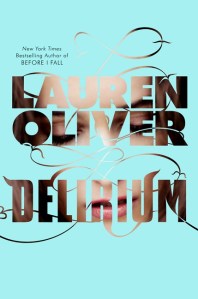
Delirium by Lauren Oliver

Delirium
Lauren Oliver

This is a review based on an ARC copy I received from the publisher.

The Premise: In a unspecified future, the United States government has identified love as a disease and has administered a cure for over forty-three years. Lena is terrified of getting amor deliria nervosa and can’t wait till her eighteenth birthday when she can get the procedure and be safe. She doesn’t want to become like her mother, who was so affected by love that she left Lena and her sister behind, to be cared for by their Aunt Carol and Uncle William. That is, until Lena meets Alex and begins to question whether it’s a good thing to lose the ability to feel excess emotion.

Read an excerpt of Chapter 1 of Delirium here

My Thoughts: The set up for this story is that sixty-five years before it begins, the United States identifies love as a disease that encompasses “stress, heart disease, anxiety, depression, hypertension, insomnia, [and] bipolar disorder”. This disease, so they say, begins with symptoms like difficulty breathing and preoccupation, slides into euphoria and despair, and then spirals into paralysis and death. The country is so rigidly run by this idea that the Safety, Health, and Happiness Handbook (aka Shhh), is a new Bible, and cities are enclosed for their protection behind high electrified fences. Patrols and raids are regularly carried out. All citizens are required to be cured at eighteen, and are ever villigent should their friends or neighbors show signs of the disease. Of course Lena believes in all of this because she’s grown up in this society. The author does a good job conveying Lena’s frightfulness, particularly in the beginning of the book. Lena is the narrator, and she often uses words like “anxiety”, “blur”, “dizzy”, “suddenly dazzled” and “flashing” when she describes a situation that isn’t her norm, so much so that I began to feel like I needed a Dramamine reading about her experiences.

As a reader, however, I know that the whole basis for this society: “love is a disease”, is a lie, and that Lena’s fears are unnecessary. In order for me to accept this dystopian scenario, I needed more than the descriptions of Portland gripped by bureaucracy and fear. I needed to understand how something generally accepted as good could be seen as something bad. This book didn’t deliver that. All I had was Lena’s point of view, and she was clearly misinformed. There are infinitesimal snatches of information (a religion founded by scientists, the blitz), which has something to do with how things became the way they are, but it’s not clear how it fits with Lena’s present. It may be that book two will delve into the past, but I have no guarantee of it. As it is, I felt like I was missing the foundation to accept the premise that love came to be classified as a deadly disease. How was the population convinced? But by who and for what reason? How did this dystopia come to be? I don’t know, and I think that weakens any message about society that Delirium may be trying to convey.

To continue reading, I decided to trust that explanations would be forthcoming, and just focus on Lena’s story. The writing is very good. There are plenty of lovely passages just describing Lena’s day to day teenage life and how it’s been affected by amor deliria nervosa. It’s clear that it has touched every aspect of Lena’s life from her all-girl schooling to her careful choice of words in public. It hangs over every relationship. Conversations with her best friend, Hana involve dealing with phone tapping and checking for eavesdroppers. The biggest impact on her life however, is the procedure, when she will finally be cured, which means she will be Paired off with a boy selected by the government. On that day, Lena and all other teens will forget any feelings they had for friends or family. Until then, Lena experiences all the highs and lows of being a teenager, which includes a closeness with the charismatic Hana and a regimented home life with her aunt and uncle and their other wards, Jenny and Gracie.

Then there is of course, the relationship she begins with nineteen year old Alex.  He’s a boy who seems very different from everyone she knows. In the process of falling for Alex, Lena discovers what love is and how twisted her society has become because it has suppressed it. The romance here was very clandestine and intensely described, but while I could appreciate Lena’s and Alex’s feelings on a logical level, and I wanted them to beat the odds, there was something that held me back in believing the romance viscerally. I think that my problem was that their initial attraction felt off.  Lena seemed like a scared rabbit to me, but as someone “awake” to Alex. That he has been interested in her from afar didn’t fly, so I stayed unmoved about their initial connection. After this there was a scene when Alex and Lena are first alone together which I found compelling, followed by a montage of summer days spent together. All nice, but it was only at the end of the story that Alex really stepped up as a hero and convinced me of his feelings. Although Delirium ends on a bittersweet note, it was the perfect good-bye.

Overall: It’s very well written and it has an interesting premise, but overall I’d mark Delirium as “very good”, not “excellent”. I think that love as a disease was not believable enough for me – I ended up wondering what the REAL reason for a society built on this lie was, and feeling frustrated that I couldn’t see one. I hope that the idea is expanded more in the next book, so that we can see the history behind Lena’s world. Otherwise, I really liked how this story progressed, how Lena grew and changed, the careful way Portland under a totalitarian regime was constructed, and the bittersweet ending that leaves no illusions about what it means to love.

Buy: Amazon | Powell’s | The Book Depository

Other reviews (there are A LOT!):
The Book Smugglers – DNF
The Hiding Spot – positive
Debbie’s World of Books – positive
Imperial Beach Teen Blog – positive
One Librarian Reviews – comparison of Delirium with Scott Westerfeld’s Uglies – 5 stars
The Compulsive Reader – positive
All Things Urban Fantasy – 5 bats (out of 5)
Book Reviews by Jess / The Cozy Reader – Perfect Score
Princess Bookie – 5/5
S. Krishna’s Books – positive
Karin’s Book Nook – positive
Book Sake – positive
Reading with Tequila – 2 out of 5
Ink and Paper – positive
Presenting Lenore – 5 out of 5
Need_tea – C grade

Song inspired by the book. Written & performed by a fan:

Videos of Lauren Oliver discussing Delirium on Amazon.com: One & Two

A Discovery of Witches by Deborah Harkness

A Discovery of Witches
Deborah Harkness

I received a finished copy of this book via the publisher, Viking/Penguin.

The Premise: Diana Bishop has a degree from Oxford and tenure at Yale. She specializes in the history of science, primarily on alchemy. During a research trip to Oxford’s Bodleian library, Diana requests a manuscript from the Ashmole collection: known as Ashmole 782, and when she sets eyes on it she realizes that it’s enchanted. Diana is a witch, albeit a non-practicing one.  She’s avoided magic after her parent’s death. Yet the enchanted manuscript opens for her, igniting both her powers and a storm of supernatural creatures curious about the manuscript and the person who unlocked it. First and most formidable of the daemons, witches and vampires who show up is Matthew Clairmont, a professor of biochemistry, member of the Royal Society, and vampire.

Read an excerpt of A Discovery of Witches: @Fantasy Cafe or @Deborah Harkness’ website

My Thoughts: Before starting A Discovery of Witches, I saw that it was likened to “Twilight for adults”. I spent a lot of time mulling over this while I was reading the book. I think that comparisons, particularly to a book like Twilight may do more to turn readers off than to draw them in. At first,  I didn’t think that the comparison made sense. The narrator is a witch, the setting is academia, and nothing reminded me of Twilight, except the detailed prose. I thought: “Is Twilight the first thing that comes to mind when there’s a vampire romance?”, but as I got further into the story, I began to see where the comparison came from: Matthew is protective of Diana; he breaks into her rooms while she sleeps; he feels conflicted over his feelings; the Congregation wants to keep them apart. But is this book like Twilight? Well… no, not really. There are plenty of differences between the two books, and the concepts that feel similar feel only superficially similar. In fact, I feel like A Discovery of Witches sidesteps a lot of the problems with why people didn’t like Twilight. Diana Bishop is a more independent character than I found Bella, and overall the romance felt more mature (I could see what drew these two to each other despite their age differences), and the plot itself was more complex.

The subtitle “a novel” also threw me off as to what to expect. Was this something in the literary fiction sphere, or something that is essentially a paranormal romance? While the story has a lot of historical references, the protagonists drink the finest wine and practice yoga, it’s accessible to fans of the paranormal romance and urban fantasy genres. There are paranormal creatures, a slow moving romance that is a big part of the plot, and I didn’t feel like it took itself too seriously. There is an escapist side to the writing. And when it came to history, I think the author indulged a little, because Matthew owns a Gutenberg Bible, a bound copy of “Will’s plays”, a 1795 wine from Madiera, a 500 year old Tudor Manor house, and a castle. It tickled me to run into these things though, so don’t take that as a negative.

The one aspect of the writing in this book that could be seen as negative however, is how detailed it was. A meal could be cover several pages because each course is thoroughly recounted, down to individual tastes in the wine and Diana and Matthew’s reactions to everything. If you don’t like this thick, descriptive writing, you’ll be stopping this book early.  On the other hand, if you enjoy having a really lush picture of what’s going on, this book delivers. I found the details so intertwined with the slow courtship that I felt like I was enjoying something comforting and extra-wordy that I wouldn’t normally savor in large doses: like rich chocolate.  This writing style (all 579 pages of it), makes A Discovery of Witches the kind of book you read in installments, not cover to cover in one sitting.

Most of the first half of this hefty volume is a lengthy courtship between Matthew and Diana, with the discovery of the enchanted Ashmole manuscript as the initiator. Diana is the main narrator of this story, so most of the book is told from the first person point of view, although there are a couple of instances when the story follows Matthew and switches to third person. Once it’s clear there’s something the two protagonists, the consequences of inter-species dating, Diana’s powers, and the Ashmole manuscript come to the forefront. That’s when the story widens from the focus on Matthew and Diana to the people around them. On Diana’s side there are witches, on Matthew’s there are vampires. Witches are born, vampires are made. Then there is a third race, daemons who are not the demons you typically see in paranormal fiction. These are born from humans but possess genius and/or madness that sets them apart. Once the plot thickens, I was pleasantly surprised how much enjoyed the seamless mix of action and conspiracy against the romance. The author adds secret societies, power-hungry factions, paranormal forces, conspiracies, a house with it’s own personality (I loved this house, I want to live in this house), and lots of grumpy vampires with long lives and long grudges. This looks to be the beginning of an epic battle between good and evil, and while there’s a satisfying ending to A Discovery of Witches, it is clear that there’s more. I hadn’t realized this when I got the book, but A Discovery of Witches is part of a trilogy and sets the scene for Matthew and Diana’s continued adventures.

Overall: This is a book that I think is supposed to be shelved in fiction, but it has a lot of cross-over appeal for urban fantasy and paranormal romance fans. Don’t let the Oxford setting and protagonists with long academic credentials dissuade you, this is an accessible story with a slow moving romance that’s a guilty pleasure to read, but the romance isn’t all — the story is shaping up to be a great good versus evil tale. I’d recommend this one with reservations however — there’s a lot of description and exposition in this story which isn’t for everyone. If you aren’t bothered by the writing style, then I think it’s a good one to try.

This looks to be the first in a 3 book series.

Buy: Amazon | Powell’s | The Book Depository

Other reviews:
The Book Smugglers – DNF