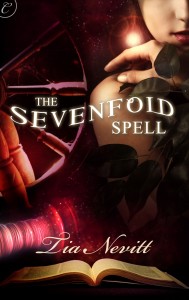
The Sevenfold Spell by Tia Nevitt

The Sevenfold Spell
Tia Nevitt

There was some buzz about this novella a few months ago, so I requested an eARC for review from Carina Press through Netgalley.


The Premise: This is a retelling of Sleeping Beauty, told from the point of view of a young woman and spinner who is affected by the curse. Talia is a plain, not very attractive girl, with limited prospects, but she has a nice relationship with Willard, a farmer’s son, and she hopes to marry him one day. These simple dreams are shattered when the princess of the land is cursed by an evil fairy, and all spinning wheels are ordered destroyed, including Talia and her mother’s. This is the end of their livelihood and, with their reduced circumstances, Willard’s father uses the opportunity to renege on his promise to let his son marry Talia. Instead, Willard is destined for the monastery.
 
Read an excerpt of A Sevenfold Spell here
 
My Thoughts: I really liked the premise of this one – an ordinary girl who doesn’t seem much, with her simple desire to marry the not-so-attractive himself Willard has her life turned upside down because of how the Royal family’s life affects the everyday people. Talia’s anger and grief over what her life has been reduced to is a palpable thing, and when she has almost no income, and she’s lost Willard, she grasps at what she can get. So before Willard leaves for the monastery, she gives herself to him, in the hope that at least she will have a child.
 
It is around here where the story goes from a regular fantasy tale into more erotic/steamy territory. Several trysts are recounted in detail, with Talia uncaring of Willard’s brother’s overhearing them, or of the village knowing. The creative ways they’ve found to be together are described. I don’t know if this is my prudish side coming out or just not being a fan of this much explicit sex in my stories, but this is where I sort of got bored and stopped reading. I guess I wasn’t expecting this ebook to have this level of sex in it because it was labeled as being in the “Fae, Fantasy, Legends & Mythology” category. I understood that Talia was trying to hold on to Willard in some way, but after the first couple of encounters, I got the idea and recounting all the sex didn’t seem to add much to the story.
 
A few months later I figured I would pick up the novella again, and once Willard has left to join the order, the sex continues. Talia is looking for a connection similar to that she had with Willard, and she enjoys having sex, so she uses her body to pay for favors from their next door neighbor, and describes getting a reputation and gives us a general idea of her numerous trysts. What kept me going was that outside of all this, there are hints of the Sleeping Beauty tale. Characters familiar to that story appear, and I wondered where it was going and how Talia fit into the story. I’m glad I kept reading because just when the story seemed to be getting darker, suddenly something happens which manages to propel the story forward into a happy ending with a twist. It all ends on a sweet note.
 
Overall: Not a bad way to pass the time, and at 97 pages, this is a short read and it has a unique spin on a well-known fairy tale, but it’s heavy on the sexual content, which almost kept me from finishing this short piece. I’m glad I pushed on because of the last part of this story, which had a nice twist on the happy ever after.
 
Buy: Amazon (kindle) | Carina (PDF/ePub)
 
Other reviews:
Fantasy Cafe – 7/10
The Book Pushers – B-
The Book Smugglers (Joint review) – both gave it a 6 (Good)
Fantasy Literature – 4/5
One More Page – 2/5
Stella Matutina – 3.5 stars (out of 5)
A Buckeye Girl Reads – positive
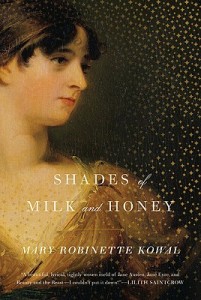
Shades of Milk and Honey by Mary Robinette Kowal

Shades of Milk and Honey
Mary Robinette Kowal

I’ve been eying this book since last year, particularly after this review at The Book Pushers when I basically realized that this was a regency romance with magic in it. When it was nominated for the Nebula Awards, I joined the Nebula Readathon at The Book Smugglers as an excuse to read this.
 
The Premise: (I’m going to go with the book blurb on this one) Shades of Milk and Honey is an intimate portrait of Jane Ellsworth, a woman ahead of her time in a version of Regency England where the manipulation of glamour is considered an essential skill for a lady of quality. But despite the prevalence of magic in everyday life, other aspects of Dorchester’s society are not that different: Jane and her sister Melody’s lives still revolve around vying for the attentions of eligible men.
 
Jane resists this fate, and rightly so: while her skill with glamour is remarkable, it is her sister who is fair of face, and therefore wins the lion’s share of the attention. At the ripe old age of twenty-eight, Jane has resigned herself to being invisible forever. But when her family’s honor is threatened, she finds that she must push her skills to the limit in order to set things right–and, in the process, accidentally wanders into a love story of her own.”
 
Read an excerpt of Shades of Milk and Honey here
 
My Thoughts: This book really feels like a big ol’ homage to regency romances of Jane Austen’s era. From the get-go I was struck by how regency-eque Shades of Milk and Honey was and how often it uses the same conventions as Jane Austen’s stories. We begin by being introduced to the Ellsworths, a respected family with two daughters, a hysterical mother, and a doting father who would like nothing more than to see his daughters happily settled. Jane is the sensible and somewhat plain older sister, and at twenty-eight she’s resigned herself to being on the shelf. Melody is the pretty one, and at eighteen she has a much higher chance of getting married, but as the younger sister, she’s also more impulsive and reckless than Jane. The Ellsworths spend most of their time visiting their friends nearby and going to parties, and proper manners are always assumed. Sounds familiar no? Yes, it’s like a mix of every Jane Austen novel out there. Jane Austen era spellings like ‘shew’, ‘chuse’, ‘teaze’ and ‘nuncheon’ to add to that feel.
 
What makes Shades of Milk and Honey not just a remix of Austen, is the idea of glamour, a type of small magic that is used for pretty illusions. With glamour, a lady may create a subtle scent in the air, embellish a painting, record and play music, and even enhance her own appearance. There is no end to its uses, although it is considered mainly an artistic skill, not a dangerous one. It is a skill of high merit in well-bred ladies of society, much like the ability to play music or paint.
 
Jane is particularly skilled at glamour. I was hoping that Jane’s skill in glamour would be more essential to the story than it was, but it seems to be merely there as an interesting skill that gains Jane admiration from those around her. In fact, it is the quality that she is most admired for, and her sister harbors some jealousy because of it, despite her own pretty face and easy grace, which Jane lacks. There’s a bit of sisterly competition when it comes to men because of the their differences. Both girls share an admiration for a neighbor, Mr. Dunkirk, and he is a point of contention, despite never giving either sister a reason to hope. At times, the little jabs at each other got a little nasty, at others they are remorseful for their previous behavior. It was a bit of a see-saw, which I suppose shows the complications of sisterhood, but I wish their relationship was delved into a little further, beyond their little squabbles.
 
On the other hand, none of the relationships in this book were delved into. The story is very readable and I was easily drawn into Jane’s world, but beyond the social obligations and underlying drama of who may be courting who, I felt a lack of connection between Jane and the other characters. Jane feels more like an observer than a participant in this story. She watches as her sister flirts with gentlemen such as Mr. Dunkirk, and the newly returned Captain Livingston. She sees her mother go into yet another fit of hysteria and commiserate with similarly afflicted Mrs. Marchand. She wonders what secrets her friends Beth and Mr. Dunkirk are hiding. She wonders at the surly Mr. Vincent who creates beautiful works of glamour but doesn’t seem to like her very much. Internally she has a lot of thoughts about her glamour and what people around her are doing, but she doesn’t voice them. She doesn’t act until she is forced to by others, and about 75% into the book, I realized that I wasn’t really sure where the story was going. I felt like Shades of Milk and Honey was circling the airport. I wondered aloud “When are you bringing this baby in?”.
 
It’s not until she is drawn in by an unexpected suitor and by the threat of family ruin that the story really gets anywhere, and this happens far into the story. I did like where it went, but some of the excitement and interaction at the end of the book would have been nice to see in the rest of the story. I also felt like the romance Jane had was trying to replicate a Darcy and Elizabeth romance, with what looks like initial dislike becomes something more, but I must have missed the subtle growth of their relationship, because when the declarations of love happened, I really wasn’t sure why. Jane spends so little time with her eventual paramour, that the romance, while very sweet, didn’t feel backed up by emotional growth.
 
Overall: Shades of Milk and Honey reminds me of the stories of Jane Austen in that it has characters that spend their time visiting one another and going to parties, and proper manners are expected. It also has a lot of plot points that hark back to the Jane Austen books: sisterly bonds, strawberry picking, men after dowries, and secret engagements. I think that my love for this stuff kept me reading at a happy clip. For this alone, I’d call the book “good”, but beyond the Jane Austen trappings, I wanted more out of the characters and plot (and more out of the concept of glamour), so it didn’t move past being merely entertaining for me.
 
P.S. Does anyone know the significance of the title of this book? Is it a reference to the biblical phrase ” “a land flowing with milk and honey“? OK, that would make sense…
 
Buy: Amazon | Powell’s | The Book Depository
 
Other reviews:
Jawas Read, Too! – 8 (out of 10)
The Book Smugglers – 6 (good)
SFF Chat – “didn’t turn out to be exactly what I had been hoping for, it was a pleasurable way to pass a couple of hours”
The Book Pushers – 5 stars (out of 5)
Fantasy Book Critic – A- (“a very light novel that epitomizes “beach reading” for me”)
Christina_reads – Didn’t live up to expectations
Stella Matutina – 3.5 stars (really liked it)
I love this book trailer


Children of Scarabaeus by Sara Creasy

Children of Scarabaeus
Sara Creasy

I think that thanks to a couple of influential bloggers, this series is on more people’s radars, and that makes me happy. I really enjoyed Song of Scarabaeus when I read it in September last year (https://i0.wp.com/i58.photobucket.com/albums/g254/jayamei2/livejournal_com.gifhttps://i0.wp.com/i58.photobucket.com/albums/g254/jayamei2/wordpress.jpg), and when I heard that it’s sequel, Children of Scarabaeus was available on NetGalley, I requested it ASAP.
 
**** mild spoilers for Song of Scarabaeus ****
 
The Premise: In this continuation of the story that follows Edie Sha’nim and her bodyguard Finn, Edie has freed herself from her kidnappers and her goal is to use what she’s recently learned to help Fringe worlds with their reliance on Crib technology to keep their environments viable. Unfortunately, her freedom is short-lived, as the Crib government catches up with Edie and her friends, and reclaims her as their property. Edie has to cooperate or Finn suffers, so she reluctantly goes back to work as a biocyph for Liv Natesa’s pet project on a new terraformed world named Prisca. During the project she makes some startling discoveries about what the Crib is up to, including the use of children as their new breed of cypertecks. In the meantime she’s also asked to return to the place where it all began for her: the planet Scarabaeus.
 
Read the first chapter of Children of Scarabaeus here (pdf)
 
My Thoughts: I was anticipating this read so much that it leaped over all others in my TBR and landed on the top of my queue, and then I read it all in one day. I’m happy to say it felt very readable and I had no inclination to put it down once I started. This book had much of the same sort of twists and turns as the first, with escapes and captures, spaceship crashes, deadly planetary disasters and wild animals. Not to mention the manipulations of Natesa, who wants Edie on her project, which promises terraforming at a much faster pace than ever before and of Colonel Theron who wants Edie to work for him on Scarabaeus. Like the first book, Children of Scarabaeus has a lot going on. In fact, it surprises me how much happens in it within a relatively short number of pages (my eARC is numbered at 322 pages).
 
Edie and Finn begin the story with the same relationship they had when Song of Scarabaeus ended, which was a place where they trust each other completely, but things are still new and Edie isn’t quite sure where she stands. It doesn’t help matters that the chip in Finn’s head (the one that could kill him if he’s too far from Edie) causes emotional feedback that makes romantic entanglements complicated, or that Finn is a hard man for Edie to read. Edie wants Finn by her side, but she also wants him to be free, and not have to be by her side, especially when her skills make her a resource everyone wants. I wasn’t sure how things were going to go for them with their general lack of communication, but this book moves them forward a lot more than the first did, and the romance was not as understated as the first installment.
 
The descriptions of the biocyph and cyperteck technology as Edie sees it continues to be fascinating. I really love how it’s described visually instead of trying to explain the technical details behind it. When the cyperteck children are introduced, I liked how they related to the code differently from even Edie and other ‘tecks. Instead of understanding things visually, they go by sound and by feeling. The code is something living that needs fixing so it can be “well”, and the children instinctively work as a team to patch the code up. They have no idea what the code does, all they are interested in is the feel of the code itself.
 
Children of Scarabaeus does a very good job in tying up all the loose plot strings left over from Song of Scarabaeus. There were a few times where I thought the story was going to go one way (and this probably would have lengthened the plot), but Edie and Finn instead are steered towards their destinies. The way things are satisfyingly tied up leads me to believe that this series is now complete, which is in a way disappointing. This is a case where I would be really happy for more books and more adventures with Edie and Finn. I don’t really think that Children of Scarabaeus rushes to a conclusion, but it upon me before I wanted it to be. I wanted to spend more time, leisurely exploring the galaxy and watching the relationship develop between Edie and Finn. I could have used a book or two between book 1 and the conclusion here, and I think that would have also sidestepped the feeling that the plot twists and deaths in the story were a means to get to the appropriate ending within the pages allowed. I hope that the next series Sara Creasy writes next gets to be longer. And this is from a girl who balks at long series, so do not take my words lightly.
 
Overall: I really loved Song of Scarabaeus, and this is a worthy sequel that has the same action and awesome world building as it’s predecessor. It comes pretty close to pleasing me in the same way the first book does, but it has one handicap – it has to complete the story in one book, which means the romance and the complex plot are tied up before I was ready. I think the author did a good job at making these things satisfying (particularly the ending), but I would have been fine if I had to wait one more book (or two) for it. Thumbs up for this series – get both books.
 
Children of Scarabaeus comes out on March 29th.
 
Buy: Amazon | Powell’s | The Book Depository
 
Other reviews:
It’s early yet..

A Lot Like Love by Julie James

A Lot Like Love
Julie James

Julie James is on my auto-buy list now. I had a friend say it’s surprising how much I like these books because they seem more fluffy than what I usually go for. Tsk, people.  Sometimes I need the light and fluffy.  I like to mix it up. (Although I don’t necessarily consider these books fluffy).


The Premise: FBI agent Nick McCall is used to going undercover and pretending to be someone else for months at a time, but his latest assignment starts off short and simple. He has to pretend to be the date of billionaire heiress and wine store owner Jordan Rhodes at the annual wine tasting and fundraiser at Bordeaux restaurant. All he needs to do is plant a few bugs in the office of Bordeaux’s owner and suspected mob money launderer, Xander Eckhart, and that will be that. Unfortunately, an unforeseen circumstance turns a one day job into one with no end in sight.
 
Read an Excerpt of A Lot Like Love here
 
My Thoughts: The plot is in the same ballpark as James’ earlier book, Something About You (which I reviewed here: https://i0.wp.com/i58.photobucket.com/albums/g254/jayamei2/livejournal_com.gifhttps://i0.wp.com/i58.photobucket.com/albums/g254/jayamei2/wordpress.jpg), we watch as an FBI agent falls in love with the woman he’s supposed to protect. This was a straightforward contemporary suspense romance: boy meets girl; there’s some friction and banter, but sparks fly; bad guy gets in the way;  love prevails. It’s not a overly complex plot, but it’s oh so much fun. A Lot Like Love reads like a nice romantic comedy that is perfect for a rainy day.
 
This story begins with Nick finishing up another long stint undercover and ready to spend a few days off to visit his family, when he’s called in by his boss to consult on another case. An agent new to the undercover business needs Nick as backup as he takes heiress Jordan Rhodes to the exclusive, 5000 dollar a head charity fundraiser at Bordeaux. Jordan is well known within Chicago because of her very rich, billionaire father, not to mention her infamous twin brother who is in jail for a computer-related crime. Nick expects a spoiled rich girl, but Jordan really doesn’t live off her father’s money — she makes her own money via her wine store.  I loved that Jordan is a business owner and her knowledge of fine wine is a large part of the book (she may not be a lawyer like past Julie James heroines, but her job is still very important to the story). When Nick first meets Jordan, he has his initial assumptions, and neither is happy that Nick has to replace the original agent assigned to be her date. Nick learns very quickly though that Jordan is not a snob. I liked that Jordan really is unpretentious. Her friends aren’t all wealthy socialites and she owns a wine shop because she loves wine, not for the prestige. She treats wine as something she wants people to feel comfortable with and to try, and that she’s geeky about, not as some way to flaunt her wealth and privilege. It was fascinating as a non-wine expert to read about it, and It was nicely done how Jordan’s open approach was so different from Eckhart’s: he wanted to show off, and it is a competition to him. His snobbery extends to the rest of his character, and this is shown in the book in many little ways.
 
The romance in A Lot Like Love was just right. Sweet, but not too sweet, steamy (there is sex), but not too steamy. And there’s plenty of sarcasm from everyone which adds a nice touch of humor to the romance. Nick is a guy through and through, and Jordan brings out an introspective side of him that he isn’t used to. Jordan is perfect for him because she’s just as unused to saying how she feels. In her family, they deal with things through sarcastic humor. So when Nick and Jordan are together, they are on the same sort of wavelength. Nick calls her Rhodes, and Jordan tries to expand his comfort zone. I liked that they both realize how they feel and it’s not hard for them to be honest with themselves (being honest with each other is another story). They had their bumps but they were relatively easily resolved along with the investigation.
 
I also liked the other relationships in this book. Jordan had good relationships with her store assistant, Martin and with her twin brother. She also has a tight-knit set of friends. Although they were on the page too quickly for me to get individual impressions of them, I could tell that they were important to Jordan. Nick too has family that he is close to, and his relationships with his brothers and with the guys at the FBI are full of the friendly ribbing that Jordan gives her brother.  It was also nice to see some familiar characters from Something About You show up here, and bonus points for a couple of Pride and Prejudice references (as well as Lost and Dancing with the Stars).
 
Overall: I liked this one just about as much as I liked Something About You. They’re both romantic suspense, is a subgenre I don’t really go for, and I prefer her straight contemporaries without the suspense plots, but Julie James writes comfort food for my soul, and that trumps my romance reading preferences. It’s an uncomplicated story, but it hits the spot. A Lot Like Love was the right read for me this past rainy weekend.
 
I’m already looking forward to her fifth book, which will have Jordan’s twin brother, Kyle, as its hero, and has been tentatively titled About That Night (via trueromance).
 
Buy: Amazon | Powell’s | The Book Depository
 
Other reviews:
Chachic’s Book Nook – positive
Dear Author – B
Babbling About Books, and More – A
Smexy Books (guest post) – A
The Book Binge – A
The Book Smugglers – 7 (Very Good)
 
Book Trailer:

The Dead Travel Fast by Deanna Raybourn

The Dead Travel Fast
Deanna Raybourn

I was thrilled to get an autographed copy of this book at BEA last year and I’ve been saving this read for a few months. I finally got around to it last weekend, and it was a relatively fast, atmospheric read.

The Premise:
Theodora Lestrange is left with little prospects after the death of her scholarly grandfather, and despite her sister and her husband’s good intentions, she has no desire to live with them. Theodora longs for passion and adventure and to be able to continue writing her books.  So when an old school friend writes to Theodora asking her to come to Transylvania to celebrate her betrothal and stay for a little while, Theodora jumps at the chance to be bold and to have her creativity sparked. When she gets there she falls in love with the mysterious countryside and the man who is lord of it, despite the disturbing beliefs of it’s people.
 
Read an excerpt of The Dead Travel Fast here
 
My Thoughts: The Dead Travel Fast is a book that is separate standalone from the Lady Julia Grey series, with a very different heroine and a very different tone.  Rather than a Victorian mystery, this is a tale spun in sensational Gothic fiction tradition, starting with it’s horror setting: a crumbling castle set imposingly above a rustic village in the Carpathian mountains. This is where Theodora arrives and meets an eccentric bunch: an aging but haughty countess, a stoic group of servants, a jovial family doctor, Theodora’s school friend Cosmina, and the handsome, enigmatic Count Andrei Dragulescu. Stories of vampires and werewolves abound, and Theodora is thrilled to have so much fodder for her writing. She doesn’t believe any of it’s true at first, but as she experiences more of this place, it’s difficult to disbelieve that there are not evil creatures roaming the night. As she falls under the spell of the castle, she also falls for the seductive count.
 
This story felt like a tribute to the Gothic genre and thus certain “rules” of that genre were followed, which I think lent this story a simpler feel compared to Raybourn’s other books, both in plot and character. Theodora felt like your typical intrepid but still innocent Gothic romance heroine. She has a high level of imagination and a romantic heart.  She tells her sister she wants to feel passion and will settle for nothing less, and when she meets the count, despite his improprieties, she just can’t seem to help herself. Over and over she resolves to stay away, and over and over she does not.
 
The count on the other hand is a despoiler, and it’s very obvious that he’s seducing our heroine. He even explains to her that there are “only three types of women that matter in a man’s life –those he marries, those he seduces, and those he takes. I have only to tailor my behavior to become whatever the lady in question wants me to be and I’m assured of success.” I think this sentence explains why I found his character unlikable. While he may be genuinely attracted to Theodora, the calculated way he got her attention rubbed me the wrong way. What softened the dislike was that his character fit the Gothic tale – is he the hero, or the villain? I hoped he was the hero because Theodora (the narrator) sees him through rose-colored glasses, but I questioned her judgment severely.
 
The first part of The Dead Travel Fast builds up the melodrama of the story, and I wasn’t sure whether a supernatural being would appear or not or if this would be just a romance or something more. Thankfully, the typical Raybourn mystery does appear (albeit in a smaller dose than in previous books). While this was a quick read, I was relieved by the mystery because that’s where I feel Raybourn shines. Theodora may not be as sharply observant as Julia Grey, but once she does put her mind to it, she’s just as quick to see the possibilities. As a result, the book ends on a satisfying high note.
 
Overall: This is a story which nods it’s head towards the Gothic fiction tradition and mixes that with a romance and a mystery. In the end I liked this one, but I wanted to like it more than I actually did. I understood where the author was going, but the Gothic affectations of the characters stopped me from really connecting to them. If it wasn’t for the satisfying ending this would have fallen into my “OK” category, but if I was an English Literature major or someone interested in the Gothic genre, I think I’d probably have appreciated this more.
 
Buy: Amazon | Powell’s | The Book Depository
 
Other reviews:
Angieville – positive
See Michelle Read – mixed feelings
fashion_piranha – positive/some criticisms
The Book Harbinger – positive
Dear Author – B-
 

Cold Magic by Kate Elliot

Cold Magic
Kate Elliot

Ever since KMont posted a glowing review of Cold Magic on her blog, I’ve been really interested in reading it. So despite my teetering TBR, when I saw it in my local library I made an impulsive decision to grab it.

The Premise: (taken from the blurb) “It is the dawn of a new age…The Industrial Revolution has begun, factories are springing up across the country, and new technologies are transforming the cities. But the old ways do not die easy. Cat and Bee are part of this revolution. Young women at college, learning of the science that will shape their future and ignorant of the magics that rule their families. But all of that will change when the cold mages come for Cat. New dangers lurk around every corner and hidden threats menace her every move. If blood can’t be trusted, who can you trust?”

Read an excerpt of Cold Magic here

My Thoughts: This is one of those books that just throws you into the world and you glean information as the characters make their way. The story begins on a relatively typical day in Catherine and Beatrice’s (Cat and Bee’s)  life in Adurnam.  Cat lives with Bee, who is her cousin, and with her aunt and uncle. Along with her cousin, she’s a student at the local university. There is a feeling of excitement about industry and human innovation, and about the airship for the “Great Expedition”. The two girls, who are very close, have a great chemistry and I loved reading scenes with them together. All seems as usual, even Cat and Bee’s mischief, but when they go home, and their day turns dark.  A cold mage, Andevai Diarisso Haranwy, from Four Moons house, arrives at the family’s home, asking for the eldest Hassi-Barahal girl as per some agreement. By the end of the night, Cat is married to this arrogant mage, and taken away.

This seems like a set up for a captive-bride romance, but the story doesn’t really go there. There’s a twist which brings down a whole world of trouble, but Cat reacts and survives. She refuses to be used, nor will she let her beloved cousin be used. Luckily for her, her true lineage gives her an edge that no one realizes.

This is a fantastic story in terms of world building. There are steampunky elements in this book, but it also throws in an alternate history and hints at a well-built magical world. It’s clear that the two forces of magic and science are at odds, not only among cold mages, the ruling aristocrats and the common man, but among men and other creatures. The part of me that loves that stuff was very happy.  At times I worried that things were going over my head, but I’m not sure if it was my fault for reading the book when I was tired or if this was to be expected, as things made more sense as the story progressed. Anyway, the book is chock-full of details about a world that is like ours, except not. The icy climate, the spirit world, the history of the cold mages and how Cat’s people adapted after Roman rule are all mixed in with Cat’s adventures. As is Cat’s personal history which she realizes isn’t what she thought.

Cat is a great heroine. As the narrator she has a strong grasp on recent history and a pride in her people, the Kena’ani (called Phoenicians by the Romans). I liked that she was interested in technology and in science, but although magic is an accepted part of the world, it’s not something she’s very knowledgeable in. As a result, when he fate intersects with that of cold mages and spirit worlds, Cat has to rely on her wits and instinct to survive. The world seems to be reaching an impasse, and it’s not certain which way things will go, but Cat is in the center of big changes.

My favorite secondary characters were Cat’s husband Andevai and her cousin Bee. Bee is someone Cat loves and wants to be safe, and who shares similar feelings for Cat. I really enjoyed the relationship between the two girls and I liked how they had their own distinct personalities – Bee being more the winsome and artistic one, but who is just as quick as Cat. I loved their close relationship, as I loved how well that immediate recognition of family that was elsewhere in this story (saying more would spoil the fun). Their antics and banter had me grinning. I also ultimately liked Andevai although he starts off as someone who I couldn’t pin down as someone I should like. Cat isn’t sure if he’s ally or an enemy.  It’s not obvious how he feels because he blindly follows the instructions given him, and his arrogance and vanity makes him rather unlikable. I felt somewhat irritated that Cat would note how handsome he was at the same time she was complaining about his faults, but as the book went along he showed more depth. There’s an obvious set up for romance between the two but it’s definitely something for that’s not going to be simple and will likely develop over multiple books.

Overall: This was a solid fantasy story with a really imaginative world (alternative history, hints of steampunk, cold magic). My favorite things were the world building and the relationships between characters, two important things in my checklist for liking a book. My only criticisms would be that the pacing felt uneven and things went over my head, problems that not everyone may share. In the end, I really want to know what happens next, and do look forward to the second book, Cold Fire, so I can experience all these characters again. I recommend it for fans of straight fantasy who like independent female heroines.

Buy: Amazon | Powell’s | The Book Depository

Other reviews:
Lurv a la Mode (ARC review) – The Biggest 5 Scoops ever (out of 5)
Charlotte’s Library – mixed review, “here’s much to admire […] didn’t quite come together”
Dreams and Speculation/Dirty, Sexy Books Dueling Review – 4 stars (DSB) / 6 out of 10 (D&S). I tend to have similar opinions DSB, and I agree with this one
Chachic’s Book Nook – positive review (I share her opinion on this one too!)
Smexy Books – B-
SFF Chat – some problems but ultimately positive
Got Schephs – 8 out of 10
The Book Smugglers – 8 (Excellent)
Dear Author – A-
Starmetal oak book blog – A

A Discovery of Witches by Deborah Harkness

A Discovery of Witches
Deborah Harkness

I received a finished copy of this book via the publisher, Viking/Penguin.

The Premise: Diana Bishop has a degree from Oxford and tenure at Yale. She specializes in the history of science, primarily on alchemy. During a research trip to Oxford’s Bodleian library, Diana requests a manuscript from the Ashmole collection: known as Ashmole 782, and when she sets eyes on it she realizes that it’s enchanted. Diana is a witch, albeit a non-practicing one.  She’s avoided magic after her parent’s death. Yet the enchanted manuscript opens for her, igniting both her powers and a storm of supernatural creatures curious about the manuscript and the person who unlocked it. First and most formidable of the daemons, witches and vampires who show up is Matthew Clairmont, a professor of biochemistry, member of the Royal Society, and vampire.

Read an excerpt of A Discovery of Witches: @Fantasy Cafe or @Deborah Harkness’ website

My Thoughts: Before starting A Discovery of Witches, I saw that it was likened to “Twilight for adults”. I spent a lot of time mulling over this while I was reading the book. I think that comparisons, particularly to a book like Twilight may do more to turn readers off than to draw them in. At first,  I didn’t think that the comparison made sense. The narrator is a witch, the setting is academia, and nothing reminded me of Twilight, except the detailed prose. I thought: “Is Twilight the first thing that comes to mind when there’s a vampire romance?”, but as I got further into the story, I began to see where the comparison came from: Matthew is protective of Diana; he breaks into her rooms while she sleeps; he feels conflicted over his feelings; the Congregation wants to keep them apart. But is this book like Twilight? Well… no, not really. There are plenty of differences between the two books, and the concepts that feel similar feel only superficially similar. In fact, I feel like A Discovery of Witches sidesteps a lot of the problems with why people didn’t like Twilight. Diana Bishop is a more independent character than I found Bella, and overall the romance felt more mature (I could see what drew these two to each other despite their age differences), and the plot itself was more complex.

The subtitle “a novel” also threw me off as to what to expect. Was this something in the literary fiction sphere, or something that is essentially a paranormal romance? While the story has a lot of historical references, the protagonists drink the finest wine and practice yoga, it’s accessible to fans of the paranormal romance and urban fantasy genres. There are paranormal creatures, a slow moving romance that is a big part of the plot, and I didn’t feel like it took itself too seriously. There is an escapist side to the writing. And when it came to history, I think the author indulged a little, because Matthew owns a Gutenberg Bible, a bound copy of “Will’s plays”, a 1795 wine from Madiera, a 500 year old Tudor Manor house, and a castle. It tickled me to run into these things though, so don’t take that as a negative.

The one aspect of the writing in this book that could be seen as negative however, is how detailed it was. A meal could be cover several pages because each course is thoroughly recounted, down to individual tastes in the wine and Diana and Matthew’s reactions to everything. If you don’t like this thick, descriptive writing, you’ll be stopping this book early.  On the other hand, if you enjoy having a really lush picture of what’s going on, this book delivers. I found the details so intertwined with the slow courtship that I felt like I was enjoying something comforting and extra-wordy that I wouldn’t normally savor in large doses: like rich chocolate.  This writing style (all 579 pages of it), makes A Discovery of Witches the kind of book you read in installments, not cover to cover in one sitting.

Most of the first half of this hefty volume is a lengthy courtship between Matthew and Diana, with the discovery of the enchanted Ashmole manuscript as the initiator. Diana is the main narrator of this story, so most of the book is told from the first person point of view, although there are a couple of instances when the story follows Matthew and switches to third person. Once it’s clear there’s something the two protagonists, the consequences of inter-species dating, Diana’s powers, and the Ashmole manuscript come to the forefront. That’s when the story widens from the focus on Matthew and Diana to the people around them. On Diana’s side there are witches, on Matthew’s there are vampires. Witches are born, vampires are made. Then there is a third race, daemons who are not the demons you typically see in paranormal fiction. These are born from humans but possess genius and/or madness that sets them apart. Once the plot thickens, I was pleasantly surprised how much enjoyed the seamless mix of action and conspiracy against the romance. The author adds secret societies, power-hungry factions, paranormal forces, conspiracies, a house with it’s own personality (I loved this house, I want to live in this house), and lots of grumpy vampires with long lives and long grudges. This looks to be the beginning of an epic battle between good and evil, and while there’s a satisfying ending to A Discovery of Witches, it is clear that there’s more. I hadn’t realized this when I got the book, but A Discovery of Witches is part of a trilogy and sets the scene for Matthew and Diana’s continued adventures.

Overall: This is a book that I think is supposed to be shelved in fiction, but it has a lot of cross-over appeal for urban fantasy and paranormal romance fans. Don’t let the Oxford setting and protagonists with long academic credentials dissuade you, this is an accessible story with a slow moving romance that’s a guilty pleasure to read, but the romance isn’t all — the story is shaping up to be a great good versus evil tale. I’d recommend this one with reservations however — there’s a lot of description and exposition in this story which isn’t for everyone. If you aren’t bothered by the writing style, then I think it’s a good one to try.

This looks to be the first in a 3 book series.

Buy: Amazon | Powell’s | The Book Depository

Other reviews:
The Book Smugglers – DNF

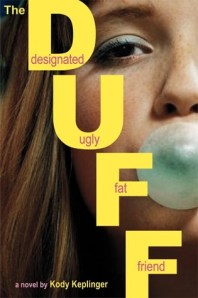
The DUFF (Designated Ugly Fat Friend) by Kody Keplinger

While I saw a lot of positive reviews for this book, I wasn’t in love with the premise — a girl begins a sexual relationship with a guy she pretty much hates? Hmm. What made me decide that I would give this book a try was this review from Debbie’s World of Books. I’m glad I did.

The Premise: Bianca Piper is a cynical high school girl who spends her time with her two best friends, Casey and Jessica. One night at the local teen hangout, Wesley Rush, the resident “man-slut”, who Bianca cannot stand, begins a conversation with her. His purpose? To get to Bianca’s friends via their weakest link — the Duff, aka the Designated Ugly Fat Friend. Thoroughly disgusted by Wesley’s hurtful label and slimeball plans, Bianca throws her Cherry Coke in his face, gives him what for, and storms off. That probably would’ve been the end of that, except that soon after, Bianca discovers that her often absent mom wants a divorce. So Bianca seeks escape in a physical relationship with Wesley. What was meant to be a distraction has complications that Bianca never intended.

My Thoughts: It blows my mind that this author is 18 years old. Eighteen! The writing doesn’t suffer for it. I think that instead, her age is a strength — the teenage voice in The Duff was more honest and believable than many of the YA books I’ve read lately. Bianca, the narrator, is full of snark and bluster, particularly around her friends (and Wesley who she never holds back from), but she feels like a real teenager. Sure, not all teens are as free with their expletives or as sexually experienced as Bianca, but I could relate to his girl and where she was in her life.

OK. Sneaking around to have sex with the boy you hate is not the healthiest way to deal with your problems. In fact, it is the opposite of healthy. But I could believe Bianca’s need to be distracted from her personal problems (what is reading if not a distraction?), and Wesley is an easy distraction. Bianca manages to ignore what’s going on for a little while,  but it all catches up with her. There’s a clear message that there are consequences for what she does: the distancing from her friends that she’s hiding things from, the emotional entanglements, and the possibility of pregnancy or disease (touched lightly, but it’s there). And Bianca isn’t not the only one who learns that you can’t run away forever.

On the other hand, Bianca is really lucky how things ultimately worked out. Wesley easily could have been the bastard she calls him, and the emotional repercussions of their numerous sexual encounters while messy, could have been much more messy. I liked Wesley by the end of this book, but a small (practical) part of me stayed resistant. I think this is where life experience colors the story, but I’m willing to see him as a character with flaws and I could let my disbelief go enough to enjoy the ending, particularly because I wanted these two to work things out. The chemistry between Bianca and Wesley was quite perfect, and I did love their semi-disfunctional, trading-insults relationship.

The secondary characters in this book all had what felt like realistic relationships with Bianca. Her relationship with her parents showed an awareness of their flaws but they do care about their daughter. Her father’s relapse may have been on the dramatic side, but Bianca’s reaction to it was believable. I also loved Bianca’s friendships with Casey and Jessica. The three girls have differing personalities but they each fit a role within their group.  There’s a lot of love and loyalty amongst the three, and when Bianca realizes that she’s the Duff of the group, it doesn’t make her search for new, less attractive friends to make herself look better. And realistically, there is worry and hurt feelings when Bianca distances herself from them because of her problems.

The idea that you are not your label is probably the Big Message of this book, but I think it’s an important message, and one that really affects self-esteem. The fact that everyone feels like the Duff, and that one should look beyond a label is something I wish more girls would believe. I liked that Bianca’s choices lead her to these truths.  

Overall: While I don’t agree with how the main character initially dealt with her problems, I liked the lessons she ultimately learned, and there was something refreshing in reading a book that embraced sexuality and expletives. I’d recommend this one if you feel like you can look past the idea of a teen’s using sex as an emotional outlet, because this story has a snarky teen voice that I loved because it felt real and honest.

Buy: Amazon | Powell’s | The Book Depository

Other reviews:
Debbie’s World of Books – positive
Karin’s Book Nook – 5 out of 5
Steph Su Reads – 4.5 out of 5
Book Fare Delights – 4 out of 5
Sophistikated Reviews – 4 out of 5
Pop Culture Junkie – 4.5 out of 5
The Story Siren – 5 out of 5
The Hiding Spot – A+
Book Crazy – 5 mushrooms (must read)

The Native Star by M. K. Hobson

The Native Star
M. K. Hobson

I bought this book based purely off this review by calico_reaction over at Dreams and Speculation. Wild West setting with an alternative history involving Warlocks and Witches? I shall have to try some of that.

The Premise: It’s 1876, and Emily Edwards, the Witch of a small town called Lost Pine, is getting desperate for money in the face of competition from the fancy mail-order company, Baugh’s Patent Magicks. So she does a bad thing. She creates a love charm and uses it on Dag Hansen, the timber man who has brought jobs and prosperity to Lost Pine. When she does, she’s almost immediately called out for it by the town clairvoyant, Besim. Besim also reveals that the zombies working in the town mine are going to break free. Besim is ignored by everyone, since he’s made bad pronouncements before, but Emily knows he’s not lying about her use of bad magic, so she goes to check out the mine, along with irritating town newcomer, Warlock Dreadnought Stanton. One thing leads to another and suddenly Emily has a mysterious blue stone lodged in the palm of her right hand, she’s fleeing Lost Pine with Dreadnought Stanton, and evil Warlocks who want the stone are trying to kill them both.

My Thoughts: This reads very much like a Wild West cross-country adventure which just happens to be set in an alternative world where magic is an accepted part of life. I imagine Emily Edwards and Dreadnought Stanton are dressed up much like Jodie Foster and Mel Gibson in Maverick, (minus the confidence artist personalities), as they take horse, train, and a hybrid mechanical-magical flying machine from one destination to another, chased by various men bent on getting the blue stone embedded in Emily’s hand. The author has mentioned in guest posts a pulp novel influence, particularly Horatio Alger, and she eludes to the influence in The Native Star with characters who read pulp fiction from Mystic Truth Publishers, and magazines like Ladies’ Repository.

The world building goes along with the pulp fiction influence. There’s Wild West adventure staples mixed with Victorian era sensibilities. Emily has to deal with being a woman in a world where women were often expected to stay at home and act proper, but she’s grown up with a lenient father in a town where she is respected for her witchcraft. When she ventures outside of Lost Pine, the disparity between her rural upbringing and the straightlaced expectations of how she should act is a big one. There’s even a sort of woman’s suffrage movement in the form of a group called the Witches Friendly Society.

Along with this mixed attitude about women, is a mixed attitude about magic. It’s something everyone knows exists, but whether magic is a natural part of life and can be explained scientifically or as the work of the devil depends on who you are talking to.  This world is on a cusp of change, and I think that whether Progress comes at a price is a big question. Some advancements are for the better, but some come at a cost that people are only beginning to discover.

Of course, it’s often the bad guys of the story with the condescending attitude towards women or who want to eradicate all Witches and Warlocks. Her companion on the road, Dreadnought, clashes with Emily over other things. The two have a bickering sort of relationship and although this sort of thing suggests a romance is on it’s way (which is correct), the romance is a very low key one — the adventure and magic are in the forefront of the story most of the time, and the banter gave me a little chuckle or two as a bonus. This is not one of those stories where there’s a lot of sexual tension in my opinion, maybe because the focus on the book is more on the plot than it is on character development.

I enjoyed the way that magic was explained in this story. There are three forms of magic – animancy (spirit magic), sangrimancy (blood magic), and  credomancy (belief magic). Emily Edwards, who with her Pap, the local magic practitioners of Lone Pine, California, practice animancy. Dreadnought Stanton is a credomancer, and his magic comes from belief. The use of blood magic (sangrimancy) has been outlawed with a notable exception. Hobson takes the idea of magic and a natural explanation for it a bit further when she introduces an ecological component — magic, once used is absorbed by the Earth and recycled, and the process creates waste in the form of a sticky black tar-like substance known as Black Exchunge.  This has some significance in the story and I enjoyed learning as the Emily and Dreadnought did, the significance of Emily’s blue stone in relation to magic.

I’m looking forward to the next book, The Hidden Goddess, out this April.

Overall: A very fun story that combines pulp fiction, magic, Wild West adventure, a bit of steampunk and romance in a seamless way. I enjoyed the alternative history and how magic fit into the Victorian mindset where Progress and Tradition often butted heads. This is very much a plot-driven story, and I liked how the world-building felt effortless. The only thing that I personally would have liked was more room to really delve into the two main characters, but the second book promises to give us more, so I’m looking forward to it.

Buy: Amazon | Powell’s | The Book Depository

Other reviews
The Book Pushers – 5/5
Dreams and Speculation (guest review by Calico_reaction) – 7/10
All Things Urban Fantasy – 4/5
The Book Smugglers – 8/10

Links:
Guest Post at The Book Pushers

Darkship Thieves by Sarah A. Hoyt

Darkship Thieves
Sarah A. Hoyt

I’ve been lusting after this book for a while, so long in fact, that I forgot exactly where I first learned of it’s existence and my need to own it, but I vaguely remembered it was an author’s blog on my friend’s list. Turns out that was Ilona Andrews, who had a guest post by Sarah A. Hoyt about Darkship Thieves in January last year (now that’s a long time to want a book, but not really my longest stretch – sad isn’t it?) In her post she talked about this space opera where a bad-girl socialite heroine with Daddy issues meets a bio-engineered hero with calico-hair and issues on top of other issues.  Anyway, I not-so-subtly asked for it for Christmas – and lo, it is mine.

The Premise: Athena Hera Sinistra was sleeping in her father’s space cruiser in a return trip to Earth, when she wakes up to find someone in her room. Although Athena is a socialite, she’s also been put in to, and escaped from, several boarding schools and institutions, and she has the ability to sometimes move at speeds that others cannot match. One thing leads to another, and Athena flees in a life pod, her father’s goons in hot pursuit. In desperation, she flies into dangerous territory and stumbles upon Kit Klaavil, a prickly man who surprises her by having even faster reflexes than her own super-speed.

Read a three chapter excerpt of Darkship Thieves here

My Thoughts: I was pretty happy to begin this book and have it match my expectations of page-turning action and space opera goodness.  Racing through the bowels of a space ship and beating up thugs along the way, followed by a pursuit in space, and a surprising rescue — it’s good stuff. The reaction of Kit and Athena to each other was hilarious — even though Athena is over-matched, she uses all the dirty tricks at her disposal, and Kit’s reaction to this is fun to follow. Once the dust settled, I was glued to the pages, wondering where things would go next.

The story doesn’t disappoint in it’s exploration of Kit’s character, and in turn Athena’s when Kit takes Athena back to his home — an asteroid home to people very different from Earth, but whose very existence and beliefs are due to Athena’s home world.  As Athena struggles to figure out Kit’s world and it’s rules, we’re introduced to ideas about the ethics of genetic manipulation, cloning, societal laws, and bureaucracy. These ideas were very provocative, but I was most drawn to the characters in this story, and into the odd courtship that takes place between Kit and Athena. Darkship Thieves isn’t quite a science fiction romance because a lot of the story deals with things like technology and morality, and there isn’t a focus on romance, but there is a quiet progress towards a relationship.  I think that Kit, who lives with the world at arm’s length, is now a favorite hero although I also quite like Athena’s tough, unloved, rich girl voice.

Of course, being a girl who likes the falling-in-love bits, after the relationship hit a particular point and the story gets back to the conspiracy that led to why Athena had to flee her father’s spaceship, I think I lost a little interest. I don’t know if it was the pacing, or my just wanting more of Kit and Athena together, but the last part of the book didn’t have quite the zing I felt in the first. The more I think about it, the more I think it may have been the latter for me, but I think this is the only real problem I had with this book. The other was minor: when I first started reading Darkship Thieves, I thought Athena was in her mid-twenties and Kit was over thirty, when they were supposed to be 19 and 22. There was something in Athena’s been-there-seen-everything tone that made her seem older to me.

A note on the cover: Ug, I know. Half-naked women on covers does not draw in a female audience. All I can say in defense is that this scene does happen early on in the book and it does make sense in context.

Overall: Finding this space opera with a dash of romance has put me in a happy mood. Sarah Hoyt’s space opera has the edginess of Ann Aguirre’s minus (so far) the heartbreak. I’m eager to try other books by this author and I’m looking forward to the second book, Darkship Renegade, out sometime in 2011.

Buy: Amazon | Powell’s | The Book Depository

The Big Idea: Sarah A. Hoyt

Other reviews:
Bookdaze – positive review (“an entertaining adventure-packed romp”)
If I missed your review, let me know and I’ll link to it!