You Don’t Have To Say You Love Me by Sarra Manning

I didn’t even look at what the blurb for You Don’t Have to Say You Love Me by Sarra Manning was about – I was so pleased with Unstickythat I went and bought it. It wasn’t until I started reading that I realized that this was a story with a heroine with weight issues – not my favorite trope, but I kept reading, and I wasn’t disappointed. It managed to not offend me by treating the heroine’s problem with a lot more thought than I usually see when this trope is involved.
 
The Premise: Neve Slater was once morbidly obese, and weighed 358 pounds. She’s been working hard and is half the size she used to be, but she’d still like to shed some more weight and be a magical size 10 (US size 6). That way, when William, the man she’s been in love with since university, comes back from his three years overseas, she can surprise him with her improved self. The problem is that Neve has never been in a relationship, and this is where Max, her sister Celia’s co-worker at fashion magazine Skirt comes in. Max is a total man-slut, and willing to be her partner in a “fake” relationship, where she can learn what it’s like to be part of a couple. With Neve and Max knowing that this is a throw-away, pancake relationship from the outset, there’s no danger of hurt feelings or becoming too involved. Right?
 
My Thoughts:  Neve Slater is a heroine who is very different from that of Unsticky. She’s a good girl; more of a reader and thinker. She’s not much for partying (and has to be dragged out by her sister Celia), and works at a literary archive. And she’s got a romantic idea of what she wants in a relationship, as exemplified by her crush on William and her dream that when he gets back from the U.S., they can be together. Towards this end, Neve has been improving her body, writing him letters, sending him care packages and generally obsessing about his return. William’s arrival back in England is six months away when Neve realizes that she may changed outwardly, but inwardly, she’s still just as inexperienced as she was when he left. Luckily there is Max, her sister Celia’s co-worker and general womanizer who Neve went a little too far with one night when she was a little drunk. When she explains how she’s holding out for William but needs practice in being in a relationship, Max is completely fine with volunteering for the position as a fake boyfriend to figure out the ropes and then bowing out when William gets back.
 
This premise sounds a little hokey, yet it seems to be perfectly reasonable the way it’s presented in this story. Neve is not an idiot and this is not a set up for comedic effect. Instead the pancake relationship is taken seriously and has it’s strict ground rules. With his reputation as a shallow man-whore, Max could have been a big jerk (and Neve’s friends and family are concerned about how he would treat their sweet Neevy), but Max turns out to be a rather nice guy. For all his flirting and easy charms, Max is surprisingly caring and perceptive. It’s just that he has his way of keeping people at arm’s length, the way that Neve has hers. That’s why the “pancake relationship” arrangement is so good for the both of them. With Neve’s declaration that William is the man she’s in love with, there’s no pressure for Max and Neve to be anyone but themselves around each other. Things start off awkwardly between them, yet they soon settle into an easy understanding. Before long they’re sharing things with one another and Neve is surprised to find herself getting a thrill from seeing Max’s name on her caller ID instead of William’s.
 
When I compare this story with Unsticky, it felt less dark than that one. It felt sweeter and more open. I think that although the characters had their share of problems (particularly Neve with her body image issues), they don’t feel as broken as Vaughn and Grace felt to me. They’re very different couples, but both these stories share the characteristic of really well plotted relationships, where small moments build upon each other to give us a satisfying window into a love story. (Speaking of Vaughn and Grace – I was eager to see any update on those two, but they’re mentioned obliquely and separately – not as a couple, but fans of Unsticky will recognize Neve’s trainer, Gustav).
 
The only thing I was bothered by was how fixated Neve was about becoming a certain size, but I was eventually satisfied by how this was handled. And perhaps the only reason I was bothered at all is that I’m very close to someone with an eating disorder, and let’s just say it has colored my view of certain things. I believe that offhand comments that imply what a person should look like can be damaging, and that you can be gorgeous and still be a miserable, miserable person. I don’t have much patience for stories that feature some character who sound like they have an average body size whine about wanting to lose 5 to 10 pounds (*coughBridgetJonescough*), and I’m also not fond of reading about characters who go from overweight and miserable, to svelte and have their self-confidence issues solved. Blergh I tell you.
 
Anyway, with these hot buttons of mine, when I read about Neve’s concerns about her stomach and her body while at a club with her sister, I was full of trepidation, but I soldiered on based on my love of Unsticky. I am so relieved that You Don’t Have To Say You Love Me has a character who has weight problems that felt realistic.  I could believe in a character like Neve, who is incredibly smart and bookish and very likable, but who still has issues with how she looks, despite how much weight she’s lost. This is because the story doesn’t dismiss the path Neve had to take to where she is now. She may be thinner and have much healthier habits, and physically she’s doing well, but mentally she’s also still dealing her recent past, like a bully from her school days who torments her even into adulthood, and to a family member she won’t speak to because of what they said about her weight.
 
I liked how supportive and protective Neve’s family was of her, particularly her sister, Celia. Actually I found many secondary characters reacted wonderfully to Neve’s weight problems, including Max. He still managed to be something of a guy, but I loved how he dealt with Neve’s hang-ups. Alternatively, I love how she dealt with his.
 
Overall: I want chocolate right now so I’m going to go for a chocolate analogy. I feel like You Don’t Have to Say You Love Me is milk chocolate and nougat to Unsticky‘s 80% cocoa dark chocolate bar: less edgy; complicated in a different way; still rich and satisfying. After reading this story, I have that same experience of having pieces of the story stuck in my head for days afterward, but the couple is very distinct and separate from that of my previous read by this author. This is good. Also good: a heroine with weight issues that were thoughtfully done and a story that addresses a serious topic without becoming depressing. Yes, Neve’s body issues are a part of Neve’s life, but it’s not all the Neve is and not all that this book is about.
 
Buy: Amazon | Powell’s | The Book Depository
 
Other reviews:
About Happy Books – positive
Dot Scribbles – positive
The Queen of Attolia by Megan Whalen Turner

The Queen of Attolia
Megan Whalen Turner
This book may be one of the oldest books on Mt. TBR in the Janicu Household (if not the oldest), but before you admonish me for this, I stopped reading it because it was a sequel. And I didn’t buy The Thiefuntil 5 years later. This is what happens when you are easily distracted.

I think you should read the The Thief before Queen of Attolia because this book’s world and characters don’t make as much sense without the first book. There’s also one thing that the second book would probably spoil for you in The Thief.  I’m going to try to avoid spoilers in my review, but for those who haven’t read The Thief, here is my review of it: https://i0.wp.com/i58.photobucket.com/albums/g254/jayamei2/livejournal_com.gifhttps://i0.wp.com/i58.photobucket.com/albums/g254/jayamei2/wordpress.jpg

The Premise: The story begins with Eugenides in Attolia again, using his skills as a thief to spy on the Queen of Attolia.  Attolia seems to be getting friendly with the ambassador of the Medes Empire, a nation held in check from invading the three countries of Attolia, Eddis and Sounis by treaties with greater nations, but never-the-less, they are a threat. Unfortunately for Gen, he can’t help leaving messages for the Queen to let her know that he was there, which infuriates her and makes her very determined to catch him. This time  – she does. It is not long before Eugenides and his homeland are paying for this mistake.

Excerpt from Queen of Attolia

My Thoughts: I had mixed feelings about stepping back from Eugenides in this installment of the series. He’s no longer the narrator, and I miss getting a shot of his wit from his own mouth. On the other hand, with the point of view being in third person, I can see what other characters are up to, especially the Queen of Attolia, and it makes sense to change the point of view when the story is not so much about Eugenides, as it is about the political turmoil ignited by his capture by the Attolians. And don’t get me wrong – Eugenides still feels like the main character. It is just that this time the focus is not always on him.

Luckily, the switch to third person wasn’t a hardship. As long as I had a dose of Eugenides I am happy. And I think part of me was also pretty forewarned. It turns out that I read far more of The Queen of Attolia than I thought I did before I realized it was the second book in a series. I thought I didn’t get past the first chapter, but when I was reading Queen, everything was familiar for the first 175 pages. There were elements of this story that ended up not surprising me, but which I think would be surprising to others – particularly what happens at the start of this book.

It all begins with a shocker, and a good chunk of the first half of this story is characters adjusting to what happened. Things are hard for a little while for certain characters, but there are bigger things going on. Attolia, Eddis and Sounis are embroiled in war, with the Medes Empire looking on with decided interest in the outcome. With such mechanisms going on, there’s quite a bit of plot that deals with the skirmishes between armies. The strategums employed by Eddis and Attolia are particularly fascinating, and I was rooting for one country in particular, but I have to admit that war games aren’t my favorite thing in fiction. Thankfully, while the story does cover the fighting, there’s plenty of focus on individuals to stop me from becoming bored.

Of course the individual I found myself caring most about was Eugenides, and again, he does not disappoint. I loved his role in this story, and how he manages to steal Peace, a man, and a Queen. There also a nice dash of romance in this one, although one character involved in it kept things closer to the vest than I’d fully like, it is a very, very good beginning, and I can’t wait to read the next book.

Overall: A great second installment. The focus is widened beyond Eugenides so that the changes to Sounis, Eddis and Attolia are displayed, but he still stays a central character. He may not be the same carefree boy he was in The Thief, but once you’ve fallen under the spell of Eugenides’ mix of wit and vulnerability, you’re in his corner forever, eager to see what mess he’ll put himself into next, and how he will get out of it. This book is a bit more serious than the last one, but I love where the story went and the romance we glimpse. Here is where I say I can’t wait to read the next one, but I’m already reading it.

Buy: Amazon | Powell’s | The Book Depository

Other reviews:
Angieville – positive
The Book Harbinger – positive
Fantasy Cafe – 9/10
Emily and Her Little Pink Notes – 5/5
Presenting Lenore – positive
Monkey Bear Reviews (spoilery) – B+
jmc_books – B+
stella matutina – 4 stars (out of 5)
It’s All About Books – positive
Dear Author – B+
calico_reaction (spoilery) – “Worth the read” with caution

Unsticky by Sarra Manning

Unsticky
Sarra Manning

(Reason for the quiet over here: I’m SO ludicrously swamped at work – we’re talking 15 hour days. Weekends too. I’m behind on blog email, but trying to keep up with comments when I can. This review is a result of my brain needing a break from work to save my sanity).

Usually when I hear about a book these days, I’ll wait for news in the ether, let my awareness build and then this percolates into a desire to read the book. Very rarely do I read one review and I HAVE to get the book right away, but this is what happened when I read the review for Unsticky at Angieville (the ‘Bibliocrack’ in the post’s title had my book lover sense’s tingling). I’m so, so glad I for my impulse buy.

The Premise: Grace Reeves is a twenty-something working for a pittance at the fashion magazine Skirt, and massively in debt. Her relationships with a string of grungy rock-band boys never seem to last, but it’s still a surprise when her latest boyfriend dumps her on her birthday – in the middle of her favorite high-end store. When Grace refuses to take the break-up quietly, she’s rescued by bystander Vaughn. This chance encounter becomes something more when Grace and Vaughn meet again and Vaughn proposes an arrangement. Grace has to follow specific rules and cater to Vaughn’s demands in return for thousands of pounds and exposure to the jet-set she’d never meet otherwise.

My Thoughts: Yep, this is sort of a Pretty Woman scenario, and I have to admit having qualms about how this would be portrayed. Thankfully, the story does not sugarcoat things – it’s pretty messed up, but on the other hand, so are Vaughn and Grace. At first Grace is horrified by the idea of being under contract to have a relationship with a man (which includes sex), in return for gifts and money, but she also has no idea how things work in Vaughn’s world and he makes it seem like the most reasonable thing. After some time to think about her ridiculously high debt and the rationalization that she wanted to have sex with Vaughn before he made his offer, she enters into a contract.

It’s a case of mutually using one another. Vaughn demands all Grace’s free time outside of work, and expects her to make him look good. This means weekends socializing in places like New York, Paris, or Beunos Aires, and weekdays preparing for these parties with spa treatments and shopping for new designer clothes, on top of her job at Skirt.  Grace gets cash which she uses to try to pay off her credit cards, and a new luxurious lifestyle.

In a typical romantic comedy, this would be all conveyed in a fun, frivolous way, but in Unsticky, this is not the case. The narration feels grounded (and very British), and it has a gritty underside – there’s drinking, swearing and sex, and questionable actions from the characters. Vaughn is an obnoxious dictator, a hard man, and he’s eighteen years older than Grace is. Grace has to deal with his demands as well as those of her equally scary, bordering on abusive, boss at Skirt.

I have to admit that part of the pleasure of reading this book is the ‘Did they really just do that?’ factor and wondering if I was watching a train wreck about to happen or not. There were things that Grace does that I can’t see myself doing, but it fit her character to make the decisions she did. And I rooted for her. She’s passionate about fashion and I sympathized with her issues with money and the way she bought things to make herself feel better, only to make herself sick at the thought of more debt. She goes through a culture shock at Vaughn’s world but her determination rise to the occasion was very endearing. At the same time, Vaughn has his own demons. Clearly a man who insists on having his mistress sign a contract has issues, and he has them in spades. He’s aware of what a obnoxious bastard he is, and that’s part of why he wants to pay Grace.

“Despite their differences, because of their differences, they were a perfect mismatched set. Two sides of the same tarnished penny. An out-of-step Fred and Ginger. Vaughn was just as fucked up as she was – he was just so much better at hiding it.”

Vaughn’s childhood and Grace’s have left them both with scars. The story works because despite the scars they each bear, there’s something lovely between them.  I loved how their broken pieces fit each other, but it’s not an easy relationship at all. These two may have excellent chemistry, but their understanding of each other and of themselves is sorely lacking. I think they both want to cross the divide, but the mercenary aspects of the relationship and their own hangups with love get in the way. They may be dropping their walls despite themselves, but there are also setbacks.  Parts of this story put me on the verge of heartbreak, but somehow despair becomes hope. I loved that both these characters have dark sides to them, but I loved more that they found each other and were better for it.

Overall: I am blown away. This book may be classified as chick lit, but I think I’d call it dark chick lit. It has such deliciously complex characters that it stands apart from the frothy, light reads that people associate with this genre, but it is ultimately not a dark story.  I felt like I’d fallen for Grace and Vaughn myself when I read this book, vicariously lived through their heartache and self-discovery, and came out the other side feeling like I had a good cathartic cry without having had one at all. I am seriously hooked.

I’m currently reading Manning’s other adult title You Don’t Have to Say You Love Me which I bought before I even finished Unsticky.

(I’m putting lots of buy options today because it’s only available in the UK right now, so may be hard to find)
Buy: Amazon | Powell’s | The Book Depository | Awesome Books | bookcloseouts

Other reviews:
Angieville – positive
Emily’s Little Pink Notes – 4/5
About Happy Books – positive
Book Harbinger – positive

The Thief by Megan Whalen Turner

The Thief
Megan Whalen Turner

This is one of those series that is beloved by many which I just haven’t read. Actually. Strike that. I heard about it and tried to read it something like 8 years ago, but I didn’t know it was a series or what order the books were in. I tried to read The Queen of Attolia, and felt like it wasn’t making much sense. I don’t recall getting past the first chapter. (This is why publishers should put series information on book covers). Anyway, I figured out much later that the first book is really The Thief, and got myself a copy through a giveaway from  Dreams and Speculation.  I’ve been nudged to read it from a veritable mob of book bloggers: Ana from The Book Smugglers, Chachic, Angie, and Kristen – and that’s just the people who piped in on twitter last month when I said I still had it on the TBR.
 
Being the self-preserving girl that I am and realizing that BEA is coming up, I decided I better read it.
 
Alright you guys. I liked it.
 
The Premise: I don’t think I can do better than the back blurb: “‘I can steal anything.’ After After Gen’s bragging lands him in the king’s prison, the chances of escape look slim. Then the king’s scholar, the magus, needs the thief’s skill for a seemingly impossible task-to steal a hidden treasure from another land. To the magus, Gen is just a tool. But Gen is a trickster and a survivor with a plan of his own.
 
Browse inside The Thief
 
My Thoughts: Despite the build up for this book, I wasn’t worried that the book wouldn’t live up to it’s promise. Based on the number of people recommending this whose tastes are similar to my own, it was a fair bet I’d like it too,  so it’s unsurprising by how easily I was drawn into the story of a young man languishing in a prison because of his big mouth. I think that the Gen-love in the blogosphere made me expect a clever and quick witted character, which I think led me to have certain expectations of him, but I really liked how subtly this was conveyed. Gen is the narrator of The Thief, and his voice is rather young for someone in prison (somewhere in his late teens I want to say), and he’s a bit of an underdog with his small size and lack of choices, but his attitude about it all made me smile. When he’s taken out of prison to meet with the magus (the king’s most learned advisor), Gen sits on the nicest chair in the room, despite being filthy and a little terrified. I loved both his chutzpah and the showing, not telling, of Gen’s character through these little interactions with Gen’s captors.
 
Gen learns that the magus wants him to steal something. What or where it is, the magus does not say, but it’s not like Gen can turn down the job. This begins a journey out of the kingdom of Sounis into its neighboring countries for a special treasure. The magus, and his two students, Ambiades and Sophos, a soldier, Pol, accompany Gen, their tool in this special mission of thievery. Along the way the political climate, history, religion and trade of the area are described, both in the story and through some storytelling within the story. I wasn’t sure at first what to make of the world – on one hand Gen and the others travel by horse, stay at inns and eat bread an cheese – the typical fantasy world that’s pseudo-medieval, but there are also guns and watches. This is combined with a religion that seems loosely based on a Greek pantheon, but not quite, as well as Greek names. It’s sort of a unique hodgepodge, but it’s very carefully constructed and feels real.
 
You know, I think this book covers my list of basic reader-wants in a story. I liked Gen’s character. I found the world building intriguing. I enjoyed its tight plot which slowly drew me in with it’s treasure stealing and the implications on the kingdoms of Sounis, Eddis and Attolia. There’s a simple storytelling style which ties it all together, and the cherry on the top is that if you attention to the story, you are rewarded. The combination of all these things are what I want in my stories, and I could tell from the very moment I started reading The Thief that it belonged in the same category as those books I fell in love with when I was a teen – books by Diana Wynne Jones, Robin McKinley, and Margaret Mahy.  This book has that same indefinable quality. Maybe it’s a sense that the writer assumes the reader will meet her expectations so she doesn’t need to lower them, and maybe that makes this book and those by the authors I mentioned just not just good young adult books, but just plain good.
 
Overall: Yep, I liked this one. It’s got a light, straightforward style with sly undercurrent that I liked. I felt quite satisfied when the book was over. If you still haven’t read this series and you are a fan of those character-driven fantasy books by Robin McKinley and writers of that ilk, I think you should try this. I’ve been promised that The Queen of Attolia will really light my fire for this series, and this makes me want to read it very soon.
 
Buy: Amazon | Powell’s | The Book Depository
 
Other reviews (whoo, there are a lot):
Angieville – positive
jmc-bks – positive
My favourite books – positive
Chachic’s Book Nook – (review for the series) – positive
Good Books and Good Wine – positive
Emily’s Little Pink Notes – 4.5 out of 5
Monkey Bear Reviews – A
Bogormen – 3.5 out of 5
Presenting Lenore – positive
Stella Matutina – 3 out of 5 (found the opening slow)
The Book Smugglers – (review for the series) – positive
Fantasy Book Cafe – 7.5 out of 10
calico_reaction – Worth the Cash (link has spoilers)


The Espressologist by Kristina Springer

The
Kristina Springer

Bookcloseouts is the cause of many impulse buys – the prices on their discount books make it very easy for me to try out a new-to-me author whose book I don’t see in my library catalog. During one of my periodic checks for Jane Austen modern-day retellings (shh, it is my weakness, don’t judge), I came across a mention of the Emma-like heroine of The Espressologist. Before you get excited – this is not a retelling of Emma, but the comparison was made because the heroine of this book, Jane, is a young matchmaker who does a great job matching others, but not herself.
 
The Premise: Jane Turner is a barista at Wired Joe’s, who spends her time on an idle hobby – taking notes about how a person’s favorite coffee drink matches their personality. She’s a senior in high-school with a final semester of fluffy subjects to take and a couple of college credit classes in community college, but with all that and a job, she enjoys figuring people out based on their drinks. It doesn’t take long before she realizes that her personality test can be used to hook up her friends based on their drink orders. She even matches her best friend Em, with Cam, the cute boy in her English class. When her manager, Derek gets wind of Jane’s Espressology, it becomes a marketing device for their coffee shop. But why is Jane feeling unsettled?
 
Read an excerpt of The Espressologist via google books
 
My Thoughts: At 184 easy pages, this is another short read (I’d been in the mood for short reads this last week). I had no trouble reading this book in one sitting. I would call this a light, untroubled story. It was sweet and passes the time. I wouldn’t necessarily call it shallow, but the story is light on complications. Jane is the narrator and she describes her day to day goings on, where her job and the observations are the highlight of her days. We meet Jane’s regulars, her best friend Em, her co-workers, and even a nemesis in the form of a high school mean girl who discovers where Jane works.
 
The behind-the-scenes look at a local coffee shop was appealing – just the description of the drinks made me want one, and it seems like the author did her research in that area. And this setting is a good one because the most interesting part of this story has to be the concept of matching personalities with drinks. There are several examples, and some of them are quite funny, including the one the book starts off with, the “Large, Non-fat, Four-shot, Caffe Latte”, which Jane calls the “Cocky sex-deprived butthead guy drink.” I had fun reading about the customers that went with each drink and Jane’s attempts at matchmaking, which she turns out to be very good at. Other than that though, there is relatively low conflict in Jane’s life. She may have to deal with snarky comments from her high school nemesis and she has trouble finding a guy for herself, but these aren’t life changers. When something does happen that knocks Jane for a loop, it’s settled quickly. I found the coffee and matchmaking concept memorable, but not really the rest of the story. I was hoping the romance in this one would be a bigger part of the story, but it ends up feeling underdeveloped.
 
Overall: I liked the concept of coffee and matchmaking, and that part of the story enlivened the plot, but outside of that concept, The Espressologist isn’t very meaty.  I still found it a fun little book, but a passing diversion more than anything else.
 
Buy: Amazon | Powell’s | The Book Depository
 
Other reviews:
The Hiding Spot – C+
Amaterasu Reads – Shining. 4 (out of 5)

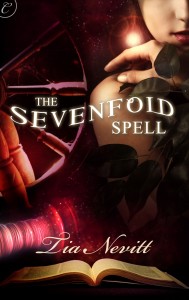
The Sevenfold Spell by Tia Nevitt

The Sevenfold Spell
Tia Nevitt

There was some buzz about this novella a few months ago, so I requested an eARC for review from Carina Press through Netgalley.


The Premise: This is a retelling of Sleeping Beauty, told from the point of view of a young woman and spinner who is affected by the curse. Talia is a plain, not very attractive girl, with limited prospects, but she has a nice relationship with Willard, a farmer’s son, and she hopes to marry him one day. These simple dreams are shattered when the princess of the land is cursed by an evil fairy, and all spinning wheels are ordered destroyed, including Talia and her mother’s. This is the end of their livelihood and, with their reduced circumstances, Willard’s father uses the opportunity to renege on his promise to let his son marry Talia. Instead, Willard is destined for the monastery.
 
Read an excerpt of A Sevenfold Spell here
 
My Thoughts: I really liked the premise of this one – an ordinary girl who doesn’t seem much, with her simple desire to marry the not-so-attractive himself Willard has her life turned upside down because of how the Royal family’s life affects the everyday people. Talia’s anger and grief over what her life has been reduced to is a palpable thing, and when she has almost no income, and she’s lost Willard, she grasps at what she can get. So before Willard leaves for the monastery, she gives herself to him, in the hope that at least she will have a child.
 
It is around here where the story goes from a regular fantasy tale into more erotic/steamy territory. Several trysts are recounted in detail, with Talia uncaring of Willard’s brother’s overhearing them, or of the village knowing. The creative ways they’ve found to be together are described. I don’t know if this is my prudish side coming out or just not being a fan of this much explicit sex in my stories, but this is where I sort of got bored and stopped reading. I guess I wasn’t expecting this ebook to have this level of sex in it because it was labeled as being in the “Fae, Fantasy, Legends & Mythology” category. I understood that Talia was trying to hold on to Willard in some way, but after the first couple of encounters, I got the idea and recounting all the sex didn’t seem to add much to the story.
 
A few months later I figured I would pick up the novella again, and once Willard has left to join the order, the sex continues. Talia is looking for a connection similar to that she had with Willard, and she enjoys having sex, so she uses her body to pay for favors from their next door neighbor, and describes getting a reputation and gives us a general idea of her numerous trysts. What kept me going was that outside of all this, there are hints of the Sleeping Beauty tale. Characters familiar to that story appear, and I wondered where it was going and how Talia fit into the story. I’m glad I kept reading because just when the story seemed to be getting darker, suddenly something happens which manages to propel the story forward into a happy ending with a twist. It all ends on a sweet note.
 
Overall: Not a bad way to pass the time, and at 97 pages, this is a short read and it has a unique spin on a well-known fairy tale, but it’s heavy on the sexual content, which almost kept me from finishing this short piece. I’m glad I pushed on because of the last part of this story, which had a nice twist on the happy ever after.
 
Buy: Amazon (kindle) | Carina (PDF/ePub)
 
Other reviews:
Fantasy Cafe – 7/10
The Book Pushers – B-
The Book Smugglers (Joint review) – both gave it a 6 (Good)
Fantasy Literature – 4/5
One More Page – 2/5
Stella Matutina – 3.5 stars (out of 5)
A Buckeye Girl Reads – positive

Outside In by Maria V. Snyder

Outside In
Maria V. Snyder

I really enjoyed Outside In when it came out last year so I’ve been looking forward to the second book for a while. I snapped this one up on Netgalley.

*** The premise of this book has spoilers for the ending of Outside In, so if you don’t want to be spoiled, go check out the review for the first book: https://i0.wp.com/i58.photobucket.com/albums/g254/jayamei2/livejournal_com.gifhttps://i0.wp.com/i58.photobucket.com/albums/g254/jayamei2/wordpress.jpg ****


Have they gone yet? OK.

The Premise: Trella and her band of Sheep have managed to overthrow the dictatorship of the Pop Cops and the Insiders now know they are in a giant spaceship and that Outside is really Outer Space. The good news for everyone is that their ship has many more levels than they previously thought – plenty of room to expand, but the whole ship suffers from growing pains as a result of the recent changes and revelations. A committee has been created to lead the ship, but it can’t seem to agree on anything, scrubs and uppers still treat each other with the same disdain, and Trella wants nothing more than to explore and let others take care of the current mess.

Read Chapter 1 of Outside In here

My Thoughts: The story begins again with Trella trying to get back into her old habits – which are to do her own thing and let others fend for themselves. Although Trella notes that the committee is having difficulties and that there is a general sense of dissatisfaction on the ship, all she wants to do is let someone else take care of the problems for once. She doesn’t feel comfortable making decisions responsible for the people of the ship, but when saboteurs appear, Trella doesn’t hesitate to jump in and help. That Trella is willing to risk her life for people on the ship, but not willing to lead them, frustrates Riley. This frustration is compounded by Trella’s usual reluctance to let him know what is going on.

I thought that the first half of this book was promising, albeit without the same sort of pull that the first book had on me. I felt like there was a little awkwardness in its execution – a lot of dialogue and a plot that feels oddly episodic (a string of events following each other with cliffhanger-ish endings to each that segue into the next event). I had mixed feelings about Riley’s character in this book as well – his reaction to being unhappy with Trella didn’t sit well with me, but I was willing to see where their relationship went.  I still felt that the story had some interesting ideas that I was willing to follow where the plot led. I liked that things were not easy for the Insiders – after what happened in Inside In, things aren’t all solved. Instead there’s chaos as people try to figure out what to do next and what their roles are. Although the story wasn’t as strong as the first book’s, the science fiction concepts are interesting enough as an introduction to the genre, and comparing it to a similar book with people in a spaceship (Across the Universe), I felt like I liked this book better. There are a lot more secondary characters which influence the running of the ship and the conflicting personalities made me hope for some compelling drama. The mystery of who was behind the explosions and why also captured my imagination. I wondered what it would take to fix these problems and to get the people of the ship to band together.

Then the concept of Outsiders is introduced. (This is not a spoiler, it’s mentioned in the back blurb).

At first I was still relatively optimistic about this. It seemed to be just the igniter for Trella’s determination to save her ship and for the Insiders to band together. But then the plot sort of dissolved into a bunch of vignettes in which Trella moves forward only to find another setback. One disaster followed another but they happened so quickly, without pause between each that there was no room for Trella to do any self-analysis or any contemplation before she’s moving on into the next fray.  The constant action felt forced, and it made events blur into one another in a meaningless jumble. By the time the end came, I found myself disappointed in the direction of the story.

To be honest, in the midst of reading this book, I read a review of it over at the Book Smugglers where Thea pointed out “once the outsiders become known, they change the trajectory of the story, shifting the focus from internal strife to banding together against an external threat – which feels like a writerly cop-out”. I don’t think I am one to be influenced by others opinions but I did read this before the Outsiders began to really influence the plot – take that as you may. I still don’t dislike this book as much as Thea ended up disliking it, but I did end up agreeing with her on the above point.

What compounds my disappointment beyond feeling like using the Outsiders was an easy way out is that with this addition to the story we have the first book all over again. All you have to do is replace the Outsiders with the Pop Cops and the Trava family. Trella begins with her usual exploration, she ignores others, she is pulled into current events, she and others unite against a common enemy.  I don’t see anyone else remarking on this, so I am definitely in the minority in seeing this pattern. At any rate, I wish I didn’t see it, because I’d prefer if Outside In was more distinct from its predecessor. When I compare this book to the first one, it makes me wonder if the series was planned beyond book 1. There doesn’t seem to be a long-running story ARC, just a sort of repetition of the same concepts.

Overall: I have mixed feelings.  This is still a fine story for newcomers to the science fiction genre. If you loved Beth Revis’ Across the Universe, I’d recommend this – I like it as much if not better. It has plenty of urgency and action as well as a twisty plot. However, Outside In suffered from an awkwardness that I didn’t find in the first book, and the direction of the story was disappointing. I wanted things to be less pat, and more complicated. I wanted harder lessons. I’m not sure how others would weigh the mix of likes and dislikes I had, but they sort of balanced each other out and put this book under “it was OK” in my mind. So I recommend the first book but feel that your mileage may vary on the second.

Buy: Amazon | Powell’s | The Book Depository

Other reviews:
All Things Urban Fantasy – 4 bats (out of 5)
Galleysmith – mixed review (I had similar feelings to hers)
Squeaky Books – 5/5
Presenting Lenore – 4 zombie chickens (out of 5)
Yummy Men and Kick Ass Chicks – 3.5 (out of 5)
Good Books and Good Wine – positive
Tez Says – positive
Larissa’s Bookish Life – 4 Loveys (out of 5)
Reading with Tequila – 5 shots (out of 5)
The Book Smugglers – 4 (Really Bad)
Genrereviews – 3.5 pints of blood (out of 5)
Calico_reaction – Like, not love

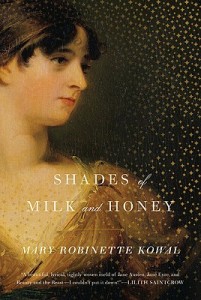
Shades of Milk and Honey by Mary Robinette Kowal

Shades of Milk and Honey
Mary Robinette Kowal

I’ve been eying this book since last year, particularly after this review at The Book Pushers when I basically realized that this was a regency romance with magic in it. When it was nominated for the Nebula Awards, I joined the Nebula Readathon at The Book Smugglers as an excuse to read this.
 
The Premise: (I’m going to go with the book blurb on this one) Shades of Milk and Honey is an intimate portrait of Jane Ellsworth, a woman ahead of her time in a version of Regency England where the manipulation of glamour is considered an essential skill for a lady of quality. But despite the prevalence of magic in everyday life, other aspects of Dorchester’s society are not that different: Jane and her sister Melody’s lives still revolve around vying for the attentions of eligible men.
 
Jane resists this fate, and rightly so: while her skill with glamour is remarkable, it is her sister who is fair of face, and therefore wins the lion’s share of the attention. At the ripe old age of twenty-eight, Jane has resigned herself to being invisible forever. But when her family’s honor is threatened, she finds that she must push her skills to the limit in order to set things right–and, in the process, accidentally wanders into a love story of her own.”
 
Read an excerpt of Shades of Milk and Honey here
 
My Thoughts: This book really feels like a big ol’ homage to regency romances of Jane Austen’s era. From the get-go I was struck by how regency-eque Shades of Milk and Honey was and how often it uses the same conventions as Jane Austen’s stories. We begin by being introduced to the Ellsworths, a respected family with two daughters, a hysterical mother, and a doting father who would like nothing more than to see his daughters happily settled. Jane is the sensible and somewhat plain older sister, and at twenty-eight she’s resigned herself to being on the shelf. Melody is the pretty one, and at eighteen she has a much higher chance of getting married, but as the younger sister, she’s also more impulsive and reckless than Jane. The Ellsworths spend most of their time visiting their friends nearby and going to parties, and proper manners are always assumed. Sounds familiar no? Yes, it’s like a mix of every Jane Austen novel out there. Jane Austen era spellings like ‘shew’, ‘chuse’, ‘teaze’ and ‘nuncheon’ to add to that feel.
 
What makes Shades of Milk and Honey not just a remix of Austen, is the idea of glamour, a type of small magic that is used for pretty illusions. With glamour, a lady may create a subtle scent in the air, embellish a painting, record and play music, and even enhance her own appearance. There is no end to its uses, although it is considered mainly an artistic skill, not a dangerous one. It is a skill of high merit in well-bred ladies of society, much like the ability to play music or paint.
 
Jane is particularly skilled at glamour. I was hoping that Jane’s skill in glamour would be more essential to the story than it was, but it seems to be merely there as an interesting skill that gains Jane admiration from those around her. In fact, it is the quality that she is most admired for, and her sister harbors some jealousy because of it, despite her own pretty face and easy grace, which Jane lacks. There’s a bit of sisterly competition when it comes to men because of the their differences. Both girls share an admiration for a neighbor, Mr. Dunkirk, and he is a point of contention, despite never giving either sister a reason to hope. At times, the little jabs at each other got a little nasty, at others they are remorseful for their previous behavior. It was a bit of a see-saw, which I suppose shows the complications of sisterhood, but I wish their relationship was delved into a little further, beyond their little squabbles.
 
On the other hand, none of the relationships in this book were delved into. The story is very readable and I was easily drawn into Jane’s world, but beyond the social obligations and underlying drama of who may be courting who, I felt a lack of connection between Jane and the other characters. Jane feels more like an observer than a participant in this story. She watches as her sister flirts with gentlemen such as Mr. Dunkirk, and the newly returned Captain Livingston. She sees her mother go into yet another fit of hysteria and commiserate with similarly afflicted Mrs. Marchand. She wonders what secrets her friends Beth and Mr. Dunkirk are hiding. She wonders at the surly Mr. Vincent who creates beautiful works of glamour but doesn’t seem to like her very much. Internally she has a lot of thoughts about her glamour and what people around her are doing, but she doesn’t voice them. She doesn’t act until she is forced to by others, and about 75% into the book, I realized that I wasn’t really sure where the story was going. I felt like Shades of Milk and Honey was circling the airport. I wondered aloud “When are you bringing this baby in?”.
 
It’s not until she is drawn in by an unexpected suitor and by the threat of family ruin that the story really gets anywhere, and this happens far into the story. I did like where it went, but some of the excitement and interaction at the end of the book would have been nice to see in the rest of the story. I also felt like the romance Jane had was trying to replicate a Darcy and Elizabeth romance, with what looks like initial dislike becomes something more, but I must have missed the subtle growth of their relationship, because when the declarations of love happened, I really wasn’t sure why. Jane spends so little time with her eventual paramour, that the romance, while very sweet, didn’t feel backed up by emotional growth.
 
Overall: Shades of Milk and Honey reminds me of the stories of Jane Austen in that it has characters that spend their time visiting one another and going to parties, and proper manners are expected. It also has a lot of plot points that hark back to the Jane Austen books: sisterly bonds, strawberry picking, men after dowries, and secret engagements. I think that my love for this stuff kept me reading at a happy clip. For this alone, I’d call the book “good”, but beyond the Jane Austen trappings, I wanted more out of the characters and plot (and more out of the concept of glamour), so it didn’t move past being merely entertaining for me.
 
P.S. Does anyone know the significance of the title of this book? Is it a reference to the biblical phrase ” “a land flowing with milk and honey“? OK, that would make sense…
 
Buy: Amazon | Powell’s | The Book Depository
 
Other reviews:
Jawas Read, Too! – 8 (out of 10)
The Book Smugglers – 6 (good)
SFF Chat – “didn’t turn out to be exactly what I had been hoping for, it was a pleasurable way to pass a couple of hours”
The Book Pushers – 5 stars (out of 5)
Fantasy Book Critic – A- (“a very light novel that epitomizes “beach reading” for me”)
Christina_reads – Didn’t live up to expectations
Stella Matutina – 3.5 stars (really liked it)
I love this book trailer


Children of Scarabaeus by Sara Creasy

Children of Scarabaeus
Sara Creasy

I think that thanks to a couple of influential bloggers, this series is on more people’s radars, and that makes me happy. I really enjoyed Song of Scarabaeus when I read it in September last year (https://i0.wp.com/i58.photobucket.com/albums/g254/jayamei2/livejournal_com.gifhttps://i0.wp.com/i58.photobucket.com/albums/g254/jayamei2/wordpress.jpg), and when I heard that it’s sequel, Children of Scarabaeus was available on NetGalley, I requested it ASAP.
 
**** mild spoilers for Song of Scarabaeus ****
 
The Premise: In this continuation of the story that follows Edie Sha’nim and her bodyguard Finn, Edie has freed herself from her kidnappers and her goal is to use what she’s recently learned to help Fringe worlds with their reliance on Crib technology to keep their environments viable. Unfortunately, her freedom is short-lived, as the Crib government catches up with Edie and her friends, and reclaims her as their property. Edie has to cooperate or Finn suffers, so she reluctantly goes back to work as a biocyph for Liv Natesa’s pet project on a new terraformed world named Prisca. During the project she makes some startling discoveries about what the Crib is up to, including the use of children as their new breed of cypertecks. In the meantime she’s also asked to return to the place where it all began for her: the planet Scarabaeus.
 
Read the first chapter of Children of Scarabaeus here (pdf)
 
My Thoughts: I was anticipating this read so much that it leaped over all others in my TBR and landed on the top of my queue, and then I read it all in one day. I’m happy to say it felt very readable and I had no inclination to put it down once I started. This book had much of the same sort of twists and turns as the first, with escapes and captures, spaceship crashes, deadly planetary disasters and wild animals. Not to mention the manipulations of Natesa, who wants Edie on her project, which promises terraforming at a much faster pace than ever before and of Colonel Theron who wants Edie to work for him on Scarabaeus. Like the first book, Children of Scarabaeus has a lot going on. In fact, it surprises me how much happens in it within a relatively short number of pages (my eARC is numbered at 322 pages).
 
Edie and Finn begin the story with the same relationship they had when Song of Scarabaeus ended, which was a place where they trust each other completely, but things are still new and Edie isn’t quite sure where she stands. It doesn’t help matters that the chip in Finn’s head (the one that could kill him if he’s too far from Edie) causes emotional feedback that makes romantic entanglements complicated, or that Finn is a hard man for Edie to read. Edie wants Finn by her side, but she also wants him to be free, and not have to be by her side, especially when her skills make her a resource everyone wants. I wasn’t sure how things were going to go for them with their general lack of communication, but this book moves them forward a lot more than the first did, and the romance was not as understated as the first installment.
 
The descriptions of the biocyph and cyperteck technology as Edie sees it continues to be fascinating. I really love how it’s described visually instead of trying to explain the technical details behind it. When the cyperteck children are introduced, I liked how they related to the code differently from even Edie and other ‘tecks. Instead of understanding things visually, they go by sound and by feeling. The code is something living that needs fixing so it can be “well”, and the children instinctively work as a team to patch the code up. They have no idea what the code does, all they are interested in is the feel of the code itself.
 
Children of Scarabaeus does a very good job in tying up all the loose plot strings left over from Song of Scarabaeus. There were a few times where I thought the story was going to go one way (and this probably would have lengthened the plot), but Edie and Finn instead are steered towards their destinies. The way things are satisfyingly tied up leads me to believe that this series is now complete, which is in a way disappointing. This is a case where I would be really happy for more books and more adventures with Edie and Finn. I don’t really think that Children of Scarabaeus rushes to a conclusion, but it upon me before I wanted it to be. I wanted to spend more time, leisurely exploring the galaxy and watching the relationship develop between Edie and Finn. I could have used a book or two between book 1 and the conclusion here, and I think that would have also sidestepped the feeling that the plot twists and deaths in the story were a means to get to the appropriate ending within the pages allowed. I hope that the next series Sara Creasy writes next gets to be longer. And this is from a girl who balks at long series, so do not take my words lightly.
 
Overall: I really loved Song of Scarabaeus, and this is a worthy sequel that has the same action and awesome world building as it’s predecessor. It comes pretty close to pleasing me in the same way the first book does, but it has one handicap – it has to complete the story in one book, which means the romance and the complex plot are tied up before I was ready. I think the author did a good job at making these things satisfying (particularly the ending), but I would have been fine if I had to wait one more book (or two) for it. Thumbs up for this series – get both books.
 
Children of Scarabaeus comes out on March 29th.
 
Buy: Amazon | Powell’s | The Book Depository
 
Other reviews:
It’s early yet..