The Serpent Sea by Martha Wells

I was having such a good time reading The Cloud Reads that I was voicing aloud my need for The Serpent Sea before I was finished. I asked, and the Husband answered by gifting me with a copy on my birthday. You could read this book before the first, but I’d recommend you don’t because there’s character growth that’s more rewarding when the books are read in order.

My review of book 1, The Cloud Roads can be found here: https://i0.wp.com/i58.photobucket.com/albums/g254/jayamei2/livejournal_com.gifhttps://i0.wp.com/i58.photobucket.com/albums/g254/jayamei2/wordpress.jpg

**** This review may contain spoilers for the first book!!  ****

The Serpent Sea
Martha Wells

The Premise: Finally orphan Moon has found a place for himself in the Raksura colony of Indigo Cloud. He’s still adjusting to being a Consort and all that entails, but in the meantime, the Indigo Cloud court is moving. The influence of the Fell has reduced their numbers and poisoned their home, and now Indigo Cloud is returning to the great tree that they left, generations ago. Unfortunately, when the colony arrives at their tree, they discover that a vital part of it has been recently stolen: the seed at its heart. Without it, the tree will die and Indigo Cloud would be left homeless and vulnerable. The colony needs to find the stolen piece before the damage is irreversible.

My Thoughts: The Serpent Sea begins almost where The Cloud Roads left off: with Raksura of Indigo Cloud traveling to their ancestral home via flying boat. It’s been a long journey and Moon and the rest are eager to finally be at their destination, but when they land, the great tree doesn’t feel quite right. It’s not long before they discover the reason why. Someone has come into the tree and stolen the seed at its heart. Of course this now puts Indigo Cloud back into peril again — without a home, they’re vulnerable. The other nearby Raksura colonies may accept their return to their tree, but they wouldn’t necessarily tolerate Indigo Cloud settling in other territory.

As with The Cloud Roads, I loved the fantastic landscapes of The Serpent Sea, especially when it came to the places that the people of the Three Worlds lived. Every one seemed more amazing than the last. It really felt like anything goes here with building places to live. It begins with the colony’s new home amongst the mountain-trees, with branches that interweave to create platforms for smaller trees to grow:

“It grew darker, the green-tinted sunlight muted as clouds closed in high above the treetops. The drizzle turned into a light rain that pattered on the deck. The platforms of the suspended forest grew wider and more extensive.  Many of them overlapped, or were connected by broad branches, with ponds or streams. Waterfalls fell from holes in some of the mountain-sized trees. Moon wondered if the water was drawn up from the forest floor through the roots. It was like a while multi-layered second forest hanging between the tree canopy and the ground, somewhere far below.”

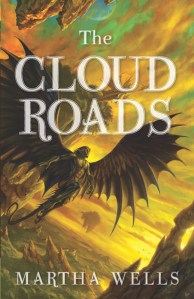
The quest for the seed leads them to other settlements, including the one shown on the cover — a city built on a giant water-monster (!!!) that swims in a large body of water named the Serpent Sea. These are great settings but there is some thought behind them: why people chose to live in these places, and how it affects them are considerations that aren’t omitted from the story. As you’d expect there are also new creatures introduced as the Raksura travel to find the seed for their tree, but there’s no revisit from races encountered in the last book. This may be to underscore how far the colony has traveled, or how isolated populations become from one another because of the difficulty of travel.

I was fascinated as usual by the variety and differences in cultures, but this story doesn’t forget the Raksura themselves. I continue to enjoy how Raksura society is conveyed through Moon’s experiences.
At this point Moon is no longer the newcomer and his actions have granted him some respect. When the colony decides to search for the missing seed, he’s part of those plans, but he’s still settling into his new role as a Consort and he’s not always confident in that role. In the meantime there’s still some tension between the queens, Pearl and Jade. These types of adjustments don’t happen overnight, and The Serpent Sea reflects that.

There’s an implied system of hierarchy based on birth and an internal ranking system and it is fun to see where certain Raksura placed. I loved that this was a society where women were leaders, and queens are expected to be more aggressive than consorts. There’s a scene in particular (towards the end of the book), that illustrates this point and had me cheering. There are some developments that shed light on the history of Indigo Cloud as well as some eye-opening interactions with other Raksura.  I also enjoyed learning a little more about the magical abilities of the mentors. I would love to learn more, and I hope the unique situation that Chime is in (he’s the only Raksura known to have changed from a mentor into a warrior) gets more attention in the next book.

Most of my reaction to The Serpent Sea is positive, but I had one (probably unfair) issue with it. The Serpent Sea is basically a quest story. The goal from the beginning is clear: Indigo Cloud Court wants a home and to have one they must have their seed. Because of this, to me, the plot felt a lot simpler than The Cloud Roads. Since Moon’s past and Indigo Cloud Court’s problems with the Fell have been cleared up, the focus is now on Indigo Cloud Court resettling. The quest for the seed has it’s complications and there are bumps along the way, but I didn’t feel as though there was as much that was unexpected. I feel like I’m being a tough critic with that that reaction though. In other ways, The Serpent Sea shines. It delivers just as rich world building and gripping action as the first book did, and it continues Moon’s personal journey in a believable way.

Overall: I think part of me compares this with the first installment and wants something more complex than a quest story, but when I put that quibble (which I feel very few people would share) aside, The Serpent Seas is very enjoyable and shows the same imagination (the world building in these books is amazing) as the previous book. This is well-written fantasy and has an incredibly creative, visual story-telling style.

I will be reading the third book, The Siren Depths, which is out in December and has artwork, but no cover yet.

Buy: Amazon | Powell’s | The Book Depository

Other Reviews:
The Book Smugglers – 8 (excellent)

P.S. While reading this I came across this artwork of a harpy by Sandara on deviantart which I thought could also work as a Raksura. Pretty, no?

Seraphina by Rachel Hartman

I requested Seraphina from Netgalley because the summary mentions dragons that fold “themselves into human shape”. Shapeshifters in the fantasy genre is something I’m still thrilled by, even though I should have my fill already in urban fantasy. Not sure how, but it’s different I tell you. Other things that also drew me: tensions between humans and dragons, a heroine trying to hide a secret while working beside a “dangerously perceptive” prince, and the great blurbs by Naomi Novik and Tamora Pierce. Not to mention some very tempting book reviews.

Seraphina by Rachel Hartman
Rachel Hartman

The Premise: (taken from goodreads) “Four decades of peace have done little to ease the mistrust between humans and dragons in the kingdom of Goredd. Folding themselves into human shape, dragons attend court as ambassadors, and lend their rational, mathematical minds to universities as scholars and teachers. As the treaty’s anniversary draws near, however, tensions are high.

Seraphina Dombegh has reason to fear both sides. An unusually gifted musician, she joins the court just as a member of the royal family is murdered—in suspiciously draconian fashion. Seraphina is drawn into the investigation, partnering with the captain of the Queen’s Guard, the dangerously perceptive Prince Lucian Kiggs. While they begin to uncover hints of a sinister plot to destroy the peace, Seraphina struggles to protect her own secret, the secret behind her musical gift, one so terrible that its discovery could mean her very life.”

My Thoughts: This story starts with Seraphina.

“I remember being born.
In fact, I remember a time before that. There was no light, but there was music: joints creaking, blood rushing, the heart’s staccato lullaby, a rich symphony of indigestion. Sound enfolded me, and I was safe.
Then the world split open, and I was thrust into a cold and silent brightness. I tried to fill the emptiness with my screams, but the space was too vast. I raged, but there was no going back.
I remember nothing more; I was a baby, however peculiar. Blood and panic meant little to me. I do not recall the horrified midwife, my father weeping, or the priest’s benediction for my mother’s soul.
My mother left me a complicated and burdensome inheritance. My father hid the dreadful details from everyone, including me. He moved us back to Lavondaville, the capital of Goredd, and picked up his law practice where he had dropped it. He invented a more acceptable grade of dead wife for himself. I believed in her like some people believe in Heaven.”

 
Not surprisingly, my first impression of Seraphina was that she is an odd duck. Clearly there’s something strange about her for remembering her birth, and the inheritance she alludes to. Then she tells us that her father has told her time and again that to stay safe she must stay under the radar.  That her secret, if discovered, would mean her death. Only a select few know it, among them her father and Orma, a her music tutor (who happens to be a dragon). But Seraphina can’t help herself. She doesn’t want attention, but she is herself. Despite her best intentions, Seraphina stands out. Her prodigal musical talent is difficult to suppress, and after she’s noticed for that, it’s hard to forget her.

When the story begins, Seraphina has been court composer’s assistant for two whole weeks. Two weeks of rushing to be ready for the kingdom’s forty year celebration of the treaty with the dragons where the Ardmagar (the dragon equivalent of a king) is scheduled to make an appearance. Then Prince Rufus is found dead during a hunting trip. He was decapitated, and whispers that a dragon is responsible begin to be passed along. Things are difficult enough with the peace without these new rumors — many Goreddis still fear the dragons and worry about Goredd disbanding the knights who practiced dracomachia (a fighting technique used specifically against the dragons).

Seraphina thinks something is about to happen because of Prince Rufus’s death. She isn’t sure what, but she wonders who really killed the Prince and why. Seraphina’s position within the palace gives her special access to the royal family and she tries to keep an eye out for possible threats. She devises her own ways of finding things out, often finding herself face-to-face with Prince Lucian, head of the guard, as a result — and he proves a little too smart and nice for Seraphina’s comfort (especially since he has a fiancée). In the meantime, she also worries about her tutor Orma and the ominous message he received at the Prince’s funeral. Interwoven with that is Seraphina’s own issues with keeping her secret — her flute solo at the funeral moved everyone to tears and of course made her noticed. I’m half tempted to say what Serphina’s secret is in this review (it’s a big part of her character), but I am not sure it’s exactly revealed in the first fifty pages and the blurb dances around it. Let’s just say it is a great secret for storytelling. There’s a lot of little anecdotes about Seraphina’s past and how they relate to her secret all while everything else is going on. Her struggle to understand her mother (who died at childbirth) is a big part of Seraphina’s ruminations. If that isn’t enough, there’s also this strange mental garden that is tied to Seraphina’s secret.

Maybe that sounds like a lot of odd little threads, but these things are related in a smooth and interesting way. This is the type of world building that you sink into and while it has that medieval, city-built-around-a-castle setting that a lot of Fantasy has, much of the world felt fresh and new to me. The highlight was that dragons can shapeshift into people. What I loved about this that is in Seraphina, becoming human is a truly alien experience for a dragon. They can’t really deal with a new body that sometimes makes them feel and think in ways dragons aren’t supposed to. They needs Censors to make sure they don’t go insane – which in their culture, is when a dragon allows emotion to overrule logic. Dragons literally have memories of such a distasteful lapse scrubbed away. Of course, with the dragons so concerned with being dragons and keeping themselves apart from what they think of as human weakness, they also stay unknowable to their human allies who say they have no souls. There’s so many little details like that that are thrown in here. Seraphina knows more about dragons than most people so she bridges the cultural gap in her narrative. Tidbits about dragon and human relationships are dropped as needed throughout the story (not to mention the cultures of neighboring countries Porphyry, Samsam, and Ninys), and they fascinated me. I couldn’t get enough of the meeting of different worlds.

The other thing I really loved about this story were the characters. Seraphina was my favorite. She has more than one facet – sometimes quiet and a bit grumpy, sometimes scared and secretive, other times just fierce and brave. She starts off as a sixteen year old girl who wants to blend into the walls, but as the story progresses her chutzpah shines through as she throws herself into stopping anything from ruining the treaty. I loved this, but I also loved her vulnerability because she has the daily anguish of hiding her true self. And let’s not forget the secondary characters. First of all: Prince Lucian – my goodness, the awesome interactions he and Seraphina have! There was something a little fun about how they both surprise each other, and I can’t wait to see how their relationship develops. Then there’s Seraphina’s father, who tells her to stay unnoticed every chance he gets, but who does so because of his fear for his daughter; Orma, who is a dragon and who has always seemed distant, but who Seraphina still trusts and loves; even Princess Grisselda, granddaughter of the current queen and Lucian’s fiancee proves to be more complicated than she initially seems.

Overall: You know those books that kind of make you excited because you read them and think, “This is right up my alley! This book has things I find awesome in it!” ? Seraphina is one of those books for me. I just want everyone who likes Fantasy with girls doing stuff (and dragons!) to read it already. The characters! The world building! Have I mentioned the shapeshifting dragons?! Alright, I get that not everyone loves YA Fantasy and books with a drop of romance, but if you like that sort of stuff, just a little bit? If you like the quality and creativity of Robin McKinley, Megan Whalen Turner, and Diana Wynne Jones? Then maybe you should try this one.

Seraphina is out July 10th

Buy: Amazon | Powell’s | The Book Depository

Other reviews:
Stella Matutina – ” SERAPHINA is just plain delicious from start to finish. I want all of you to read it as soon as you possibly can. “

For Darkness Shows the Stars by Diana Peterfeund

This review is based on a uncorrected proof won through a contest on the author’s blog.

For Darkness Shows the Stars
Diana Peterfeund

The Premise: (from the back blurb) “It’s been several generations since a genetic experiment gone wrong–the Reduction–decimated humanity, giving rise to a Luddite nobility who outlawed technology.
Eighteen-year old Luddite Elliot North has always known her place in the world. Four years ago she refused to run away with her childhood sweetheart, the servant Kai, instead choosing duty to her family’s estate. Since then the wold has changed: a new class of Post-Reductionists threatens Luddite control; Elliot’s estate is floundering; and she’s forced to rent land to the Cloud Fleet, a group of explorers that includes a renowned Captain Malakai Wentforth–an almost unrecognizable Kai. And while Elliot wonders if this could be their second chance, Kai seems determined to show Elliot what she gave up when she abandoned him.
But Elliot soon discovers Kai carries a secret–one that could change the society in which they live…or bring it to its knees. And she’s faced with a choice: cling to what she’s been raised to believe or cast her lot with the only boy she’s ever loved, even if she’s lost him forever.”

My Thoughts: The premise of For Darkness Shows the Stars was pretty much guaranteed to make me read it. It’s a retelling of Persuasion, my favorite Jane Austen book, and a futuristic romance? Um, yeah, sold.

In the futuristic world of For Darkness Shows the Stars, the social classes have been cleverly structured to mirror that of Regency England. The Luddite lords own all the land, and lives lives of noble leisure. Almost everyone else is Reduced. They are servants, trained by the Luddites to do simple tasks, and unable to take care of themselves. Many years ago, technology was abused, leading to to generations born with developmental difficulties (the Reduced) and world war. The Luddites were spared by their own caution, and now reap the benefits. But now there is also a new class – the Posts, rare children born from the Reduced that are just like the Luddites, but without their social position. As can be expected, their appearance has begun to shake up the social structure. Some Posts have run away from their estates and made their own fortunes in exploration and enterprise, forming a new class that is wealthy, if not noble.

Within the current social structure, the Norths are high ranking nobility. Elliot’s position allows her to manage the household since her sister, Tatiana, and her father, Baron Zachariah North, have no interest, but as the younger daughter of an estate to which she’s not an heir, Elliot has little power against her father. In the years since her mother’s death, Elliot has deflected the worst of his selfishness, but as far as Baron North is concerned, he is lord and master. He reinforces his supremacy over Elliot subtly, with punishments designed to hit Elliot where it hurts the most. His latest act is to cut down a field of wheat that Elliot had secretly modified to end the food shortage on the North lands. Beneath his casual callousness, Elliot fears that her father choose her wheat field on purpose.

The loss of the genetically modified wheat leads Elliot to convince her family to rent out her grandfather’s shipyard to the Cloud Fleet, even though the Fleet is staffed entirely by free Posts. Admiral Innovation of the Cloud Fleet brings with him an interesting assortment of wealthy and adventuring Posts, among them his wife Felicia, Captains Andromeda and Donovan Phoenix, and finally, Captain Malakai Wentforth. But when Elliot lays her eyes on Captain Wentforth, she gets a shock. He’s Kai, the young Post boy she fell in love with but failed to run away with four years ago.

The set up of the book has quite a few nods at the original Persuasion, with Elliot in reduced circumstances, her frivolous family spending money while she worries about bills, and a newly wealthy lower class as a means for the Norths to survive. But For Darkness Shows the Stars really takes at most the skeleton of the original as a guide, choosing to make social commentaries in it’s own, very different way. Instead of drama playing out under the surface in drawing rooms, this story is more out in the open. Elliot has a close relationship with Posts and Reduced on her estate, relying on her Post foreman Dee and others for advice, and often visiting Ro, a pretty Reduced girl her age, for company. While Elliot works with the Posts and Reduced, others in her social class treat them no more than indentured servants or slaves. There are several examples showing the huge divide between the Luddites and others. For instance, the birthing and healing houses for the Reduced and Posts. These places are ill-staffed, and inadequate. Many Posts, in no need to be treated like the Reduced are, leave their estates but fall prey poverty and new forms of abuse.

Kai/Malakai keenly feels the unfairness of the class system and questions it — why should he be servant and answerable to the Luddites when he has skills and a mind just as sharp if not sharper than theirs? Letters between Kai and Elliot through the years break up the story and are evidence of their attachment, but also show the two questioning the Luddite beliefs. The dynamics between classes plays a more obvious role when Kai left the North Estate, and Elliot stayed, and later, Kai more openly holds a grudge over Elliot’s rejection than in the original. When Malakai shows up again with other successful Posts, what he’s done to achieve that success also becomes a plot point.

I liked these differences from the original story. I’ve read a lot of retellings, and I always end up liking the stories that take the bones of the original but infuse it with its own flavor over those stories that rigidly follow the script. Baron North is more scary than he is vain. Several characters no longer exist or are in very different forms, and of course, names have been changed, but characters are still recognizable, if different. I liked the concept of a future where events have produced a class system similar to the Regency period, and that use of technology was linked to religion. I liked that this was cleverly incorporated into the conflict between characters. More cleverness: the clues about where the story was set (not in the U.K). I enjoyed that the settings for many of the scenes were unique to this retelling.

And how did I feel about the romance? Kai and Elliot’s correspondence peppering the book showed their early friendship as children, with only a few hints of their romance later. Where the romance really resonated for me was in Elliot’s internal anguish over Kai. Her emotions now, which she takes great pains to keep hidden, tell me more than anything else. Kai is harder to read — the third person narration focuses more on Elliot — and he was surprisingly bitter at the start of the story. Later on, I felt like he showed a different emotion but you had to read between the lines to guess how he felt, until the expected letter. Like the original, Kai’s inscrutability makes Elliot’s feelings more palpable, and it was on Elliot’s behalf that I rooted for the couple.  This wasn’t a story that was about a new love, it was about already being in love and sick with it. I wanted them to be reunited. I liked the way that happened, and how some of the class issues (at least at the North estate) were resolved. Some readers may have wanted more social issues settled, but I didn’t think the scope of the story would have made that realistic. This ending was a beginning, and I was happy with that.

For Darkness Shows the Stars is out June 10th, 2012.

Overall: This is one of my favorite retellings. Readers should not go into this expecting a story that follows the Persuasion formula to the letter, but since For Darkness Shows the Stars is set in a post-apocalyptic society where new advancements are frowned upon, things are bound to go off script. And they do, in the best way. I liked this for being an homage but also for being incredibly original at the same time.

Buy: Amazon | Powell’s | The Book Depository

Other reviews:
Book Harbinger – “While overall this didn’t work for me”, recommends with reservations.
Angieville – “Everything about this book soars, from its supernal setting to the dreams its characters hold in their hearts.”

The Cloud Roads by Martha Wells

After a spat of straight contemporary reads this year, I finally started looking at my TBR for a nice fantasy and my eye landed on The Cloud Roads, a book I picked up at LunaCon. This book has been on my radar after a joint review at The Book Smugglers, but Kristen putting it on her favorites list sealed it. I think Kristen has great taste in fantasy, and have resolved to listen to her when she recommends something.

The Cloud Roads
Martha Wells

The Premise: Moon is a orphan who doesn’t know exactly what he is. The sole survivor of the massacre of his mother and young siblings, Moon has wandered among the groundlings, blending in with his own earth-bound form, for much of his life. When no one is looking, he shape-shifts into a scaled, winged creature with claws, frills around his head, and a long tail. Unfortunately, once shifted, he has more than a passing similarity to the Fell, a reviled, sociopathic race with no purpose than to conquering and decimating cities, leaching all resources, and moving on to restart the cycle elsewhere. Moon is not a Fell, but he looks like one, and if his secret form is discovered, the consequences could be dire. And then Moon meets another shape-shifter just like him, who wants to take Moon back to his colony. Moon accepts the offer, if only to find out more about his race, but this stranger has more than altruistic motives for bringing Moon to the others. Moon doesn’t know just how crucial he is to the survival of this colony, nor is it certain he would he have come if he’d known of its recent upheavals.

My Thoughts: The lost orphan making his way in the world. It’s a common trope in the fantasy genre, but ever since I read The Belgariad I’ve loved it. There’s something about the search for identity and the possibilities within the Fantasy landscape that I adore. Add this to another trope I have a thing for, which is discovering new cultures through a character’s eyes, and you’ve got me eagerly absorbing the story of Moon finding his people.

The Cloud Roads establishes Moon’s isolated and temporary lifestyle early on. Typically Moon spends his day hunting alone, then comes home to the hut and the two women he shares it with (assigned to him by the Cordan camp). Sometimes, he sneaks out of the camp at night and assumes his other form. Always, this is in secret:

“Moon had been very young when his mother and siblings had been killed, and she had never told him where they had come from. For a long time he had searched sky-islands looking for some trace of his own people. The islands flew; it stood to reason that the inhabitants might be shifters who could fly. But he had never found anything, and now he just explored because it gave him something to do.
When Moon had first joined the Cordans, he hadn’t thought of staying this long. He had lived with other people he had liked–most recently the Jandin, who had lived in cliff caves above a waterfall, and the Hassi, with their wooden city high in the air atop a thick mat of link-trees–but something always happened. The Fell came or someone got suspicious of him and he had to move on.”

The opening sentence of The Cloud Roads warns us that things are to change for Moon (“Moon had been thrown out of a lot of groundling settlements and camps, but he hadn’t expected it from the Cordans.”), and it soon does. Things happen very quickly, and suddenly Moon is on a journey with Stone, an older shapeshifter. Stone is a Raksura, and so is Moon. Stone wants Moon to come to his colony, Indigo Cloud Court, and Moon agrees, both because Moon has no where else to go, and because he has a burning desire to learn what he is. At the colony, Moon meets the Raksura, a race of shapeshifters with different attributes — some that can shift to winged shape (the Aeriat class) which are the warriors and royals, and others that only have a ground form (the Arbora) which are hunters, mentors, soldiers and teachers. It’s a hive-type society where everyone has their role and place in the overall hierarchy, and the queens are its rulers. Moon is an awkward outsider at first, but he was born a consort, with all the privileges and expectations that that brings. He just has to figure out how to be one. As a solitary, he’s grown up less sheltered and pampered than he normally would be.

There is enough from Stone’s not-being-quite-forthcoming to make a guess where the story would go, but I was never exactly right. Just when I thought I knew what would happen, something else would. The Cloud Roads had a very dynamic plot — new problems were always being thrown into the mix and Moon and the other Raksura spend a lot of time having to react to the latest fire, but at the same time, this was done quite smoothly. I never felt like anything was forced, and Moon’s adjustment to everything had just as much page-time as the threats to Indigo Cloud Court. There is plenty of time for Moon to make both friends and enemies among the Raksura and to begin to understand their politics and culture. Meanwhile, there are also threats outside the colony that need to be dealt with. The outside enemies are your typical shadowy bad guys (although there were suggestions of their viewpoints, they weren’t delved into), but I was okay with this because Moon’s fledgling relationship with the other Raksura felt like the primary focus.

There are also several races in The Cloud Roads world. None are human, although a couple are human-like. There are lizard-like people, snail-like people, tusked people, tentacle-faced people, and opalescent people. There’s the feeling that there are many more. This is a big world and Moon and the Raksura don’t know all that is in it. When Moon and others venture out, they are journeys to places they haven’t been to before, so there’s always an element of wonder and discovery. And it’s quite lovely: the fantastic vistas and architectural marvels captures the romantic notions of fantasy. I particularly liked how the artifacts of past civilizations dotting the landscape added a sense of lost history to the world building.

Overall: A hive-like society, an orphan in search of his people, and a world populated by strange races, none of them human. The Cloud Roads is recognizable fantasy, but with a fresh spin. I really enjoyed the mix of comfort and creativity as well as the imaginative world building, but I was won over by Moon’s personal struggles. I felt empathy for his initial loneliness and culture shock, and I wanted to see him thrive in his new place. I recommend this for traditional fantasy fans who like feel-good adventure and maybe a drop of romance.

I already started reading the sequel, The Serpent Sea, and will probably also buy the third book of this trilogy, The Siren Depths, when it comes out in December this year.

Buy: Amazon | Powell’s | The Book Depository

Other reviews:
Fantasy book cafe – 8/10
The Book Smugglers – 7 (Thea) and 8 (Ana)
Calico Reaction – 7 (A good read)
Starmetal Oak Reviews – 8 (out of 10)

Something Like Normal by Trish Doller

This is the perfect example of bloggers influencing my reading — this was only on my radar because I saw a banner on Holly’s blog. Chachic, who recently reviewed it also credits a blogger for her interest in the book. And why is this debut author getting good buzz? Well, I think what she does right is her website is nice and clean and information is easy to find, she uses social media well, and she has a nice long excerpt (very crucial). All good things, but hey, most importantly – the book is a good read too!

This review is based on an eARC copy I received via Netgalley.

Something Like Normal by Trish Doller
Trish Doller

The Premise: Travis Stephenson is a nineteen-year-old Marine on leave for thirty days. He’s been in Afghanistan for a year and his best friend Charlie was recently killed over there. Now that he’s home, everything that was once familiar is now strange, and Travis isn’t as okay as he pretends to be. While he’s dealing with his own messed up head, he also has to deal with his less-than-ideal family life. His parents’ marriage is strained, and his younger brother Ryan is a rival, not an ally (he stole Travis’s girlfriend and car while Travis was gone). Then he meets Harper, the girl whose reputation he ruined in middle school after a game of seven minutes in heaven led to rumors he didn’t bother to curtail.

Read an excerpt of Something Like Normal here

My Thoughts: There’s a lot in Travis’ life that he has to deal with. Non-trivial things. His best friend Charlie is dead. Travis has trouble sleeping and may be suffering from PTSD. He wants to pay Charlie’s mothers his respects, but he isn’t sure how to do that when he can’t even process Charlie’s absence himself. On leave from Afghanistan, Home has become an alien planet. He’s surrounded by a reputation-obsessed father, an anxious mother, and a brother that covets what Travis has. His parents’ relationship has deteriorated, and his ex-girlfriend Paige is with his brother Ryan now — but keeps showing up in his bedroom late at night. Every relationship Travis has is fraught with complications and unresolved issues.

Then Travis runs into Harper Gray, a girl who has every reason to hate him because he’s why the world thinks she’s a slut. After a good punch in the face, Harper is surprisingly non-judgmental, and Travis, messed up and floundering, recognizes that she’s someone that he wants to be around. Their past history and Travis being drawn to Harper now becomes another sign of changes in Travis. I’d normally question if Harper should forgive a guy who hurt her, but here, Travis is suffering already. Harper’s intuition that Travis is in pain and her decision not to hold a grudge (well, after that punch), makes her strong rather than weak. There was something quiet and right (and a little delicious) about their burgeoning relationship.

Just like Chachic says in her review, I have never been a nineteen-year-old boy, but I could see Travis fitting in with the ones I’ve known. Bonding with his friends from the unit means giving them all a hard time, and physical exertion is part of his coping mechanism. He really likes girls. And he’s realistically flawed. Actually, his younger self sounds rather immature: his treatment of Harper is one example, his rocky relationship with his ex is another (“We cheated on each other all the time. That’s the way it was with me and Paige–insane and toxic“). He STILL has growing up to do, and Something Like Normal captures how painful the process of adulthood can be. The the emotion underlying everything Travis says as he narrates underscores it. Every word seems to tell us just how cut up he is about Charlie and how difficult it is for him when he feels nothing near normal, but he’s trying hard – both to cope, and to be a better person. Thankfully this pain is balanced nicely with the thrill of finding a connection with someone who understood it.

If I had one criticism of this book it would be that there was a lot of personal drama and a short time frame. I’d have preferred more time on the romance or with his processing of Charlie’s death over some of the drama, but it’s hard to complain with all the threads so seamlessly interwoven. Travis’ thoughts of Charlie and Afghanistan, to his talks with Harper and his mom, to the friction with his dad, and the non-relationship with his brother – I was never really confused of overwhelmed by all of these, they were just so well integrated into the story.

I should also say – I really rooted for Travis. I wanted him to be happy, to find some peace over the loss of his best friend, and to get the girl. I finished the book hoping Travis would come back safely after the years he had left to serve.

Something Like Normal comes out June 19th

Overall: It doesn’t feel like I get to read many contemporary YA books told from the first person POV of a teen male, much less one in the military. Something Like Normal stands out because of its Marine protagonist, but add Travis’ painfully honest voice and this becomes a very personal, character driven story about a young man who has been changed by his experiences at war. Something Like Normal captures the mix of humility and vulnerability of his hard-earned maturity. The sweet, slow romance makes it all the better.

Buy: Amazon | Powell’s | The Book Depository

Other reviews:
Angieville – positive
Book Harbinger – positive
See Michelle Read – positive
The Crooked Shelf – positive
Chachic’s Book Nook – positive

Other links:
Trish Doller discusses her photo inspirations for the book

[Edited to add: I realized that my description of Travis’ voice as a teenage boy was similar to Chachic’s characterization, so I’ve updated to link to her review in that sentence].

Unearthly by Cynthia Hand

This was the latest readalong book that Holly, Chachic, and I read.

Unearthly
Cynthia Hand

The Premise: Clara Gardner is a regular seventeen year old, except for one thing – she’s part angel. With visions of a boy standing among pine trees as a fire rages towards him, Clara thinks she knows what her Purpose is. She has to save him. When her visions give her enough details to figure out where this fire is going to be, her mom uproots the whole family from Silicon Valley to Jackson Hole, Wyoming. Clara thinks all she has to do is find the boy from her vision and make sure she’s there at the right time and place to fulfill her destiny. Except things aren’t always as simple as they appear. The longer Clara is in Jackson, the more she learns how little she knows about her powers and about her vision, and how life never goes the way you expect.

My Thoughts: I have to admit that I went into this story with a little bit of trepidation. It’s not really anything against angels (although they aren’t my favorite supernatural creatures), so much as a bias against young adult paranormals these days. I think I have this little aversion to this genre because I’ve read one too many with a predictable storyline. That said, I hadn’t seen anything about Unearthly that sounded any alarms. In fact, I’d mostly read good reviews. With that in mind, and without knowing much else, I borrowed Unearthly from the library, and I’m happy to report that Unearthly doesn’t go the predictable YA paranormal route (although it does do a couple of things that seem to be common in YA these days – more on that later).

What stood out for me was a few things. First of all there’s Clara’s voice, which felt like it had the right mix of pre-adulthood maturity peppered with sarcasm and angst. She’s no airhead, but there is a balance between her angelic traits (good looks, preternatural athletic ability and angel powers), and her human ones. For all her awe-inspiring ability (wings and glowing and speaking in tongues), she is still an awkward teen. Actually, it seems like Clara is more awkward than angelic – for every moment of celestial grace, she has more than her fair share of humiliation, like a hair dye horror story and New Girl dorkiness. Then there’s Clara’s relationship with her mother. They don’t always see eye to eye, but they have a close relationship, one in which her mom is in the picture, wants to know about her life, and actually tells her daughter that she’s part angel! Basically, she’s a mom that actually acts like one.

Because of her mother, when Clara talks about her visions, she is matter-of-fact. After all, she’s known what she is since her fourteenth birthday. We don’t have to go through the slow build-up of Clara discovering her angelic side, instead the story begins a little further along. Yes, there’s a lot that Clara still doesn’t know, and her mother isn’t always forthcoming, but at least it feels like Clara has a tangible goal, one that I was curious about:

“In the beginning, there’s a boy standing in the trees. He’s around my age, in that space between child and man, maybe all of seventeen years old. I’m not sure how I know this. I can only see the back of his head, his dark hair curling damply against his neck. I feel the dry heat of the sun, so intense, drawing the life from everything. There’s a strange orange light filling the eastern sky. There’s the heavy smell of smoke. For a moment I’m filled with such a smothering grief that it’s hard to breathe. I don’t know why. I take a step toward the boy, open my mouth to call his name, only I don’t know it. The ground crunches under my feet. He hears me. He starts to turn. One more second and I will see his face.
That’s when the vision leaves me. I blink, and it’s gone.”

The fire, the boy, and Clara’s purpose drive the story. At first, everything she does is for the sole goal of getting to the place and time that the vision foretells, and at first it looks like you can see where things are going. The first day Clara arrives at school, she sees him. His name is Christian, and of course, he’s perfect. All-American, popular, and as beautiful as can be. Clara promptly faints. I cringed, expecting the usual saccharine love story to follow.  In my mind, all kinds of red flags were going off. I didn’t like that Clara hardly knew Christian and was so intensely involved, vision or not. He had a girlfriend! Clara just looked like a stalker, so obsessed was she with fulfilling her purpose. But the story didn’t go the way I expected. It wasn’t about Christian so much as it was about Clara, making new friends (strange loner Angela and friendly, nice-girl Wendy), and finding a life outside of her vision. Things happen which begin to suggest that there is more to being an angel than a purpose, and there are darker things afoot that Clara’s mother never told her about. Another boy begins to get Clara’s attention. Things weren’t going like I expected and pages were flying by as I raced to find out what happened next.

The love triangle in Unearthly at first felt like a necessary evil. Clara had to discover some things about relationships for herself. I hoped that once she realized that one relationship was superficial compared to the one developed over the course of the story, that we’d see the end of it. It looked that way – the intensity of Clara’s feelings is palpable and reflected the emotions of first love. Clara seemed to know what her heart wanted, and I liked her more for it. I also really liked the romance. Then the love triangle is shoehorned back into the plot. Despite how much I want to know what happens next (enough to want to read the second book, Hallowed), and how much I liked the romance and the angel elements, the threat of the unending love triangle brought my enjoyment down a notch.

Overall:  There were quite a few things I enjoyed about Unearthly. It’s a compulsively readable – I wanted to know what would happen next and the pages just few by as I got caught up in the mix of real world teen drama and paranormal intrigue, all voiced by the very human Clara. In many ways it avoids the cliches of YA paranormals – but it doesn’t completely avoid common YA tropes like the dreaded love triangle, nor is Clara always poised – I winced a few times on her behalf. I think it will depend on the reader if what Unearthly does differently from your typical paranormal YA balances out where it treads over well-worn territory. For me, the differences outweighs the commonalities, and I am curious about the second book, but if Hallowed strings the love triangle out further, I’m going to bail.

Buy: Amazon | Powell’s | The Book Depository

Other reviews:
Bunbury in the Stacks – “Hit it!”
Mystifying Paranormal Reviews – DNF
A Room with Books – 4.5 (out of 5)
The Crooked Shelf – “completely and utterly compelling”

Interesting links
Literary Swoon with Cynthia Hand

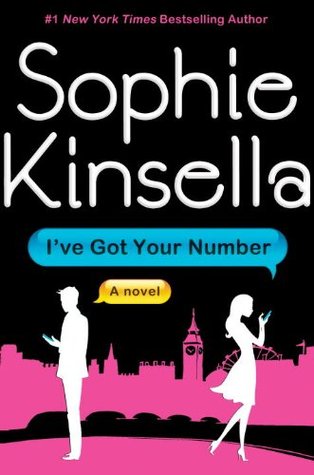
I’ve Got Your Number by Sophie Kinsella

[Hi Everyone! I started a class that goes on for a month (it’s for work) and the labwork is seriously cutting into my free time, which means less posting over here on the ol’ blog, at least for May. This class is crazy busy – it’s the pilot  so they’re throwing everything at us right now to see how much we can take. Thankfully there are no grades, but each lab has to be completed correctly in order to do the next one – which means homework that takes me 3 hours every frickin’ day. *shakes fist at instructors who cackle loudly as they give us our assignments*. But I STILL manage to squeak in some reading time, so there. ]
 
OK, review time.
 
Copy borrowed from my local library.
 

I've Got Your Number
Sophie Kinsella

The Premise: Poppy Wyatt was having a bad day. First she lost her engagement ring, the one that’s been in her fiance’s family for at least three generations. Then, her phone is snatched out of her hand by a passing thief on a bike. Now if someone finds her ring, they can’t call her to tell her about it! Frantic, salvation comes to Poppy in the form of a phone she finds tossed in the trash – a perfectly good phone that still works. She quickly tells everyone her new number, but then businessman Sam Roxton shows up. He says Poppy has his phone, and he needs it back. Desperate to find her ring and not to let her fiance Magnus or his intimidatingly intellectual family know it’s missing, Poppy gets Sam to reluctantly agree on a temporary deal – she will forward all his messages until she finds her ring. Of course, nosy Poppy can’t help glancing at a message or two as she forwards it to Sam, and pretty soon she’s giving him unasked for advice about his life and business, and Sam is helping Poppy out with her own problems.
 
Read an excerpt of I’ve Got Your Number here
 
My Thoughts: Sophie Kinsella is hit or miss for me. I either like her books OK, but not that enthusiastically (Shopaholic, Remember Me?), or I find them hilarious keepers (Can You Keep A Secret?). Sometimes they fall somewhere in between those two (The Undomestic Goddess). She’s an author who is perpetually on my “maybe” list. I’ve Got Your Number caught my eye because it looked like it had some of the elements that I liked so much about Can You Keep a Secret? (a quirky heroine, an alpha businessman, a plot with an amusing set of circumstances). I wasn’t sure about there being a potential love triangle, but when positive reviews from bloggers I trust came out, it gave me the push to get my hands on it. I’m so glad, because you can put I’ve Got Your Number in the keeper column now. It gave me what I wanted: a chick lit with a nice amount of getting-to-know-you time between characters, good romantic chemistry, and plenty of laughs.
 
Poppy narrates the story. I liked her. She amusing, but not so silly that I wanted to strangle her, and a pleaser, but not so accommodating that she becomes a complete idiot (I like to laugh, but not at the expense of my respect for the main character). Yes, Poppy has her moments, but I always understood where she came from, even if what she did was sometimes questionable. Plenty of people would peek at someone else’s emails given the opportunity, and who doesn’t understand keeping something quiet so they can themselves time to fix it? Of course, that Poppy is too afraid to talk to Magnus about losing her engagement ring says something about their relationship that she hasn’t admitted to herself, but that’s another issue altogether. Another is her fear of her soon-to-be in-laws, who intimidate Poppy with their genius level intellect. In Poppy’s eyes, the academic Tavish’s are so much smarter than her that she feels put on the spot when they ask her anything.
 
But what Poppy perceives and what the truth is are sometimes two different things – not just about her in-laws but about other people, including Sam. This is why the outside perspective of a complete stranger (like Sam) works out well for her. Similarly, Poppy’s nosiness starts off like it’s crossing the line, but it has its uses, which Sam finds out. There’s a lot of different elements of their lives in the mix here, and I really enjoyed how Kinsella managed to seamlessly tackle both the corporate politics of Sam’s world and the interpersonal relationship tangle of Poppy’s. There was something so addictive in following Poppy and Sam’s texts and emails and the breathless twists and turns that came from their fateful meeting. Everything manages to make sense in the end, and it worked out in a way that I was happy with. I had been worried about how the story would handle Poppy’s engagement while meeting another man, but that was tied up nicely. I felt that Kinsella made things romantic and even heady with anticipation at the appropriate times. And have I mentioned how hilarious the story is too? There is one part, Poppy and Sam’s second official face-to-face, that had me laughing so loud that my husband reports I scared the cat in the other room. It’s too long to excerpt here, but I tell you, it’s a scene I think about and grin like a fool. Instead, here’s a small example of the texts Poppy and Sam send back and forth. This is early in their relationship and you can already tell that there’s a familiarity forming between these two:

How will you explain missing ring?
I have a moment’s internal debate. What not get a second opinion? Lining up the screen carefully, I take a photo of my bandaged hand and MMS it to him. Five second later he replies.
You cannot be serious.
I feel a twinge of resentment and find myself typing:
What would YOU do then?
I’m half-hoping he might have some brilliant idea I hadn’t thought of. But his next text just says:
This is why men don’t wear rings.
Great. Well, that’s really helpful. I’m about to type something sarcastic back, when a second text arrives:
It looks phony. Take off one bandage.
I stare at my hand in dismay. Perhaps he’s right.
OK. Thx.

Overall: I really liked this one. I thought that I’ve Got Your Number had that perfect balance of hilarity and lightness with a page-flipping, not-always-expected plot while at the same time serving up the slow-burn of two strangers meeting and falling for each other over text messages and emails, shared secrets and experiences. I devoured it and sighed happily at the ending. I plan to eventually buy myself a copy for my keeper shelf.
 
Buy: Amazon | Powell’s | The Book Depository
 
Other reviews:
Smexy Books – B+
Emily and Her Little Pink Notes – “Kinsella at her best: fun & light & romantic & entertaining”
Book Harbinger – “I haven’t had such a fun reading experience since I read my first Julie James novel”
Clear Eyes, Full Shelves – 4/5 stars
Angieville – “a real charmer”

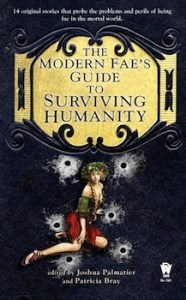
The Modern Fae’s Guide to Surviving Humanity by various authors, edited by Joshua Palmatier and Patricia Bray

The Modern Fae's Guide to Surviving Humanity
edited by
Joshua Palmatier
and Patricia Bray

This is an anthology of short stories that I bought while I was at Lunacon earlier this year. The concept behind each of the stories is how fae creatures may have adapted to modern times. I guess you can say all urban fantasy explores this idea, but these stories really focus on the clash of cultures and creative ways a square peg can fit into a round hole.There are fourteen stories in this book and I don’t plan to give away spoilery details to any of them, so this review is going to be really brief overviews and impressions of each story.
 
1) We Will Not Be Undersold by Seanan McGuire – This story centers around big-box store Undermart. Regular-guy Dan is an employee dating Nimh, one of the junior managers, and all is well until he begins to notice odd behavior at work. This was a quick, cute, tongue-in-cheek read and a good one to start anthology on a light note. It feels very different from what I’ve read from Seanan McGuire before. There’s something of a young adult air to it.
 
2) Changeling by Susan Jett – Marisol, a new mother distraught over complications during her son’s birth, discovers how the fae have adapted to New York when her midwife remembers just where she saw the birthing nurse before. A hero’s journey story that has a few familiar folktale elements and a thought-provoking ending.
 
3) Water-called by Kari Sperring – Jenny is some sort of water spirit or elemental that has fed on humans that have fallen into her canal for centuries. Lately the bodies have been leeched prior to their dumping and Jenny is forced to deal with the hunter infringing on her territory. This is a story set in the nighttime, with a main character that is far removed from human concerns and emotions. She is a predator — ancient and terrible. I enjoyed the tangible descriptions of the canal and its surroundings and everything to do with Jenny. Where this story went wrong for me was the ‘hunter’ character.
 
4) The Roots of Ashton Quercus by Juliet E. McKenna – Another story with fae as the protagonist, but this time with less predatory concerns than the last story. It is about a grove of dryads that have discovered that their trees are about to be razed for a new road. I liked the solution they came up with and how their group dynamics played out within the story.
 
5) To Scratch an Itch by Avery Shade – This time the fae in question is a little girl named Avery Sky who was told she had to abide by three rules, and one of them has to do with telling her parents if she ever got an itch between her eyes. This is what happens to Avery when the itch finally comes. This was a sweet story about childhood. I liked that the mystery behind the itch rule is revealed to the reader at the same time it is to Avery.
 
6) Continuing Education by Kristine Smith – Lee Kincaid is enrolled in an MBA program at the Old Campus of Monckton College, but her school’s professors are more than they appear to be. This was a mostly straightforward tale, but touches on the idea of the symbiotic relationship between the fae and humans.
 
7) How To Be Human™ by Barbara Ashford – A jaded “menopausal male fairy” uses his charismatic powers to make money off of self-help seminars. I liked both the premise and the link between power, age, and cynicism in the fairy world.
 
8) How Much Salt by April Steenburg – This is a story about a selkie named Dylan who is forced to go inland because of the way humans are encroaching on the sea shores. The story revolves around where he ends up. I was mildly amused by this one but wouldn’t have minded if it had gone further.
 
9) Hooked by Anton Strout – Hooked is the sort of story that changes as you read it. It starts off with a man knocking on a door because of a flyer, takes a little turn I wasn’t sure I liked, veers into something darker, and then twists and lands elsewhere. Hmm. The destination was OK, but I liked the journey there more.
 
10) Crash by S. C. Butler – A female trader hears a rumor about leprechauns on Wall Street and follows up on it. This left me with a feeling like I’d been gently nudged to imagine some twisted humor in some real world events.
 
11) Fixed by Jean Marie Ward – Jack Tibbert starts off as a cat and is taken to an animal shelter where trouble ensues. This was another story that felt decidedly YA since the narrator, Jack, is a teenage boy and definitely notices the teenage girl who picked him up. There was a good sense of urgency and action in this one, but I could guess where the story was going.
 
12) A People Who Always Know by Shannon Page & Jay Lake – A sort of cloak and dagger story that reveals political fighting between older traditionalists and younger upstarts among the fae. I always like stories that have something of a battle of wits in them so I liked where this went, but I wish there was more to this.
 
13) The Slaughtered Lamb by Elizabeth Bear – I think The Slaughtered Lamb was one of my favorite stories in the anthology in terms of the world building. It had that gritty UF style, and a New York City where magic overflow means there’s a “liaison between the real world and the otherwise one”. This is conveyed to us through the eyes of a transvestite werewolf with achy feet. I liked the characters more than what was actually going on, mostly because the action was quickly dealt with. The characters lingered longer. Yup, another I wanted to continue.
 
14) Corrupted by Jim C. Hines – This was (in my mind) the darkest of the stories, so this book closes on a very different note from which it began. A fairy whose job is protecting humans from those of her own kind, has to pay a high price to keep people safe. I thought this was very grim.
 
Overall: I think my reaction is on the middle ground when I look at the anthology as a whole. There were bits and pieces of each story that sparked my interest but I didn’t find a story that really burned itself in my brain. All of these stories stood alone just fine (if they were companion stories to a series, I couldn’t tell), but there were a few stories here whose worlds I wouldn’t mind revisiting – Elizabeth Bears’, Shannon Page and Jay Lake’s, and April Steenburg’s, in particular. Many felt complete and satisfying as they were (Susan Jett’s, Juliet E. McKenna’s, Barbara Ashford’s, Seanan McGuire’s and a few others), then there were the 3 or 4 stories that felt a little flatter than the rest. These focused on the premise of the fae creatures surviving among humans but I didn’t really notice other elements to them. The stories that incorporated some sort of growth and/or inner conflict, or conveyed the adaptation while telling a bigger story were the most memorable for me.
 
Buy: Amazon | Powell’s | The Book Depository
 
Links:
The Modern Fae’s Guide to Surviving Humanity website

About That Night by Julie James

Based on my love of Julie James’ first two books, Practice Makes Perfect and Just the Sexiest Man Alive, I’ve been continue to buy her books whenever a new one comes out.
 

About That Night
Julie James

The Premise: Rylann Pierce and Kyle Rhodes met in a college bar while they were both pursuing advanced degrees (she for law, he for a Ph.D. in Computer Science). They shared a walk home and a good night kiss, but life got in the way of anything more. That was it, until nine years later when their paths crossed again. Just starting her new job as an assistant U.S attorney in Chicago, Rylann is surprised to discover that her first assignment involves a motion to reduce Kyle’s sentence. Kyle, an heir to a billion dollar empire is now the infamous Twitter Terrorist who shut down the site for two days.
 
My Thoughts: About That Night is the third book in Julie James’ FBI/US Attorney series. The first book, Something About You (reviewed here: https://i0.wp.com/i58.photobucket.com/albums/g254/jayamei2/livejournal_com.gifhttps://i0.wp.com/i58.photobucket.com/albums/g254/jayamei2/wordpress.jpg) focuses on Assistant U.S. Attorney Cameron Lynde and Special Agent Jack Pallas, and the second book, A Lot Like Love (reviewed here:  https://i0.wp.com/i58.photobucket.com/albums/g254/jayamei2/livejournal_com.gifhttps://i0.wp.com/i58.photobucket.com/albums/g254/jayamei2/wordpress.jpg) focuses on wine store owner and heiress Jordan Rhodes and FBI agent Nick McCall. Cameron (book 1) is Rylann’s boss, and Jordan (book 2) is Kyle’s twin sister – but don’t let this discourage you from starting with any of the books in the series. The cameos from other characters aren’t gratuitous because they have real relationships with the main couple, but that doesn’t mean you need to know their backstories to understand what’s going on in About That Night.
 
What you may want to know before reading About That Night is that this book is a little bit different than the previous two in that there is not really a suspense plot. This makes sense – Kyle is a computer guy and businessman who made a huge mistake in bringing down a website used by millions. He’s not a FBI agent whose job it is to protect the heroine. So instead of a villain somewhere pushing our couple together, this book has a more straightforward contemporary romance plot. Boy meets girl. Boy asks girl out on a date. Boy doesn’t show up. Nine years later, Boy is thrown in prison for hacking Twitter, and Girl shows up at his motion to reduce his sentence…
 
The real conflict in the story is about who Rylann and Kyle are. Rylann is more of the Good Girl – she has a six-year plan, she knows what she wants to do, and she follows the rules and works her butt off to get what she wants. While Kyle is a computer whiz kid, and thus a bright guy, he’s also more impulsive and less sure about his direction in life. He’s sort of a Bad Boy what with his reputation with women and being an heir to a billion dollar empire. When she first sets eyes on him at a college bar, Rylann pegs him as more trouble than he’s worth, but he makes her realize that he’s more than he first appears to be. Unfortunately, circumstances prevent the two from getting to know each past that night. Fast forward nine years and the spark is still there, but Rylann is an assistant U.S attorney. She just started her job. She doesn’t want a tarnished reputation, and that is what she would get if she were to date someone surrounded by controversy like Kyle, not to mention that he’s an ex-con her office prosecuted.
 
Romantic suspense has never been my bag, so I was pleased that About That Night took a different direction and was just straightforward contemporary romance. One caveat: although this had an entertaining, comfort read quality, it was almost too straightforward. What I mean by that is that the conflict level was low. Yes, there is an issue with Rylann’s career versus her interest in Kyle, but this couple are grown-ups and deal with it in a grown-up way. I like this about them – I like characters that are adults and act like it, and Julie James always has characters that care about their responsibilities and careers and are good at what they do. It’s refreshing not to have silly overblown drama, but there is also a feeling like there’s no fire, no feverish need to turn the pages when everyone is so reasonable. Rylann’s conflict of interest was a minor dilemma, and the steamy sex scenes (at three, I think this is the steamiest James book yet) may have added ‘oomph’ for some readers, but threw me. Are these huge issues? Not really. What keeps you hooked instead is the genial writing and just how darn cute and compelling Kyle and Rylann are together. As I was reading, I was happy. It’s only now that I look back do I realize that the book was relatively even-keeled with little drama. How that will go over depends on who you are as a reader.
 
Overall: If you are looking for high drama and strife,  About That Night may not be the book for you. This is a low-frill, straightforward contemporary romance (with a shot of sexytimes) – a good comfort read and a solid Julie James book. While it wasn’t my favorite by this author, it fits right in the middle of the pack on my personal rating scale.
 
Buy: Amazon | Powell’s | The Book Depository
 
Other reviews:
Chachic’s Book Nook –  positive
Babbling About Books, and More – B+
The Book Pushers – B- and B (Joint review)
Parajunkee’s View – positive

24-hour Readathon – progress post

I didn’t expect to be up that early today, but I kept waking up after 5am, so I started early with the readathon at 7:30 – I’ve read a few more chapters of I’ve Got Your Number by Sophia Kinsella so far.  It’s pretty funny, there was a scene that had me laughing out loud last night.

Anyway, this is going to be my official Readathon post which will get updated throughout the day. I expect to read a good chunk in the morning, but I have shopping plans with the sister and then work to do this weekend so I don’t expect to be reading all day. I feel pretty relaxed about this readathon – I have no real goals for it! 🙂

hide

484 pgs read

9:00 am – I’ve read approx 80 pages in the last hour from I’ve Got Your Number by Sophia Kinsella. I’m starting Chapter 11 – people are running around and things are getting nailbiting!

i've got your number by sophie kinsella

11:00 am – Finished with I’ve Got Your Number. That was a good book, happy sigh ending. Peering around for food now – I had some oatmeal for breakfast but I’m feeling peckish. 174 pages added to the count for a total of 254.

1:30 pm   I took a bit of a break to eat half a pomelo and watch an episode of Friends. I just started Unearthly – about 37 pages in, but I don’t want to read the whole book today – I’d rather pace it so I can discuss with my readalong buddies. Total pages read = 291. The Husband is bringing me lunch from Panera soon and I will be going out with the sis after that.

unearthly by cynthia hand

6:30 pm – I’m back! I had lunch then went with my sister to Macy’s where she returned 5 pairs of shoes from 2 years ago and nearly killed me with her chuztpah. Then it was to Target where she looked at some earrings/necklace on clearance and nearly killed me with her indecisiveness (I made her buy the earrings). On the way home I had some nice tart frozen yogurt – quite refreshing in this hot day. Back to reading now, on page 70 of Unearthly. Total pages read  = 324.

9:30 pm – I read up to page 156 of Unearthly. I’m stopping there for today with that book, so I can pace it out for the readalong.  Moving on to another one soon. I TRIED to join in the Name that Book minichallenge but um.. yes, I fail – all the books I’ve guessed have already been guessed. Total pages read = 410.

11:30 pm – Read 22 pages of Attachments by Rainbow Rowell, but was getting very sleepy so I switched to my graphic novel, which was The Extraordinary Adventures of Adele Blanc-Sec and read 52 pages of that (and finished it off) – that one is the basis of this French movie I’m interested in seeing one day. Total pages read = 484

the extraordinary adventures of adele blanc-sec vol 1

midnight – I think I’m done! I have to wake up in 5 and a half hours, so it’s off to bed for me. 🙂

Are you participating in the readathon? If so, how is it going for you so far? If not, how’s your weekend so far?