Alright. So Angie reviewed Easy on Tuesday and by that evening I had bought the book, fully intending to hold on to it while I finished off other books I was reading. But then, I read a few pages. By lunch the next day I’d read the whole thing.
The Premise: Jacqueline Wallace is having a horrible sophomore semester in college. After 3 years together, her boyfriend Kennedy dumps her so that he can sleep with other girls. Two weeks after that, his frat brother Buck attacks Jacqueline in a parking lot and tries to rape her. She escapes only because a guy in her economics class was there. Shaken by the assault, all Jacqueline wants to do is to move on and act like nothing is wrong. She doesn’t tell anyone what happened, but Lucas, the boy who saved her knows, and suddenly she’s noticing him everywhere. To add to everything else, Jacqueline has missed two weeks of Economics because she was avoiding Kennedy and if she doesn’t make up the midterm she missed, she’s going to fail the class.
My Thoughts: Since I didn’t really look at any reviews besides the one before beginning Easy, I was genuinely freaked out by the first few pages. I didn’t know what would happen to Jacqueline, and I had a sinking feeling at the pit of my stomach when she walked to her truck and was suddenly pinned down from behind. I was relieved when a savior appeared, but after this incident I still worried since Jacqueline didn’t report Buck for the attempted rape. I’m putting that out there now for anyone for whom this would be uncomfortable with descriptions of sexual assault. My rule of thumb is not to discuss what happens after the first fifty pages of a book, so I won’t say whether things get darker for Jacqueline, but I will say that the first few pages with the attempted assault is at the threshold of what the reader actually gets to “see”.
As can be expected, Jacqueline wants to put the attack behind her. She has a lot of other things to deal with on top of her trauma. Besides getting over her breakup with Kennedy, tutoring upright bass, and working towards her music education major, she has to save her GPA by not failing in Economics. This means getting in touch with the class tutor, Landon Maxfield. As Jacqueline’s busy schedule would have it, she can’t make any of the face-to-face session with Landon, so instead they communicate by email, and what starts off as a formal interaction (“Mr. Maxfield”, “Ms. Wallace”), soon becomes a light flirtation (“I already looked forward to his name in my inbox, our back-and-forth banter”). At the same time, Jacqueline is also noticing someone else — Lucas, the guy who saved her from Buck. He sits in the back of her Economics class, sketching instead of taking notes, makes her coffee at Starbucks (he’s the barista), and shows up at the club to ask her to dance. He’s got a mysterious bad boy edge — lip piercing and tattoos, and girls coming up to him after class. At first seeing him makes Jacqueline relive that night, but after she’s noticed him, she’s drawn in, and it looks like the feeling is mutual.
Minutes before the end of class, I turned and reached into my backpack as an excuse to sneak a look at the guy on the back row. He was staring at me, a black pencil loose between his fingers, tapping the notebook in front of him. He slouched into his seat, one elbow over the back of it, one booted foot casually propped on the support under his desk. As our eyes held, his expression changed subtly from unreadable to the barest of smiles, though guarded. He didn’t look away, even when I glanced into my bag and then back at him.
I snapped forward, my face warming.
If you like romance with that delicious build-up of falling in love, where a couple’s addiction for one another is a force you can feel, this is probably a book you will like. Jacqueline is decidedly pursued over the course of seven weeks by a guy who says and does all the right things. I mean, this guy is good. Things begin with light touches and long stares and progress until the electricity is fairly crackling, but this guy is also respectful and not aggressive (mysterious too). When Jacqueline’s best friend and roommate Erin advises her to “make him chase you” that’s when things get interesting. And here’s when I get contrary. Yes, I was sucked in, but my own cynicism kept rearing its head. The male romantic lead here was too much of a fantasy for me, by all accounts some sort of dream guy, showing up at just the right time to boost Jacqueline’s confidence. I couldn’t stop myself from feeling disbelieving even as I raced to finish the book. It felt like there was so much going on with him that he unbalanced the story a little.
If Easy was just about the romance, I wouldn’t have liked this book as much as I did. I liked it’s depiction of college. This is not a book where the college setting is just icing — no, this story is permeated by its setting: dorm hallways as hangout areas, lectures with auditorium seating, lugging laundry to the basement, and equal parts study and being with friends. College life is shown with ups (like independence and intense friendships) as well as downs (like rumors and clique culture). The dialogue was particularly good — utterly natural and believable. I always felt like it captured the emotions of the moment.
I also liked Easy for being a story with a positive message. It put the blame of sexual assault where it belongs and had a proactive message to women as well. Those who blame the victim and support the abuser exist here, but are clearly not in the right. I loved the message of sisterhood and of women looking out for one another, and I was really invested in Jacqueline move upwards and forward from what happened. My empathy for Jacqueline made me cheer for all the positive things that came her way. This story wasn’t perfect (see above), but it was a good one.
Overall: An entertaining New Adult contemporary with a pro-female message. I quite happily was swept along by the easy writing style, the banter of the college set, and the electric romance. Even if part of me found Jacqueline’s hero too conveniently perfect to suspend my disbelief (he fell in that uncanny valley between an awesome guy and a god), I liked this one. Definitely worth the $3.99 I spent on it.
Other reviews: Dear Author – B+ Clear Eyes, Full Shelves – “I’m usually quite wary of self-published books, but Easy was worth the risk.” Angieville – “Highly recommended, especially for fans of Jessica Park’s Flat-out Love, Jennifer Echols’ Going Too Far, all things new adult, and just substantial, swoony contemporaries in general.”
The Premise: (blurb from publisher) “When Jacob Dawes is Selected for the Imperial Intellectual Complex as a child, he’s catapulted from the poverty-stricken slums of his birth into a world where his status as an unclass is something no one can forget, or forgive. His growing scientific renown draws the attention of the emperor, a young man Jacob’s own age, and they find themselves drawn to each other in an unlikely, and ill-advised relationship. Jacob may have won the emperor’s heart, but it’s no protection when he’s accused of treason. And fighting his own execution would mean betraying the man he loves.”
My Thoughts: Told from the first person POV, this had the feel of a memoir. I couldn’t tell what prompted this introspection, but I saw the story as three parts: Jacob’s early years at the IIC, his relationship with the Emperor, and the fallout from that relationship.
Jacob Dawes starts off as an unclass in Mexico City. His father, an abusive drunk, was Resettled years ago, leaving Jacob (or Jake), his mentally ill mother, and his toddler sister to fend for themselves. When he’s eight-years old, Jake’s intellect gets him selected for the Imperial Intellectual Complex (the IIC), so that he and a handful of genius children can serve the Emperor with their technological and intellectual advancements. It’s an honor to be chosen, but too poor to receive advance notice that this would happen, Jake is taken away from his family by unsympathetic servants of the Empire. At the IIC, his poverty and class keep working against him. He’s immediately singled out by the Director as a likely troublemaker and unworthy of being in the program at all. Shunned by many of the students and instructors, Jake struggles to prove himself, but he’s often the target of punishment and bullying. Eventually, he finds his niche in Physics under a kindly mentor, and after that he becomes a rising star with a series of breakthroughs under his name. By the time he’s fifteen, his advancements bring him to the attention of the young emperor, Rikhart IV, who is exactly Jake’s age. An unlikely relationship begins.
Jake and Peter (the Emperor) are on the exact opposite spectrum of the class ladder. At first Jake is in awe of Peter, but he quickly adjusts and sees Peter as another person – someone he likes. When Peter brings Jake along on a year-long tour of the Empire, the two have a chance to spend time alone. They begin a romantic relationship after an easy companionship (sex here is fade-to-black after some kissing and enthusiastic pushing). There’s not a lot of slow burn in their romance – their falling in love feels inevitable — but after they do, that’s where the drama really begins.
Class division is a big theme in this book. It’s clear from the start that although Fighting Gravity is set in a future where space travel is common, the social structure is traditional and hierarchical. While the Emperor has absolute power (so much so that the word “Emperor” is used in everyday phrases where we’d say “God”), merely being born as an unclass has made Jacob’s life a constant battle against the extreme bias of those around him. Jake resolves to be beyond reproach, he doesn’t always succeed, and his impulsiveness often overrules his self-preservation. His non-conformist attitude about class (reacting to the individual, not their status) is welcomed by some (such as the Emperor), but makes enemies of others.
I worried for Jake. He’s the underdog in Fighting Gravity, and while he is extraordinarily gifted, he’s also flawed. His biggest weaknesses involve impulsiveness and letting his anger overrule diplomacy. Jake sees how people react to his class, is annoyed, and just reacts instead of protecting himself and to soothing egos. He knows that the aristocrats have “quiet, unpleasant ends that didn’t involve petitioning committees” if they wanted to be rid of him, but he kicks the hornet nest anyway.
“Others may say what they think, but you cannot.”
“Oh no? And why’s that?” She heard the edge of anger in my voice because her eyebrow quirked.
“You know why. Because of what you are.”
The hot rush of anger spread from my head down through my fingers and toes. My fists clenched. “I thought you were different than them, Your Grace, but I guess I was wrong. I don’t get to have an opinion because I’m unclass? I should have known. You’re like the rest of them.”
The crack of her hand against my cheek left my jaw throbbing and my ears ringing.
“Stupid man. Yes, it is because you are unclass, and you know I do not think less of you for it. If I did, would I be trying to protect you?”
This was a character and relationship-centric story. A big pull of Fighting Gravity (once we’re past his time at the IIC), is the drama that unfolds from the volatile combination of Jake and his closeness to the Emperor. With Peter, who treats him as an equal, everything is wonderful, but that’s in private. In public, time and again, Jake just makes himself an easy target for others and makes decisions without telling his powerful lover. He gets threatened and tells no one, and then of course his enemies carry out their threats. I sped through the story in a matter of hours because I wanted to know whether Jake would be alright and if he could be happy with Peter. It was really frustrating though–Jake brought a lot of trouble on himself, but the hatred against him was unjustified too.
I really liked how much Jake’s class played a role in the story, but I also felt like Jake’s problems center on himself. He’s hated for being an unclass, but he’s oblivious to others with similar situations. When he does think of others not as lucky as himself, his attentions are too little or too late. I’m hoping that enlightenment in this area is being saved for later. I’d like to see how both Jake and Peter would approach the class issues in the Empire.
Another niggle I had was over the extremity of some of what Jake goes through. Despite being caught up in what was going on, a romantic gesture and some painful punishment still felt over the top to me. I found myself asking “did they really have to do that?” at certain scenes. I’d have preferred more nuanced consequences for Jake, even if the angst and drama had me flying through the pages. I preferred the subtler moments, like those between Jake and his assigned servant, Jonathan. There was the suggestion all is not as it seems in that area, and I’m curious where it will go in the next book. Well, if there is a next book. Fighting Gravity didn’t end with a cliffhanger, but it did feel like Jake’s story wasn’t over.
Overall: Fighting Gravity is a science fiction romance styled as a memoir about a poor unclass boy (Jake) whose genius intellect brings him out of the slums and into the path of the Emperor. They fall in love, but there are consequences because of deeply engrained beliefs about class hierarchy. Overall I thought this was a well-written, emotionally gripping type of read that went down easy. It may not have knocked my socks off because I wanted the class issues further developed, but I can see others not having that issue, and at $2.99 for the ebook, it’s worth giving it a go. Recommended for those looking for a coming-of-age type of SFR.
Buy: Amazon (kindle) | Dragon Moon Press (epub/kindle)
(paperback is also available at the above sites and B&N)
Other reviews:
My blogging buddies haven’t read this one yet.
While reading The Cloud Roads by Martha Wells I was reminded of how much I enjoy stories with a floating island in them. It doesn’t seem to be a really common trope, and it got me digging into my bookshelves to find instances of it.
Endless Blue by Wen Spencer:
(There’s a floating island on the cover, but it’s obscured by the author and title)
A newcomer sees a floating island for the first time:
Floating landmasses, like the one they had hit, dotted the sky. One plowed through the clouds, roiling the white into a gray. Lightening flickered in the tight knot of polarized air, like a storm inside a bottle. That island was a wedge of stone, perspective obscuring its topside. An island farther in the distance, though, showed a crown of thick green. He would only see the top of the island if it was traveling up a curve.
A local worries it will destroy her boat:
“Orin, have you figured out which vimana it is?”
“It’s — Icarus — I think.” He pushed his work towards her to confirm. “This is where we are.” He tapped the glass covering their chart, their position marked in grease pencil. “There are twenty vimanas on this orbit band. Only one crosses zero around this time. Icarus.”
She turned the book so she could read the detailed listing. Like most vimanas Icarus was roughly boat-shaped with the tapered bow cutting the wind. It was the stern of the landmass that they needed to worry about. Icarus was sixty miles wide and a hundred miles long — one giant sized rain-collector. the overflow poured down off the back end of the vimana in a mile high waterfall. If they were hit by it, nothing on the Rosetta would survive.
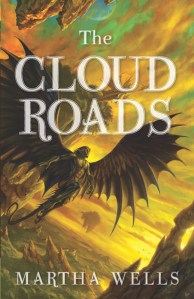
The Cloud Roads by Martha Wells:
(nice floating islands behind the Raksura on the cover of The Cloud Roads)
The floating islands of The Cloud Roads by Martha Wells hold mysterious ruins of old civilizations on them:
Moon turned back toward the sky-island where it floated in isolation over the plain. He pushed himself higher until he was well above it.
He circled over the island. Its shape was irregular, with jagged edges. It had been hard to tell how large it was from the ground; from above he could see it was barely four hundred paces across, smaller than the Cordans’ camp. It was covered with vegetation, trees with narrow trunks winding up into spirals, heavy falls of vines, and white, night-blooming flowers. But he could still make out the round shape of a tower, and a building that was a series of stacked squares of vine-covered stone. There were broken sections of walls, choked pools and fountains.
He spotted a balcony jutting out of curtains of foliage and dropped down toward it.
The Death Gate cycle by Margaret Weis and Tracy Hickman:
(the floating islands can only be seen on the back side of this cover, which you can check out here– it took a lot of googling to find that online)
In the Death Gate Cycle by Margaret Weis and Tracy Hickman has several worlds created by a Sundering. Arianius, Realm of Sky, is where the first book, Dragon Wing is set. It has floating islands all over, on three different levels – the High realm, the Mid realm, and the Low realm. These islands are vast, and dragons or flying ships are used to fly between them.
All the floating isles in the Realm of Sky are composed of coralite. The secretion of a small, harmless, snake-shaped creature known as the coral grubb, coralite is spongelike in appearance. When it hardens, it is as strong as granite, though it cannot be cut and polished. Coralite forms very fast; structures made out of the substance are not built so much as grown. Coral grubbs give off a gas that is lighter than air. This keeps the isles suspended in the sky, but can be a nuisance when attempting to construct buildings. The magic of first-house land wizards is necessary to remove it.
Coralite gives off a faint blush of light, causing strands of forest to show up black against the silvery radiance of the ground. Landmarks were easy to locate. Castles or fortresses made of coralite that have not been covered over with a paste of crushed granite gleam softly. Towns, with their shining ribbons of coralite streets, show up easily from the air.
Can you think of other books with this trope in them? I already have my eye on The Floating Islands by Rachel Neumeier, but I don’t know what else is out there.
Just to be clear: the floating island is different from say a floating castle or other man-made floating thing (like the moving castle in Howl’s Moving Castle or airships in many books).
I was having such a good time reading The Cloud Reads that I was voicing aloud my need for The Serpent Sea before I was finished. I asked, and the Husband answered by gifting me with a copy on my birthday. You could read this book before the first, but I’d recommend you don’t because there’s character growth that’s more rewarding when the books are read in order.
My review of book 1, The Cloud Roads can be found here:
**** This review may contain spoilers for the first book!! ****
The Premise: Finally orphan Moon has found a place for himself in the Raksura colony of Indigo Cloud. He’s still adjusting to being a Consort and all that entails, but in the meantime, the Indigo Cloud court is moving. The influence of the Fell has reduced their numbers and poisoned their home, and now Indigo Cloud is returning to the great tree that they left, generations ago. Unfortunately, when the colony arrives at their tree, they discover that a vital part of it has been recently stolen: the seed at its heart. Without it, the tree will die and Indigo Cloud would be left homeless and vulnerable. The colony needs to find the stolen piece before the damage is irreversible.
My Thoughts: The Serpent Sea begins almost where The Cloud Roads left off: with Raksura of Indigo Cloud traveling to their ancestral home via flying boat. It’s been a long journey and Moon and the rest are eager to finally be at their destination, but when they land, the great tree doesn’t feel quite right. It’s not long before they discover the reason why. Someone has come into the tree and stolen the seed at its heart. Of course this now puts Indigo Cloud back into peril again — without a home, they’re vulnerable. The other nearby Raksura colonies may accept their return to their tree, but they wouldn’t necessarily tolerate Indigo Cloud settling in other territory.
As with The Cloud Roads, I loved the fantastic landscapes of The Serpent Sea, especially when it came to the places that the people of the Three Worlds lived. Every one seemed more amazing than the last. It really felt like anything goes here with building places to live. It begins with the colony’s new home amongst the mountain-trees, with branches that interweave to create platforms for smaller trees to grow:
“It grew darker, the green-tinted sunlight muted as clouds closed in high above the treetops. The drizzle turned into a light rain that pattered on the deck. The platforms of the suspended forest grew wider and more extensive. Many of them overlapped, or were connected by broad branches, with ponds or streams. Waterfalls fell from holes in some of the mountain-sized trees. Moon wondered if the water was drawn up from the forest floor through the roots. It was like a while multi-layered second forest hanging between the tree canopy and the ground, somewhere far below.”
The quest for the seed leads them to other settlements, including the one shown on the cover — a city built on a giant water-monster (!!!) that swims in a large body of water named the Serpent Sea. These are great settings but there is some thought behind them: why people chose to live in these places, and how it affects them are considerations that aren’t omitted from the story. As you’d expect there are also new creatures introduced as the Raksura travel to find the seed for their tree, but there’s no revisit from races encountered in the last book. This may be to underscore how far the colony has traveled, or how isolated populations become from one another because of the difficulty of travel.
I was fascinated as usual by the variety and differences in cultures, but this story doesn’t forget the Raksura themselves. I continue to enjoy how Raksura society is conveyed through Moon’s experiences.
At this point Moon is no longer the newcomer and his actions have granted him some respect. When the colony decides to search for the missing seed, he’s part of those plans, but he’s still settling into his new role as a Consort and he’s not always confident in that role. In the meantime there’s still some tension between the queens, Pearl and Jade. These types of adjustments don’t happen overnight, and The Serpent Sea reflects that.
There’s an implied system of hierarchy based on birth and an internal ranking system and it is fun to see where certain Raksura placed. I loved that this was a society where women were leaders, and queens are expected to be more aggressive than consorts. There’s a scene in particular (towards the end of the book), that illustrates this point and had me cheering. There are some developments that shed light on the history of Indigo Cloud as well as some eye-opening interactions with other Raksura. I also enjoyed learning a little more about the magical abilities of the mentors. I would love to learn more, and I hope the unique situation that Chime is in (he’s the only Raksura known to have changed from a mentor into a warrior) gets more attention in the next book.
Most of my reaction to The Serpent Sea is positive, but I had one (probably unfair) issue with it. The Serpent Sea is basically a quest story. The goal from the beginning is clear: Indigo Cloud Court wants a home and to have one they must have their seed. Because of this, to me, the plot felt a lot simpler than The Cloud Roads. Since Moon’s past and Indigo Cloud Court’s problems with the Fell have been cleared up, the focus is now on Indigo Cloud Court resettling. The quest for the seed has it’s complications and there are bumps along the way, but I didn’t feel as though there was as much that was unexpected. I feel like I’m being a tough critic with that that reaction though. In other ways, The Serpent Sea shines. It delivers just as rich world building and gripping action as the first book did, and it continues Moon’s personal journey in a believable way.
Overall: I think part of me compares this with the first installment and wants something more complex than a quest story, but when I put that quibble (which I feel very few people would share) aside, The Serpent Seas is very enjoyable and shows the same imagination (the world building in these books is amazing) as the previous book. This is well-written fantasy and has an incredibly creative, visual story-telling style.
I will be reading the third book, The Siren Depths, which is out in December and has artwork, but no cover yet.
OK, as a lot of book bloggers are aware, Book Expo America (BEA) is a huge trade fair for the book industry. Every year librarians, authors, book sellers, publishers, and other book-related professionals gather to network, attend panels, do business, and pick up new books.
Can you believe I’ve been going to BEA since 2009? That makes me sound like an old hand, but every year I get very excited the night before and can barely sleep. This year was the same, but at least this time I was able to sleep fine after day 1 (which was the BEA Blogger Con). I am clearly getting used to this. The one big difference for me this year was in the number of books I picked up at the BEA floor. I’ve finally gotten to the point where (gasp!) my willpower is stronger. I think in the past I’ve had the “well, it’s free and maybe I’ll like it” mentality. This year I was tough! I was strong! Most of the books I got were ones I was really excited to read, and so I think my average was 9 books each day. It was 20 books per day in the past.
Magisterium by Jeff Hirsch – One of my two impulse pick ups for the day. It was so shiny. “On one side of the Rift is a technological paradise without famine or want. On the other side is a mystery” — sounds vaguely dystopian.
The Ruins of Lace by Iris Anthony – this was my other impulse pick up for the day. I just love the cover. It’s a historical fiction surrounding the illegal lace trade of the 1600s.
The City’s Son by Tom Pollock (signed) – The blurb sold me with these two lines: “graffiti artist Beth Bradley is looking for sanctuary. What she finds is Filius, the ragged and cocky crown prince of London’s mystical underworld.” – Mystical underworld? Cocky crown prince? Yes!
Full Blooded by Amanda Carlson – A new urban fantasy with a werewolf protagonist.
Paris in Love by Eloisa James – this is a autobiography that was in the goodie bags at the Random House breakfast. I actually didn’t pick up a goodie bag (tough executive decision), but another blogger was going through their bag and gave this to me.
The Killing Moon by N.K. Jemisin (signed) – one of my most anticipated fantasy books of this year.
Throne of Glass by Sarah J. Maas (signed) – teenaged assassin fights as royal champion until a new royal assassin can be chosen.
Eventide by Tracy and Laura Hickman (signed) – Sounds like a fantasy version of 1001 Nights with a dragon instead of a king. Also – that’s right, I met Tracy Hickman of Dragonlance fame!
Breed by Chase Novak – Horror, so a gamble for me. Adore the tactile, rubbery feel of this cover though
Saving June by Hannah Harrington – YA roadtrip and loss story. I won this on Pirate Penguin’s Reads and Sandy handed it to me while I was at BEA. 🙂
TIME WITH BOOK BLOGGERS
While new books are nice, the highlight for me really was seeing old and new book blogger faces. I mentioned meeting some bloggers at the BEA Blogger Con, but unfortunately, while I kept tweet-asking certain people where they were, it was difficult to go find and socialize with them. Some people were simply going to BEA rather than the BEA Blogger Con. The way to go turned out to be exchanging cell phone numbers and texting people to find out where they were (and I’m thankful I have Verizon – better reception at the Javits than other carriers).
I don’t know if I can name every person I saw and met for the first time so I’m sorry in advance for forgetting some people. I enjoyed texting with Sandy of Pirate Penguin’s Reads while both of us were commuting in by train and finally meeting in line for an autographing. I ran into Memory (Stella Matutina), Grace (Books of Love), Jessica (Read, React Review), Jane (Dear Author), Ana and Thea (The Book Smugglers), and Elizabeth (Gossamer Obsessions) a few times. Holly from Book Harbinger and Angie of Angieville and I had a good bowl of ramen after the BEA Blogger Con, and I saw them a couple more times on the floor. I also spent a few hours with Kristen of Fantasy Cafe – just sitting and relaxing for a bit. Later we had an adventure walking in the rain with a bunch of books and one umbrella. I finally got to meet Heidi of Bunbury in the Stacks (texting – the way to go) while we were in line for N. K. Jemisin’s signing (and discovered we were in at least 3 other lines together). I met a few people at the Apocalypsies event as well. I reconnected with Romance lovers Kate (Babbling About Books and More), @nystacey, @KwanaWrites, and @marireads. Christine from The Happily Ever After came into the city and carved out time for a snack with Kristen and me before we had to head out for the NYPL event. And I also finally met Lisa of Starmetaloak at the Random House Breakfast and got to mingle with her there. I also met new-to-me bloggers Donna (Bites) and Grace (Books Without Any Pictures).
RANDOM HOUSE BREAKFAST
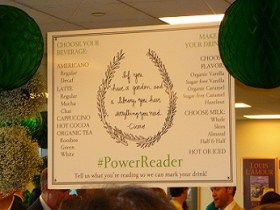
On Wednesday morning was the Random House Power Reader Breakfast. I have to say I was really impressed. The event space was really lovely, and the food was amazing (there was even a coffee station) – I couldn’t help comparing it to the breakfast at the BEA Blogger Con, and Random House came out looking better by leaps and bounds. There were short speeches by Nate Berkus (The Things That Matter) and Charles Duhigg (The Power of Habit). I thought they were both speeches that were respectful and not pushy towards book bloggers. There were probably 100 book bloggers there and we got to socialize amongst ourselves as well as talk to Random House authors, editors, and publicists. I took several pictures, but Random House has a more lovely set on Pinterest here.
READINGS AT THE NYPL
Wednesday evening the New York Public Library hosted a “Science Fiction, Fantasy, and Musical Improv” from 6pm to 7:30pm at the Stephen A. Schwarzman Building. The website said: “Join Lev Grossman for an evening of literature and lyrics, featuring readings by Kristin Cashore, N.K. Jemisin, Naomi Novik, and Catherynne M. Valente”. Thank you to Kristen of Fantasy Cafe for giving me a heads up on this! There were a few things going on in the evenings after BEA but this was definitely on my to-go-to list.
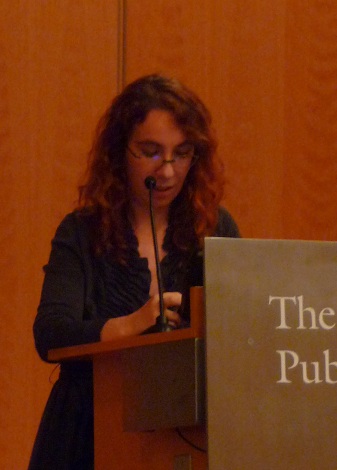
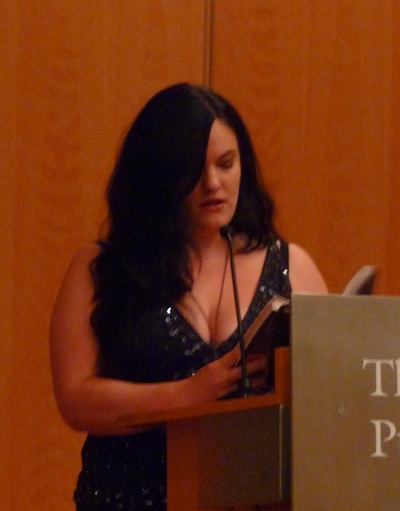
I was expecting a crowd but the auditorium had a surprising amount of empty seats given who was speaking! It was a really nice evening. Lev Grossman introduced the authors after a nice speech in honor of Ray Bradbury’s passing, and then we were treated to readings set to live improvised mood music! Kristin Cashore, N.K. Jemisin, and Catherynne M. Valente read from their just released or to-be-released books (Bitterblue, The Shadowed Sun, and The Girl Who Fell Beneath Fairyland respectively), and Naomi Novak chose to read from the first of her Temeraire books (His Majesty’s Dragon). Afterwards, there was a nice question and answer session. I really enjoyed it and am still not over the fact that there weren’t more people there!
And those were the highlights of Tuesday and Wednesday of BEA for me this year. I went back to work on Thursday so I missed that day, but.. yeah, I am spent.
I requested Seraphina from Netgalley because the summary mentions dragons that fold “themselves into human shape”. Shapeshifters in the fantasy genre is something I’m still thrilled by, even though I should have my fill already in urban fantasy. Not sure how, but it’s different I tell you. Other things that also drew me: tensions between humans and dragons, a heroine trying to hide a secret while working beside a “dangerously perceptive” prince, and the great blurbs by Naomi Novik and Tamora Pierce. Not to mention some very tempting book reviews.
The Premise: (taken from goodreads) “Four decades of peace have done little to ease the mistrust between humans and dragons in the kingdom of Goredd. Folding themselves into human shape, dragons attend court as ambassadors, and lend their rational, mathematical minds to universities as scholars and teachers. As the treaty’s anniversary draws near, however, tensions are high.
Seraphina Dombegh has reason to fear both sides. An unusually gifted musician, she joins the court just as a member of the royal family is murdered—in suspiciously draconian fashion. Seraphina is drawn into the investigation, partnering with the captain of the Queen’s Guard, the dangerously perceptive Prince Lucian Kiggs. While they begin to uncover hints of a sinister plot to destroy the peace, Seraphina struggles to protect her own secret, the secret behind her musical gift, one so terrible that its discovery could mean her very life.”
My Thoughts: This story starts with Seraphina.
“I remember being born.
In fact, I remember a time before that. There was no light, but there was music: joints creaking, blood rushing, the heart’s staccato lullaby, a rich symphony of indigestion. Sound enfolded me, and I was safe.
Then the world split open, and I was thrust into a cold and silent brightness. I tried to fill the emptiness with my screams, but the space was too vast. I raged, but there was no going back.
I remember nothing more; I was a baby, however peculiar. Blood and panic meant little to me. I do not recall the horrified midwife, my father weeping, or the priest’s benediction for my mother’s soul.
My mother left me a complicated and burdensome inheritance. My father hid the dreadful details from everyone, including me. He moved us back to Lavondaville, the capital of Goredd, and picked up his law practice where he had dropped it. He invented a more acceptable grade of dead wife for himself. I believed in her like some people believe in Heaven.”
Not surprisingly, my first impression of Seraphina was that she is an odd duck. Clearly there’s something strange about her for remembering her birth, and the inheritance she alludes to. Then she tells us that her father has told her time and again that to stay safe she must stay under the radar. That her secret, if discovered, would mean her death. Only a select few know it, among them her father and Orma, a her music tutor (who happens to be a dragon). But Seraphina can’t help herself. She doesn’t want attention, but she is herself. Despite her best intentions, Seraphina stands out. Her prodigal musical talent is difficult to suppress, and after she’s noticed for that, it’s hard to forget her.
When the story begins, Seraphina has been court composer’s assistant for two whole weeks. Two weeks of rushing to be ready for the kingdom’s forty year celebration of the treaty with the dragons where the Ardmagar (the dragon equivalent of a king) is scheduled to make an appearance. Then Prince Rufus is found dead during a hunting trip. He was decapitated, and whispers that a dragon is responsible begin to be passed along. Things are difficult enough with the peace without these new rumors — many Goreddis still fear the dragons and worry about Goredd disbanding the knights who practiced dracomachia (a fighting technique used specifically against the dragons).
Seraphina thinks something is about to happen because of Prince Rufus’s death. She isn’t sure what, but she wonders who really killed the Prince and why. Seraphina’s position within the palace gives her special access to the royal family and she tries to keep an eye out for possible threats. She devises her own ways of finding things out, often finding herself face-to-face with Prince Lucian, head of the guard, as a result — and he proves a little too smart and nice for Seraphina’s comfort (especially since he has a fiancée). In the meantime, she also worries about her tutor Orma and the ominous message he received at the Prince’s funeral. Interwoven with that is Seraphina’s own issues with keeping her secret — her flute solo at the funeral moved everyone to tears and of course made her noticed. I’m half tempted to say what Serphina’s secret is in this review (it’s a big part of her character), but I am not sure it’s exactly revealed in the first fifty pages and the blurb dances around it. Let’s just say it is a great secret for storytelling. There’s a lot of little anecdotes about Seraphina’s past and how they relate to her secret all while everything else is going on. Her struggle to understand her mother (who died at childbirth) is a big part of Seraphina’s ruminations. If that isn’t enough, there’s also this strange mental garden that is tied to Seraphina’s secret.
Maybe that sounds like a lot of odd little threads, but these things are related in a smooth and interesting way. This is the type of world building that you sink into and while it has that medieval, city-built-around-a-castle setting that a lot of Fantasy has, much of the world felt fresh and new to me. The highlight was that dragons can shapeshift into people. What I loved about this that is in Seraphina, becoming human is a truly alien experience for a dragon. They can’t really deal with a new body that sometimes makes them feel and think in ways dragons aren’t supposed to. They needs Censors to make sure they don’t go insane – which in their culture, is when a dragon allows emotion to overrule logic. Dragons literally have memories of such a distasteful lapse scrubbed away. Of course, with the dragons so concerned with being dragons and keeping themselves apart from what they think of as human weakness, they also stay unknowable to their human allies who say they have no souls. There’s so many little details like that that are thrown in here. Seraphina knows more about dragons than most people so she bridges the cultural gap in her narrative. Tidbits about dragon and human relationships are dropped as needed throughout the story (not to mention the cultures of neighboring countries Porphyry, Samsam, and Ninys), and they fascinated me. I couldn’t get enough of the meeting of different worlds.
The other thing I really loved about this story were the characters. Seraphina was my favorite. She has more than one facet – sometimes quiet and a bit grumpy, sometimes scared and secretive, other times just fierce and brave. She starts off as a sixteen year old girl who wants to blend into the walls, but as the story progresses her chutzpah shines through as she throws herself into stopping anything from ruining the treaty. I loved this, but I also loved her vulnerability because she has the daily anguish of hiding her true self. And let’s not forget the secondary characters. First of all: Prince Lucian – my goodness, the awesome interactions he and Seraphina have! There was something a little fun about how they both surprise each other, and I can’t wait to see how their relationship develops. Then there’s Seraphina’s father, who tells her to stay unnoticed every chance he gets, but who does so because of his fear for his daughter; Orma, who is a dragon and who has always seemed distant, but who Seraphina still trusts and loves; even Princess Grisselda, granddaughter of the current queen and Lucian’s fiancee proves to be more complicated than she initially seems.
Overall: You know those books that kind of make you excited because you read them and think, “This is right up my alley! This book has things I find awesome in it!” ? Seraphina is one of those books for me. I just want everyone who likes Fantasy with girls doing stuff (and dragons!) to read it already. The characters! The world building! Have I mentioned the shapeshifting dragons?! Alright, I get that not everyone loves YA Fantasy and books with a drop of romance, but if you like that sort of stuff, just a little bit? If you like the quality and creativity of Robin McKinley, Megan Whalen Turner, and Diana Wynne Jones? Then maybe you should try this one.
[Note: If you aren’t a book blogger, feel free to skip this post. It’s long and probably only interesting to a certain group of people who read my blog]
I have been an attendee at the Book Blogger Convention since the very first one in 2010. My posts on these can be found under the “book blogger convention” tag, otherwise look at:
Usually I’ve enjoyed the Book Blogger Convention (BBC). It’s been an event surrounding book blogging and I’ve meet a lot of bloggers there and had a chance to listen in on panels where different book bloggers discussed a particular topic. Sometimes I don’t agree with something a panelist says, but that’s to be expected. I still felt like I came away with a better understanding of how others blogged about books and felt more rejuvenated about book blogging. It was also a fantastic deal: $90 for the first book blogger con, $120 the next. This included a pass to the BEA floor for the rest of BEA. The first year registration was with Paypal and the organizers set it up so BEA issued me a pass, the second year I was instructed to sign up directly through the BEA website, where I was identified as Non Editorial/Media when I signed up with the Book Blogger Convention.
This year, I didn’t have the same positive experience.
REGISTRATION HELL
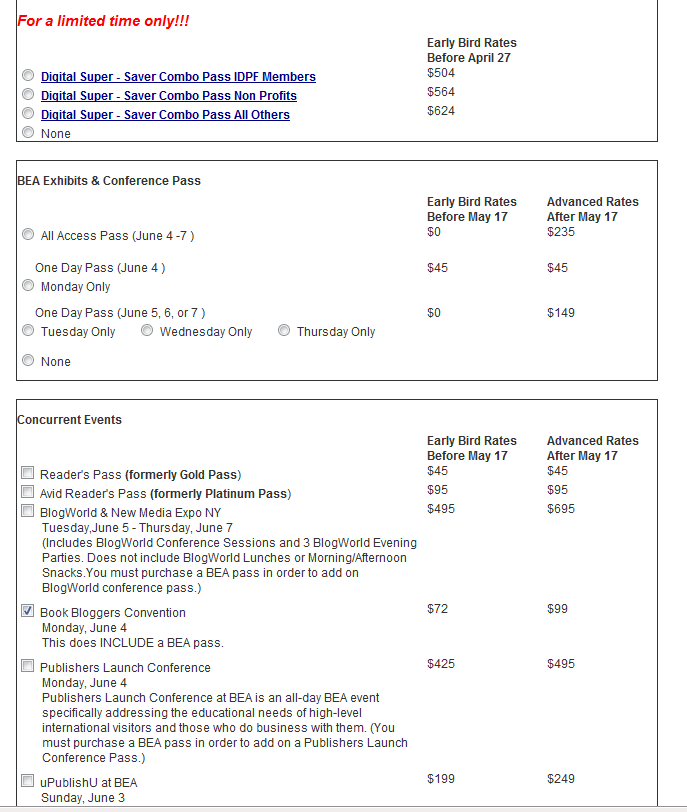
I think my discontent started early, with registration. At the end of January, it was announced that Reed Exhibitions had bought the Book Blogger Convention. This was a surprise to many, and bloggers wondered what it meant to the BBC. I didn’t have any expectations one way or another, but I was soon feeling the repercussions of the buyout. I was on twitter right after the announcement, and another blogger was complaining about issues with understanding how to register. Thinking I’d be helpful, I tried to register myself. I went through the BEA website, through the regular registration, as I had last year. I selected Book Bloggers Convention, and the form said the early bird rate (before May 17th) would be $72 and “This does INCLUDE a BEA pass”. I also said I was Non Editorial Media, which I assumed I should, like last year, on another page during the registration process. Here’s a screenshot I made for part of that:
I was shocked when I got to the payment part of the process and it said I owed $65 for the BBC, and another $159.00 on top of that for being non-editorial/media, for a grand total of $224.00, which is almost twice how much it cost last year. On top of that, why did I have to pay the $159, when the BBC is supposed to include BEA? Other bloggers on twitter informed me they only paid $65 for their registration, but they had registered before the announcement that the BBC was bought. I thought that there had to be a mistake.
So then I located the number for customer service and called them. I explained my issues and wondered why I had to pay for being non-editorial/media on top of the BBC cost, when it said BEA was included. I asked if I should have gone through the press registration (which was on a different part of the website), because apparently that would have been $0 on top of the BBC cost. The woman I spoke to wanted to know how big my blog was – how much traffic did I get? I told her it shouldn’t matter because I was still a book blogger and last year, my traffic wasn’t an issue to getting into a conference about book blogging access to the floor was included in the price. I also told her: book bloggers are people who post their opinions on the Internet. They will not be happy if BEA was saying a big blogger got to pay less for an event and a small blogger had to pay more. She said she would talk to someone, took my number and promised to call back before the end of the day. She never called. This was Friday, and customer service was only available during working hours, so I got to stew all weekend before I could contact another representative. I also loved how I had to call while I was at work myself.
Also notable: I had to point out another huge error in their registration pages – the BEA website said the Children’s Breakfast was on Wednesday, the registration had it listed on Thursday. They fixed this quickly, but as for my registration? It took me almost 2 weeks and several phone calls and emails to Reed. As I said, this was during my work hours, and it did impact my mood and productivity to be calling BEA or waiting for them to call me back. In the end, there was so much confusion that they had to make an announcement on their BEA news blog. The price would be $135 for book bloggers, and this would cover the BEA pass. But since when I had tried to register the price was wrong, and that since I saw the price as $72, that’s what they would charge me. I had to jump through an extra hoop, filling out a form and faxing it to them (I ended up emailing them a PDF because who has a fax?) in order to get this price. I know I could have argued for $65 since I saw that too, but I was tired. I honestly debated just paying the $135 everyone else seemed to be, but after all the grief I had gone through and images of my mother smacking me for not knowing the value of money, I took the discount. At this point, I considered writing up a post on how to register for the BBC (at that point rebranded as “BEA Bloggers Conference”), but I thought BEA had fixed most of their issues and I didn’t want to revisit the whole thing because it just annoyed me thinking about it. I had people tell me that they saw the issues I was going through (I was ranting on twitter for some of it) and it made them wait till Reed had their registration straightened out.
STRANGE PHONE CALLS, ASKING FOR STATS, and the UNCON
On March 20th I got a voicemail message on my home phone. It was from a PR representative asking me to blog about a religious/spiritual book. I was shocked that anyone had my home phone number to market a book. The only place I could think of that I gave my number to in relation to book blogging was BEA, but in the past I’ve only gotten junk email because of signing up. I wasn’t sure it was BEA who passed along my phone number, and when I asked on twitter if anyone else had this experience, no one replied that they had. I was half-tempted to call the PR firm back to ask where they got my number, but didn’t. I saw a post somewhere where BEA denied they gave out bloggers numbers, so I didn’t pursue it. Last month I heard more that more bloggers were getting calls, and they were told the PR firm got their number from BEA. I went to look for the post I thought I saw, I couldn’t find it. I pointed a fellow book blogger at an opt-out I saw on the BEA form I filled out. I still don’t know what to think about the phone call I got and if BEA really handed out book bloggers contact information to PR firms.
From the comments on twitter in March and April I saw a lot of people were having issues with registering. People who had registered as press were being rejected 2 months after they had applied. These included big name blogs. The very first BEA I went to in 2009, I went as press and had no problems whatsoever. I wasn’t asked about stats and got into BEA for free. Of course I have no problem paying for BEA and the Book Blogger Con, and I have for the past 2 years — as long as I was paying a reasonable price. I don’t like the idea of different prices for different people just because you were lucky enough to register before the announcement that the BBC was bought, or that you have a blog with some number of hits that the organizers thought was an acceptable number.
Because of my experience, I was considering the Book Blog UnCon when I found out about it. An “uncon” to my understanding is a convention where there is a free-flowing structure and attendees create the panels. This appealed to me, but after all the trouble getting registered for the BEA Blogger Con, the thought of calling Reed’s customer service again to cancel my registration made me recoil. I decided to try to forget what I’d been through and just see how the official BEA Blogger Convention was.
THE BEA BLOGGER CON ITSELF
Arrival and Breakfast
I arrived a couple minutes after 8:45am because I went to the wrong wing at first. When I arrived there were goodie bags and some books for the taking. I believe the books in the bag were by the authors who were at the author networking breakfast and lunch. This is what I got:
The breakfast was continental (muffins and bagels and some fruit). I looked at the networking list for breakfast and saw no authors from the genres I usually blog about. The closest thing was Dystopian, but I felt that YA bloggers would rather have those tables than me. They didn’t distribute the authors very well either. Few tables had 4 authors (see table 9), some had 3, and these were grabbed early. Many tables had just 2. When I got there, I realized that there were probably over 30 tables and there were only 24 tables in the list, so many tables didn’t have authors at all. Thankfully, I was enthusiastic about meeting William Joyce because I had watched and loved his short film, The Fantastic Flying Books of Mr. Morris Lessmore, and it just won the Oscar for Short Film (animated) this year, so I ended up sitting at a table that he would be visiting and thoroughly enjoyed meeting him, despite the short visit. I also liked the other author who stopped by, Lee Woodruff. Even though her book sounded like it is a heart-wrencher, I appreciated hearing her thoughts about why she herself enjoys reading that type of story, even during hard times.
Also thankfully: I did manage to sit with bloggers I know (Angie and Holly), and their company saved a lot of the day for me. Holly is a blogger I talk to a lot online, but never met, I also was able to meet Jane from Dear Author, Jessica from Read, React, Review, and Elizabeth from Gossamer Obsessions for the first time, and I saw Ana and Thea from the Book Smugglers, Charlotte from Charlotte’s Library, Kate from Babbling about Books, and More, and Kristen from Fantasy Cafe. I met a few other new faces at our tables and would have liked more time just meeting other book bloggers, but this was difficult to do during the author networking.
Opening Keynote:
I think the best thing would be to have the video of Jennifer Weiner’s keynote and her Q&A here:
The text of Jennifer Weiner’s speech can be found here.
Blogging Today: What you need to know and what’s next This was a panel moderated by Zoë Triska, Associate Books Editor of the Huffington Post. Speakers were: Erica Barmash, Senior Marketing Manager at Harper Perennial and Harper paperbacks, Patrick Brown, Community Manager of Goodreads, Jen Lancaster, author/blogger of jennsylvania.com, and Candace Levy of Beth Fish Reads.
Only one of these speakers (Candace Levy) is a book blogger, which I thought was odd. This proved to be a foreshadowing of things to come. Here’s a good set of notes about the questions and the main points taken from the answers the panel gave. My overall impression of this panel was that it didn’t feel very specific. “What you need to know” is subjective. Overall it felt like a meandering discussion that sort of had to do with what other people who weren’t necessarily book bloggers, but have blogs, thought of book blogging. I tensed a little when one of the panelists called review copies “free books” — please, can we stop calling them FREE? The moment of the conference was when one of the panelist said that she would not want to work with a known plagiarist. I came away from this one most impressed by Patrick Brown of Goodreads, who had some of the most interesting comments (for example – advice to book bloggers to not alienate readers of their blog who aren’t book bloggers, his experience with Facebook is that people there love infographics, and Goodreads’ policy is not to allow reviews that have been paid for).
Lunch:
Lunch was another networking affair, and unfortunately we were unable to get any of the tables we wanted to sit at (here’s the list of options). The table we ended up with was one with 2 authors coming by, and one didn’t show. One was a non-fiction author (WordPress for Dummies was the book) and one was a fantasy/genre fiction author (Larry Correia) I appreciated the latter because at least he writes in a genre I read, and he actually showed up, but the rest of the lunch was awkward wait until his arrival. There was a strange mix at the table and I didn’t relate to the people there to learn about wordpress that weren’t book bloggers. I wondered if people had wandered in from the Blogworld conference because it was in the same area as the BEA Bloggers Conference.
Afternoon Breakouts
At this point we finally moved out of the room we were in and had the choice of 2 panels from 1:45 to 2:45, and then again from 3:00pm to 4:00pm
From 1:45 to 2:45 I had the choice of Critical Reviews or So You Want to Make Money? — Other than being an affiliate, I have no plans to monetize my blog, but I was curious about the money panel, so I went to that one. The moderator was Scott Fox of ClickMillionares.com, and speakers were Rita Arens, senior editor of BlogHer, Ron Hogan of Beatrice.com, Thea James, co-founder of The Book Smugglers, and Sara Pitre, blogger at Forever Young Adult. Again, the moderator was not a book blogger, and took the opportunity to promote his book (questions would be rewarded with a copy). They started off with why they monetized their blogs. Rita Arens made a good point about wanting to see more people in book blogging think about being paid for their time. Most of the panelists use Blogads, no one used Google Adsense. This had to do with being able to customize the advertising on their blogs. Thea told people to sweat the small stuff: investigate what was out there, look at your blog and choose a theme that has room for standard ads, consider the number of ads you want . I sort of got the impression that it is difficult to make a lot more than “ramen money” (covers just the cost of running the website with a little bit more for ramen) with book blogging. When question time came by, the first to the come up was a website owner, and non-book blogger which made me again wonder if we had BlogWorld attendees wandering in. The second was another author who took a moment to self promote. I forget what her question was.
From 3:00 to 4:00 the choices were Creating Community & Driving Engagement, and Demystifying the Book Blogger & Publisher Relationship. I chose the latter. The moderator was Derek Stordahl, Global Publishing Expert and Blogger, Jenn Lawrence, blogger at Jennsbookshelves.com, Lucille Rettino, Vice President, Director of Marketing at Simon & Schuster, and Lindsey Rudnickas of NetGalley. I don’t know whether it was the length of the day or if it was because there was a panel like this in previous years, but I found myself not really paying much attention to this panel, so I sort of missed it when a panelist said that a “mature” blogger had to do more than review – they had to do other promotion on top of that, like covers and Q&As. But I did catch it on twitter since my tweetstream sort of came alive for a minute there. I did get the impression, like The Book Smugglers commented in their write up, that this panel was a what can book bloggers do for publishing — and maybe this was because there was just ONE book blogger on the panel to represent the group.
I skipped the closing keynote. I just didn’t want to hear another promotion.
OVERALL THOUGHTS:
My mood shifted throughout the day. It went from cautious optimism to general disappointment.
I was OK with the author breakfast even though only 2 authors came by, and it was them promoting their book because they only had so much time with us. I was OK with Jennifer Weiner’s speech, even though she did seem to be self-promoting a lot in it. By lunch I began to feel a bit more awkward because there was more promotion. At the breakout panels, when the moderators promoted their to-be-released book and there were at most 2 bloggers in a 4 person panel (and the usual number was 1 blogger per panel), I started to get tired. When people would go up to ask “questions” and then hijacked the conversation to promote their book, it grated on my nerves.
I thought this was a book blogger conference, but there was a shocking number of people who weren’t book bloggers or who weren’t in the book industry at all. Maybe BlogWorld being nearby caused a mixup and we had people from that conference waltzing into ours, or maybe Reed thought “book blogging” and “blogging” could be mixed without issue, but I didn’t go to a Book Blogger Convention to meet someone with a blog about the environment. There didn’t seem to be a cap on the number of non-book bloggers present, which I feel affected the conference. I am very curious how many people there that day were book bloggers, how many were authors, and how many were publicists.
Hearing perspectives from other parts of the industry is one thing, but I didn’t go there to be marketed to and to be told how to be a better cheerleader for publishing. In previous years, there were complaints about things said at panels, but at least there were panels full of book bloggers.
There is talk amongst the book bloggers about sending Reed constructive ideas for making the event better next year. I am always optimistic, and this is Reed’s first try, so I hope the event will improve. But next time, I am waiting a bit before I register. I’m going to have to see what they have planned before I come back to this conference.
Next I’ll post about BEA itself, which I had a much more positive reaction to.
The Premise: (from the back blurb) “It’s been several generations since a genetic experiment gone wrong–the Reduction–decimated humanity, giving rise to a Luddite nobility who outlawed technology.
Eighteen-year old Luddite Elliot North has always known her place in the world. Four years ago she refused to run away with her childhood sweetheart, the servant Kai, instead choosing duty to her family’s estate. Since then the wold has changed: a new class of Post-Reductionists threatens Luddite control; Elliot’s estate is floundering; and she’s forced to rent land to the Cloud Fleet, a group of explorers that includes a renowned Captain Malakai Wentforth–an almost unrecognizable Kai. And while Elliot wonders if this could be their second chance, Kai seems determined to show Elliot what she gave up when she abandoned him.
But Elliot soon discovers Kai carries a secret–one that could change the society in which they live…or bring it to its knees. And she’s faced with a choice: cling to what she’s been raised to believe or cast her lot with the only boy she’s ever loved, even if she’s lost him forever.”
My Thoughts: The premise of For Darkness Shows the Stars was pretty much guaranteed to make me read it. It’s a retelling of Persuasion, my favorite Jane Austen book, and a futuristic romance? Um, yeah, sold.
In the futuristic world of For Darkness Shows the Stars, the social classes have been cleverly structured to mirror that of Regency England. The Luddite lords own all the land, and lives lives of noble leisure. Almost everyone else is Reduced. They are servants, trained by the Luddites to do simple tasks, and unable to take care of themselves. Many years ago, technology was abused, leading to to generations born with developmental difficulties (the Reduced) and world war. The Luddites were spared by their own caution, and now reap the benefits. But now there is also a new class – the Posts, rare children born from the Reduced that are just like the Luddites, but without their social position. As can be expected, their appearance has begun to shake up the social structure. Some Posts have run away from their estates and made their own fortunes in exploration and enterprise, forming a new class that is wealthy, if not noble.
Within the current social structure, the Norths are high ranking nobility. Elliot’s position allows her to manage the household since her sister, Tatiana, and her father, Baron Zachariah North, have no interest, but as the younger daughter of an estate to which she’s not an heir, Elliot has little power against her father. In the years since her mother’s death, Elliot has deflected the worst of his selfishness, but as far as Baron North is concerned, he is lord and master. He reinforces his supremacy over Elliot subtly, with punishments designed to hit Elliot where it hurts the most. His latest act is to cut down a field of wheat that Elliot had secretly modified to end the food shortage on the North lands. Beneath his casual callousness, Elliot fears that her father choose her wheat field on purpose.
The loss of the genetically modified wheat leads Elliot to convince her family to rent out her grandfather’s shipyard to the Cloud Fleet, even though the Fleet is staffed entirely by free Posts. Admiral Innovation of the Cloud Fleet brings with him an interesting assortment of wealthy and adventuring Posts, among them his wife Felicia, Captains Andromeda and Donovan Phoenix, and finally, Captain Malakai Wentforth. But when Elliot lays her eyes on Captain Wentforth, she gets a shock. He’s Kai, the young Post boy she fell in love with but failed to run away with four years ago.
The set up of the book has quite a few nods at the original Persuasion, with Elliot in reduced circumstances, her frivolous family spending money while she worries about bills, and a newly wealthy lower class as a means for the Norths to survive. But For Darkness Shows the Stars really takes at most the skeleton of the original as a guide, choosing to make social commentaries in it’s own, very different way. Instead of drama playing out under the surface in drawing rooms, this story is more out in the open. Elliot has a close relationship with Posts and Reduced on her estate, relying on her Post foreman Dee and others for advice, and often visiting Ro, a pretty Reduced girl her age, for company. While Elliot works with the Posts and Reduced, others in her social class treat them no more than indentured servants or slaves. There are several examples showing the huge divide between the Luddites and others. For instance, the birthing and healing houses for the Reduced and Posts. These places are ill-staffed, and inadequate. Many Posts, in no need to be treated like the Reduced are, leave their estates but fall prey poverty and new forms of abuse.
Kai/Malakai keenly feels the unfairness of the class system and questions it — why should he be servant and answerable to the Luddites when he has skills and a mind just as sharp if not sharper than theirs? Letters between Kai and Elliot through the years break up the story and are evidence of their attachment, but also show the two questioning the Luddite beliefs. The dynamics between classes plays a more obvious role when Kai left the North Estate, and Elliot stayed, and later, Kai more openly holds a grudge over Elliot’s rejection than in the original. When Malakai shows up again with other successful Posts, what he’s done to achieve that success also becomes a plot point.
I liked these differences from the original story. I’ve read a lot of retellings, and I always end up liking the stories that take the bones of the original but infuse it with its own flavor over those stories that rigidly follow the script. Baron North is more scary than he is vain. Several characters no longer exist or are in very different forms, and of course, names have been changed, but characters are still recognizable, if different. I liked the concept of a future where events have produced a class system similar to the Regency period, and that use of technology was linked to religion. I liked that this was cleverly incorporated into the conflict between characters. More cleverness: the clues about where the story was set (not in the U.K). I enjoyed that the settings for many of the scenes were unique to this retelling.
And how did I feel about the romance? Kai and Elliot’s correspondence peppering the book showed their early friendship as children, with only a few hints of their romance later. Where the romance really resonated for me was in Elliot’s internal anguish over Kai. Her emotions now, which she takes great pains to keep hidden, tell me more than anything else. Kai is harder to read — the third person narration focuses more on Elliot — and he was surprisingly bitter at the start of the story. Later on, I felt like he showed a different emotion but you had to read between the lines to guess how he felt, until the expected letter. Like the original, Kai’s inscrutability makes Elliot’s feelings more palpable, and it was on Elliot’s behalf that I rooted for the couple. This wasn’t a story that was about a new love, it was about already being in love and sick with it. I wanted them to be reunited. I liked the way that happened, and how some of the class issues (at least at the North estate) were resolved. Some readers may have wanted more social issues settled, but I didn’t think the scope of the story would have made that realistic. This ending was a beginning, and I was happy with that.
For Darkness Shows the Stars is out June 10th, 2012.
Overall: This is one of my favorite retellings. Readers should not go into this expecting a story that follows the Persuasion formula to the letter, but since For Darkness Shows the Stars is set in a post-apocalyptic society where new advancements are frowned upon, things are bound to go off script. And they do, in the best way. I liked this for being an homage but also for being incredibly original at the same time.
Other reviews: Book Harbinger – “While overall this didn’t work for me”, recommends with reservations. Angieville – “Everything about this book soars, from its supernal setting to the dreams its characters hold in their hearts.”
After a spat of straight contemporary reads this year, I finally started looking at my TBR for a nice fantasy and my eye landed on The Cloud Roads, a book I picked up at LunaCon. This book has been on my radar after a joint review at The Book Smugglers, but Kristen putting it on her favorites list sealed it. I think Kristen has great taste in fantasy, and have resolved to listen to her when she recommends something.
The Premise: Moon is a orphan who doesn’t know exactly what he is. The sole survivor of the massacre of his mother and young siblings, Moon has wandered among the groundlings, blending in with his own earth-bound form, for much of his life. When no one is looking, he shape-shifts into a scaled, winged creature with claws, frills around his head, and a long tail. Unfortunately, once shifted, he has more than a passing similarity to the Fell, a reviled, sociopathic race with no purpose than to conquering and decimating cities, leaching all resources, and moving on to restart the cycle elsewhere. Moon is not a Fell, but he looks like one, and if his secret form is discovered, the consequences could be dire. And then Moon meets another shape-shifter just like him, who wants to take Moon back to his colony. Moon accepts the offer, if only to find out more about his race, but this stranger has more than altruistic motives for bringing Moon to the others. Moon doesn’t know just how crucial he is to the survival of this colony, nor is it certain he would he have come if he’d known of its recent upheavals.
My Thoughts: The lost orphan making his way in the world. It’s a common trope in the fantasy genre, but ever since I read The Belgariad I’ve loved it. There’s something about the search for identity and the possibilities within the Fantasy landscape that I adore. Add this to another trope I have a thing for, which is discovering new cultures through a character’s eyes, and you’ve got me eagerly absorbing the story of Moon finding his people.
The Cloud Roads establishes Moon’s isolated and temporary lifestyle early on. Typically Moon spends his day hunting alone, then comes home to the hut and the two women he shares it with (assigned to him by the Cordan camp). Sometimes, he sneaks out of the camp at night and assumes his other form. Always, this is in secret:
“Moon had been very young when his mother and siblings had been killed, and she had never told him where they had come from. For a long time he had searched sky-islands looking for some trace of his own people. The islands flew; it stood to reason that the inhabitants might be shifters who could fly. But he had never found anything, and now he just explored because it gave him something to do.
When Moon had first joined the Cordans, he hadn’t thought of staying this long. He had lived with other people he had liked–most recently the Jandin, who had lived in cliff caves above a waterfall, and the Hassi, with their wooden city high in the air atop a thick mat of link-trees–but something always happened. The Fell came or someone got suspicious of him and he had to move on.”
The opening sentence of The Cloud Roads warns us that things are to change for Moon (“Moon had been thrown out of a lot of groundling settlements and camps, but he hadn’t expected it from the Cordans.”), and it soon does. Things happen very quickly, and suddenly Moon is on a journey with Stone, an older shapeshifter. Stone is a Raksura, and so is Moon. Stone wants Moon to come to his colony, Indigo Cloud Court, and Moon agrees, both because Moon has no where else to go, and because he has a burning desire to learn what he is. At the colony, Moon meets the Raksura, a race of shapeshifters with different attributes — some that can shift to winged shape (the Aeriat class) which are the warriors and royals, and others that only have a ground form (the Arbora) which are hunters, mentors, soldiers and teachers. It’s a hive-type society where everyone has their role and place in the overall hierarchy, and the queens are its rulers. Moon is an awkward outsider at first, but he was born a consort, with all the privileges and expectations that that brings. He just has to figure out how to be one. As a solitary, he’s grown up less sheltered and pampered than he normally would be.
There is enough from Stone’s not-being-quite-forthcoming to make a guess where the story would go, but I was never exactly right. Just when I thought I knew what would happen, something else would. The Cloud Roads had a very dynamic plot — new problems were always being thrown into the mix and Moon and the other Raksura spend a lot of time having to react to the latest fire, but at the same time, this was done quite smoothly. I never felt like anything was forced, and Moon’s adjustment to everything had just as much page-time as the threats to Indigo Cloud Court. There is plenty of time for Moon to make both friends and enemies among the Raksura and to begin to understand their politics and culture. Meanwhile, there are also threats outside the colony that need to be dealt with. The outside enemies are your typical shadowy bad guys (although there were suggestions of their viewpoints, they weren’t delved into), but I was okay with this because Moon’s fledgling relationship with the other Raksura felt like the primary focus.
There are also several races in The Cloud Roads world. None are human, although a couple are human-like. There are lizard-like people, snail-like people, tusked people, tentacle-faced people, and opalescent people. There’s the feeling that there are many more. This is a big world and Moon and the Raksura don’t know all that is in it. When Moon and others venture out, they are journeys to places they haven’t been to before, so there’s always an element of wonder and discovery. And it’s quite lovely: the fantastic vistas and architectural marvels captures the romantic notions of fantasy. I particularly liked how the artifacts of past civilizations dotting the landscape added a sense of lost history to the world building.
Overall: A hive-like society, an orphan in search of his people, and a world populated by strange races, none of them human. The Cloud Roads is recognizable fantasy, but with a fresh spin. I really enjoyed the mix of comfort and creativity as well as the imaginative world building, but I was won over by Moon’s personal struggles. I felt empathy for his initial loneliness and culture shock, and I wanted to see him thrive in his new place. I recommend this for traditional fantasy fans who like feel-good adventure and maybe a drop of romance.
I already started reading the sequel, The Serpent Sea, and will probably also buy the third book of this trilogy, The Siren Depths, when it comes out in December this year.
This is the perfect example of bloggers influencing my reading — this was only on my radar because I saw a banner on Holly’s blog. Chachic, who recently reviewed it also credits a blogger for her interest in the book. And why is this debut author getting good buzz? Well, I think what she does right is her website is nice and clean and information is easy to find, she uses socialmedia well, and she has a nice long excerpt (very crucial). All good things, but hey, most importantly – the book is a good read too!
This review is based on an eARC copy I received via Netgalley.
The Premise: Travis Stephenson is a nineteen-year-old Marine on leave for thirty days. He’s been in Afghanistan for a year and his best friend Charlie was recently killed over there. Now that he’s home, everything that was once familiar is now strange, and Travis isn’t as okay as he pretends to be. While he’s dealing with his own messed up head, he also has to deal with his less-than-ideal family life. His parents’ marriage is strained, and his younger brother Ryan is a rival, not an ally (he stole Travis’s girlfriend and car while Travis was gone). Then he meets Harper, the girl whose reputation he ruined in middle school after a game of seven minutes in heaven led to rumors he didn’t bother to curtail.
My Thoughts: There’s a lot in Travis’ life that he has to deal with. Non-trivial things. His best friend Charlie is dead. Travis has trouble sleeping and may be suffering from PTSD. He wants to pay Charlie’s mothers his respects, but he isn’t sure how to do that when he can’t even process Charlie’s absence himself. On leave from Afghanistan, Home has become an alien planet. He’s surrounded by a reputation-obsessed father, an anxious mother, and a brother that covets what Travis has. His parents’ relationship has deteriorated, and his ex-girlfriend Paige is with his brother Ryan now — but keeps showing up in his bedroom late at night. Every relationship Travis has is fraught with complications and unresolved issues.
Then Travis runs into Harper Gray, a girl who has every reason to hate him because he’s why the world thinks she’s a slut. After a good punch in the face, Harper is surprisingly non-judgmental, and Travis, messed up and floundering, recognizes that she’s someone that he wants to be around. Their past history and Travis being drawn to Harper now becomes another sign of changes in Travis. I’d normally question if Harper should forgive a guy who hurt her, but here, Travis is suffering already. Harper’s intuition that Travis is in pain and her decision not to hold a grudge (well, after that punch), makes her strong rather than weak. There was something quiet and right (and a little delicious) about their burgeoning relationship.
Just like Chachic says in her review, I have never been a nineteen-year-old boy, but I could see Travis fitting in with the ones I’ve known. Bonding with his friends from the unit means giving them all a hard time, and physical exertion is part of his coping mechanism. He really likes girls. And he’s realistically flawed. Actually, his younger self sounds rather immature: his treatment of Harper is one example, his rocky relationship with his ex is another (“We cheated on each other all the time. That’s the way it was with me and Paige–insane and toxic“). He STILL has growing up to do, and Something Like Normal captures how painful the process of adulthood can be. The the emotion underlying everything Travis says as he narrates underscores it. Every word seems to tell us just how cut up he is about Charlie and how difficult it is for him when he feels nothing near normal, but he’s trying hard – both to cope, and to be a better person. Thankfully this pain is balanced nicely with the thrill of finding a connection with someone who understood it.
If I had one criticism of this book it would be that there was a lot of personal drama and a short time frame. I’d have preferred more time on the romance or with his processing of Charlie’s death over some of the drama, but it’s hard to complain with all the threads so seamlessly interwoven. Travis’ thoughts of Charlie and Afghanistan, to his talks with Harper and his mom, to the friction with his dad, and the non-relationship with his brother – I was never really confused of overwhelmed by all of these, they were just so well integrated into the story.
I should also say – I really rooted for Travis. I wanted him to be happy, to find some peace over the loss of his best friend, and to get the girl. I finished the book hoping Travis would come back safely after the years he had left to serve.
Something Like Normal comes out June 19th
Overall: It doesn’t feel like I get to read many contemporary YA books told from the first person POV of a teen male, much less one in the military. Something Like Normal stands out because of its Marine protagonist, but add Travis’ painfully honest voice and this becomes a very personal, character driven story about a young man who has been changed by his experiences at war. Something Like Normal captures the mix of humility and vulnerability of his hard-earned maturity. The sweet, slow romance makes it all the better.
[Edited to add: I realized that my description of Travis’ voice as a teenage boy was similar to Chachic’s characterization, so I’ve updated to link to her review in that sentence].


 Ranting & raving is something I do periodically on this blog. Look for the “













 specficromantic
